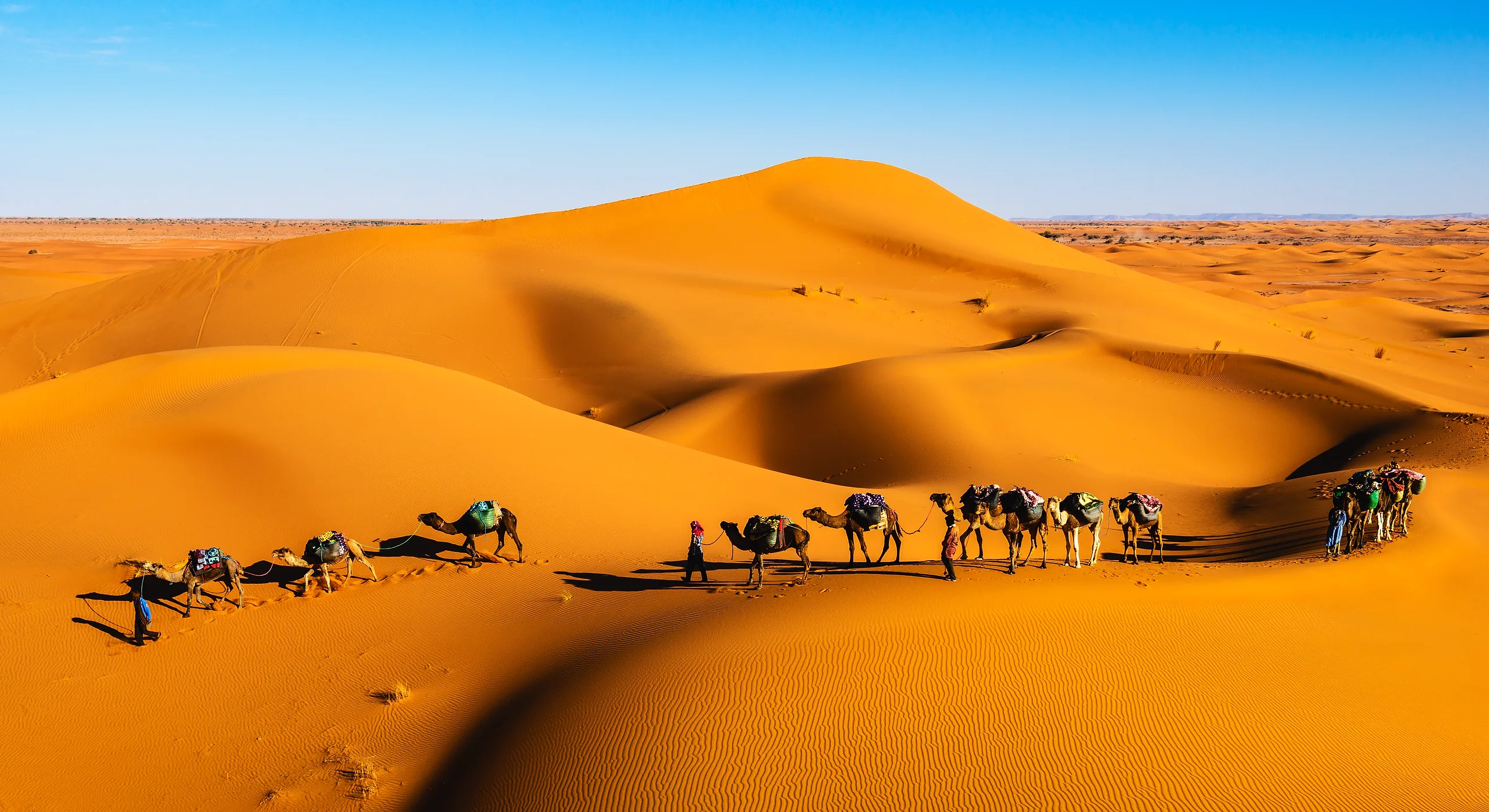
Luxury desert camp tents glowing at night among the Erg Chebbi dunes near Merzouga
Budget bivouac to luxury glamping — all tiers compared

Best Desert Camps in Merzouga 2026

The Erg Chebbi dunes rise to 150 metres just east of Merzouga — and somewhere in them, the right camp is waiting for you. Here is how to tell which one that is.

By City Tours Morocco Editorial Team

Published 17 June 2026 Last updated 29 October 2026

The best desert camp in Merzouga is not necessarily the most expensive one — it is the one that matches what you actually want from a night in the Sahara. The dunes do not change based on your tent category. What changes is the bed beneath you, the water temperature in your shower, and whether the dinner arrives on crockery or a tin plate. Once you know which of those details matter to you, choosing becomes easy.

Merzouga sits at the foot of the Erg Chebbi, a 50-kilometre arc of dunes that belongs firmly to the Moroccan Sahara rather than to any more accessible pseudo-desert. Getting here takes a full day from Marrakech (roughly nine hours by road via the High Atlas and Todra Gorge) or around five hours from Fes. Most visitors arrive tired, ride a camel into the dunes at sunset, sleep under a sky that genuinely has no light pollution, and wake for sunrise before the drive back. The camp is the centrepiece of the whole thing — not a footnote.

Below you will find a breakdown of every camp tier, realistic indicative prices for 2026, a comparison of what each level includes, and answers to the questions most travellers only think to ask after they have booked.
The Three Camp Tiers: What Each One Really Offers

Every camp promises stars and silence — that part is true everywhere. Here is what actually differs.

Budget Bivouac

From ~300–500 MAD / $30–$50 pp per night

Basic Berber tents with mattresses and blankets — no private bathrooms, shared squat toilets, and often no electricity beyond a solar lantern. The trade-off is genuine simplicity: fewer tourists, no Instagram crowds, and proprietors who still serve tea the old way. Meals are usually a single tajine and bread, eaten around a fire.

Typically included

  • Mattress and blankets
  • Shared toilet facilities
  • Dinner tajine and breakfast
  • Drum circle most evenings

Watch out for

Flush toilet and hot shower are rarely included at this tier.

Mid-Range Camp

From ~600–1,000 MAD / $60–$100 pp per night

The sweet spot for most travellers. Proper beds with linen, en-suite or semi-private bathrooms with flushing toilets and warm showers (gravity-fed, so pressure is light). Generator power runs for a few hours in the evening — enough to charge a phone. Dinner is usually a three-course spread with Moroccan salads, pastilla or harira soup, tajine or couscous, and mint tea with pastries.

Typically included

  • Proper beds with linen
  • Semi-private warm shower
  • Three-course dinner + breakfast
  • Camel ride to/from camp
  • Solar or generator power (evenings)

Watch out for

WiFi is hit and miss; bring a local SIM with data for anything critical.

Luxury Glamping

From ~1,500–3,500 MAD / $150–$350 pp per night

Permanent canvas or wooden-floored suites with king beds, private en-suite bathrooms (hot water all night), air cooling for summer, and décor that would not look out of place in a boutique hotel. Some properties add plunge pools, sound-proofed entertainment spaces, and curated cocktail menus. The dune views are identical to a budget camp — the difference is entirely in what surrounds you.

Typically included

  • King bed with hotel-quality linen
  • Private en-suite (hot water all night)
  • Cocktail or mocktail on arrival
  • Five-course dinner, full breakfast
  • Dedicated private camel trek
  • Stargazing with telescope (select camps)

Watch out for

Prices vary sharply by season. Expect to pay 30–50 % more in October–November and around major holidays.

Quick Comparison: What Each Tier Delivers

FeatureBudgetMid-RangeLuxury
Private bathroom✗~ (semi-private)✓
Hot shower✗✓ (limited hours)✓ (all night)
Real bed + linen✗✓✓
Electricity / charging✗✓ (evenings)✓ (all night)
WiFi✗UnreliableLimited but available
Camel trek included✓✓✓
Three-course+ dinner✗✓✓ (five-course+)
Stargazing setup✗✗✓ (select camps)
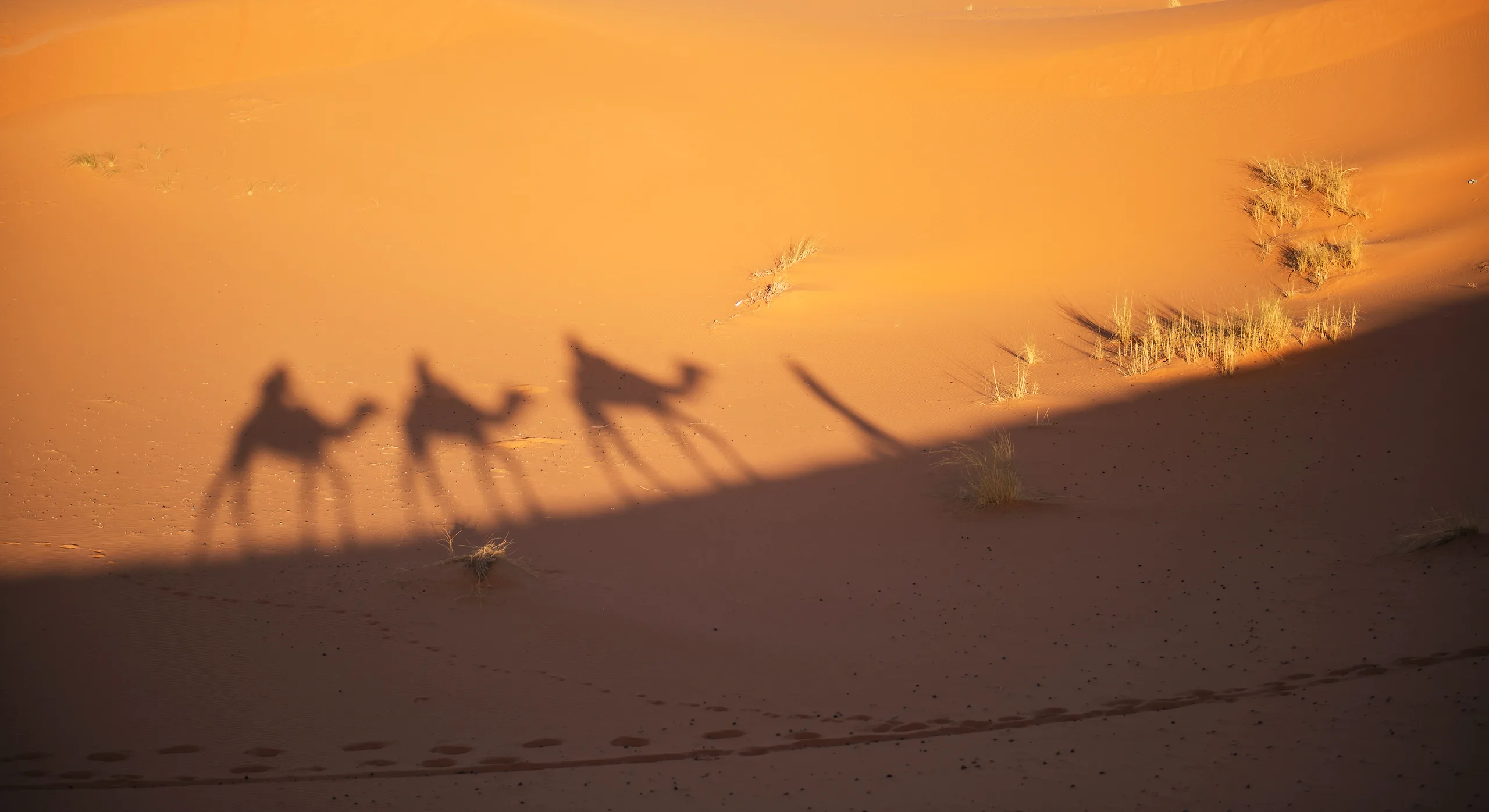
Camel silhouettes walking into the Erg Chebbi dunes at sunset near Merzouga

Getting to the Camps: How the Logistics Actually Work

Merzouga village — or more precisely, the hamlets of Hassilabied and Ksar Hassilabied on the dune edge — is where you leave your bags in a vehicle and swap to a camel. The trek into the dunes takes between 30 and 60 minutes depending on which camp you are headed to and how deep inside the erg it sits. Luxury camps tend to go further in, which means better solitude and more dramatic dune backdrops, but also a longer camel ride. If you or someone in your group cannot ride, most camps will arrange a 4x4 drop to within walking distance.

The camel ride back the following morning (usually around 06:30 for sunrise, though the exact time shifts with the season) deposits you at the edge of the dunes in time for breakfast at a village cafe or at your guesthouse in Merzouga. From there you are either heading back west or continuing north toward Midelt and the Middle Atlas.

Booking a camp independently is possible — many travellers walk into Merzouga and negotiate on the spot. Expect to haggle: listed prices at the village entry are often inflated by 20–40 %. Booking as part of a private guided tour removes this friction entirely, typically bundles transport, the camel trek and the camp night into one price, and means you arrive knowing exactly which tent your luggage is already in.

Best season

Oct–Apr

Night temp (Jan)

5–10 °C

Mid-range camp from

~600 MAD / $60 pp

Five Things to Confirm Before You Book Any Camp

These are the questions that separate a memorable night from a frustrating one.

  1. 1

    Is the camel trek included or priced separately?

    At budget camps, the trek is almost always included in the headline price. At luxury camps, it is also included, but some mid-tier operators separate it. Confirm in writing before paying.

  2. 2

    How many tents does the camp have?

    A camp with 5–10 tents will feel intimate and quiet. A camp with 50 tents can sound like a festival by 10 pm. If solitude matters, ask for the camp capacity.

  3. 3

    Where exactly is the camp located?

    Some camps are 20 minutes into the dunes; others are essentially on the road edge with a few sand piles around them. Ask for GPS coordinates or a photo taken from inside the camp looking out — the view tells you everything.

  4. 4

    What is the cancellation or weather policy?

    Sandstorms occasionally make the camel trek dangerous. A reputable camp will offer a jeep transfer alternative and will not charge you for opting out of the ride.

  5. 5

    Is the return transfer to your guesthouse organised?

    After the sunrise camel ride back, you need to get from the dune edge to wherever your bags are. Many independent travellers find themselves stranded and negotiating with motorbike taxis. A guided tour handles this automatically.

Merzouga Desert Camp FAQs

What is included in an overnight desert camp in Merzouga?

Most camps include a camel trek to reach the site at sunset, dinner (usually tajine or couscous with Moroccan salads), breakfast the following morning, and sleeping accommodation in a furnished tent. Mid-range and luxury camps add warm showers and proper beds; budget camps typically offer a mattress and shared facilities. A drum session around the fire is standard across all tiers. Lunch, drinks, and the return vehicle to Merzouga village are almost always separate.

Are luxury desert camps in Merzouga worth the extra cost?

If sleep quality matters to you, yes. The dune scenery is identical at every price point — the same stars, the same silence, the same orange glow at sunrise. What luxury camps deliver is genuine comfort: a real bed with good linen, hot water all night, en-suite bathrooms, and food that goes well beyond a basic tajine. For couples or travellers who do not camp ordinarily, the upgrade removes the friction that can turn a once-in-a-lifetime moment into a night of mild discomfort.

How cold does it get at night in the Merzouga desert camps?

Significantly colder than most visitors expect. Even in July and August, desert nights can drop to 15–18 °C once the sun sets, which feels sharp after 40 °C afternoons. From October to March, temperatures regularly fall to 5–10 °C and occasionally below freezing in January. Budget camps provide blankets, but mid-range and luxury camps offer proper duvets. Regardless of tier, pack a warm layer — a fleece or light down jacket is enough in spring and autumn, a proper coat in winter.

Do desert camps in Merzouga have electricity and WiFi?

Budget bivouacs typically run on solar lanterns only; no charging points and no WiFi. Mid-range camps run a generator for two to four hours in the evening, giving you enough time to charge a phone or camera battery. Luxury glamping sites usually maintain power all night via stronger solar or diesel backup, and some offer limited WiFi in a communal area — though speeds are slow and reliability is unpredictable. The honest approach is to treat any camp as a digital detox and bring a power bank.

Is it safe to sleep in a desert camp in Morocco?

Yes, by all practical measures. The Erg Chebbi region is one of Morocco’s safest tourist areas, and camp staff are used to hosting international visitors year-round. Camps are fenced or positioned well away from the main tracks, and the stillness of the desert makes any unusual sound obvious. The main practical risks are weather-related: sandstorms can reduce visibility suddenly and make tent flaps noisy, and cold snaps hit fast. Book through a reputable tour operator rather than walking in off the street, and you eliminate the vast majority of variables.

When is the best time to book a desert camp in Merzouga?

October through April is the ideal window — warm days, cold clear nights, and dunes that glow deep amber in the low sun. October–November and March–April are peak shoulder seasons; luxury camp suites sell out weeks in advance during these months, so book early. December and January are beautifully quiet and crisp, though a cold night in a budget tent can be uncomfortable. June, July and August see midday heat above 40 °C; camel rides are best moved to very early morning or evening, and the dunes can be almost deserted.

Plan it with a local expert

Travel Morocco with Serenity Morocco Tours

Crafting extraordinary journeys through Morocco's timeless landscapes. 100% private journeys, handcrafted around you.

  • Moroccan-owned
  • 100% Private Tours
  • 100% private tours since 2018
Sahara Desert Luxury Expedition — Marrakech → Erg Chebbi, Morocco

5 days Marrakech → Erg Chebbi

Sahara Desert Luxury Expedition

Essential Morocco: Imperial Cities Circuit — Marrakech · Fes · Meknes · Rabat, Morocco

7 days Marrakech · Fes · Meknes · Rabat

Essential Morocco: Imperial Cities Circuit

Sahara to Sea: Morocco Complete — Full-country circuit, Morocco

14 days Full-country circuit

Sahara to Sea: Morocco Complete

Browse the private tours, quoted on request →