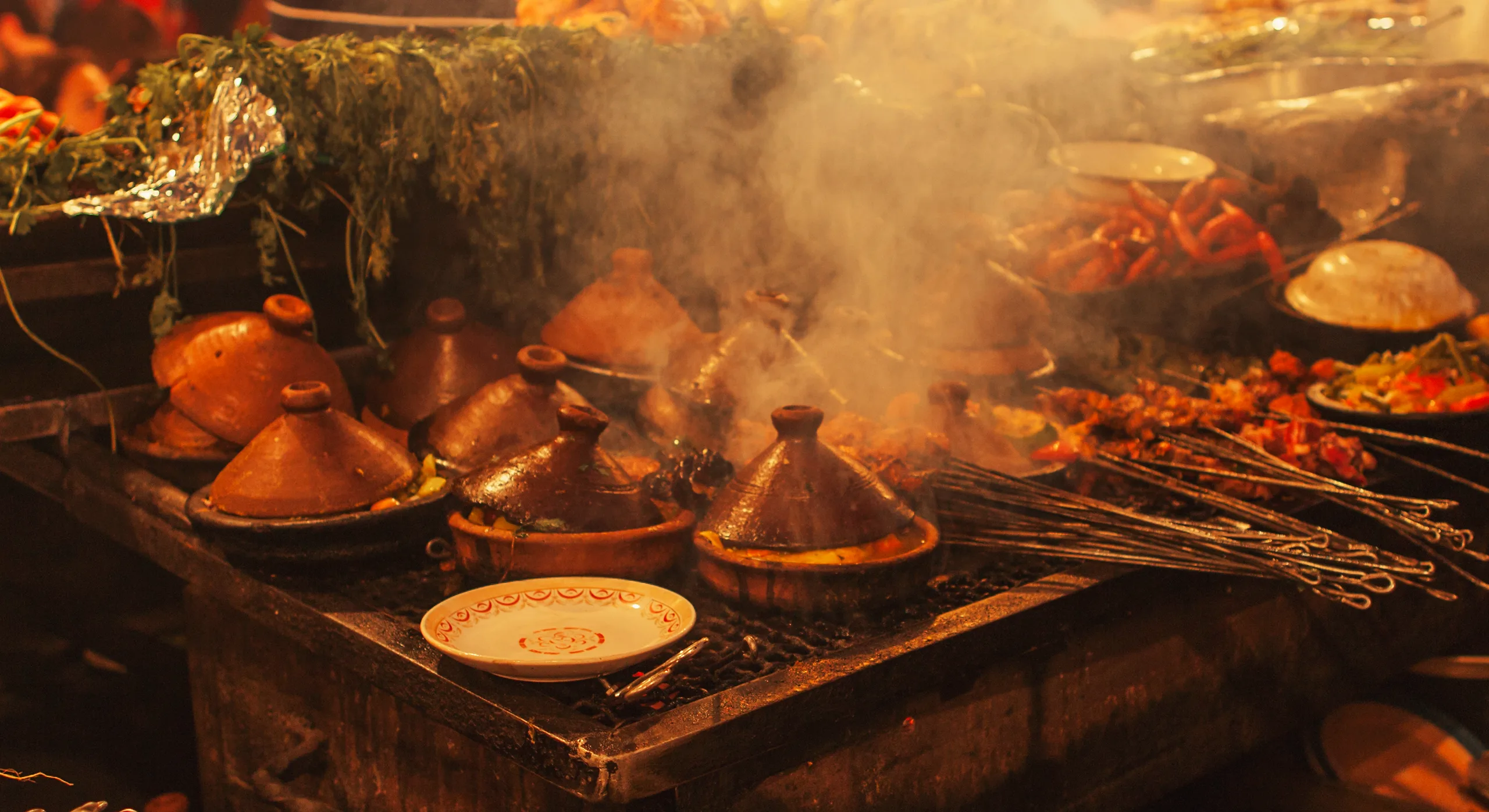
The table: street food
Moroccan street food: the guide
From 1 MAD sfenj to brochettes on Jemaa el-Fna: fifteen dishes, six cities, prices in MAD, food safety, vegetarian picks and how to order.
Stall no. 1 on Jemaa el-Fna, Marrakech. Photograph: Grand Parc - Bordeaux, France, CC BY 2.0
- Cheapest bite
- Sfenj, from 1 MAD
- Stall meal
- from 20 MAD
- Evening stalls
- From 5-6 PM
- Prices
- Approximate; vary by season and place
Why eat on the street in Morocco
In Morocco the street stall is often the original and the restaurant the copy. The grandmother frying msemen at the corner has been at it for forty years, and the dishes restaurants serve were first made for people eating on their feet.
For centuries the medina was the centre of daily life, and its lanes were both market and kitchen. Craftsmen, merchants and laborers ate from street vendors; the communal bread oven (ferran), the soup seller and the itinerant sfenj maker were as much part of the city as its mosques and fountains.
A walk through any medina still shows it: brochettes on charcoal, msemen dough slapped thin, pots of harira, oranges squeezed to order, honey-soaked chebakia. A full street-food meal rarely costs more than 30 MAD (3-5 USD).
This guide covers the 15 dishes to try, where to eat in six cities, food safety, vegetarian options, prices, etiquette, and useful phrases in Darija (Moroccan Arabic) and French.
A thousand years of street food
The tradition goes back to the founding of the imperial cities. When Fes was founded in the 9th century as a centre of Islamic scholarship, its medina became an open-air kitchen: tanners, weavers and students all ate from street vendors, and the ferran, the soup seller and the sweets vendor became pillars of city life.
Andalusian refugees who arrived after the fall of Granada in 1492 brought refined techniques. Pastilla, with its warqa pastry and cinnamon sugar, descends from Andalusian cooking, and such dishes moved from palace kitchens to the street over time.
French rule (1912-1956) added another layer: the baguette became the bocadillo, the cafe became cafe noir with msemen, and French patisserie met Moroccan pastry. Berber, Arab, Andalusian, French and sub-Saharan influences all show in what is sold on the street today.
Key historical influences
- Berber origins
- Khobz, couscous, tagine, dried meats, and herbal broths from the indigenous Amazigh people
- Arab arrival (7th c.)
- Spice trade routes brought cumin, saffron, cinnamon, and the tradition of communal eating
- Andalusian exodus (15th c.)
- Pastilla, refined pastries, the sweet-savory flavor profile that defines Moroccan cuisine
- Ottoman influence
- Brochette culture, grilling techniques, and coffee-house traditions spread across North Africa
- French Protectorate (1912-56)
- Baguettes, cafe culture, patisserie, and the bocadillo sandwich tradition
- Modern era
- Food trucks, fusion cuisine, and tourism bringing new attention to traditional street food
15 must-try Moroccan street foods
From 1 MAD sfenj to the slow-cooked tangia of Marrakech.
Msemen
مسمنLayered square flatbread, crispy outside and soft within
Msemen is the quintessential Moroccan breakfast street food: a square-shaped, layered flatbread made from a simple dough of flour, semolina, butter, and oil. The dough is stretched paper-thin on an oiled surface, folded into layers, and cooked on a flat griddle until golden and flaky. The result is a bread that shatters with a satisfying crunch on the outside while remaining soft, chewy, and slightly buttery inside. Every morning across Morocco, you will see women sitting beside small charcoal stoves, patting and stretching msemen dough with practiced, mesmerizing speed. Eaten plain with honey and butter for breakfast, or stuffed with kefta, vegetables, or cheese for a savory snack, msemen is pure comfort food and one of the most affordable bites in the country.
- Price
- from 2 MAD. Plain is cheapest; stuffed versions cost more
- Where to find it
- Every medina corner, morning markets, and roadside stalls across Morocco
- Best time
- Breakfast (6-10 AM)
- Vegetarian
- Yes
Baghrir
بغريرThousand-hole spongy pancakes that soak up honey
Known as "the thousand-hole pancake," baghrir is a uniquely Moroccan creation that looks like no other pancake in the world. Made from a batter of fine semolina, flour, yeast, and baking powder, the magic happens when the batter hits the hot griddle: as it cooks from one side only, hundreds of tiny bubbles form and burst on the surface, creating a sponge-like texture riddled with tiny craters. These holes serve a delicious purpose -- they act as tiny reservoirs that absorb the traditional topping of melted butter mixed with honey. The first bite releases a flood of warm, sweet butterscotch-like flavor. Baghrir is cooked on one side only, never flipped, and the contrast between the smooth, golden bottom and the porous, crater-covered top is part of its charm. A breakfast staple during Ramadan and year-round.
- Price
- from 2 MAD. Per pancake; usually sold in stacks of 3-5
- Where to find it
- Breakfast stalls, medina bakeries, and Ramadan night markets
- Best time
- Breakfast or Ramadan ftour (sunset)
- Vegetarian
- Yes
Harira
حريرةRich tomato-based soup with lentils, chickpeas, and warming spices
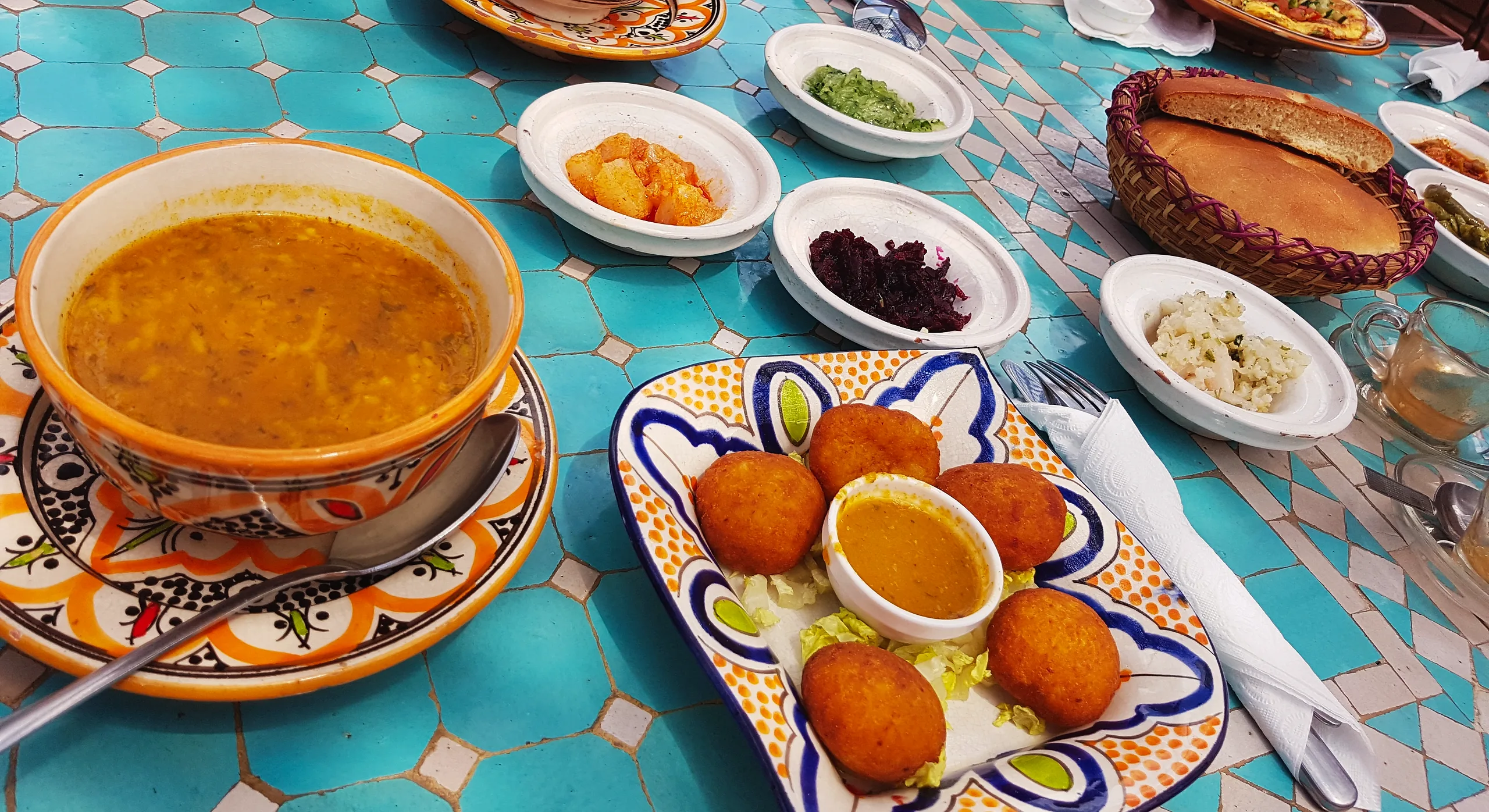
Harira, the soup that breaks the fast in Ramadan. Photograph: AxlsPacific, CC BY-SA 4.0 This thick, hearty soup is the national comfort food, traditionally served to break the Ramadan fast but beloved year-round as a street food staple. The base is a rich tomato broth, thickened with a fermented flour-water mixture called tadouira that gives it a silky, slightly tangy body. Into this go green lentils, chickpeas, diced lamb or beef (though vegetarian versions are common), celery, onions, and a generous handful of fresh cilantro and parsley. The spice profile is complex but never overwhelming: ginger, turmeric, cinnamon, saffron, and pepper work in harmony. Just before serving, a squeeze of lemon brightens everything. Street vendors serve harira in small bowls alongside dates and chebakia honey cookies. During Ramadan, entire streets transform into open-air harira kitchens, with enormous cauldrons simmering throughout the afternoon. The first sip at sunset, breaking a day-long fast, is one of the most communal and sacred food moments in Moroccan culture.
- Price
- from 5 MAD. Per bowl; often served with bread and dates
- Where to find it
- Everywhere during Ramadan; year-round in medina soup stalls and small restaurants
- Best time
- Evening, especially during Ramadan
- Vegetarian
- No
Tangia
طانجيةMarrakech-exclusive slow-cooked meat in an earthenware urn
Tangia is the ultimate bachelor food of Marrakech -- literally. This dish was invented by the unmarried craftsmen of the Marrakech souks who needed a meal that would cook itself while they worked. The preparation is brilliantly simple: chunks of lamb or beef are placed in a tall, amphora-shaped earthenware urn along with preserved lemons, garlic, cumin, saffron, ras el hanout, and a generous pour of olive oil. The urn is sealed with parchment paper and string, then taken to the local hammam (public bathhouse) and buried in the hot ashes of the furnace that heats the bathwater. It slow-cooks for 6-8 hours until the meat is so tender it dissolves at the touch. The result is intensely concentrated, falling-apart meat in a rich, golden broth. Tangia is unique to Marrakech -- you will not find it in Fes or Casablanca. It is traditionally a communal dish, prepared by groups of men for celebrations, and remains a living symbol of Marrakchi working-class food culture.
- Price
- from 40 MAD. Per serving; often shared among 2-3 people
- Where to find it
- Marrakech medina only -- stalls near Jemaa el-Fna and Rahba Kedima spice square
- Best time
- Lunch (12-3 PM)
- Vegetarian
- No
Maakouda
معقودةGolden-fried potato fritters, crispy outside and creamy inside
These golden discs of deep-fried potato are seasoned with cumin, parsley, garlic, and sometimes a touch of turmeric for color. The technique is what makes them special: boiled potatoes are mashed smooth, shaped into thick patties, dipped in a light batter, and fried in bubbling oil until they develop a shatteringly crisp golden crust while remaining creamy and fluffy inside. Maakouda are rarely eaten alone -- they are most commonly stuffed into a sandwich (bocadillo) with harissa hot sauce, tomato, and olives, one of the best-value meals in Morocco. You will find them at virtually every street food stall and sandwich shop in Morocco, and they are a staple filling for the working-class lunch bocadillo. The best maakouda are fried to order in fresh oil and served piping hot, so the crust crackles when you bite into it.
- Price
- from 3 MAD. Per piece; 2-3 make a filling snack
- Where to find it
- Sandwich stalls, medina food carts, and bocadillo shops everywhere
- Best time
- Lunch (11 AM - 3 PM)
- Vegetarian
- Yes
Brochettes
بروشيتCharcoal-grilled meat skewers seasoned with cumin and paprika
These skewers of marinated meat -- lamb, beef, chicken, or kefta (seasoned ground meat) -- are threaded onto metal skewers and grilled over white-hot charcoal. The marinade is deceptively simple: cumin, paprika, salt, pepper, and a brush of oil. The magic is in the searing heat of the charcoal, which chars the exterior while keeping the inside juicy and smoky. Brochettes are served on a plate with bread, raw onion slices, salt, and cumin for dipping, alongside a simple tomato-and-onion salad. The best brochette stalls display their raw meat proudly, letting you choose your cut, and you watch as it is threaded, seasoned, and grilled before your eyes. At Jemaa el-Fna in Marrakech, competitive brochette vendors form an entire row, each one calling out to passersby with theatrical enthusiasm. Lamb liver and heart brochettes (boulfaf) are a particular delicacy, often wrapped in caul fat.
- Price
- from 15 MAD. Per skewer; lamb is priciest, kefta most affordable
- Where to find it
- Jemaa el-Fna, all medina grill stalls, and roadside restaurants
- Best time
- Evening (6-11 PM)
- Vegetarian
- No
Sfenj
سفنجAiry Moroccan donuts, golden-fried and sugar-dusted
Sfenj are the Moroccan donut, from 1 MAD each. These ring-shaped, yeasted dough fritters are made from a very wet, sticky dough that is shaped by hand with impressive dexterity: the sfenj maker grabs a handful of dough, stretches it into a ring around his fingers, and drops it into a vat of hot oil where it puffs up into a golden, airy ring with a slightly chewy crust. Unlike Western donuts, sfenj have no sugar in the dough itself -- they are sometimes dusted with granulated sugar after frying, but many Moroccans prefer them plain, still glistening with oil, their natural yeasty sweetness enough. The outside is crispy and golden, the inside is soft, airy, and stretchy, with large irregular air pockets. Sfenj are best eaten within minutes of frying, often paired with a glass of mint tea or strong cafe noir for the quintessential Moroccan breakfast. You will spot sfenj makers by their massive round frying pans of oil and the crowd of locals waiting impatiently for the next batch.
- Price
- from 1 MAD. Per piece; buy 5-10 for a family breakfast
- Where to find it
- Morning stalls near mosques, bakeries, and medina intersections
- Best time
- Breakfast (6-10 AM)
- Vegetarian
- Yes
Babbouche (Snail Soup)
بابوشSnails simmered in a fragrant herbal broth with medicinal spices
Babbouche is a beloved Moroccan street snack of small garden snails (not the French escargot variety, but smaller, more tender Moroccan species) slowly simmered in a complex broth infused with over a dozen herbs and spices: thyme, licorice root, gum arabic, anise, mint, caraway, black pepper, and other closely guarded secret ingredients that vary by vendor. The broth is considered deeply medicinal -- locals swear it aids digestion, warms the body in winter, and cures everything from the common cold to stomach ailments. The snails themselves are mild and earthy in flavor, but it is really the broth that people come for. Vendors serve it in small bowls with a toothpick for extracting the snails and a spoon for the precious broth. Each vendor has their own proprietary spice blend, and regular customers are fiercely loyal to their preferred babbouche stall.
- Price
- from 5 MAD. Per bowl; the broth is the star
- Where to find it
- Jemaa el-Fna (Marrakech), Rcif area (Fes), central medina squares in most cities
- Best time
- Evening (5-11 PM)
- Vegetarian
- No
Bocadillos
بوكاديوStuffed baguette sandwiches with endless filling combinations
The bocadillo (from the Spanish word for sandwich) is the everyday lunch of working Morocco. A crusty half-baguette is split open and loaded with an extraordinary variety of fillings. The classic combination includes maakouda (potato fritters), hard-boiled egg, tuna, olives, harissa, and a drizzle of olive oil -- all in one sandwich. Other popular fillings include grilled kefta, merguez sausage, fried fish, omelette, liver, brain, or simply vegetables with cheese. The beauty of the Moroccan bocadillo is the customization: you point at the fillings you want from an array of bowls and containers displayed at the stall, and the vendor assembles your creation. Harissa hot sauce and cumin are standard additions. A loaded bocadillo for just 15 MAD is one of the most satisfying and filling budget meals in Morocco. Bocadillo stalls are particularly busy during the lunch rush (12-2 PM), when workers, students, and shoppers queue for their daily fix.
- Price
- from 15 MAD. Depends on fillings; kefta and merguez cost more
- Where to find it
- Every medina, near schools, markets, and bus stations
- Best time
- Lunch (11 AM - 3 PM)
- Vegetarian
- No
Fresh Orange Juice
عصير البرتقالFreshly squeezed from sweet Moroccan oranges, served ice-cold
Morocco is one of the world's great citrus producers, and the fresh-squeezed orange juice available at virtually every street corner is pressed to order. Moroccan street orange juice is made from sweet, sun-ripened oranges pressed to order in front of you, with nothing added. The juice is thick, vibrant, and intensely sweet with a brightness that comes from fruit picked at peak ripeness. At Jemaa el-Fna in Marrakech, entire rows of orange juice stalls compete for customers, their counters piled high with pyramids of oranges, vendors squeezing on manual or electric presses. The juice is served in glasses or poured into plastic cups with ice. at just 5 MAD per glass (roughly 0.50-1 USD), it is one of the best deals in Morocco and the perfect antidote to the heat, dust, and sensory overload of the medina. Some vendors also offer mixed juices -- orange with carrot, pomegranate, or grapefruit. The orange juice at Jemaa el-Fna is a rite of passage for every Morocco visitor.
- Price
- from 5 MAD. Jemaa el-Fna stalls may charge more; 4 MAD in local neighborhoods
- Where to find it
- Jemaa el-Fna, all medinas, roadside stands, and juice bars nationwide
- Best time
- Anytime, especially afternoon
- Vegetarian
- Yes
Khobz
خبزRound communal bread baked in neighborhood wood-fired ovens
Khobz is not just bread in Morocco -- it is a utensil, a plate, a social ritual, and the foundation of every meal. This round, flatish loaf with a golden crust and soft, dense crumb is the most consumed food in the country. Every neighborhood has a communal wood-fired oven (ferran) where families bring their homemade dough to be baked for a few dirhams. The baker marks each family's loaves to identify them, slides them into the blazing oven on a long wooden paddle, and returns them golden and fragrant. On the street, you will see children and adults carrying wooden trays of bread on their heads to and from the ferran -- one of the most iconic sights of Moroccan daily life. Khobz is torn by hand (never cut with a knife at a traditional Moroccan table) and used to scoop tagine sauce, pinch pieces of meat, and mop every last drop from the plate. Wasting bread is considered sinful -- leftover bread is dried and used in other dishes or given to animals. At street stalls, fresh khobz is always available as an accompaniment to any meal.
- Price
- from 1 MAD. Per loaf; one loaf feeds 2-3 people
- Where to find it
- Neighborhood fernans (bakeries), medina bread stalls, and every food vendor
- Best time
- Morning and late afternoon baking times
- Vegetarian
- Yes
Grilled Sardines
سردين مشويWhole sardines charcoal-grilled with chermoula marinade
Morocco is the world's largest exporter of sardines, and nowhere is this abundance more delicious than at the street-side grill stalls of Essaouira, Casablanca, and Tangier. Whole fresh sardines are marinated in chermoula -- a vibrant green paste of cilantro, parsley, garlic, cumin, paprika, lemon juice, and olive oil -- then grilled over charcoal until the skin blisters and chars while the flesh stays moist and oily. They are served on a plate or in a sandwich, head and all, with a wedge of lemon, sliced onion, and crusty bread. The flavor is intensely marine, smoky, and herbaceous. At the fish market in Essaouira, you choose your sardines from the fishmongers (still glistening from the morning catch), hand them to the grill next door, and within minutes you are eating the freshest possible grilled fish at a rickety seaside table. In Casablanca, the old medina and port area have legendary sardine grill stalls. Eating charcoal-grilled sardines by the ocean, watching fishing boats rock in the harbor, is a quintessential Moroccan coast experience.
- Price
- from 10 MAD. For a generous plate; cheaper at fish markets than tourist areas
- Where to find it
- Essaouira fish market, Casablanca port, Tangier fish market, all coastal cities
- Best time
- Lunch (11 AM - 3 PM)
- Vegetarian
- No
Kefta Sandwiches
كفتةSpiced ground meat grilled and stuffed in bread with toppings
Kefta is spiced Moroccan ground meat. Beef or lamb is mixed with grated onion, fresh parsley, cilantro, cumin, paprika, and a touch of cinnamon, then shaped into logs around a skewer or pressed into flat patties and grilled over charcoal. The spice blend gives kefta a distinctive warmth and depth that distinguishes it from any Western hamburger. As a street food, kefta is most commonly served in a crusty bread roll (bocadillo) with sliced tomato, raw onion, and a generous smear of harissa hot sauce. Some stalls also offer kefta in a tagine -- grilled patties simmered in a spiced tomato sauce with a cracked egg on top, served bubbling in a small clay dish with bread for dipping. The charcoal grill gives kefta a smoky char on the outside while keeping the center juicy and aromatic. Kefta stalls are identifiable by the distinctive scent of grilling spiced meat and the cloud of charcoal smoke hovering above them.
- Price
- from 15 MAD. Sandwich; kefta tagine with egg costs from 25 MAD
- Where to find it
- Grill stalls in medinas, bocadillo shops, and night food markets
- Best time
- Lunch and evening
- Vegetarian
- No
Chebakia
شباكيةFlower-shaped sesame cookies drenched in honey
Chebakia is the most labor-intensive and visually stunning sweet in the Moroccan pastry repertoire. Strips of dough flavored with orange blossom water, anise, sesame, vinegar, and saffron are hand-folded into intricate rose or flower shapes (a skill that takes years to master), deep-fried until golden, immediately dipped in hot honey syrup until they absorb maximum sweetness, then coated in toasted sesame seeds. The result is a cookie that is simultaneously crispy, chewy, sticky, fragrant, and deeply sweet. Chebakia is traditionally associated with Ramadan, where it is served alongside harira soup at iftar (the sunset meal breaking the fast). The combination of savory, warming harira with sweet, honey-drenched chebakia is one of Ramadan's most iconic flavor pairings. Making chebakia is a communal activity -- extended families gather (usually the women) in the days before Ramadan to fold hundreds of these intricate pastries. On the street, chebakia is sold by weight at pastry stalls and is available year-round, though production peaks during Ramadan.
- Price
- from 5 MAD. For 2-3 pieces; sold by weight at pastry stalls
- Where to find it
- Pastry shops, medina sweet stalls, and Ramadan markets everywhere
- Best time
- Afternoon tea and Ramadan iftar
- Vegetarian
- Yes
Avocado Smoothie
عصير الافوكادوThick, creamy avocado shake blended with milk and nuts
The Moroccan avocado smoothie is nothing like the savory avocado preparations of Western cuisine -- in Morocco, avocado is treated purely as a fruit, and the smoothie is a dessert-level indulgence. Ripe avocados are blended with cold milk, sugar (or honey), and sometimes a handful of almonds or walnuts to create an impossibly thick, creamy, pale-green shake. Some juice bars add a drizzle of argan oil or a sprinkle of cinnamon. These smoothies are served in tall glasses at juice bars (every medina has dozens) and are particularly refreshing in the heat of Moroccan summers. Morocco's avocados, grown primarily in the Gharb and Souss regions, are exceptionally rich and buttery. Many juice bars display their creations in the window -- towering glasses of avocado, banana, strawberry, almond, and date smoothies, each one a different shade of deliciousness. The avocado smoothie is the most popular and arguably the most uniquely Moroccan of the bunch.
- Price
- from 10 MAD. Mixed fruit smoothies cost slightly more
- Where to find it
- Juice bars in every medina, tourist areas, and modern cafes
- Best time
- Afternoon (2-6 PM)
- Vegetarian
- Yes
Where to eat street food in Morocco
Each city eats differently. Six of them.
The World Capital of Street Food
Marrakech
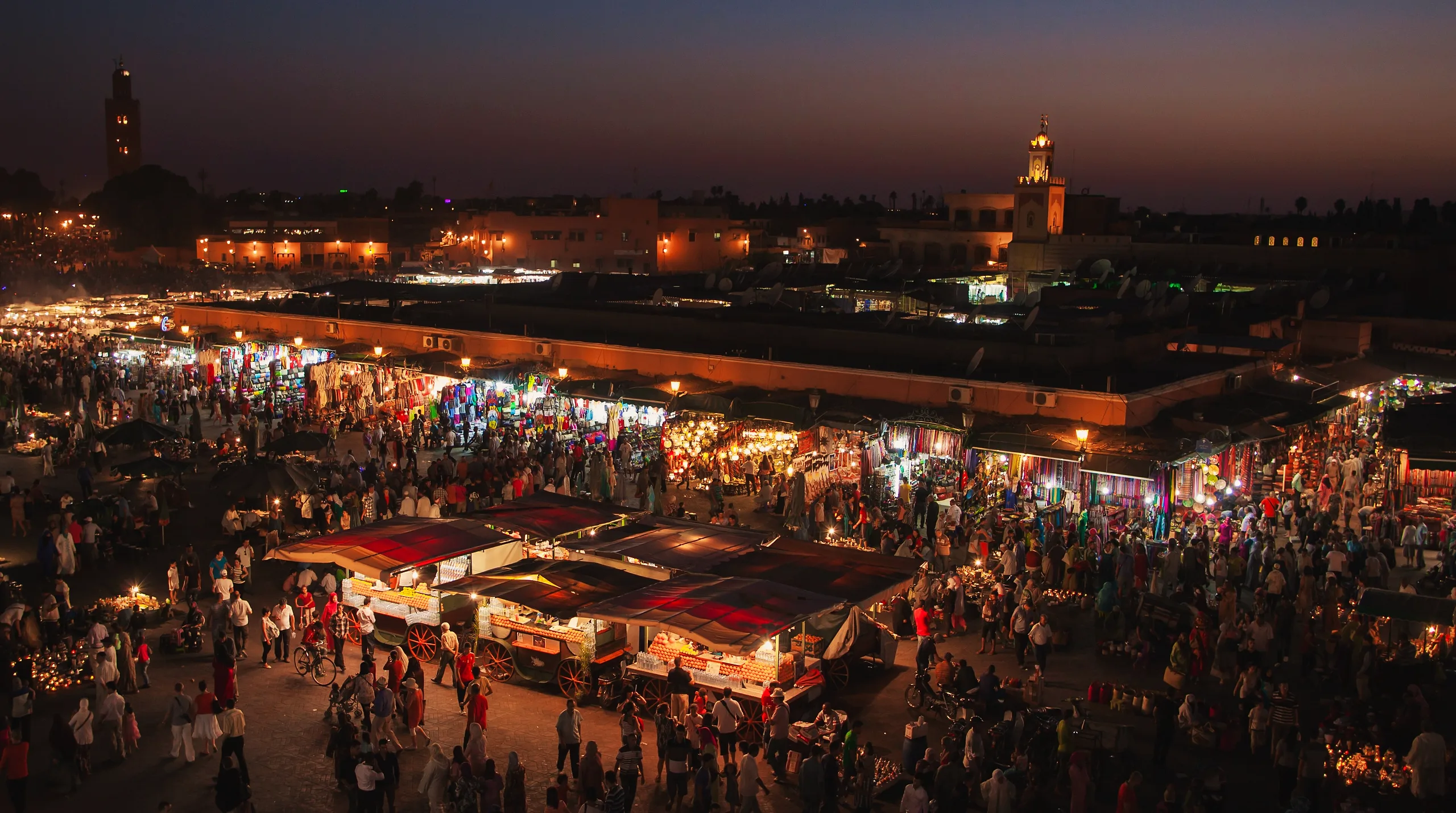
Jemaa el-Fna after dark. Photograph: Grand Parc - Bordeaux, France, CC BY 2.0 Every evening over 100 food stalls on Jemaa el-Fna square light up at sunset, filling the square with smoke, sizzle, and the theatrical calls of competing vendors. UNESCO recognized the cultural space of Jemaa el-Fna as a Masterpiece of Intangible Heritage partly because of this food tradition. Beyond the square, the surrounding medina alleys hide generations-old harira stalls, sfenj fryers, and the city's legendary tangia pots.
- Signature dish
- Tangia (the dish unique to Marrakech)
- Best area
- Jemaa el-Fna and surrounding derbs
- Specialties
- Tangia, Sheep head (tête), Snail soup, Number 1 brochette stalls
Where to go
- Jemaa el-Fna night food stalls (stalls 1, 14, and 32 are local favorites)
- Cafe Clock for camel burger and cultural events
- Rahba Kedima spice square for snail soup
- Mellah (Jewish quarter) for unique pastries
- Bab Doukkala area for working-class bocadillos
The Culinary Capital
Fes
Fes is where Moroccan haute cuisine was born, and its street food reflects centuries of refined gastronomy filtered down to the everyday level. The world's oldest functioning medina hides legendary food artisans: bakers producing paper-thin warqa pastry, pastry chefs crafting the finest chebakia, and soup masters whose harira recipes have been passed down for generations. The Rcif area and Talaa Kebira are the main food arteries, lined with stalls selling everything from fresh-fried sfenj to elaborate briouats.
- Signature dish
- Pastilla (sweet-savory pie) served as street portions
- Best area
- Rcif square and Talaa Kebira
- Specialties
- Pastilla street portions, Rfissa, Fassi chebakia, Shebakia with almond paste
Where to go
- Rcif square for the best sfenj and harira in Morocco
- Talaa Kebira street for continuous food stalls
- Ain Azliten area for traditional bakeries
- Bab Boujloud gate for bocadillo and juice stalls
- Moulay Idriss shrine area for blessed sweets
The Modern Food Melting Pot
Casablanca
Casablanca's street food scene reflects its identity as Morocco's cosmopolitan economic capital. Here, traditional Moroccan snacks mingle with French-influenced patisserie, Senegalese grills, and modern fusion food trucks. The old medina retains classic stalls, while the Derb Sultan and Hay Mohammadi neighborhoods offer the most authentic working-class food. Casablanca is also the sardine capital of Morocco -- the port area has legendary fish grill stalls.
- Signature dish
- Grilled sardines at the port fish market
- Best area
- Old medina and Central Market area
- Specialties
- Port sardines, French-Moroccan pastries, Seafood bocadillos, Modern food trucks
Where to go
- Central Market (Marche Central) for seafood and French pastries
- Old medina for traditional street food stalls
- Port area fish grills for fresh sardines
- Derb Sultan for the best bocadillos
- Habous quarter for traditional Moroccan pastries
Fish from the port to the grill
Essaouira

The fishing port at Essaouira, a few steps from the grills. Photograph: DimiTalen, CC0 Essaouira's street food identity is inseparable from the Atlantic Ocean. The fishing port is the epicenter: fishing boats unload the morning catch, fishmongers sell it steps away, and open-air grills cook it immediately. You choose your fish (sardines, shrimp, calamari, sea bream, lobster) from ice-filled displays, negotiate the price, and it is grilled with chermoula right in front of you. The combination of ocean breeze, the sound of gulls, and just-caught fish sizzling on charcoal makes this one of Morocco's most memorable food experiences.
- Signature dish
- Fish and seafood grilled at the port
- Best area
- Fishing port and Moulay Hassan square
- Specialties
- Fresh grilled fish, Seafood bocadillos, Argan oil everything, Fresh calamari
Where to go
- Fish port grills (the row of outdoor restaurants by the harbor)
- Moulay Hassan square for orange juice and bocadillos
- Skala ramparts area for sunset snacks
- Mellah area for local pastries
- Beach vendors for roasted corn and peanuts
Gateway City Where Cuisines Collide
Tangier
Tangier's street food bears the unmistakable imprint of its position as the gateway between Africa and Europe. Spanish tapas influences mingle with Riffian Berber cuisine and classic Moroccan fare. The Petit Socco and Grand Socco squares are the traditional food hubs, while the Corniche waterfront adds a modern food scene. Tangier's proximity to Spain means the bocadillo culture here is the strongest in Morocco, and the city has its own style of montaditos (small sandwiches).
- Signature dish
- Bisara (dried fava bean soup) and Spanish-influenced montaditos
- Best area
- Grand Socco and medina streets
- Specialties
- Bisara (fava bean soup), Spanish-influenced montaditos, Fish market grills, Riffian bread
Where to go
- Grand Socco for juice stalls and bocadillos
- Petit Socco for cafe culture and snacks
- Tangier fish market for grilled seafood
- Marchane neighborhood for local specialties
- Corniche waterfront for modern street food
Local prices, few tourists
Meknes
Meknes is often overlooked by tourists, which means its street food scene is the most authentically local in Morocco -- virtually zero tourist inflation and stalls catering entirely to Moroccan tastes. The Hedim square (Meknes's version of Jemaa el-Fna, but far less touristic) has excellent evening food stalls. The city is famous for its olives (Meknes is the olive capital of Morocco), and every meal comes with an extraordinary olive assortment. Meknes also produces some of Morocco's best wine, though you won't find that on the street.
- Signature dish
- Khlia (preserved dried meat) and world-class olives
- Best area
- Place el-Hedim and surrounding medina
- Specialties
- Khlia (preserved meat), Meknes olives, Beef brochettes, Affordable prices
Where to go
- Place el-Hedim for evening food stalls
- Bab Mansour gate area for brochettes
- Olive souk for the best olive selection in Morocco
- Old medina for affordable local favorites
- Near Moulay Ismail mausoleum for pastry shops
Food safety tips for Morocco
Moroccan street food is generally safe. These habits keep it that way.
Safe practices
- Choose stalls with high customer turnover: busy stalls mean fresh food
- Watch your food being cooked fresh in front of you; this is both safer and tastier
- Drink bottled water only, widely available for 3 MAD
- Eat fruits you can peel yourself: oranges, bananas, mandarins
- Start with cooked, hot food during your first days to let your stomach adjust
- Use hand sanitizer before eating if no washing facilities are available
- Eat where locals eat: a crowd of Moroccans is the best food-safety indicator
- If trying snail soup for the first time, note that the broth is boiled for hours and very safe
Things to avoid
- Raw salads from street vendors: restaurant salads are usually fine, street-side ones are riskier
- Tap water and ice from unknown sources; ask for "eau minerale" (bottled water)
- Mayonnaise-based items in hot weather: the heat can turn them quickly
- Pre-made food that has been sitting in the sun
- Unrefrigerated dairy products, especially in summer
- Meat that looks like it has been sitting out rather than freshly grilled
- Empty stalls with no local customers
- Overloading your stomach on the first day; ease in gradually
Vegetarian and vegan street food
Many traditional snacks are vegetarian or easy to adapt.
- Msemen
- Plain or with honey and butter -- naturally vegan without butter
- Baghrir
- Thousand-hole pancakes with honey -- egg-free and dairy-free
- Maakouda
- Fried potato cakes -- vegan when not served in a meat-based sandwich
- Harcha
- Semolina flatbread, buttery and golden, perfect with jam or cheese
- Zaalouk
- Smoky eggplant and tomato dip with cumin and olive oil -- fully vegan
- Fresh Orange Juice
- Nothing but oranges, squeezed to order -- naturally vegan
- Avocado Smoothie
- Can be made with almond milk for a vegan version on request
- Roasted Corn
- Whole corn cobs roasted on charcoal, a popular autumn street snack
- Boiled Chickpeas
- Served hot with cumin and salt in a paper cone -- hearty and vegan
- Chebakia
- Honey-drenched sesame cookies -- contains no dairy, naturally vegetarian
- Briwat with Cheese
- Crispy filo triangles filled with goat cheese and herbs
- Fried Aubergine
- Battered and fried eggplant slices, often in bocadillos
Moroccan street food price guide
Prices in Moroccan dirhams (MAD). 10 MAD is roughly 1 USD or 0.90 EUR.
| Item | Low | High | Notes |
|---|---|---|---|
| Sfenj (donut) | 1 MAD | 2 MAD | Per piece |
| Khobz (bread) | 1 MAD | 2 MAD | Per loaf |
| Msemen | 2 MAD | 5 MAD | Plain to stuffed |
| Baghrir | 2 MAD | 3 MAD | Per pancake |
| Maakouda | 3 MAD | 5 MAD | Per piece |
| Harira soup | 5 MAD | 10 MAD | Per bowl |
| Snail soup | 5 MAD | 10 MAD | Per bowl |
| Orange juice | 5 MAD | 10 MAD | Fresh squeezed |
| Chebakia | 5 MAD | 10 MAD | 2-3 pieces |
| Avocado smoothie | 10 MAD | 15 MAD | Large glass |
| Sardines (grilled) | 10 MAD | 20 MAD | Full plate |
| Brochettes | 15 MAD | 30 MAD | Per skewer |
| Bocadillo | 15 MAD | 25 MAD | Loaded sandwich |
| Kefta sandwich | 15 MAD | 25 MAD | With toppings |
| Tangia | 40 MAD | 60 MAD | Per serving, shared |
All prices are approximate and may vary by season, location and vendor.
A day of eating
- Budget day
- from 60 MAD~6-8 USD, 3 meals from stalls
- Moderate day
- from 100 MAD~10-15 USD, a mix of stalls and cafes
- Splurge day
- from 200 MAD~20-30 USD, everything plus restaurants
Best times to eat street food
Street food follows a daily rhythm.
6:00 - 9:00 AM
Early morning
The sfenj makers heat their oil, the msemen women set up their griddles, and fresh khobz comes out of the neighborhood ovens. The best sfenj and baghrir are only around early; by 10 AM many breakfast stalls have sold out. Pair with fresh orange juice and a cafe noir or mint tea.
Eat: Sfenj, msemen, baghrir, khobz, coffee, orange juice
9:00 - 11:30 AM
Mid-morning
The medina wakes up and the first snack vendors appear. A good time for a late breakfast at a juice bar: an avocado smoothie or mixed fruit juice. Pastry shops lay out croissants (a French colonial legacy), briouats and petits fours; carts sell roasted nuts and dried fruit.
Eat: Avocado smoothie, juice bars, pastries, nuts and dried fruit
12:00 - 3:00 PM
Lunch rush
Peak bocadillo time: working Moroccans queue at sandwich stalls for maakouda, kefta or merguez. Tangia is served at lunch in Marrakech after cooking since the morning, and grilled sardines on the coast are best now, with the morning catch. Some stalls serve mini tagines and harira. The rush is intense but fast.
Eat: Bocadillos, maakouda, tangia, grilled sardines, kefta, harira
3:00 - 5:30 PM
Afternoon
The lull between lunch and evening: sweet snacks, mint tea and light bites. Chebakia, ghriba and kaab ghzal go with tea on a cafe terrace, and juice bars get a second rush in the afternoon heat. A good time to visit pastry shops without crowds.
Eat: Mint tea, chebakia, pastries, juice and smoothies, roasted corn
5:30 PM - midnight
Evening peak
The main event. At sunset more than 100 stalls light up on Jemaa el-Fna, charcoal smoke rises over the grills, brochette vendors call out to passers-by and the harira and snail-soup pots bubble. Arrive between 6 and 7 PM for the widest choice, or after 9 PM for a calmer pace. Many stalls stay open until midnight.
Eat: Brochettes, snail soup, harira, full grill stalls, sheep head
Sunset - 2:00 AM
Ramadan
During Ramadan the schedule inverts. Nothing is sold in daylight; at sunset (iftar) the stalls open with Ramadan specialties: fresh chebakia, sellou, dates, milk and huge pots of harira. The evening goes on until 2-3 AM. See our Ramadan guide for details.
Ordering tips and eating etiquette
Eat with your right hand
In Moroccan culture the left hand is considered unclean. When eating with your hands (tearing bread, scooping tagine), always use your right hand, at street stalls, in restaurants and especially when sharing a communal dish. Left-handed travelers should make the effort.Saying Bismillah
Moroccans say "Bismillah" (in the name of God) before eating and "Alhamdulillah" (praise God) after. It is not expected of tourists, but saying "Bismillah" before eating or "Bsaha" (to your health) when someone finishes is always warmly received.Handling bread
Never waste bread or throw it on the ground: bread is sacred in Moroccan culture. Tear it by hand, never cut it with a knife. If bread falls, a Moroccan will pick it up and put it somewhere higher. Leftover bread is dried and reused, never thrown away.Tipping at street stalls
Tipping is not expected at basic stalls; for a 10 MAD harira you do not need to tip. Rounding up is kind (paying 10 MAD for an 8 MAD item). At a stall with table service, leave from 2 MAD. At Jemaa el-Fna sit-down stalls, 5-10% is reasonable.Asking for prices first
Always confirm the price before ordering, especially at tourist-area stalls. Ask "Bshhal?" (how much?) and agree before eating. If a price is far above this guide, it may be tourist inflation: politely move to the next stall.Pointing and gesturing
At most stalls, pointing and showing the quantity on your fingers is normal. Many vendors in tourist areas speak basic English or French and are used to non-Arabic speakers.Sharing food
If someone at a neighboring table offers you food, the offer is sincere and refusing several times can be impolite. Accept a small taste. You may even be invited to join a family meal.Photographing food stalls
Most vendors do not mind photos of their food, but always ask first ("Mumkin sura?", can I take a photo?). Buying something is good etiquette. At Jemaa el-Fna some entertainers and vendors expect a small tip (from 2 MAD) for being photographed.
Essential food phrases in Darija and French
For dietary needs, ordering and talking to vendors. Darija and French are both widely understood.
| English | Darija | French |
|---|---|---|
| I don't eat meat | Ana ma kanakul-sh l-hem | Je ne mange pas de viande |
| I am vegetarian | Ana nabati / nabtiya | Je suis vegetarien(ne) |
| Without meat | Bla hem | Sans viande |
| Without milk/dairy | Bla halib | Sans lait |
| Does it contain meat? | Wash fih l-hemm? | Est-ce qu'il y a de la viande? |
| Does it contain nuts? | Wash fih jawz? | Est-ce qu'il y a des noix? |
| I am allergic to... | Ana andi hassasiya mn... | Je suis allergique a... |
| Without gluten | Bla gluten | Sans gluten |
| One of this | Wahd mn hadshi | Un de ceci |
| Two of this | Jouj mn hadshi | Deux de ceci |
| How much is this? | Bshhal hada? | Combien ca coute? |
| Too expensive! | Bzzaf! | Trop cher! |
| Add a little more | Zidni shwiya | Ajoutez un peu plus |
| To your health! / Enjoy! | Bsaha! | Bon appetit! |
| Very hot (spicy) | Skhoun bzzaf | Tres chaud |
| Not spicy | Bla harr | Pas piquant |
A street food day in Marrakech
A self-guided day in the medina. Total from 80 MAD.
7:00 AM
Sfenj and coffee at Bab Doukkala
Start the day like a Marrakchi in the Bab Doukkala neighborhood, where sfenj makers have been frying since dawn. Order 3-4 sfenj (from 3 MAD total) and a cafe noir or noss-noss (half coffee, half milk), and watch the city wake up from a plastic stool. The sfenj here are lighter than the tourist-area versions.
from 8 MAD
9:00 AM
Msemen and orange juice at Riad Zitoun
Walk to Riad Zitoun el-Kedim, where several msemen stalls cluster near the entrance to the souks. Order a stuffed msemen (cheese or kefta) and a fresh orange juice from one of the carts.
from 10 MAD
11:30 AM
Maakouda bocadillo near Rahba Kedima
Around Rahba Kedima (the spice square), bocadillo stalls feed the souk workers. Order a bocadillo komplet with maakouda, egg, olives and harissa. These stalls cater to locals, and prices and quality show it.
from 15 MAD
2:00 PM
Snail soup at a medina cart
Find a babbouche cart in the northern medina; they set up near busy intersections and mosques. The herbal broth is warming and the snails come with a toothpick. Sip the broth slowly.
from 5 MAD
4:00 PM
Avocado smoothie and chebakia
Order a thick avocado smoothie with almonds at a juice bar on one of the main medina streets, pick up a few pieces of chebakia from a pastry stall, and rest in the shade before the evening.
from 15 MAD
6:30 PM
Jemaa el-Fna: brochettes and harira
As the sun sets, take a seat at one of the numbered stalls (locals recommend stalls 1, 14 and 32 for quality and fair prices). Start with harira, then lamb and kefta brochettes with bread, cumin and tomato salad.
from 30 MAD
Questions
Frequently asked questions
Is Moroccan street food safe to eat?
Yes, Moroccan street food is generally safe when you follow basic precautions. Choose stalls with high turnover and food cooked fresh in front of you. Avoid pre-made items sitting in the sun, drink bottled or boiled water, and skip unpeeled raw fruits and salads from street vendors. Locals eat this food daily, so busy stalls are a good indicator of safety.
How much does street food cost in Morocco?
Moroccan street food is extremely affordable. A full meal from street stalls can cost from 20 MAD (2-4 USD). Individual items range from 1 MAD for sfenj donuts to just 40 MAD for tangia. Fresh orange juice is from 5 MAD, sandwiches are from 15 MAD, and harira soup is from 5 MAD. You can eat well all day for under 100 MAD.
What is the most popular street food in Marrakech?
Jemaa el-Fna square in Marrakech is the world capital of street food. The most popular items include brochettes (grilled meat skewers), harira soup, snail soup (babbouche), sheep head, fresh orange juice, msemen flatbread, and bocadillos. The night food stalls open around 5-6 PM and are a must-visit experience.
Can vegetarians eat well from Moroccan street food?
Absolutely. Many Moroccan street foods are naturally vegetarian: msemen and baghrir (flatbreads), maakouda (potato fritters), zaalouk (eggplant dip), harcha (semolina bread), fresh orange juice, avocado smoothies, roasted corn, boiled chickpeas with cumin, and various nut-based snacks. Vegetable-stuffed bocadillos are also widely available.
What time do Moroccan street food stalls open?
Moroccan street food is available at different times. Breakfast stalls (msemen, baghrir, coffee) open from 6-7 AM. Lunch stalls operate from 12 PM to 3 PM. The most vibrant street food scene is in the evening, from 5-6 PM until midnight or later, especially in Jemaa el-Fna, Marrakech. During Ramadan, stalls open at sunset (iftar) and stay open very late.
Should I tip street food vendors in Morocco?
Tipping is not expected at street food stalls, but rounding up the bill or leaving from 1 MAD is a kind gesture. If you sit at a small table and are served, leaving 5-10% is appropriate. At sit-down restaurants, 10-15% is customary. Never leave coins on the ground as this is considered disrespectful.
How do I order street food if I do not speak Arabic or French?
Pointing and gesturing works perfectly at most stalls. Many vendors in tourist areas speak basic English. Learning a few Darija phrases helps enormously: "wahd mn hadshi" (one of this), "bzzaf" (a lot), "shwiya" (a little), "bsaha" (bon appetit/to your health). Showing numbers on your fingers for quantity is universally understood.
What should I avoid eating on the streets in Morocco?
Avoid raw salads and unpeeled fruits from street vendors, mayonnaise-based items in hot weather, tap water and ice from unknown sources, dairy products left unrefrigerated, and meat that has been sitting out rather than cooked fresh. Stick to piping hot freshly prepared food, peelable fruits, and bottled water. If a stall looks quiet with few local customers, move on to a busier one.
What is babbouche (snail soup) and should I try it?
Babbouche is a beloved Moroccan street snack of small snails simmered in a fragrant herbal broth with thyme, licorice root, mint, and other spices. The broth is considered medicinal, good for digestion and warming in cold weather. You pick the snails out with a toothpick and sip the broth. It costs from 5 MAD per bowl and is an authentic Moroccan experience. The taste is mild and earthy, and the broth is delicious.
Is Moroccan street food halal?
Yes, virtually all street food in Morocco is halal. Morocco is a Muslim-majority country and halal practices are the default. Meat is slaughtered according to Islamic guidelines, and pork products are not sold at street stalls. Alcohol is not available from street food vendors. This makes Morocco an excellent destination for halal-conscious travelers.