Discovering...
Critical Safety Information
Emergency Contacts &
Safety Guide Morocco
Save this page before your trip. Police, ambulance, hospitals, embassies, and everything you need in a crisis -- all in one place.
Police: 19
Fire/Ambulance: 15
Mobile SOS: 112
Save These Numbers Now
Emergency Phone Numbers
These numbers work from any phone in Morocco. Dial 112 from a mobile phone for the universal emergency line, even without a SIM card.
Police (Urban)
19
Surete Nationale - city police for urban areas, theft, assault, traffic accidents
Gendarmerie (Rural)
177
Royal Gendarmerie - covers highways, rural areas, and outside city limits
Fire & Ambulance
15
Protection Civile - fire department and emergency medical services
Universal Emergency
112
Works from any mobile phone, even without SIM card or credit - connects to nearest emergency service
Tourist Police
Varies by city
Brigade Touristique - dedicated tourist police in Marrakech, Fes, Casablanca, Tangier, and Agadir
Important: Save Before You Travel
Add these numbers to your phone contacts before arriving in Morocco. Note that 112 works from any mobile phone, even without a Moroccan SIM card or phone credit. When calling, stay calm, state your location clearly, and mention you are a tourist -- operators in major cities often speak French and sometimes English.
Medical Emergencies
Hospitals & Clinics by City
Private clinics are strongly recommended for tourists -- they offer shorter wait times, modern equipment, and multilingual staff. Most accept international insurance or payment by card.
Marrakech
Clinique Internationale de Marrakech
private+212-524-431-999
Modern facility, English and French speaking staff, 24/7 emergency department
Clinique Al Kawtar
private+212-524-434-600
Well-equipped private clinic with multilingual doctors, popular with expats
CHU Mohammed VI
public+212-524-434-813
Main public teaching hospital, handles complex cases and trauma
Casablanca
Clinique Badr
private+212-522-868-686
One of the largest private clinics in Morocco, full emergency services
Hopital Cheikh Khalifa
public+212-522-224-400
State-of-the-art public hospital, built in partnership with UAE, excellent facilities
Clinique de la Resistance
privateCentrally located private clinic with general and specialized emergency care
Fes
Clinique Atlas
private+212-535-622-200
Modern private clinic, French and some English spoken, 24h emergency
CHU Hassan II
public+212-535-619-000
Major public teaching hospital with comprehensive emergency department
Rabat
Hopital Cheikh Zaid
private+212-537-697-500
High-quality private hospital, well-regarded by diplomats and expats
Clinique Agdal
private+212-537-774-774
Modern private clinic in Agdal district, multilingual staff, walk-in emergency
Hopital Ibn Sina (Avicenne)
public+212-537-672-871
Largest public hospital in Rabat, trauma center
Tangier
Clinique du Croissant Rouge
private+212-539-325-252
Established private clinic, some English spoken, general emergency care
Hopital Mohammed V
publicMain public hospital in Tangier, emergency department open 24/7
Pharmacies in Morocco
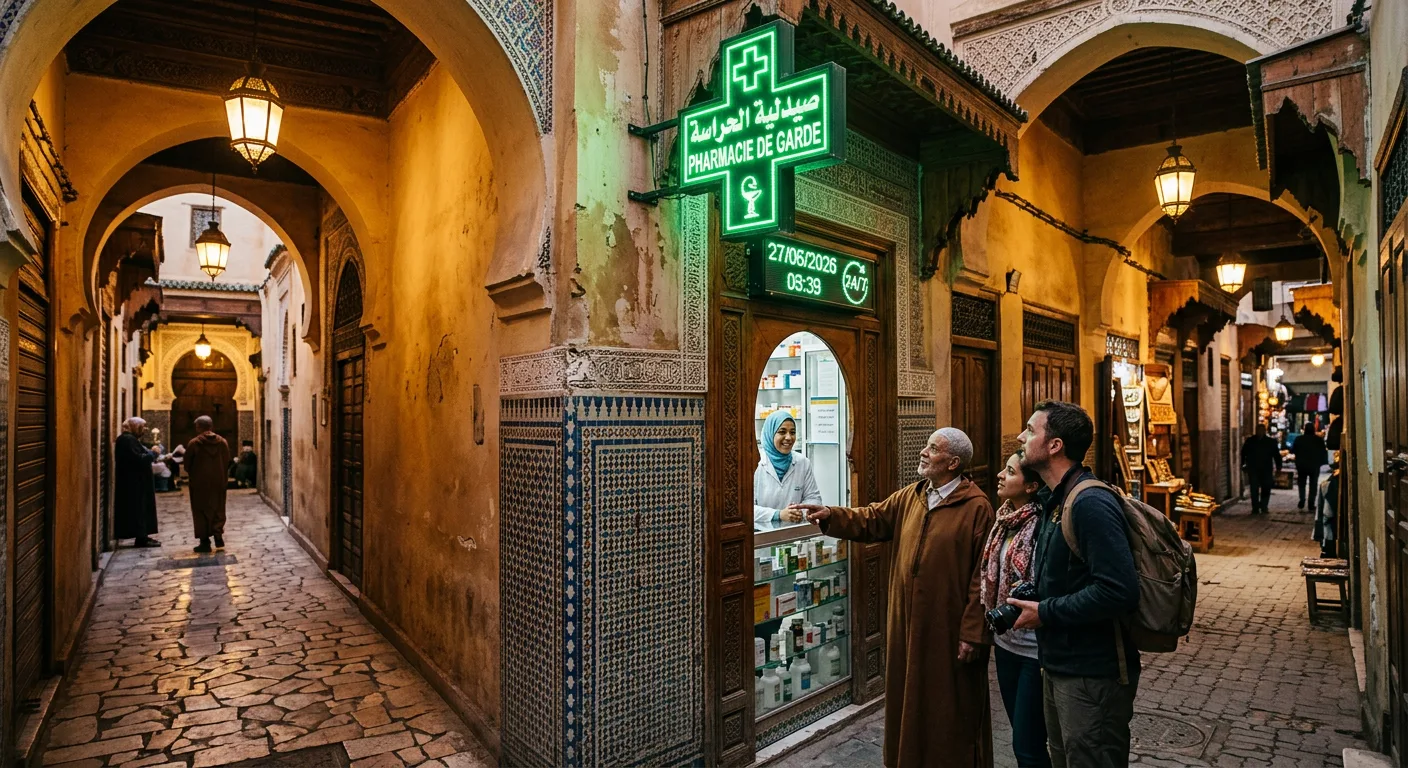
Moroccan pharmacies are identified by a green cross sign and are found on nearly every major street. Pharmacists are highly trained and can recommend over-the-counter treatments for common ailments -- many medications that require prescriptions in Europe or North America are available over the counter in Morocco at a fraction of the price.
Every city operates a pharmacie de garde (duty pharmacy) system ensuring 24/7 access to medications. When a pharmacy is closed, a sign on the door lists the nearest on-duty pharmacy. Your hotel reception can always help you locate the pharmacie de garde.
Finding the Pharmacie de Garde
- Check the sign posted on any closed pharmacy door
- Ask your hotel or riad reception
- Search "pharmacie de garde [city name]" online
- Look for an illuminated green cross at night
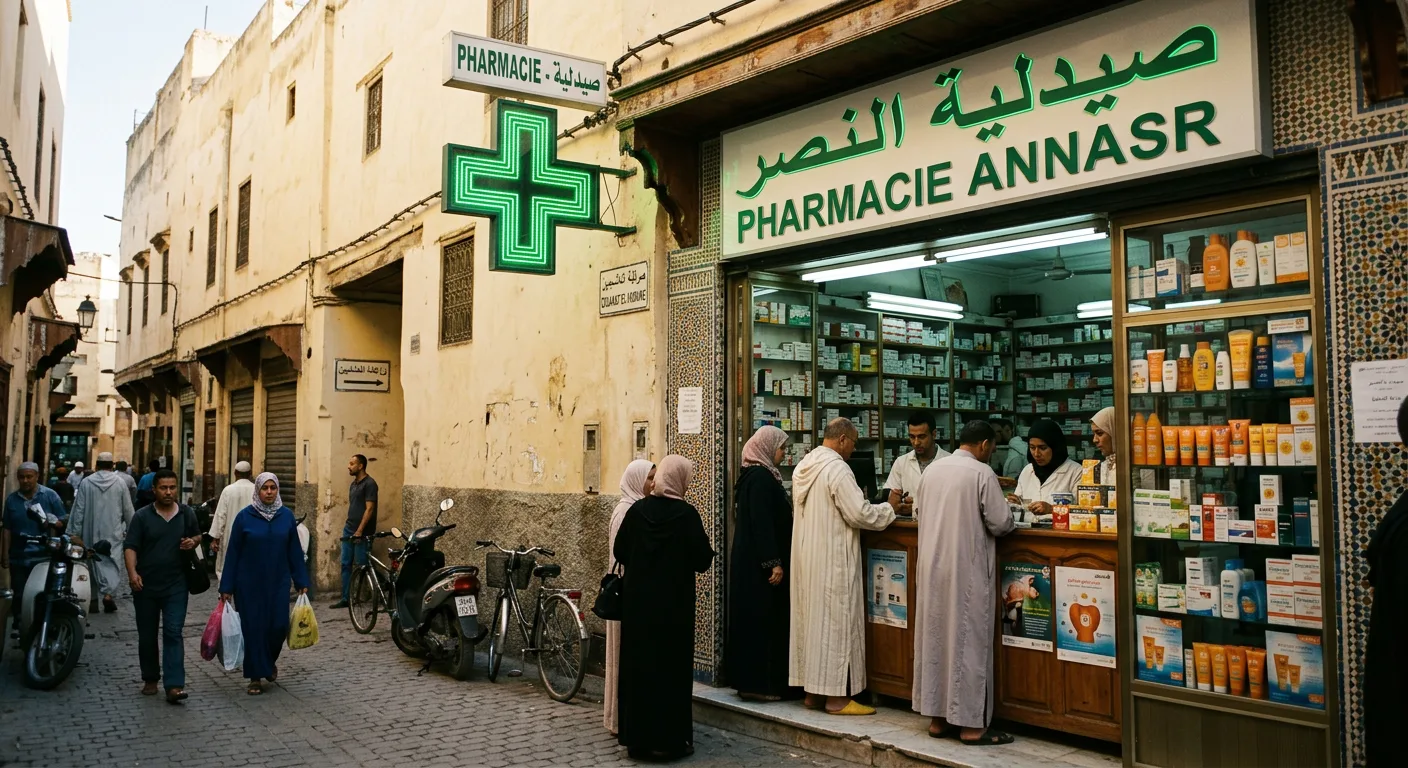
Pharmacies in Morocco are identified by the green cross symbol and are staffed by qualified pharmacists
Dental Emergencies
Morocco has excellent private dental clinics, particularly in Casablanca, Rabat, and Marrakech. Many dentists studied in France and speak multiple languages. Emergency dental work is available at most private clinics.
Expect to pay from 300 MAD for a dental consultation and basic treatment
For after-hours emergencies, go to a private clinic emergency department
Keep your travel insurance details handy -- dental emergencies are often covered
Embassies & Consulates
Your Embassy in Morocco
Contact your embassy or consulate for passport replacement, legal assistance, emergency funds, or if you are detained. Most embassies are in Rabat, with consulates in Casablanca.
United States
US
Embassy - Rabat
+212-537-637-200
Consulate - Casablanca
+212-522-642-099
After-hours emergency
+212-661-131-939
ma.usembassy.gov
United Kingdom
UK
Embassy - Rabat
+212-537-633-333
Consulate - Casablanca
+212-522-857-400
gov.uk/world/morocco
Canada
CA
Embassy - Rabat
+212-537-687-400
After-hours emergency
+1-613-996-8885
canada.ca/morocco
France
FR
Embassy - Rabat
+212-537-689-700
Consulate - Casablanca
+212-522-489-600
ma.ambafrance.org
Australia
AU
Embassy - Rabat
+212-537-768-660
After-hours emergency
+61-2-6261-3305
morocco.embassy.gov.au
Germany
DE
Embassy - Rabat
+212-537-218-600
rabat.diplo.de
Spain
ES
Embassy - Rabat
+212-537-633-900
Consulate - Casablanca
+212-522-220-752
exteriores.gob.es/embajadas/rabat
What Your Embassy Can Help With
- Emergency passport or travel document
- Legal assistance and referrals
- Medical emergency coordination
- Emergency funds transfer
- Help if detained or arrested
- Emergency repatriation assistance
Lost or Stolen Documents
What to Do If You Lose Your Passport
Losing your passport is stressful but manageable. Follow these steps in order to get back on track as quickly as possible.
1
File a Police Report (Proces-Verbal)
Go to the nearest police station (commissariat) or tourist police office. Request a proces-verbal (official police report). This document is essential for your embassy to issue a replacement. The report is free and typically takes 30-60 minutes. Bring any identification you still have and a copy of your passport if available.
Tip: Tourist police in Marrakech, Fes, and Casablanca often speak French and basic English. Ask your hotel to help translate if needed.
2
Contact Your Embassy or Consulate
Call your embassy during business hours (typically 8:30 AM - 4:30 PM, Monday to Friday) or use the after-hours emergency line. Bring the police report, two passport-sized photos, any form of ID you have, and a photocopy of your passport (or the digital scan from your email).
Pro tip: Before traveling, email yourself a scan of your passport photo page, visa, and travel insurance documents. This dramatically speeds up the replacement process.
3
Get an Emergency Travel Document
Your embassy will issue either a temporary passport or an Emergency Travel Document (ETD). Processing typically takes 1-3 business days. Some embassies can expedite for same-day or next-day departure. The ETD is valid for a single journey home and costs vary by country (US: ~$165, UK: ~95 GBP).
4
Notify Your Airline and Insurance
Contact your airline about travel with temporary documents. Notify your travel insurance company as replacement costs may be covered. If your driver's license was also lost, you may need to obtain an international driving permit replacement or avoid renting vehicles.
Prevention: Protect Your Documents
Leave your passport in the hotel/riad safe and carry a photocopy
Email yourself scans of passport, visa, insurance, and flight details
Store backup copies in cloud storage (Google Drive, iCloud)
Keep original and copies in separate locations at all times
Use a hidden money belt for documents in crowded areas
Note your embassy address and phone number before your trip
Financial Emergencies
Lost Cards & Emergency Money
Acting fast when a card is lost or stolen minimizes your financial exposure. Here is exactly what to do.
Lost/Stolen Cards
Call your bank immediately to block the card. Then call the international emergency line for your card network:
Visa Emergency (Global)
+1-303-967-1096
Mastercard Emergency (Global)
+1-636-722-7111
American Express
+1-336-393-1111
File a police report as well -- you may need it for insurance claims and chargebacks on fraudulent charges.
Emergency Money Transfer
If you are left without any money, these services can get you cash within hours from family or friends back home:
Western Union
Available at post offices (Poste Maroc) and dedicated agents in every city. Receiver needs valid ID. Cash pickup in 10-15 minutes.
MoneyGram
Available at banks and authorized agents. Similar to Western Union with competitive fees. Widely available in tourist cities.
Wise / Revolut Transfer
If you have a secondary account, transfer to a Moroccan bank account or use a local ATM with a backup card.
Emergency Cash Tips
Always carry backup cash -- keep from 500 MAD (about $50-100) hidden separately from your main wallet
Bring two bank cards from different banks and keep them in separate locations
Your embassy can help facilitate emergency fund transfers from family members
Hotels may advance cash against a confirmed booking or credit card authorization
ATMs are widespread -- Attijariwafa Bank, BMCE, and Banque Populaire accept most international cards
Note your bank's number before travel -- saved in your phone, not just on the card
Natural Disasters
Earthquake & Flood Preparedness
Morocco's geography means occasional seismic activity and flash floods. Knowing what to do before it happens can save your life.
Earthquakes
Morocco sits on the African-Eurasian plate boundary. The devastating 2023 Al Haouz earthquake (magnitude 6.8) near Marrakech was a reminder of seismic risks. While major earthquakes are infrequent, tremors occur periodically, especially near the Rif Mountains and Atlas range.
During an earthquake:
Drop, Cover, Hold On -- get under a sturdy table or desk, protect your head and neck
Stay away from windows, shelves, and anything that could fall on you
In a medina, move to an open space like a plaza or courtyard if possible -- old unreinforced buildings are at highest risk
If outdoors, move away from buildings, power lines, and street lights
After an earthquake:
Expect aftershocks -- stay in open areas for at least 30 minutes
Check for injuries and help others if safe to do so
Contact your embassy and family to report your status
Follow local authorities' instructions and monitor news
Flash Floods
Flash floods are a genuine danger in Morocco, particularly in the Atlas Mountains, desert wadis (dry riverbeds), and gorge areas like Todra and Dades. The rainy season (October through March) brings the highest risk. Dry riverbeds can transform into raging torrents within minutes after rainfall, even if it is raining far upstream.
Flash flood safety:
Never camp in dry riverbeds (wadis/oueds), no matter how dry they appear
Check weather forecasts before Atlas trekking or desert excursions, even if your area is sunny
Move to higher ground immediately if you hear rushing water or notice water levels rising
Do not cross flooded roads -- even 30cm of moving water can knock you down; 60cm can sweep away a vehicle
High-risk areas:
Todra & Dades Gorges -- narrow canyon walls amplify flood danger
Ouarzazate & Draa Valley -- desert wadis flood rapidly after upstream rain
High Atlas passes -- Tizi n'Tichka and Tizi n'Test roads close during heavy rains
Sahara edge towns -- Merzouga and Zagora areas experience seasonal flash flooding
Crime & Personal Safety
What to Do If Something Goes Wrong
Morocco is generally safe for tourists, but petty crime exists in any travel destination. Knowing the right steps protects you and speeds recovery.
If You Are Robbed
1.Do not resist -- your safety is more important than your belongings. Hand over what is demanded.
2.Move to a safe, public location immediately after and call police (19) or tourist police.
3.File a police report (proces-verbal) at the nearest commissariat. Essential for insurance claims.
4.Block stolen cards immediately by calling your bank and the card network emergency line.
5.Contact your embassy if your passport was taken, and your travel insurance provider for next steps.
Filing a Police Report
The proces-verbal is Morocco's official police report. You need it for insurance claims, embassy assistance, and card replacements.
What to bring:
- Passport or photocopy
- Details of what happened (time, location, description)
- List of stolen items with approximate values
- Any photos or evidence
- Witness information if available
The report is free and typically takes 30-60 minutes. Request multiple copies -- you will need them for insurance and embassy visits.
Tourist Police (Brigade Touristique)
Morocco's dedicated tourist police operate in major tourist cities. They are specifically trained to assist foreign visitors and often speak French and some English.
Marrakech -- Jemaa el-Fnaa area and medina entrances
Fes -- Bab Bou Jeloud and Fes el-Bali
Casablanca -- Hassan II Mosque area and downtown
Tangier -- Port and medina areas
Agadir -- Beach and tourist district
Tourist police can help with scam situations, harassment, language barriers, and connecting you with the right authorities. They are generally helpful and tourist-friendly.
Crime Prevention Tips
Keep valuables in your hotel safe and carry only what you need for the day
Use a cross-body bag or hidden money belt in crowded areas like medinas and souks
Avoid displaying expensive jewelry, electronics, or large amounts of cash
Be cautious of overly friendly strangers leading you to shops or isolated areas
Stick to well-lit, busy streets at night. Ask your hotel about safe walking routes
Use official taxis (petit taxi/grand taxi) and insist on the meter or agree on a price beforehand
Travel Insurance
Why Travel Insurance Is Essential
While Morocco has affordable healthcare compared to many Western countries, an unexpected hospital stay or medical evacuation without insurance can cost a life-changing amount of money.
What Your Policy Should Cover
Emergency Medical Treatment
Private hospital visits can cost from 1,000 MAD per day
500,000 MAD (approx. $50,000 USD)
Medical Evacuation
Air ambulance to Europe can exceed $100,000 USD
$250,000 USD
Trip Cancellation
Non-refundable flights and accommodations
Total trip cost
Lost/Stolen Belongings
Replacement of luggage, electronics, documents
$2,000-5,000 USD
Adventure Activities
Trekking, quad biking, desert tours often excluded from basic plans
Confirm specific activities covered
Repatriation of Remains
In the worst case, bringing remains home is extremely costly
Included in comprehensive policies
How to Make a Claim
1.Contact your insurer as soon as possible -- most require notification within 24-48 hours of an incident
2.Collect all documentation: police reports, medical receipts, pharmacy bills, photos of damage or injuries
3.Keep originals of everything -- insurers typically require original receipts, not copies
4.Submit your claim with the completed form, all documentation, and proof of expenses within the deadline (usually 30-90 days)
Before You Travel: Insurance Checklist
Save your policy number and insurer's 24/7 emergency number in your phone
Print a copy of your policy summary to carry with you
Check if adventure activities (trekking, quad biking) are covered
Verify your excess/deductible amount -- can you afford it if needed?
Check if pre-existing conditions are covered
Know whether your insurer pays hospitals directly or you pay and claim later
Emergency Language Guide
Essential Darija & French Phrases
In an emergency, being able to communicate basic needs in the local language can make all the difference. Save these phrases or screenshot this section.
EnglishDarija (Moroccan Arabic)FrenchPronunciation
Help!
!عاونونيAu secours !Aw-noo-nee!General cry for help
Call the police!
!عيطو للبوليسAppelez la police !Ay-too lil-boo-lees!Crime or dangerous situation
I need a doctor
بغيت طبيبJ'ai besoin d'un medecinBghit tbibMedical emergency
Call an ambulance!
!عيطو لمبيلونصAppelez une ambulance !Ay-too lam-bee-lonss!Serious medical emergency
I am lost
أنا تاه / تاهةJe suis perdu(e)Ana tah (m) / taha (f)Lost in medina or rural area
Where is the hospital?
فين السبيطار؟Ou est l'hopital ?Feen es-sbi-tar?Finding medical care
Where is the pharmacy?
فين الفارماسي؟Ou est la pharmacie ?Feen el-far-ma-see?Finding medication
I have been robbed
تسرقتJ'ai ete vole(e)Tser-getReporting theft
I need help
خصني لمعاونةJ'ai besoin d'aideKhess-nee lm-aw-naGeneral assistance
It is urgent / emergency
ضروري / مستعجلC'est urgentDah-roo-ree / Msta-jelEmphasizing urgency
I am allergic to...
...عندي الحساسية منJe suis allergique a...An-dee al-hah-sa-see-ya men...Allergic reactions
My passport was stolen
تسرق ليا الباسبورMon passeport a ete voleTser-ek lee-ya el-pass-porLost/stolen documents
Communication Tips in an Emergency
French is the most reliable second language in Morocco. Most police, doctors, and hotel staff speak French fluently.
In tourist areas, many people speak basic English, Spanish (in the north), or German (in Agadir).
If language is a complete barrier, go to the nearest hotel or restaurant -- staff can translate and help you contact authorities.
Google Translate's camera feature can translate signs and documents in real time using your phone camera.
Essential Apps & Tools
Apps to Download Before Your Trip
These apps work offline or on limited connectivity and can be invaluable in an emergency. Download them before you leave home.
Maps.me / OsmAnd
Offline Navigation
Download Morocco maps for offline use before your trip. Essential for navigating medinas where GPS signal is unreliable. Works without internet or mobile data.
Google Translate
Language Barrier
Download Arabic and French language packs for offline translation. Camera feature can translate signs and menus in real time. Essential for pharmacy and medical visits.
Communication
The primary messaging app in Morocco. Hotels, tour operators, taxi drivers, and restaurants all use it. Buy a local SIM card for reliable access.
Emergency SOS (Built-in)
Emergency Alerts
Both iPhone and Android have built-in Emergency SOS. On iPhone, hold side button + volume. On Android, press power button 5 times. Set up emergency contacts before your trip.
XE Currency
Currency Conversion
Real-time MAD to your home currency conversion. Useful for understanding medical bills and pharmacy costs. Works offline once rates are cached.
Smart Traveler (US) / TravelAware (UK)
Government Alerts
Official government travel advisory apps. Receive push notifications about safety alerts, natural disasters, and political events in Morocco.
Get a Moroccan SIM Card
A local SIM card with data is highly recommended for emergency situations. Available at the airport and in every city for around from 30 MAD (about $3-5) with a data package.
Maroc Telecom
Best coverage nationwide, including rural and desert areas
Orange Morocco
Good coverage in cities, competitive data packages
inwi
Affordable option with good city coverage, popular with travelers
Frequently Asked Questions
Emergency FAQs for Morocco
Answers to the most common questions about emergencies, safety, and getting help as a traveler in Morocco.
1What is the main emergency number in Morocco?
The universal emergency number from any mobile phone is 112. For police specifically, call 19 in cities or 177 for the Gendarmerie in rural areas. Fire and ambulance share the number 15.
2Are there English-speaking doctors in Morocco?
Yes, most private clinics in major cities like Marrakech, Casablanca, Rabat, and Fes have English-speaking doctors. French is widely spoken in all medical facilities. Private clinics are recommended for tourists as they typically offer higher standards of care and shorter wait times.
3What should I do if my passport is lost or stolen in Morocco?
First, file a police report (proces-verbal) at the nearest police station. Then contact your country's embassy or consulate with the police report. They can issue an emergency travel document or temporary passport, usually within 1-3 business days. Keep photocopies of your passport and a digital scan in your email for faster processing.
4How do I find an open pharmacy at night in Morocco?
Morocco has a pharmacie de garde (duty pharmacy) system that ensures pharmacies are open 24/7 on rotation. Look for green cross signs that are illuminated, check the notice posted on closed pharmacy doors listing the nearest on-duty pharmacy, or call your hotel reception for the nearest one.
5Do I need travel insurance for Morocco?
While travel insurance is not legally required to enter Morocco, it is strongly recommended. Private medical care can be expensive, and medical evacuation costs can reach tens of thousands of dollars. Ensure your policy covers emergency medical treatment, hospital stays, medical evacuation, trip cancellation, and lost belongings.
6What happens if my credit card is stolen in Morocco?
Immediately call your bank to block the card. Visa Emergency line: +1-303-967-1096, Mastercard: +1-636-722-7111. File a police report, which you may need for insurance claims. For emergency cash, use Western Union or MoneyGram (available in most cities) or ask your bank about emergency card replacement.
7Is Morocco prone to earthquakes?
Morocco sits on the African-Eurasian plate boundary and does experience seismic activity. The 2023 Al Haouz earthquake (magnitude 6.8) was a significant event. While major earthquakes are infrequent, tremors can occur. Know the drill: Drop, Cover, Hold On. Stay away from old unreinforced structures during tremors.
8How do I file a police report as a tourist in Morocco?
Visit the nearest police station (commissariat) or tourist police office. Major cities have dedicated tourist police brigades who often speak some English and French. You will need your passport (or a copy), details of the incident, and any evidence. The report (proces-verbal) is free and typically takes 30-60 minutes.
9What emergency apps should I download before visiting Morocco?
Download Maps.me or OsmAnd for offline navigation (essential in medinas). Google Translate with Arabic and French offline packs. Your phone should have built-in Emergency SOS features. WhatsApp is widely used in Morocco for communicating with hotels, guides, and taxi drivers.
10Can I call 911 in Morocco?
No, 911 does not work in Morocco. The emergency numbers are: 19 (police in cities), 177 (Gendarmerie for rural areas), 15 (fire and ambulance), and 112 (universal emergency from mobile phones). Save these numbers in your phone before your trip.
Quick Reference Card
Screenshot this section for instant access to the most critical numbers and information.
Emergency Numbers
Police (City)19
Gendarmerie (Rural)177
Fire / Ambulance15
Mobile SOS112
Key Phrases
Help!Aw-noo-nee!
Call policeAy-too lil-boo-lees
I need a doctorBghit tbib
Hospital?Feen es-sbi-tar?
Card Emergency Lines
Visa+1-303-967-1096
Mastercard+1-636-722-7111
Stay safe, travel smart, and enjoy your Moroccan adventure with confidence.
Continue Exploring Morocco
Discover more of what Morocco has to offer