Discovering...

Complete Rail Guide
Morocco Trains & Rail Guide
From Africa's first high-speed train to comfortable overnight services. Everything you need to know about ONCF rail travel with real prices, schedules, station guides, and connecting transport options.
Morocco's Rail Network (ONCF)
Morocco's national railway operator, the Office National des Chemins de Fer (ONCF), operates a modern and growing rail network that is the most extensive in North Africa. The system covers approximately 2,200 km of track and connects the country's major cities along two main corridors: the northern Atlantic axis (Tangier–Kenitra–Rabat–Casablanca–Marrakech) and the eastern line (Casablanca–Fes–Oujda).
In 2018, Morocco made continental history by launching the Al Boraq, Africa's first high-speed train, connecting Tangier to Casablanca in just 2 hours and 10 minutes at speeds up to 320 km/h. Built with French TGV technology and funded through a partnership between Morocco and France, Al Boraq transformed the northern corridor and set the stage for an ambitious expansion program that will eventually connect Marrakech and beyond.
For travelers, Moroccan trains offer a comfortable, affordable, and scenic way to move between cities. The rail network covers all the imperial cities (Fes, Meknes, Marrakech, Rabat) and the economic capital (Casablanca), while ONCF's partner bus service Supratours extends connectivity to destinations the tracks do not reach, including Essaouira, Chefchaouen, Agadir, Ouarzazate, and the Sahara gateway towns.
2,200 km
Track Length
45+ million
Passengers/Year
320 km/h
Al Boraq Speed
120+
Stations
Al Boraq High-Speed Train
Africa's First High-Speed Rail Service
The Al Boraq (named after the mythical winged horse in Islamic tradition) launched on November 15, 2018, making Morocco the first country in Africa — and the Arab world — to operate a high-speed rail service. The line runs 186 km of dedicated high-speed track between Tangier and Kenitra, where it joins the conventional network for the remaining distance to Casablanca.
Built using French Alstom TGV Duplex technology, the trains reach a commercial speed of 320 km/h on the high-speed section. The total journey from Tangier to Casablanca takes approximately 2 hours and 10 minutes, compared to 5 hours and 30 minutes on the old conventional service. That is a 60% reduction in travel time.
The service is popular with both commuters and tourists. With 12 departures daily in each direction, you can easily day-trip between Tangier and Rabat or use it as the backbone of a northern Morocco itinerary. Trains feature modern interiors with power outlets, fold-down tables, overhead luggage storage, Wi-Fi (basic), and electronic information displays.
Al Boraq Route: Tangier to Casablanca
The Al Boraq stops at four stations along the northern corridor. All times are approximate from Tangier (southbound direction).
Tanger Ville
0 min0 kmNorthern terminus, modern station near the port and medina
Kenitra
1h 20min200 kmIndustrial city, connection to conventional trains heading east
Rabat Agdal
1h 40min250 kmCapital city, well-connected to tram and petit taxis
Casa Voyageurs
2h 10min323 kmMain rail hub, connections to Marrakech, Fes, and all southern routes
Al Boraq Ticket Prices
Prices vary slightly depending on the specific segment and whether purchased in advance or at the station. Below are standard one-way fares for the full Tangier–Casablanca route.
1st Class (Full Route)
229 MAD
~$23 / ~21 EUR
2nd Class (Full Route)
149 MAD
~$15 / ~14 EUR
Journey Time
2h 10min
Tangier to Casablanca
Daily Departures
12
Each direction
| Segment | 1st Class | 2nd Class | Duration |
|---|---|---|---|
| Tangier - Kenitra | 150-180 MAD | 100-120 MAD | 1h 20min |
| Tangier - Rabat | 180-220 MAD | 120-140 MAD | 1h 40min |
| Tangier - Casablanca | 229-329 MAD | 149-199 MAD | 2h 10min |
| Kenitra - Rabat | 60-80 MAD | 40-55 MAD | 20min |
| Kenitra - Casablanca | 100-140 MAD | 65-90 MAD | 50min |
| Rabat - Casablanca | 80-120 MAD | 50-75 MAD | 50min |
Prices are slightly higher when purchased on the day of travel at the station. Book online at oncf.ma or via the ONCF app for the best rates. Children under 4 travel free; ages 4-12 get a 50% discount.
Schedules & Booking
Schedule Highlights
- First departure: around 06:00 from both Tangier and Casablanca
- Last departure: around 20:30 from both termini
- Frequency: approximately every 1-2 hours throughout the day
- Busiest times: 08:00, 14:00, 18:00 (commuter hours)
- Reduced schedule on major holidays (Eid al-Fitr, Eid al-Adha)
Booking Tips
- Book 2-5 days ahead for Friday/Sunday travel to guarantee a seat
- Tickets open for sale 30 days before departure
- E-tickets on your phone are fully accepted (no need to print)
- At the station, use automated machines to skip ticket window queues
- Refunds available up to 24 hours before departure (small fee deducted)
Regular Train Routes (ONCF Conventional)
Beyond the Al Boraq high-speed service, ONCF operates an extensive network of conventional trains connecting Morocco's major cities. These trains run at speeds of 120-160 km/h on well-maintained track and offer a comfortable, reliable alternative to bus travel. The main corridors are the Atlantic axis (Tangier–Rabat–Casablanca–Marrakech) and the eastern line (Casablanca–Fes–Oujda).
Conventional trains are significantly cheaper than Al Boraq and reach destinations the high-speed line does not serve, including Marrakech, Fes, Meknes, Oujda, and El Jadida. The Casablanca-Marrakech route is the busiest tourist line, while the overnight Casablanca-Oujda service is an adventure in itself. Trains are air-conditioned with reserved seating in both first and second class.
All Conventional Routes, Prices & Frequencies
| Route | Duration | 1st Class | 2nd Class | Frequency |
|---|---|---|---|---|
| Casablanca - Marrakech | 3h - 3h 30min | 160-200 MAD | 100-130 MAD | 9 daily |
| Casablanca - Fes | 3h 30min - 4h | 200-250 MAD | 130-160 MAD | 7 daily |
| Fes - Tangier | 4h 30min - 5h | 180-230 MAD | 120-150 MAD | 4 daily |
| Rabat - Meknes | 2h - 2h 30min | 100-140 MAD | 65-90 MAD | 8 daily |
| Casablanca - Oujda | 9h 30min - 10h | 300-350 MAD | 200-240 MAD | 2 daily |
| Fes - Meknes | 45min | 50-70 MAD | 30-45 MAD | 10 daily |
| Rabat - Fes | 2h 30min | 150-190 MAD | 90-120 MAD | 7 daily |
| Casablanca - El Jadida | 1h 30min | 70-90 MAD | 45-60 MAD | 6 daily |
| Fes - Oujda | 5h - 5h 30min | 180-220 MAD | 120-150 MAD | 3 daily |
| Casablanca - Tangier (conventional) | 5h - 5h 30min | 200-250 MAD | 130-170 MAD | 4 daily |
| Kenitra - Meknes | 1h 45min | 80-110 MAD | 50-70 MAD | 6 daily |
Casablanca - Marrakech
The most popular tourist route in Morocco. Trains depart approximately every 1-2 hours from Casa-Voyageurs. The 3-hour journey passes through flat agricultural plains south of Settat before arriving at Marrakech's renovated station, just a 15-minute walk from Jemaa el-Fnaa. Second class is perfectly adequate for this journey.
3-3.5 hours100-200 MAD9 daily
Casablanca - Fes
Connects Morocco's economic capital with its spiritual and cultural heart. The train passes through Rabat and Meknes before arriving in Fes. Some services require a change at Sidi Kacem. First class is recommended for the 4-hour journey. The Fes station is about 2 km from the medina entrance at Bab Bou Jeloud.
3.5-4 hours130-250 MAD7 daily
Casablanca - Oujda (Overnight)
Morocco's longest train ride takes nearly 10 hours and crosses the entire country from west to east, passing through Fes, Taza, and the Rif foothills. An overnight departure with couchette sleeping berths is available, saving you a hotel night. The overnight train departs in the evening and arrives in Oujda early the following morning.
9.5-10 hours200-400 MAD2 daily
Fes - Meknes
One of the shortest and most frequent train rides in Morocco. The 45-minute journey between two imperial cities makes it perfect for a day trip. Trains depart roughly every hour. At 30-45 MAD for second class, it is cheaper than a grand taxi and far more comfortable. Meknes station is a short taxi ride from the medina.
45 minutes30-70 MAD10 daily
Train Classes Explained
First Class (Premiere)
- Wider seats with more legroom and recline
- Reserved seating (seat number on your ticket)
- Air conditioning (sometimes too cold, bring a layer)
- Quieter carriages with fewer passengers
- Power outlets at most seats on newer trains
- Fold-down tables for laptops and meals
- Overhead luggage racks and under-seat storage
Best for: Journeys over 2 hours, business travelers, and anyone wanting guaranteed comfort and quiet.
50-80% more than second class, but still very affordable by European standards.
Second Class (Deuxieme)
- Comfortable padded seats in rows of 3+3 or 2+2
- Reserved seating on Al Boraq and most conventional trains
- Air conditioning on all mainline trains
- More crowded, especially on commuter-heavy routes
- Good value for shorter journeys (under 2 hours)
- Luggage racks available but fill up quickly
- Lively atmosphere with local travelers
Best for: Budget travelers, short journeys (Fes-Meknes, Rabat-Casa), and anyone comfortable with a busier environment.
The most affordable way to ride the ONCF network. Many locals ride second class exclusively.
Couchette (Overnight)
- Available on the Casablanca-Oujda overnight route
- 4-berth compartments with fold-down bunks
- Clean linens and blankets provided
- Lockable compartment door for security
- Saves one night of accommodation costs
- Departs evening, arrives early morning
- Limited availability, book well in advance
Best for: Budget-conscious travelers heading to eastern Morocco who want to save time and a night of accommodation.
Approximately 350-400 MAD. More expensive than first class but includes the sleeping berth.
How to Buy Tickets
ONCF Website (oncf.ma)
- 1Visit oncf.ma and select your departure and arrival stations
- 2Choose your date, class (1st or 2nd), and number of passengers
- 3Pay with Visa, Mastercard, or CMI-enabled Moroccan bank cards
- 4Receive an e-ticket by email with a QR code
- 5Show the QR code on your phone to the conductor (no printing needed for Al Boraq)
Pros
- Guaranteed seat reservation
- Prices shown before purchase
- Available 30 days in advance
Cons
- Some international cards are declined (try another card if this happens)
- Website can be slow during peak hours
ONCF Mobile App
- 1Download the ONCF app (Android and iOS)
- 2Create an account with your email
- 3Search routes and schedules in real time
- 4Purchase tickets and store them in the app
- 5Scan the QR code directly from the app at the gate or to the conductor
Pros
- Most convenient option
- Real-time schedule updates
- E-ticket stored on your phone
Cons
- App can be buggy on older devices
- Payment issues with some foreign cards
Station Ticket Windows
- 1Go to the ticket counter (guichet) at any ONCF station
- 2Tell the agent your destination, class, and preferred departure time
- 3Pay in cash (MAD) or by Moroccan bank card
- 4Receive a paper ticket with your seat assignment
- 5Keep the ticket until you exit the destination station
Pros
- Cash payment accepted
- Staff can help with schedule questions
- No technology required
Cons
- Queues can be long, especially before holidays
- No credit card (only cash or Moroccan debit)
- Must be at the station in person
Automated Ticket Machines
- 1Located at major stations (Casa-Voyageurs, Rabat Agdal, Marrakech, Tanger Ville)
- 2Select language (Arabic, French, sometimes English)
- 3Choose your route, date, and class
- 4Pay with cash (coins and notes) or Moroccan bank card
- 5Collect your printed ticket from the machine
Pros
- Skip the ticket queue
- Available during station operating hours
- Quick for simple one-way tickets
Cons
- Not all machines accept foreign bank cards
- May be out of service
- Interface in French by default
Important Booking Notes
Payment at station ticket windows
Cash only (Moroccan Dirhams) or Moroccan bank debit cards. International Visa/Mastercard credit cards are NOT accepted at ticket windows. Bring cash.
Online payment issues
The ONCF website and app accept Visa and Mastercard, but some international cards are declined by the Moroccan payment gateway. If your card is declined, try a different card or purchase at the station.
Al Boraq requires reservation
Every Al Boraq ticket has a specific train time and seat number. You cannot board a different Al Boraq train with the same ticket. Conventional train tickets are more flexible.
Children and discounts
Children under 4 travel free (no seat reservation). Ages 4-12 get 50% off. Moroccan students with ONCF Carte Jeune get 25% off. No tourist discount cards exist.
Cancellation and changes
Al Boraq tickets can be changed or refunded up to 24 hours before departure with a 10-15% cancellation fee. Conventional tickets have more restrictive change policies.
Peak travel periods
Book well ahead during Eid holidays, summer (July-August), and the Tangier-Casa corridor on Fridays and Sundays. Trains fill up during Ramadan as well.
Station Guides
Knowing what to expect at your departure and arrival stations makes train travel in Morocco much smoother. Here are detailed guides to the four most important rail stations for travelers.
Casablanca
Casa-Voyageurs
— Main national rail hubLines & Connections
All ONCF lines converge here: Al Boraq, Marrakech, Fes, Oujda, El Jadida
Facilities
ATMs, currency exchange, cafes (Paul, coffee stands), luggage storage (20 MAD/day), prayer room, newsstand, ticket windows and automated machines
Taxi Access
Petit taxis queue outside the main entrance. Insist on the meter. To medina/city center: 15-25 MAD.
Tram / Public Transit
Casablanca Tram Line 1 stops directly at the station. Line 2 connects via interchange.
Tip: Busiest station in Morocco. Arrive 20-30 minutes before departure. Supratours buses to Essaouira and Agadir depart from the station forecourt. Do not confuse with Casa-Port station (closer to port/medina, fewer long-distance trains).
Marrakech
Marrakech
— Southern terminus of the rail networkLines & Connections
Casablanca, Rabat, Tangier (via Casa). No direct train to Fes without changing.
Facilities
Modern renovated station with ATMs, cafes, a small shop, ticket counters, and electronic departure boards. Clean restrooms (2 MAD).
Taxi Access
Petit taxis (beige) line up outside. To Jemaa el-Fnaa/medina: 15-20 MAD by meter. Some drivers refuse the meter for tourists. Walk to the next taxi.
Tram / Public Transit
No tram in Marrakech. Bus line 1 (Alsa) runs from the station area to the medina.
Tip: The station is about 15-minute walk from Jemaa el-Fnaa. Supratours office is adjacent for buses to Essaouira (2.5h), Ouarzazate (4.5h), and Agadir (3.5h). Book Supratours the day before during holidays.
Fes
Fes
— Eastern gateway hubLines & Connections
Casablanca, Rabat, Meknes, Oujda, Tangier (conventional)
Facilities
Well-maintained station with ticket windows, ATMs, small cafe, prayer room, and electronic boards. Luggage storage available.
Taxi Access
Petit taxis (red) outside. To Bab Bou Jeloud (medina entrance): 10-15 MAD. The station is about 2 km from the old medina.
Tram / Public Transit
No tram. City bus 19 connects the station to the medina area but is infrequent.
Tip: From Fes station, Supratours runs buses to Chefchaouen (4h, 75-95 MAD) and Merzouga/Sahara (8h, overnight, 160-200 MAD). Grand taxis to Meknes (25 MAD/seat) depart from just outside.
Tangier
Tanger Ville
— Northern terminus for Al BoraqLines & Connections
Al Boraq to Casablanca (2h 10min), conventional to Fes, Meknes, Rabat
Facilities
Modern station renovated for Al Boraq launch. Ticket windows and machines, ATMs, cafe, newsstand, clean restrooms, prayer room.
Taxi Access
Petit taxis (aqua blue) outside. To medina/kasbah: 10-15 MAD. To Cap Spartel: 80-100 MAD.
Tram / Public Transit
No tram in Tangier. Grand taxis to Tetouan (25 MAD/seat) and Chefchaouen (70 MAD/seat) depart from nearby.
Tip: The station is centrally located in the new city (ville nouvelle), about 10-minute walk downhill to the medina. If arriving by ferry from Spain (Tanger Med port), take a bus or grand taxi to the city first, then walk to the station.
Train Travel Tips
Arrive at the station early
Get to the station 20-30 minutes before departure for Al Boraq and 15 minutes for conventional trains. You need time to find your platform, especially at busy Casa-Voyageurs where there are multiple platforms and underpasses.
Guard your luggage
Keep valuables (passport, phone, wallet) on your person at all times. Store large bags on the overhead rack where you can see them. On busy conventional trains, petty theft from unattended bags does happen. Use a small lock on your backpack zippers.
Bring food and water
There is no dining car on Moroccan trains. A vendor sometimes passes through with a cart selling coffee, snacks, and sandwiches (10-30 MAD), but availability is inconsistent. Buy water and food at the station before boarding, especially for journeys over 2 hours.
Keep your ticket until you exit
Conductors check tickets on board, and some stations have electronic gates requiring your ticket to exit. The fine for traveling without a valid ticket is 200 MAD or more. On Al Boraq, the QR code e-ticket is scanned both on the platform and on board.
Wi-Fi and connectivity
Al Boraq offers free Wi-Fi that is functional but slow. Conventional trains have no Wi-Fi. Mobile data (4G/5G) works along most of the northern rail corridor but drops out in tunnels and remote sections. Download offline content for long rides.
Delays on conventional trains
Al Boraq is generally punctual (within 5 minutes). Conventional trains can run 15-30 minutes late, especially during peak periods and bad weather. If you have a tight connection to a Supratours bus, allow extra buffer time.
Luggage storage at stations
Casa-Voyageurs and Rabat Agdal have luggage storage (consigne) for 20 MAD per bag per day. Useful if you want to explore a city for a few hours between trains. Other stations may have informal arrangements at nearby shops.
Download the ONCF app
The official ONCF mobile app shows live departure times, allows ticket purchases, and stores e-tickets. Download it before your trip. It is the most reliable way to check if your train is on time. Available in French and Arabic.
Bring cash for conventional trains
While Al Boraq tickets are often bought online, conventional train tickets at smaller stations may require cash (MAD). ATMs are available at all major stations. Ticket windows do not accept international credit cards.
Friday and Sunday rush
The busiest travel days are Friday afternoon (people heading home for the weekend) and Sunday evening (returning to work). Al Boraq seats sell out on these days. Book at least 2-3 days ahead for weekend travel.
Train vs Bus vs Shared Taxi
Choosing between trains, buses, and shared taxis depends on your destination, budget, and comfort preferences. Here is a side-by-side comparison to help you decide.
| Mode | Speed | Comfort | Cost | Best For |
|---|---|---|---|---|
Al Boraq Train | Very Fast (320 km/h) | Excellent | 149-329 MAD | Northern corridor travel between Tangier and Casablanca |
ONCF Conventional Train | Moderate (120-160 km/h) | Good | 30-350 MAD | Medium-distance intercity travel on the main corridors |
CTM / Supratours Bus | Slower (80-100 km/h) | Good (A/C, reclining) | 40-200 MAD | Essaouira, Chefchaouen, Agadir, desert towns, Atlas region |
Grand Taxi | Variable | Basic | 10-150 MAD per seat | Short hops, small towns, off-the-beaten-path destinations |
Petit Taxi | City speeds | Basic | 7-50 MAD | Getting to/from train stations, short city rides |
Choose Train When
- Traveling between major cities on the rail network
- You value comfort, space, and a smooth ride
- You want fixed departure times and reliable schedules
- You need to work on your laptop during the journey
Choose Bus When
- Your destination has no train service (Essaouira, Chefchaouen, Agadir)
- CTM or Supratours covers the route at a good price
- You want a direct connection to the Sahara or Atlas region
- The bus departs directly from the train station (Supratours)
Choose Taxi When
- The route is short (under 2 hours) and frequent
- No bus or train covers the specific route
- You want the most authentic Moroccan travel experience
- You are headed to a small town or village
CTM & Supratours Bus Connections
The ONCF rail network does not reach southern or eastern Morocco's most popular destinations. That is where Supratours (operated by ONCF) and CTM (Morocco's premium intercity bus company) fill the gap. Supratours buses depart directly from ONCF train stations, making train-to-bus transfers seamless. CTM buses operate from their own stations or from the main gare routiere (bus station) in each city.
For destinations like Essaouira, Chefchaouen, Agadir, Ouarzazate, and the Sahara desert towns (Merzouga, Zagora, M'Hamid), a combination of train plus connecting bus is the standard traveler's approach. Both CTM and Supratours offer air-conditioned coaches with reserved seating, luggage storage, and rest stops on longer routes.
Supratours
- Operated by ONCF (same company as the trains)
- Departs from ONCF train stations (seamless connections)
- Book at Supratours offices or oncf.ma
- Key routes: Marrakech-Essaouira, Fes-Merzouga, Casa-Agadir
- Price range: 50-230 MAD depending on distance
CTM
- Morocco's most established intercity bus company
- Departs from CTM stations or gare routiere
- Book at ctm.ma, CTM stations, or by phone
- Key routes: Tangier-Chefchaouen, Casa-Marrakech, Marrakech-Agadir
- Price range: 40-250 MAD. Luggage fee: 5-10 MAD per checked bag.
Popular Bus Connections from Train Stations
| From | To | Operator | Duration | Price | Frequency |
|---|---|---|---|---|---|
| Marrakech (train station) | Essaouira | Supratours | 2h 30min | 80-100 MAD | 6 daily |
| Marrakech (train station) | Ouarzazate | Supratours | 4h 30min | 100-130 MAD | 4 daily |
| Marrakech (train station) | Agadir | Supratours / CTM | 3h 30min | 100-140 MAD | 6 daily |
| Casablanca (train station) | Agadir | Supratours | 8h | 180-230 MAD | 3 daily |
| Fes (train station) | Chefchaouen | Supratours / CTM | 4h | 75-95 MAD | 3 daily |
| Fes (train station) | Merzouga (Sahara) | Supratours | 8h (overnight) | 160-200 MAD | 1 daily |
| Tangier (bus station) | Chefchaouen | CTM | 3h | 60-80 MAD | 4 daily |
| Tangier (bus station) | Tetouan | CTM | 1h | 25-35 MAD | 8 daily |
| Marrakech (Bab Doukkala) | M'Hamid (Sahara) | CTM / Supratours | 8h | 150-180 MAD | 1 daily |
| Casablanca (train station) | Essaouira | Supratours | 6h | 150-180 MAD | 2 daily |
Grand Taxi Guide
Grand taxis are Morocco's shared intercity taxis — traditionally white Mercedes 240D sedans, though increasingly replaced by newer Dacia Logans and Renault Kangoo minivans. They operate on fixed routes between cities and towns, departing from designated stations when all seats are filled (typically 6 passengers in a sedan, 7-8 in a minivan).
Grand taxis fill the gaps in the rail and bus networks, reaching virtually every town and village in Morocco. They are the primary transport for routes not served by trains, such as Fes to Chefchaouen, Marrakech to Essaouira, and many Atlas Mountain and desert towns. Prices are fixed by route and well-known to locals — simply ask your hotel for the going rate before heading to the station.
Grand Taxi Fares
| Route | Per Seat | Whole Taxi | Time | Notes |
|---|---|---|---|---|
| Fes - Meknes | 25 MAD | 150 MAD | 1 hour | Very frequent. Departs every 15-20 minutes from the grand taxi stand near Fes train station. |
| Fes - Chefchaouen | 70 MAD | 420 MAD | 3.5 hours | Scenic mountain drive through the Rif. Departs from gare routiere. |
| Marrakech - Essaouira | 80 MAD | 480 MAD | 2.5 hours | From Bab Doukkala station. Alternative to Supratours bus. |
| Casablanca - Rabat | 40 MAD | 240 MAD | 1.5 hours | From Oulad Ziane station. Train is significantly faster and more comfortable. |
| Tangier - Tetouan | 25 MAD | 150 MAD | 1 hour | Frequent departures from the Tangier bus station area. |
| Marrakech - Ouarzazate | 70 MAD | 420 MAD | 4 hours | Via Tizi n'Tichka pass (2,260m). Dramatic mountain crossing. |
| Agadir - Taroudant | 30 MAD | 180 MAD | 1.5 hours | Departs from Inezgane grand taxi station (south of Agadir center). |
| Chefchaouen - Tetouan | 35 MAD | 210 MAD | 1.5 hours | Scenic mountain route through the Rif. |
| Ouarzazate - Zagora | 50 MAD | 300 MAD | 2.5 hours | Through the Draa Valley palm groves. |
| Meknes - Moulay Idriss | 10 MAD | 60 MAD | 30 min | Quick hop for a day trip to the holy city and Volubilis ruins. |
How Grand Taxis Work
- 1. Go to the grand taxi station (ask for "station de grand taxi")
- 2. Tell the dispatcher or driver your destination
- 3. Pay for 1 seat and wait until all 6 seats fill
- 4. To leave immediately, buy 2 or more seats (or all 6 for privacy)
- 5. The driver drops you at the destination's grand taxi station
Good to Know
- No fixed schedules. They leave when full.
- Wait times: 10 min on popular routes, up to 1 hour on quiet ones.
- Luggage goes in the trunk at no extra charge.
- Front seat (next to driver) is the most comfortable spot.
- Have exact change. Drivers may not carry change for large bills.
Petit Taxi Guide
Petit taxis are small city taxis that operate only within city limits. They are your primary transport for getting from train stations to your hotel, from your riad to a restaurant, or from one neighborhood to another. Every city has its own distinctive color — red in Casablanca, beige in Marrakech, blue in Rabat, aqua in Tangier.
By law, all petit taxis must use a meter (compteur). The starting fare is typically 1.40-2.50 MAD, and most rides within the city center cost between 7 and 30 MAD. At night (after 8 PM), a 50% surcharge applies to the meter rate. If a driver refuses to turn on the meter, politely decline and take the next taxi. Never agree to a flat fare within the city — it will always be higher than the metered rate.
Petit taxis can carry a maximum of 3 passengers (they are typically small Fiat Unos, Dacia Logans, or similar compact cars). If you are a group of 4 or more, you will need two taxis or a grand taxi.
Petit Taxi Colors by City
Casablanca
Red
Marrakech
Beige / Sand
Fes
Red
Rabat
Blue
Tangier
Aqua Blue
Meknes
Blue
Agadir
Orange
Essaouira
Dark Blue
Chefchaouen
Blue
Ouarzazate
Green
Using the Meter
- Say "compteur, s'il vous plait" (meter, please) when you get in
- Starting rate: 1.40-2.50 MAD depending on the city
- Average city ride: 7-25 MAD (daytime)
- Night surcharge (after 8 PM): 50% added to meter rate
- Minimum fare: some cities enforce a 7-10 MAD minimum
Common Issues
- Driver refuses meter: politely decline and take the next taxi
- Driver claims meter is broken: it almost never is. Exit the taxi.
- Driver takes a long route: use Google Maps to follow the trip
- Overcharging at night: ensure the surcharge matches 50% of the meter
- Train station taxis may try flat fares: always insist on the meter
Ride-Hailing Apps as an Alternative
In major cities (Casablanca, Rabat, Marrakech, Tangier, Agadir), ride-hailing apps provide a convenient alternative to petit taxis. They eliminate the need to negotiate fares and provide upfront pricing.
inDrive
You propose a fare, drivers accept or counter. Often cheaper than metered taxis. Very popular in Casablanca and Marrakech. Cash or card payment.
Careem
Fixed fares calculated by the app (like Uber). Available in Casablanca, Rabat, and expanding. Card payment available. Receipts by email.
Future Rail Projects
Morocco has one of the most ambitious rail expansion programs on the African continent. Driven in part by the co-hosting of the 2030 FIFA World Cup (with Spain and Portugal), the government and ONCF are investing heavily in extending the high-speed rail network, upgrading stations, and improving urban rail services. Here are the key projects shaping the future of Moroccan rail.
Under Construction
LGV Kenitra - Marrakech
Expected completion by 2029 (before World Cup 2030)
This extension will bring high-speed rail from Kenitra through Rabat and Casablanca to Marrakech. The journey from Casablanca to Marrakech will drop from 3 hours to approximately 1 hour 20 minutes. Combined with the existing Tangier-Kenitra LGV, the full Tangier-Marrakech route will take around 3 hours at 320 km/h.
Planning Phase
LGV Marrakech - Agadir
Post-2030
A proposed extension to connect Marrakech to Agadir by high-speed rail. Currently in early feasibility studies. Would transform access to Morocco's southern coast and Souss region. Agadir currently has no rail connection at all.
Under Development
Casablanca RER (Regional Express)
Phased rollout 2028-2032
A suburban rail system for the greater Casablanca metropolitan area, connecting the airport (CMN), Casa-Voyageurs, Casa-Port, Ain Sebaa, and surrounding suburbs. Will operate with frequent departures (every 10-15 minutes) similar to Parisian RER services.
Active Planning and Construction
World Cup 2030 Rail Upgrades
2025-2030
Morocco will co-host the 2030 FIFA World Cup with Spain and Portugal. Six Moroccan host cities (Casablanca, Rabat, Marrakech, Tangier, Fes, Agadir) are receiving major rail infrastructure upgrades including station renovations, increased train frequencies, new rolling stock, and improved connections between host cities. The goal is to ensure spectators can travel between venues by rail.
Feasibility Study
Fes - Oujda High-Speed Upgrade
Post-2030
Proposal to upgrade the eastern rail corridor from Fes to Oujda to higher speeds, reducing the current 5.5-hour journey to approximately 2.5 hours. Would better connect eastern Morocco and the Algerian border region.
What This Means for Travelers
By 2030, travelers will be able to ride high-speed trains from Tangier to Marrakech in approximately 3 hours, compared to the current 5.5-hour combination of Al Boraq plus conventional train. The Casablanca-Marrakech segment alone will drop from 3 hours to about 1 hour 20 minutes.
Station upgrades across the country will improve passenger facilities, accessibility, and connections to local transit. The World Cup infrastructure investment will leave a lasting legacy that benefits all rail travelers in Morocco for decades to come.
For the latest updates on Morocco's rail expansion, visit the official ONCF website (oncf.ma) or see our World Cup 2030 guide.
Essential Transport Apps
Download these apps before your trip for the smoothest rail and ground transport experience in Morocco.
ONCF / Al Boraq
Train schedules, ticket purchase, e-tickets with QR codes
FreeCTM
Bus schedules and online booking for CTM intercity coaches
FreeinDrive
Ride-hailing with negotiable fares in major cities
FreeCareem
Fixed-price ride-hailing (Uber-style) in Casablanca and Rabat
FreeGoogle Maps
Navigation, transit directions, and offline maps for train stations
FreeMaps.me
Best offline maps for navigating medinas near train stations
FreeRelated Guides
Continue planning your Morocco trip with these related transport and travel guides.
Getting Around Morocco
Complete transport overview including flights, car rental, and ride-hailing apps
Morocco Airports Guide
All 12 airports with transfer options, customs tips, and airline information
Road Trips in Morocco
Self-drive itineraries through the Atlas, coast, and Sahara
First Time in Morocco
Essential tips for planning your first visit including transport advice
Morocco Itineraries
Multi-day trip plans that combine trains, buses, and taxis
Morocco on a Budget
Budget travel tips including the cheapest ways to get around
World Cup 2030 in Morocco
Host cities, stadiums, and transport plans for the 2030 World Cup
Sahara Desert Guide
How to reach the Sahara by train, bus, and grand taxi from Fes or Marrakech
Morocco by Rail
From Africa's first high-speed train to scenic railway routes through the mountains.
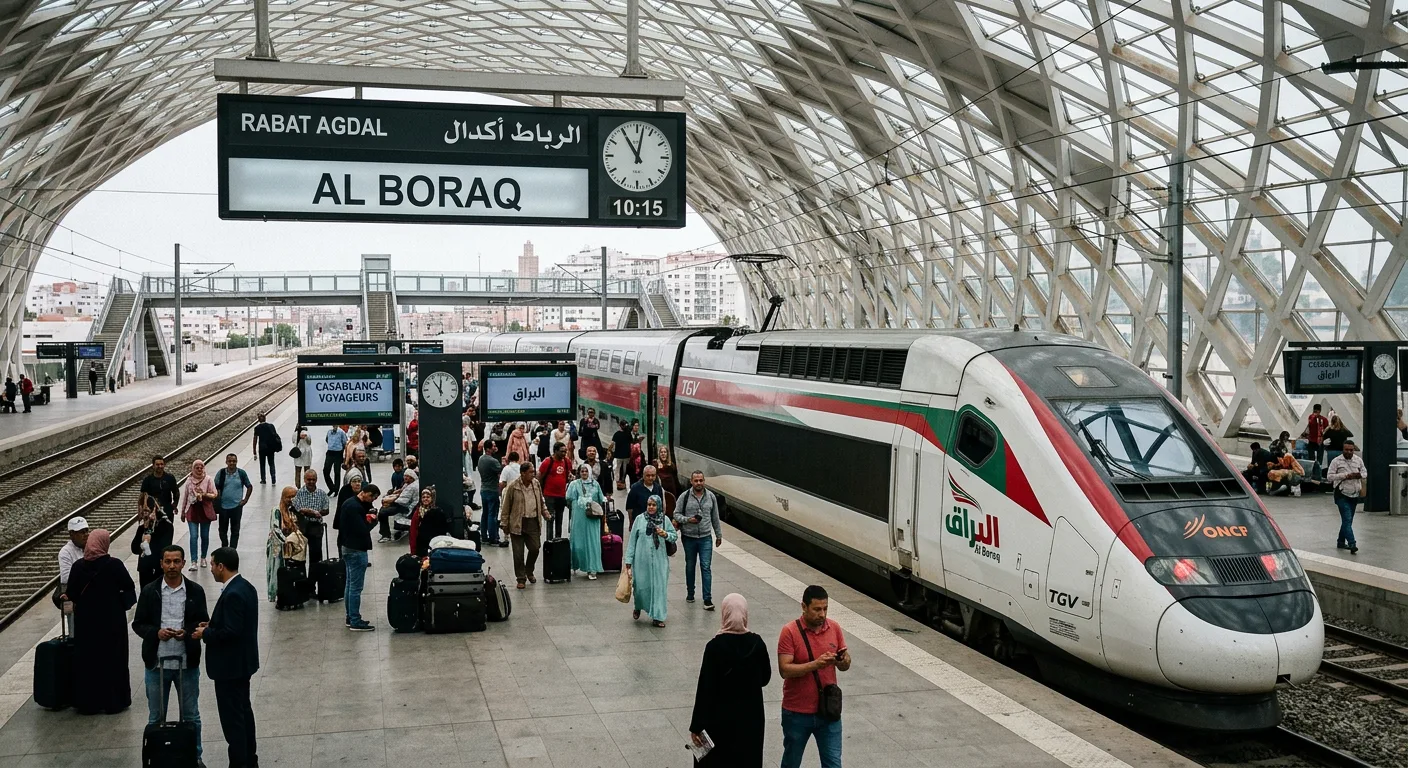
The Al Boraq -- Africa's first high-speed rail connecting Tangier to Casablanca
Plan Your Rail Journey
Combine trains, buses, and taxis to build the perfect Morocco itinerary. Explore our route planner and detailed transport guides.