Discovering...
Road Trips & Driving
Morocco Road Trip Routes:
6 Epic Driving Itineraries
From coastal cruises to Sahara crossings and mountain passes. Complete route guides with distances, fuel costs from 200 MAD, road conditions, and the best stops.
Why Morocco Is One of the World's Greatest Road Trip Destinations
Morocco offers a diversity of landscapes that few countries can match, and the best way to experience them is behind the wheel. In a single week of driving, you can cross the High Atlas through mountain passes above 2,000 meters, follow winding gorges through red-clay canyons, cruise along the Atlantic coast, and arrive at the towering sand dunes of the Sahara.
The road network has improved dramatically in recent years. Modern autoroutes connect the major cities, while well-maintained national roads thread through mountain passes and desert valleys. Morocco is one of the easiest countries in Africa to self-drive, with clear signage in French and Arabic, plentiful fuel stations on main routes, and a growing infrastructure of roadside services.
These six routes represent the very best of Moroccan road-tripping. Whether you have two days or two weeks, whether you want a relaxed coastal cruise or an adrenaline-fueled mountain crossing, there is a route here for you. Each includes detailed distances, drive times, fuel costs, road conditions, the best stops, and accommodation at every budget level.
Route Comparison at a Glance
Compare all six routes side by side to find the perfect road trip for your schedule and skill level.
All fuel costs are estimates based on a mid-size diesel vehicle. Seasonal pricing applies during peak tourist months (October-April) when car rental rates may increase by 20-30%.
Route
Distance
Drive Time
Difficulty
Recommended
Fuel Cost
Marrakech - Essaouira
Distance: 175 km
Time: 2.5h
Difficulty: Easy
Days: 1-2 days
From 200 MAD
Fes - Chefchaouen
Distance: 200 km
Time: 3.5h
Difficulty: Moderate
Days: 1-2 days
From 250 MAD
Marrakech - Merzouga
Distance: 560 km
Time: 9h
Difficulty: Moderate
Days: 2-3 days
From 600 MAD
Tangier - Agadir
Distance: 900 km
Time: 10-12h
Difficulty: Easy
Days: 4-7 days
From 900 MAD
Ouarzazate Gorge Loop
Distance: 300 km
Time: 5-6h
Difficulty: Moderate
Days: 2-3 days
From 350 MAD
Atlas Mountains Loop
Distance: 350 km
Time: 7-8h
Difficulty: Challenging
Days: 2-3 days
From 400 MAD
6 Detailed Road Trip Routes
Each route includes distances, drive times, road conditions, must-see stops, and accommodation at every budget.
Route 1 of 6
Marrakech to Essaouira
The Coastal Argan Road
175 km
Distance
2.5 hours
Drive Time
From 200 MAD
Fuel Cost
Excellent
Road Quality
One of Morocco's most popular and accessible road trips. The route from Marrakech to Essaouira takes you through the argan country of the Souss region, where you will see the famous tree-climbing goats perched in argan branches. The landscape transitions from the arid Haouz plain to rolling hills dotted with argan trees before revealing the Atlantic coast. This is a perfect half-day drive with plenty of stops.
Road Conditions: Well-maintained two-lane highway (N8). Smooth asphalt throughout. Some slow-moving trucks on uphill sections. No tolls.
Best Season: Year-round, but spring (March-May) for wildflowers. Summer can be windy in Essaouira.
Best Stops Along the Route
Argan Oil Cooperative
55 km from MarrakechSeveral women's cooperatives along the road offer demonstrations of traditional argan oil production. Watch the entire process from nut to oil. Buy genuine cosmetic or culinary argan oil directly from the producers.
Tip: Prices are fixed at cooperatives, no bargaining needed. Cosmetic-grade argan oil from 150 MAD per 100ml.
Goats in Argan Trees
80-100 km from MarrakechThe iconic sight of goats perched in argan trees. While some roadside setups are staged by herders for tips, genuine scenes are common in the argan forests. The goats eat the argan fruit and spit out the nut, which is collected for oil production.
Tip: If herders place goats in trees for photos, they expect from 10-20 MAD. Genuine wild scenes are found further from the main road.
Sidi Kaouki
25 km south of EssaouiraA sleepy beach village with some of Morocco's best surfing and windsurfing. Long, empty beach backed by dunes. A handful of surf camps, cafes, and guesthouses. Perfect for a sunset stop or overnight before continuing to Essaouira.
Tip: Surf lessons from 300 MAD per session. The village is quieter and more affordable than Essaouira.
Essaouira
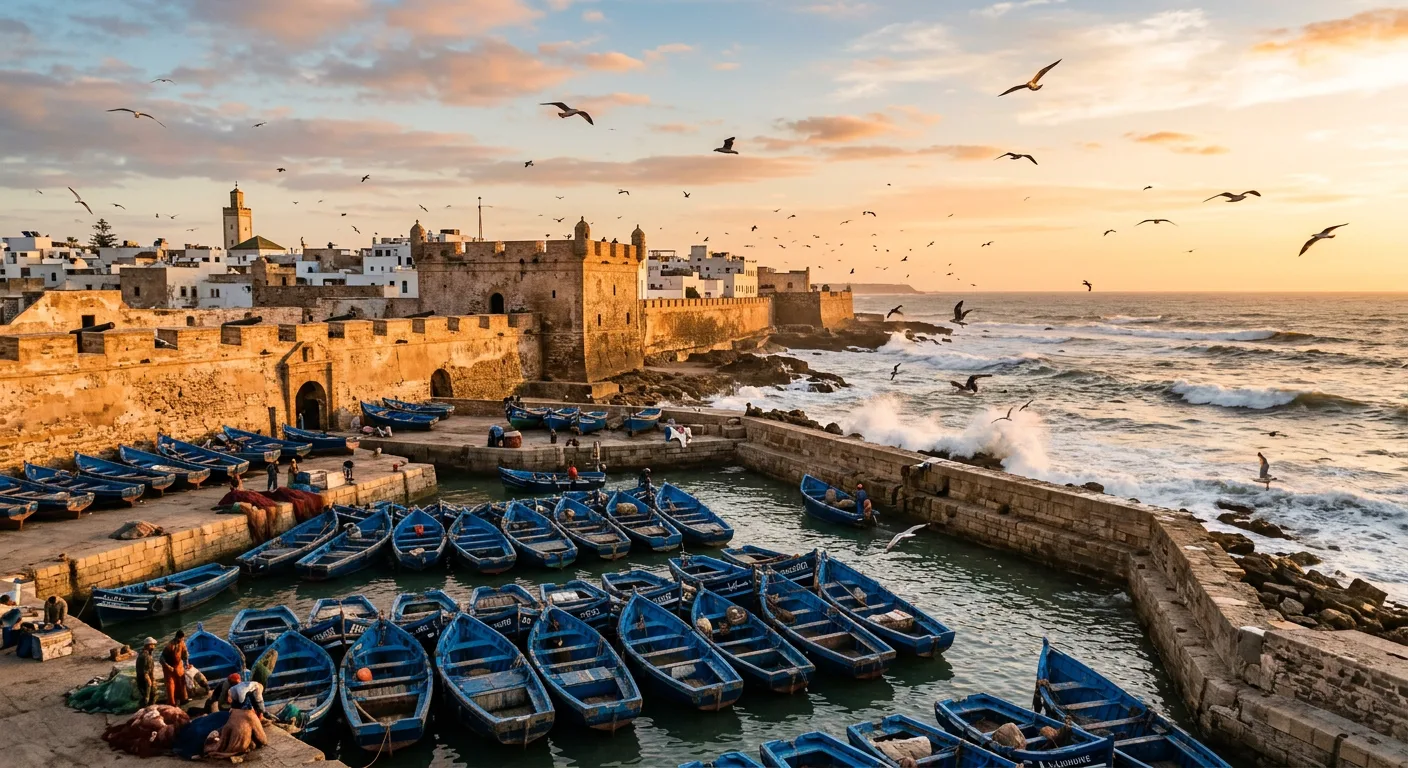
175 km (destination)The walled coastal city of Essaouira is the reward. Explore the ramparts, the fishing port, the medina (UNESCO World Heritage), and the beach. Famous for fresh seafood, Gnawa music, and a distinctly relaxed atmosphere.
Tip: Stay at least one night. The medina is compact and walkable. Budget riads from 350 MAD per night.
Where to Stay
Budget
Hostel in Essaouira medina
From 120 MAD per night
Mid-range
Riad in Essaouira medina
From 450 MAD per night
Luxury
Heure Bleue Palais or Villa Maroc
From 1,500 MAD per night
Route 2 of 6
Fes to Chefchaouen
Into the Blue Rif Mountains
200 km
Distance
3.5 hours
Drive Time
From 250 MAD
Fuel Cost
Good to Moderate
Road Quality
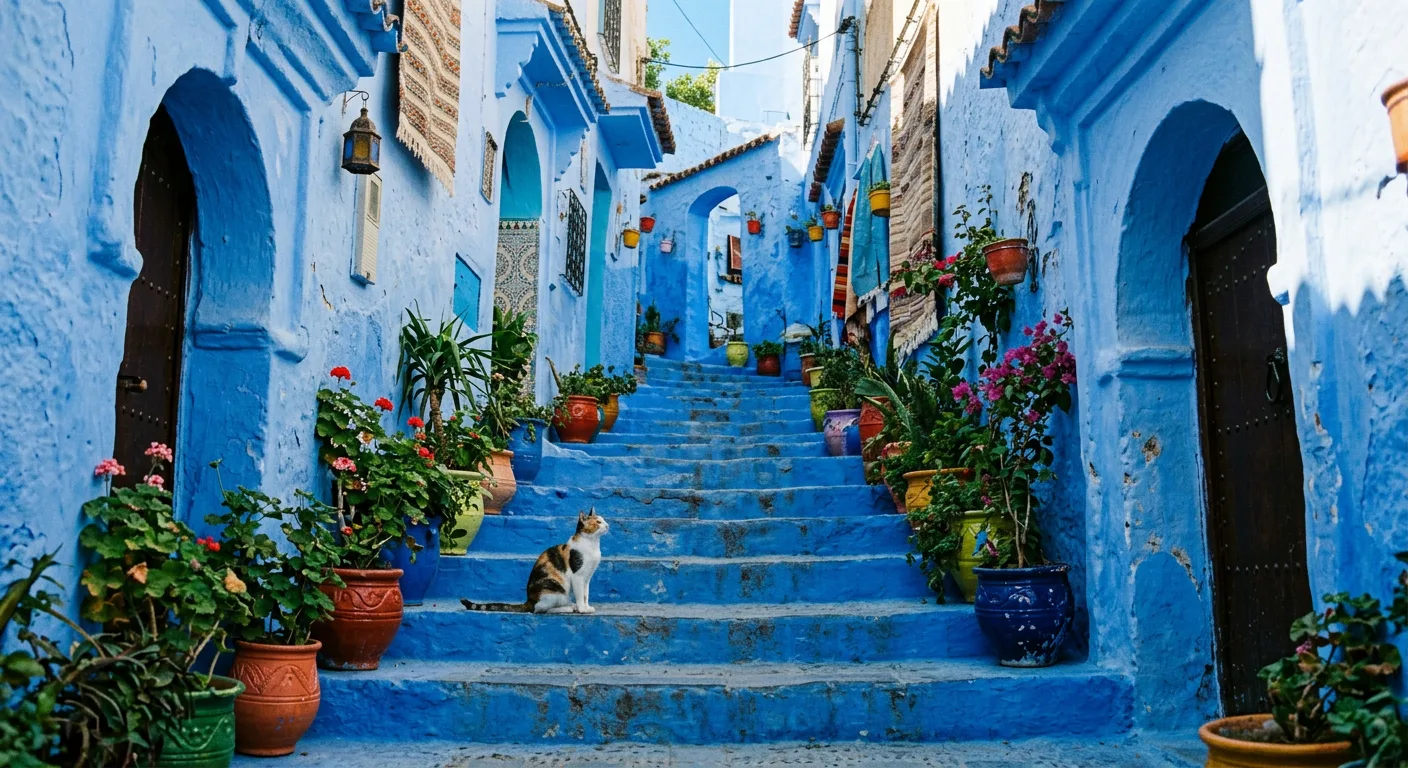
A stunning mountain drive from the imperial city of Fes into the heart of the Rif Mountains, ending at the iconic blue-washed city of Chefchaouen. The route climbs through fertile farmland into increasingly dramatic mountain scenery. The final descent into Chefchaouen, with the blue medina nestled between two peaks, is one of Morocco's most memorable arrivals.
Road Conditions: N13 highway to Ouazzane is good. The mountain road from Ouazzane to Chefchaouen (P28) is winding with hairpin turns. Narrow in places. Drive slowly and use horn on blind corners.
Best Season: Spring (March-May) for green hillsides and wildflowers. Autumn (September-November) for mild temperatures. Winter can bring fog and occasional ice on mountain passes.
Best Stops Along the Route
Ouazzane
130 km from FesA hillside town known as the "holy city" of northern Morocco. Home to important zaouias (religious lodges) and a bustling souk. A good rest stop with authentic restaurants where you can find traditional rfissa and harira.
Tip: Stop for lunch here. Local restaurants serve hearty mountain food from 40 MAD per meal.
Rif Mountain Viewpoints
160-180 km from FesAs the road climbs through the Rif, several pull-off points offer panoramic views of terraced cannabis fields (legal under recent reforms for regulated use), cedar forests, and deep valleys. The air becomes noticeably cooler and fresher.
Tip: Stop frequently for photos on the mountain road. Morning light is best for photography.
Akchour Waterfalls
30 km from ChefchaouenA side trip to the stunning waterfalls of Akchour in Talassemtane National Park. The hike to the small falls takes 45 minutes; the large falls take 2 hours. Crystal-clear natural pools for swimming in summer.
Tip: Go early to avoid crowds. Bring water and sturdy shoes. Entry from 20 MAD.
Chefchaouen
200 km (destination)The famous Blue Pearl of Morocco. The entire medina is painted in shades of blue and white, creating one of the most photogenic towns in North Africa. Wander the narrow lanes, visit the kasbah, and absorb the mountain atmosphere.
Tip: Stay at least 2 nights. Best photography at dawn before the crowds. Riads from 300 MAD per night.
Where to Stay
Budget
Hostel in Chefchaouen medina
From 100 MAD per night
Mid-range
Riad with terrace views
From 400 MAD per night
Luxury
Lina Ryad & Spa or Casa Hassan
From 1,200 MAD per night
Route 3 of 6
Marrakech to Merzouga
The Great Sahara Crossing
560 km
Distance
9 hours (2-3 days recommended)
Drive Time
From 600 MAD
Fuel Cost
Good
Road Quality
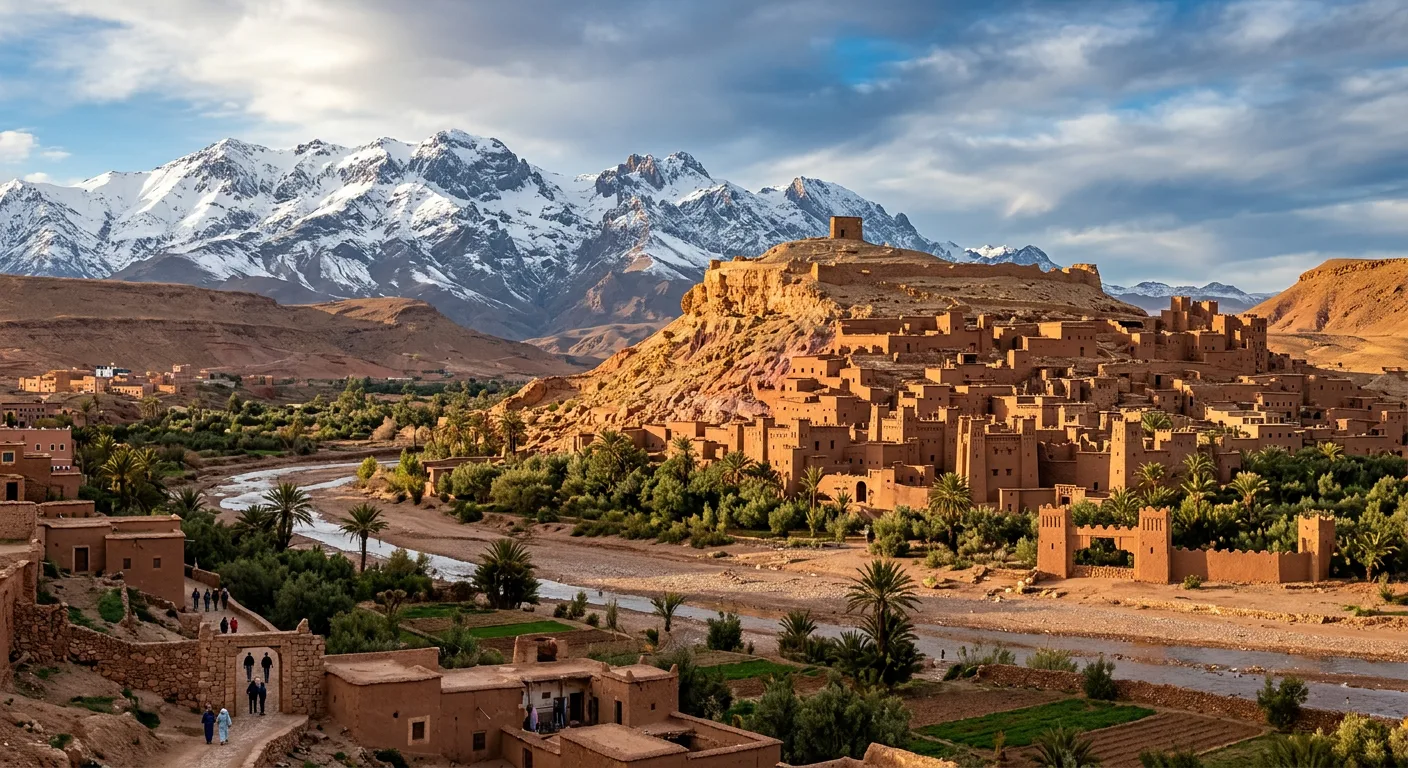
Morocco's most epic road trip. This route crosses the High Atlas via the legendary Tizi n'Tichka pass, passes through the Hollywood of Africa at Ouarzazate, winds through the Dades Valley, penetrates the Todra Gorge, and ends at the towering sand dunes of Erg Chebbi in the Sahara. It is the quintessential Moroccan adventure and should be done over 2-3 days to appreciate every stop.
Road Conditions: N9 over Tizi n'Tichka is well-maintained but winding with steep gradients (2,260m summit). N10 through Ouarzazate to Tinghir is flat and straight. N13/R702 to Merzouga is good. Occasional sandstorms near the desert.
Best Season: October-April for comfortable desert temperatures. Avoid June-August when Sahara temperatures exceed 45C. Spring (March-April) is ideal with moderate heat and green oases.
Best Stops Along the Route
Tizi n'Tichka Pass
100 km from MarrakechAt 2,260 meters, this is the highest paved road pass in North Africa. The winding road crosses the spine of the High Atlas with stunning views of terraced valleys, Berber villages, and snow-capped peaks in winter. The road was built by the French in 1936.
Tip: Stop at the summit for photos. Roadside vendors sell fossils and minerals from 20 MAD. Verify authenticity before buying.
Ait Benhaddou
185 km from MarrakechA UNESCO World Heritage ksar (fortified village) built of red clay and straw. Featured in Gladiator, Game of Thrones, and Lawrence of Arabia. Cross the river on foot or by donkey to explore the winding alleys that climb to a granary at the summit.
Tip: Visit in the morning for the best light on the clay walls. A local guide from 100 MAD adds context. Free entry to the ksar.
Ouarzazate
200 km from MarrakechThe "Door of the Desert" and Morocco's film capital. Visit Atlas Film Studios where movies from The Mummy to Kingdom of Heaven were filmed. The Kasbah Taourirt in town is worth an hour's exploration.
Tip: Atlas Studios entry from 60 MAD. Ouarzazate is the last major town for supplies before the desert.
Todra Gorge
420 km from MarrakechA dramatic canyon where 300-meter limestone cliffs narrow to just 10 meters apart. The road passes through the gorge floor alongside a river. Rock climbers come from around the world for the sheer walls. Walk into the gorge for the most dramatic section.
Tip: Visit in the morning when sunlight illuminates the gorge walls. Hotels inside the gorge from 250 MAD per night.
Erg Chebbi (Merzouga)
560 km (destination)The grand finale. Erg Chebbi's sand dunes rise to 150 meters, glowing orange at sunrise and sunset. Camel treks into the dunes, overnight in desert camps, sandboarding, and stargazing in some of the clearest skies on Earth.
Tip: Book a desert camp in advance. Budget camps from 350 MAD, luxury camps from 1,500 MAD per person including dinner, camel ride, and breakfast.
Where to Stay
Budget
Desert camp at Erg Chebbi
From 350 MAD per person
Mid-range
Riad in Ouarzazate or Tinghir
From 500 MAD per night
Luxury
Luxury desert camp (Merzouga Luxury Camp)
From 2,500 MAD per person
Route 4 of 6
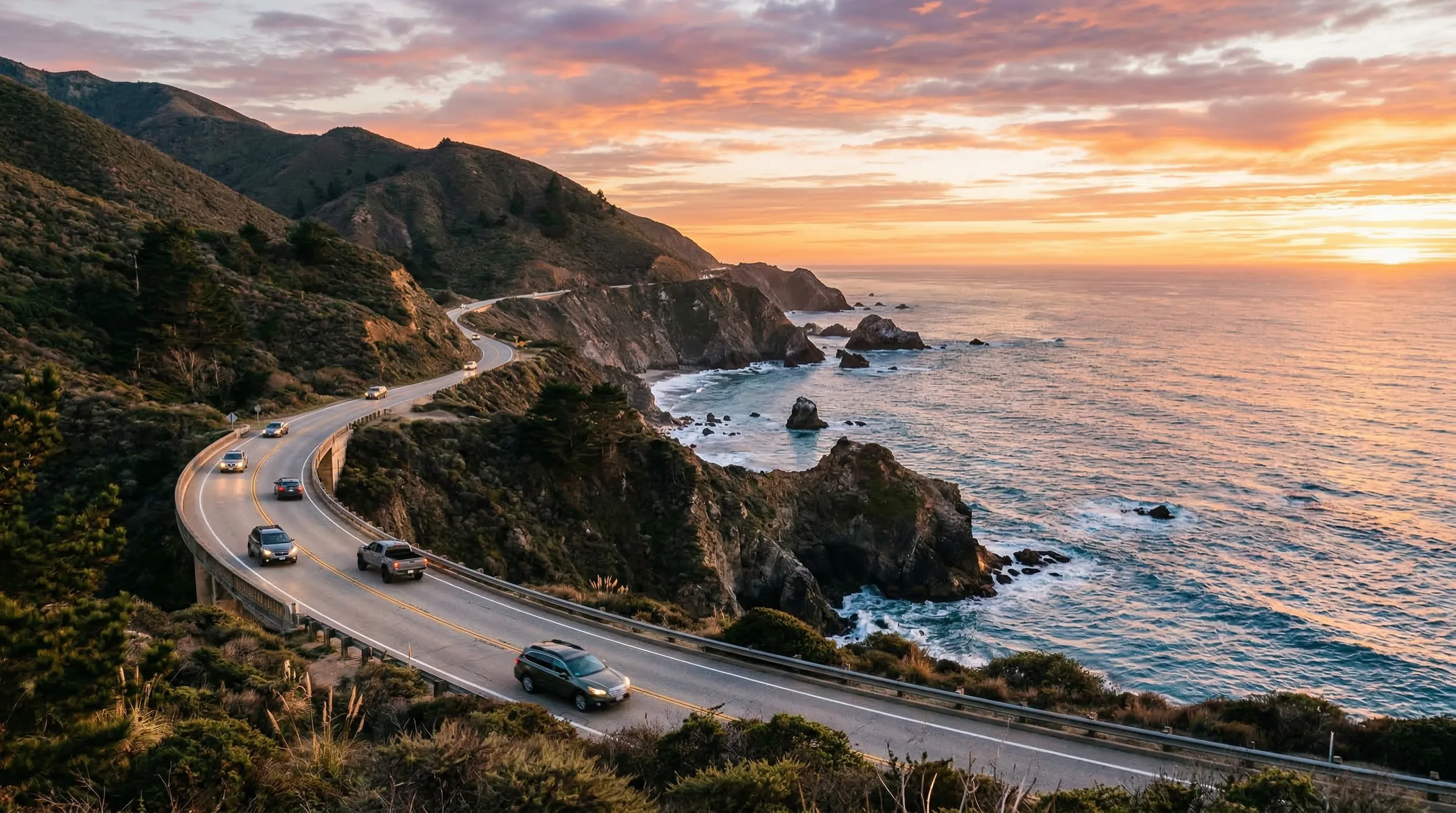
Tangier to Agadir
The Full Atlantic Coast
900 km
Distance
10-12 hours (4-7 days recommended)
Drive Time
From 900 MAD
Fuel Cost
Excellent
Road Quality
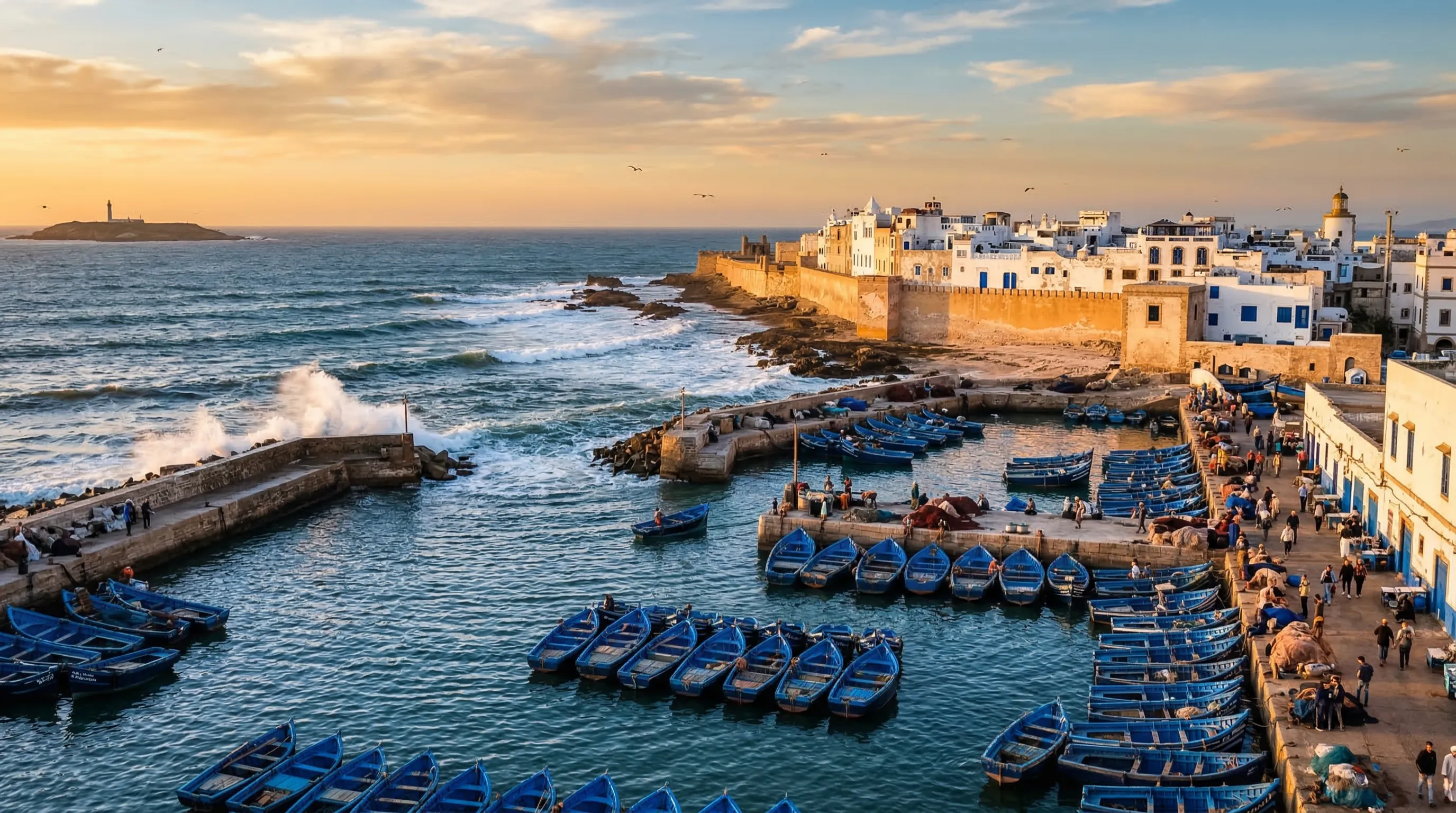
The grand coastal odyssey of Morocco. This route follows the entire Atlantic seaboard from the Strait of Gibraltar to the Souss coast, passing through some of Morocco's most diverse and historically rich cities. From the cosmopolitan energy of Tangier to the whitewashed arts town of Asilah, the political capital Rabat, the Portuguese fortress of El Jadida, the bohemian port of Essaouira, and finally the sun-drenched resort of Agadir. Do this over a week for the full experience.
Road Conditions: Mostly autoroute (toll motorway) from Tangier to El Jadida. Good national roads from El Jadida south. Well-maintained throughout. Toll costs from Tangier to Casablanca approximately 200 MAD.
Best Season: Year-round. Summer (June-September) for beach weather. Spring and autumn for milder temperatures and fewer crowds. Winter is mild along the coast.
Best Stops Along the Route
Asilah
45 km from TangierA charming whitewashed coastal town with Portuguese ramparts, colorful murals, and a peaceful medina. Famous for its annual arts festival. The beach stretches for kilometers north of town. A quieter, more artistic alternative to Tangier.
Tip: Visit the murals inside the medina walls. Seafood restaurants on the ramparts from 70 MAD per meal.
Rabat
280 km from TangierMorocco's capital and a UNESCO World Heritage city. Visit the Kasbah of the Udayas with its blue-and-white Andalusian streets, the Hassan Tower, the Mohammed V Mausoleum, and the ancient ruins of Chellah. A cultured, clean, and often-overlooked city.
Tip: The Kasbah of the Udayas is free to enter. Allow half a day minimum. Rabat has excellent modern restaurants.
El Jadida
420 km from TangierA coastal city with a stunning Portuguese cistern (UNESCO World Heritage), a fortress old town, and a long sandy beach. The underground cistern, with its vaulted ceiling reflected in shallow water, is one of Morocco's most photographed interiors.
Tip: Portuguese Cistern entry from 20 MAD. Visit in the morning for the best light reflections. Beach hotels from 400 MAD.
Essaouira
750 km from TangierThe windy city of Essaouira is a highlight of any Moroccan coastal trip. The fortified port, the bustling fish market, the Gnawa music scene, and the wide sandy beach make it a must-stop. The medina is compact and easily explored on foot.
Tip: Eat fresh grilled fish at the port from 50 MAD per plate. Stay at least 2 nights to appreciate the atmosphere.
Agadir
900 km (destination)Morocco's premier beach resort city. Rebuilt after the devastating 1960 earthquake, Agadir is modern, sunny (300+ days per year), and beachfront-focused. The long crescent beach, the marina, and the nearby Souk El Had make it a comfortable end point.
Tip: Visit the hilltop Agadir Oufella for sunset views over the city and bay. Beachfront hotels from 600 MAD per night.
Where to Stay
Budget
Hostels in each city
From 100 MAD per night
Mid-range
Riads and coastal hotels
From 500 MAD per night
Luxury
Sofitel Agadir or boutique riads en route
From 2,000 MAD per night
Route 5 of 6
Ouarzazate to Dades & Todra Gorges
The Valley of a Thousand Kasbahs
300 km loop
Distance
5-6 hours driving (2-3 days recommended)
Drive Time
From 350 MAD
Fuel Cost
Good to Moderate
Road Quality
A spectacular loop through Morocco's most dramatic canyon country. Starting from Ouarzazate, the route follows the Road of a Thousand Kasbahs along the Dades River valley, climbs into the Dades Gorge with its serpentine switchbacks, continues to the towering Todra Gorge, and returns through the Draa Valley. In spring, the Valley of Roses near Kelaat M'Gouna explodes in pink blooms. This is the heart of Morocco's pre-Saharan landscape.
Road Conditions: N10 from Ouarzazate to Tinghir is good asphalt. Roads into Dades and Todra gorges are narrower with some tight curves. The loop road between the gorges is paved but less maintained. No toll roads.
Best Season: March-May for the Valley of Roses in bloom. October-November for mild temperatures. Summer is very hot (40C+). Winter is cold at night but pleasant during the day.
Best Stops Along the Route
Skoura & Kasbah Amridil
40 km from OuarzazateAn oasis town with a magnificent palm grove (palmerie) containing some of the finest kasbahs in Morocco. Kasbah Amridil, featured on the 50 MAD banknote, is a beautifully preserved fortress. Explore the palmerie on foot or by bicycle.
Tip: Kasbah Amridil entry from 30 MAD. Rent a bicycle in Skoura from 100 MAD per day to explore the palmerie.
Kelaat M'Gouna (Valley of Roses)
95 km from OuarzazateThe center of Morocco's rose industry. In April and May, the valley is carpeted in Damask roses harvested for rose water and essential oils. The annual Rose Festival in May is a major celebration. Rose products are sold year-round at cooperatives.
Tip: Visit in May for the Rose Festival. Rose water from 30 MAD per bottle. Rose oil from 200 MAD per small vial.
Dades Gorge
120 km from OuarzazateA canyon carved by the Dades River with extraordinary rock formations known as "monkey fingers." The road climbs through switchbacks that are among the most photographed in Morocco. The gorge is 25 km deep with soaring red cliffs on both sides.
Tip: Drive slowly on the switchbacks. Stop at the famous "snake road" viewpoint. Guesthouses in the gorge from 250 MAD per night.
Todra Gorge
180 km from OuarzazateThe narrowest point of this gorge squeezes to just 10 meters between 300-meter vertical limestone walls. Walk into the gorge on the flat road for the most dramatic views. Rock climbers scale the walls year-round. A river runs through the canyon floor.
Tip: Morning is best for photos when the sun enters the gorge. There are several cafes at the gorge entrance. Climbing guides from 500 MAD per day.
Tinghir
170 km from OuarzazateA sprawling oasis town and the gateway to Todra Gorge. The old Jewish quarter (mellah) and the vast palmerie are worth exploring. From the hillside road above town, the view of the green palm oasis against the barren desert mountains is breathtaking.
Tip: Walk through the palmerie at sunset. The town has good restaurants serving Amazigh cuisine from 50 MAD per meal.
Where to Stay
Budget
Guesthouses in Dades or Todra gorges
From 200 MAD per night
Mid-range
Kasbah hotel in Skoura or Tinghir
From 500 MAD per night
Luxury
Dar Ahlam (Skoura) or kasbah boutique hotels
From 3,000 MAD per night
Route 6 of 6
Atlas Mountains Loop
Two Passes, Two Worlds
350 km
Distance
7-8 hours driving (2-3 days recommended)
Drive Time
From 400 MAD
Fuel Cost
Moderate to Challenging
Road Quality
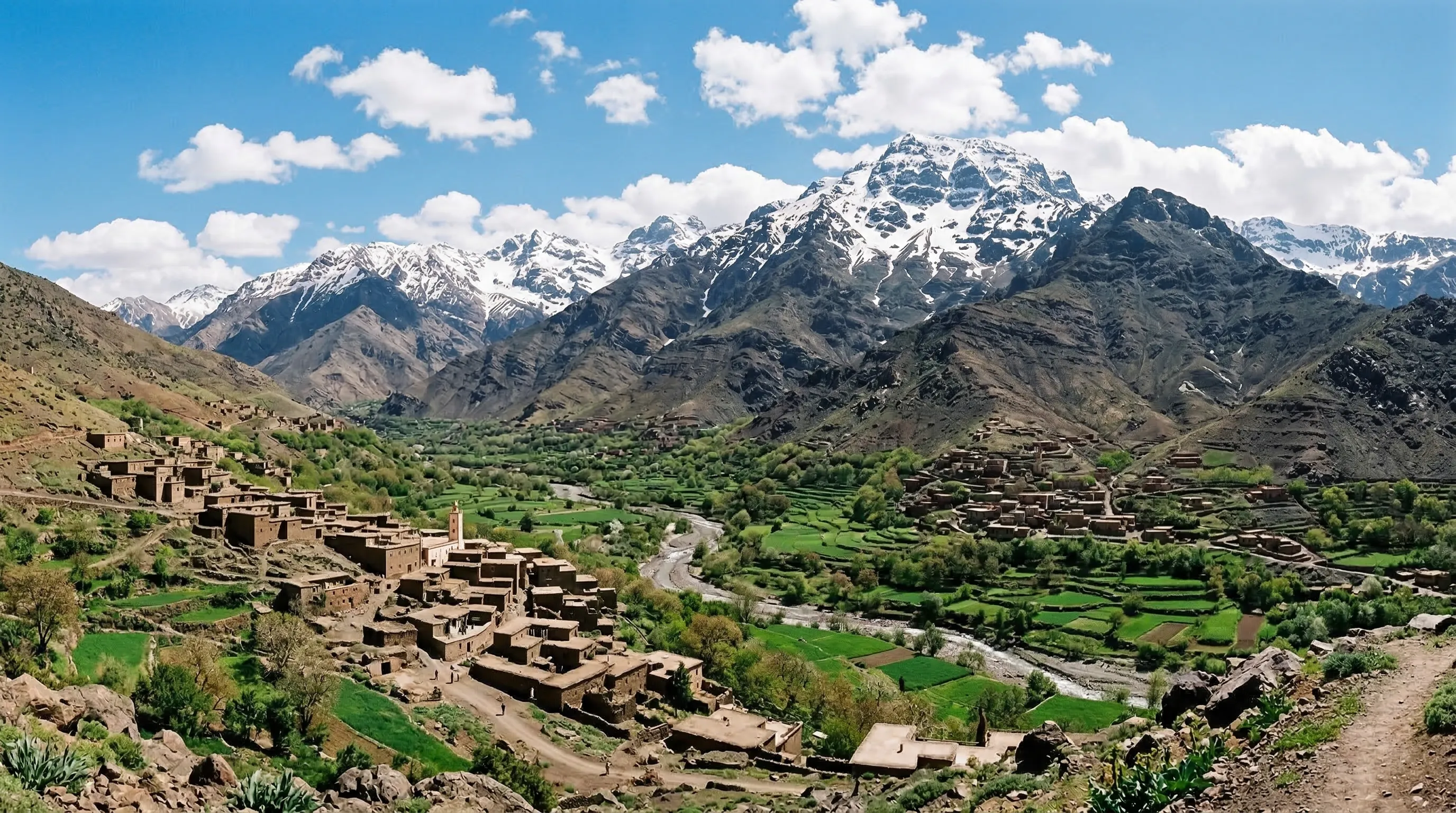
A thrilling loop that crosses the High Atlas twice via two of Morocco's most dramatic mountain passes. The route heads south from Marrakech over the wild and narrow Tizi n'Test pass (2,092m), through Berber villages and past the ancient Tin Mal Mosque, descends into the Souss Valley to the walled city of Taroudant, then returns north over the more famous Tizi n'Tichka pass (2,260m). This loop showcases the full grandeur of the Atlas range and the contrast between its northern and southern faces.
Road Conditions: Tizi n'Test (R203) is narrow, winding, and steep with hairpin bends and occasional landslide debris. Not for nervous drivers. Tizi n'Tichka (N9) is wider and better maintained. The Taroudant-Marrakech leg via Tizi n'Tichka is the easier section.
Best Season: April-June and September-November. Winter can bring snow closures on both passes. Summer is hot in Taroudant but pleasant at altitude. Check road conditions before departing in winter.
Best Stops Along the Route
Tizi n'Test Pass
130 km from MarrakechOne of Morocco's most dramatic and least-traveled mountain passes. The narrow road clings to the mountainside with sheer drops and hairpin bends. At the summit (2,092m), views stretch across the High Atlas in every direction. The road was Morocco's first trans-Atlas route, built by the French in the 1920s.
Tip: Start early to cross the pass in good light. Drive slowly and use your horn on blind corners. Not recommended for large vehicles.
Tin Mal Mosque
100 km from MarrakechA 12th-century mosque built by the Almohad dynasty founder Ibn Tumart. One of only two mosques in Morocco that non-Muslims can enter (the other being Hassan II in Casablanca). The ruined but still magnificent building sits in a remote valley surrounded by mountains.
Tip: Entry from 20 MAD. A caretaker will open the mosque and give a basic explanation. Bring water as there are no facilities.
Taroudant
230 km from Marrakech (via Tizi n'Test)Known as "Little Marrakech" for its red-clay ramparts encircling a bustling medina. Far less touristy than Marrakech with a genuine Amazigh character. Two excellent souks: the Arab souk for crafts and the Berber souk for daily goods. The surrounding Souss Valley produces saffron, argan, and citrus.
Tip: Walk the complete ramparts by calash (horse-drawn carriage) from 100 MAD. The tanneries are smaller but less overwhelming than Fes.
Tizi n'Tichka Pass
250 km into the loopThe highest major road pass in North Africa at 2,260 meters. Wider and better-maintained than Tizi n'Test. The descent toward Marrakech offers spectacular views of the Haouz plain stretching to the horizon. In winter, the summit may have snow.
Tip: Mineral and fossil sellers line the summit. Genuine fossils from 50 MAD. The pass is on the main Marrakech-Ouarzazate highway.
Berber Villages
Throughout the routeBoth passes are lined with traditional Berber villages clinging to hillsides. Adobe houses with flat roofs, terraced fields of barley and walnut, and stone-walled enclosures for livestock. Some villages offer homestay experiences and guided walks.
Tip: Ask before photographing people. Homestays from 200 MAD per person including dinner and breakfast. A genuine cultural experience.
Where to Stay
Budget
Berber homestay or guesthouse
From 200 MAD per person
Mid-range
Riad in Taroudant
From 500 MAD per night
Luxury
Dar Zitoune or La Gazelle d'Or (Taroudant)
From 2,500 MAD per night
Road Trip Cost Guide
Budget your Morocco road trip with this comprehensive breakdown of driving, accommodation, and meal costs.
All prices are starting prices. Seasonal pricing applies during peak tourist months (October-April) and holiday periods, when car rental rates may increase by 20-30%.
Item
Price
Note
Car rental (economy)
From 300 MAD per day
International agencies at airports
Car rental (SUV/4x4)
From 600 MAD per day
Recommended for mountain and desert routes
Full insurance (CDW + theft)
From 100 MAD per day
Strongly recommended for all routes
Diesel fuel
From 12 MAD per liter
Prices vary slightly by region
Petrol fuel
From 14 MAD per liter
Most rental cars run on diesel
Autoroute tolls (Tangier-Casablanca)
From 200 MAD one way
Paid at toll booths in cash or card
Autoroute tolls (Casablanca-Marrakech)
From 100 MAD one way
Shorter toll section
Parking in cities
From 5 MAD per hour
Unofficial attendants expect from 10-20 MAD
Roadside breakdown assistance
From 500 MAD per call
Included with some rental insurance
Budget accommodation (per night)
From 150 MAD
Hostels, basic guesthouses
Mid-range accommodation (per night)
From 500 MAD
Riads, kasbah hotels
Meals on the road
From 40 MAD per meal
Roadside restaurants and cafes
Best Season for Each Route
Morocco is a year-round road trip destination, but each season favors different routes.
Spring (March-May)
The ideal season for road trips. Wildflowers blanket the Atlas foothills, the Valley of Roses blooms in April-May, desert temperatures are comfortable, and daylight hours are long. Roads are clear of winter snow. The best overall time for all 6 routes.
All 6 routes
Valley of Roses in April-May
Desert routes before summer heat
Summer (June-August)
Desert and inland routes become extremely hot (45C+). Coastal routes are pleasant with cooling Atlantic breezes. Mountain passes are snow-free but hot at lower elevations. Essaouira is famously windy and cool in summer.
Tangier-Agadir coast
Marrakech-Essaouira
Avoid desert routes
Autumn (September-November)
Temperatures cool to comfortable levels across the country. Desert routes become viable again from October. Fewer tourists than spring. Date harvest season in oases. An excellent time for the Sahara crossing.
Marrakech-Merzouga
Ouarzazate gorge loop
All routes from October
Winter (December-February)
Mountain passes may close temporarily due to snow. Tizi n'Test is most affected. Desert nights are cold (near 0C) but days are sunny. Coastal routes remain pleasant. Check road conditions before any mountain crossing.
Coastal routes
Avoid mountain passes without checking conditions
Essential Driving Tips for Morocco
Everything you need to know to drive safely and confidently on Moroccan roads.
International Driving Permit
You need your home driving licence and an International Driving Permit (IDP) to legally drive in Morocco. Obtain your IDP before traveling. Rental agencies will ask for both at pickup.
Fuel Stations & Costs
Fuel stations are plentiful on main routes but scarce in desert and mountain areas. Fill up whenever you can. Diesel from 12 MAD per liter, petrol from 14 MAD per liter. Most stations accept cash only outside cities.
Speed Limits & Police
Speed limits: 60 km/h in towns, 100 km/h on national roads, 120 km/h on autoroutes. Police checkpoints are frequent. Always carry your licence, IDP, and rental documents. Speeding fines from 300 MAD payable on the spot.
Road Conditions
Main highways (autoroutes) are excellent. National roads (N-roads) are generally good. Mountain roads can be narrow and winding. Watch for livestock, donkeys, and pedestrians, especially in rural areas and at night.
Car Rental Advice
Rent from international agencies (Hertz, Europcar, Sixt) at airports for better insurance and support. Budget from 300 MAD per day for a small car, from 600 MAD for an SUV. Full insurance is strongly recommended for mountain routes.
Mountain Driving
Atlas passes require careful driving. Use low gear on descents, sound your horn on blind corners, and give way to uphill traffic. Check weather conditions before crossing passes in winter. Snow chains may be needed December-February.
Navigation
Download offline maps (Google Maps or Maps.me) before your trip. Mobile data coverage is patchy in mountains and desert. GPS is reliable on main routes. Road signs are in Arabic and French.
Night Driving
Avoid driving at night outside cities. Unlit vehicles, livestock on roads, and pedestrians in dark clothing make night driving dangerous. Plan your route to arrive at your destination before sunset.
Morocco Road Trip Scenery
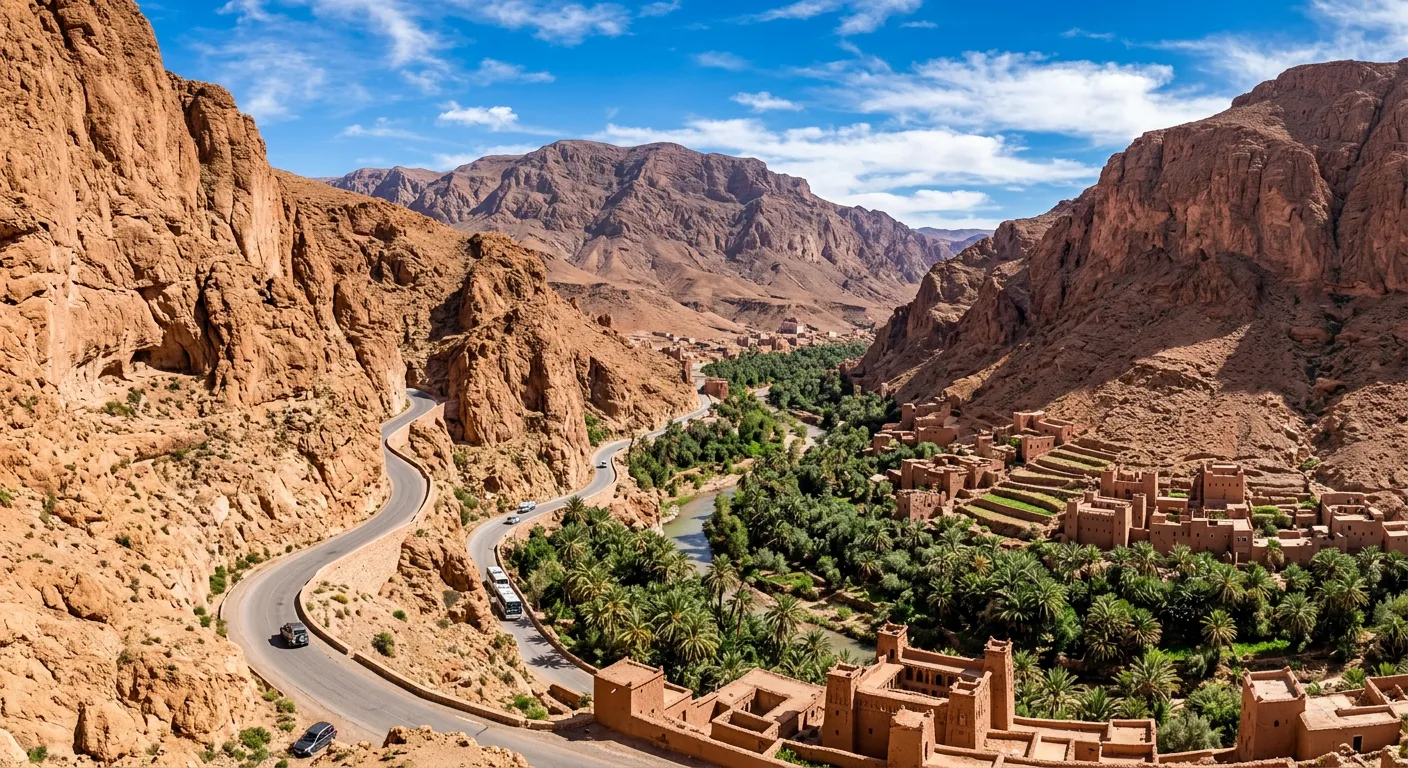
Dades Valley Road
Ait Benhaddou
Atlas Mountain Pass
Frequently Asked Questions
Is it safe to drive in Morocco as a tourist?
Yes, Morocco is generally safe for self-driving tourists. The main highways are well-maintained and clearly signposted in French and Arabic. The biggest hazards are aggressive driving by some locals, livestock on rural roads, and narrow mountain passes. Drive defensively, avoid night driving outside cities, and you will have a safe and enjoyable experience.
Do I need a 4x4 for these road trip routes?
All six routes are doable in a standard car. However, an SUV or 4x4 (from 600 MAD per day) provides more comfort on mountain passes and rough sections. For the Atlas Mountains Loop (Route 6) and the Ouarzazate gorge loop (Route 5), higher ground clearance is appreciated but not essential if you stick to paved roads.
What is the minimum age for renting a car in Morocco?
You must be at least 21 years old to rent a car in Morocco, and some agencies require you to be 25 for larger vehicles. You need a valid driving licence held for at least one year, plus an International Driving Permit. A credit card is required for the security deposit (from 3,000 MAD hold).
How much should I budget for a week-long road trip?
A budget road trip (economy car, hostels, street food) costs from 5,000 MAD for a week excluding car rental. Mid-range (SUV, riads, restaurants) costs from 12,000 MAD. Luxury (4x4, boutique hotels, fine dining) from 25,000 MAD. Car rental from 2,100 MAD per week for economy, from 4,200 MAD for an SUV. Fuel costs vary by route from 200 to 900 MAD per route.
Can I pick up a rental car in one city and drop it off in another?
Yes, most international agencies allow one-way rentals between major cities (Marrakech, Fes, Casablanca, Agadir, Tangier). A one-way fee applies, typically from 500-1,500 MAD depending on distance. This is ideal for the Tangier-to-Agadir coastal route or the Marrakech-to-Merzouga Sahara crossing if you plan to fly out from a different city.
What happens if my car breaks down on a remote road?
Ensure your rental includes roadside assistance (most international agencies include this). Save the agency emergency number in your phone. Mobile coverage exists along all main routes but may be patchy in deep gorges and remote mountain areas. Locals are generally very helpful and will stop to assist. Carry water, snacks, and a phone charger for any remote route.
Continue Exploring Morocco
Overlanding Morocco
Take your road trip off-road with our complete guide to overlanding and 4x4 adventures across Morocco.
Read moreSahara Desert Guide
Everything you need to know about visiting the Sahara, from camel treks to luxury desert camps.
Read moreAtlas Mountains Guide
Explore the High Atlas, Middle Atlas, and Anti-Atlas with our trekking, village, and adventure guide.
Read more