Discovering...
Water Sports in Morocco
3,500 kilometers of Atlantic and Mediterranean coastline delivering world-class surfing, kitesurfing, diving, and ocean adventures from the Strait of Gibraltar to the Saharan shores of Dakhla.
A Coastline Built for Adventure
Morocco's position at the northwestern corner of Africa, where the Atlantic Ocean meets the Mediterranean Sea, creates one of the most diverse water sports playgrounds on Earth. The Atlantic coast, stretching over 2,900 km from Tangier to the southern border, delivers consistent swells generated by North Atlantic storm systems, powerful trade winds, and a coastline varied enough to shelter everything from gentle longboard waves to thundering reef breaks.
The Mediterranean coast, running 500 km from the Strait of Gibraltar to the Algerian border, offers a completely different character: calmer, warmer water with exceptional clarity, making it Morocco's premier destination for diving, snorkeling, and summer swimming. Between these two coasts, Morocco caters to every water sport imaginable, from the world-class kite lagoon at Dakhla to the seasonal white water of Atlas Mountain rivers.
What makes Morocco exceptional is not just the conditions but the value. A surf trip here costs a fraction of what you would pay in Hawaii, Australia, or even Portugal. Board rental runs 100-200 MAD (10-20 EUR) per day, a week-long surf camp with accommodation and meals starts at 3,000 MAD (300 EUR), and even high-end kite resorts in Dakhla are half the price of equivalents in Mauritius or the Caribbean. Add warm North African hospitality, tagine dinners, and mint tea on the terrace, and you have the complete package.
3,500 km
Total Coastline
300+
Wind Days / Year (Dakhla)
2 Coasts
Atlantic & Mediterranean
16-25 C
Water Temp Range
Surfing in Morocco
From the legendary point breaks of Taghazout to the longest wave in Africa at Imsouane, Morocco is one of the world's great surf destinations.
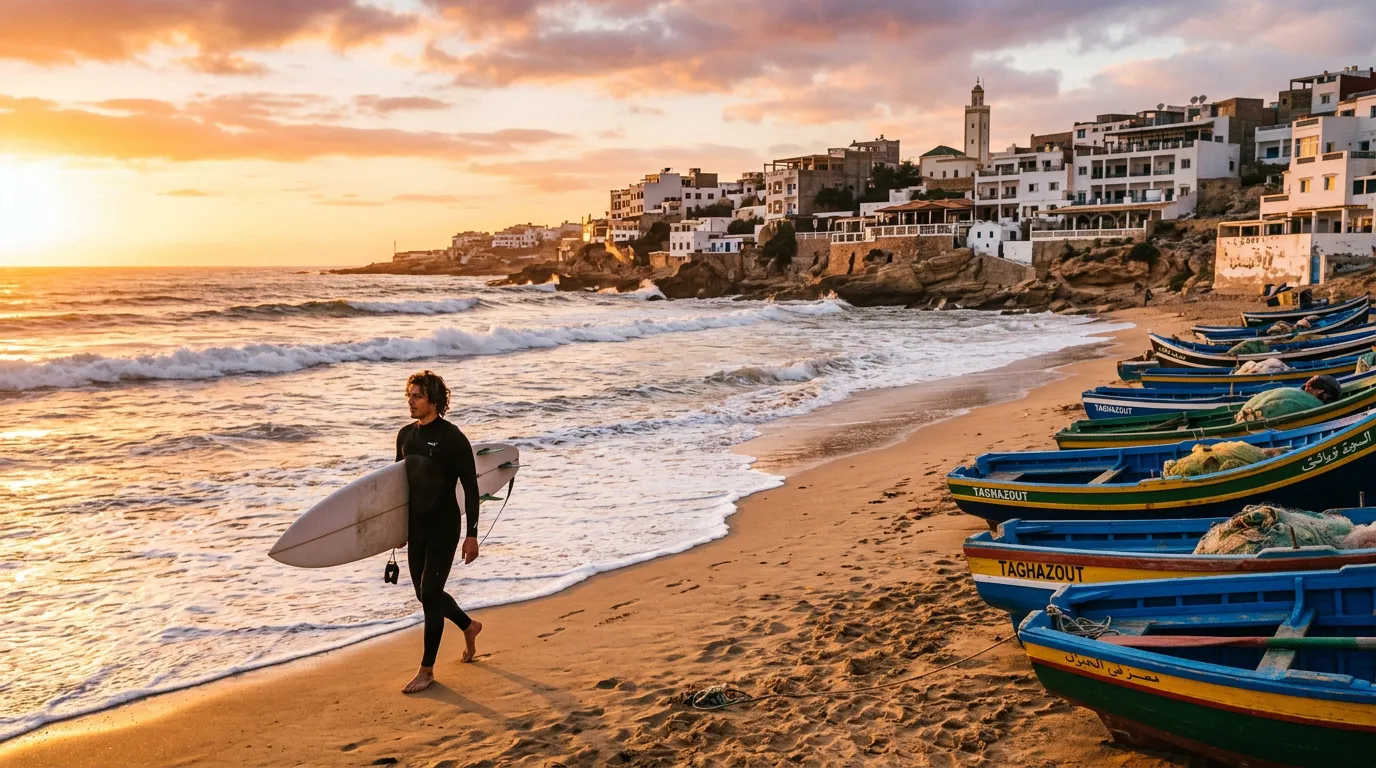
Morocco's Surf Capital
Taghazout
A former fishing village transformed into a world-class surf hub, with more quality breaks per kilometer than almost anywhere on Earth.
The Breaks
The 30-kilometer stretch between Taghazout and Tamraght contains a remarkable concentration of world-class waves. Anchor Point, just north of the village, is the headliner: a long, fast, mechanical right-hand point break that peels for up to 300 meters over a boulder reef. It needs a solid northwest swell to fire, and when it does, it draws surfers from around the globe.
North of Anchor Point lies Killer Point, a heavy, powerful right that needs even bigger swell to break. Beyond that, Boilers is Taghazout's heaviest wave, a dredging slab that only works on the biggest winter swells. For less experienced surfers, Panoramas and Hash Point offer friendlier waves closer to the village.
Seasons & Conditions
Oct - Dec — Early Season
First swells arrive. Water still warm (20C). Fewer crowds. Great for intermediate surfers as swell builds gradually.
Jan - Mar — Peak Season
Biggest, most consistent swells. Cooler water (16-17C). Most crowded. World-class conditions at all breaks.
Apr - Jun — Late Season
Swell decreasing but still surfable. Warmer weather and water. Great for beginners at mellow spots.
Jul - Sep — Off-Season
Small, inconsistent surf. Good for absolute beginners at beach breaks. Surf camps offer discounts.
Longest Wave in Africa
Imsouane
Tucked into a sheltered bay between Essaouira and Agadir, Imsouane is home to what is considered the longest right-hand wave in Africa. On a good swell, rides of 600 meters or more are possible as the wave wraps endlessly around the bay. The wave is gentle and forgiving, making it a longboarder's paradise. The tiny fishing village remains beautifully uncommercialized, with fresh sardines grilled at the port each evening.
Wave Length
600m+
Best Season
Sep - Apr
Level
All levels
Vibe
Longboard soul
Getting there: 95 km south of Essaouira, 85 km north of Taghazout. A scenic coastal drive through argan forests, with a stop at a women's argan oil cooperative along the way.
The Uncrowded Alternative
Sidi Kaouki
Twenty-five kilometers south of Essaouira, Sidi Kaouki offers what Taghazout had 15 years ago: consistent waves, a laid-back village atmosphere, and far fewer people in the water. The beach break here works on most tide states and picks up swell from multiple directions. The vibe is mystical and off-grid, centered around a whitewashed marabout (saint's tomb) on the bluff. Several small surf camps and guesthouses offer great value accommodation, and camel rides along the beach at sunset have become an iconic experience.
Consistent beach breakUncrowded wavesBudget-friendlyCamel sunset ridesYoga retreatsOff-grid atmosphere
Wave Type
Beach break
Best Swell
NW - W, 3-6 ft
Season
Sep - Apr
Level
Beginner - Intermediate
Accommodation
From 200 MAD/night
All Surf Breaks
Anchor Point
Taghazout
One of Africa's most celebrated waves. A long, fast, mechanical right-hander that peels over a boulder-strewn reef for up to 300 meters on a solid swell. The wave has multiple sections: a steep takeoff, a racing wall section, and a reforming inside. On big days, the paddle-out alone is a challenge. This is Morocco's marquee wave and draws surfers from across the world during the winter season.
Wave
Right-hand
Swell
NW
Season
October - March
Up to 300m rides Consistent in winter World-class quality Photogenic setting
Killer Point
Taghazout
Named (legend says) after the orcas once spotted here, Killer Point is a heavy, powerful right that breaks over a shallow rock shelf just north of Anchor Point. It needs a solid 6ft+ swell to start working, but when it does, it produces some of the longest, most powerful barrels in Morocco. Access is via a cliff path and the paddle-out can be treacherous. For experienced surfers only.
Wave
Right-hand
Swell
NW
Season
November - February
Heavy barrels Big wave potential Less crowded than Anchor Raw, powerful wave
Boilers
Taghazout
Named after the boiler wreckage visible at low tide, this is Taghazout's heaviest wave. A thick, dredging right that breaks over an extremely shallow reef, producing short but intense barrel rides. Only works on the biggest swells and should only be attempted by experienced surfers comfortable in heavy, shallow conditions. The reward is some of the thickest pits in North Africa.
Wave
Right-hand
Swell
NW
Season
December - February
Heavy slab-style barrel Big swell only Expert required Iconic Morocco wave
Panoramas
Taghazout
A mellow, user-friendly wave just south of Taghazout village. The inside section is sandy and forgiving, perfect for beginners and intermediate surfers building confidence. The outside offers more powerful sections for those looking to progress. This is where most surf schools take their students and where many surfers warm up before heading to the point breaks.
Wave
Beach
Swell
NW
Season
October - March
Beginner-friendly Sandy bottom Surf schools Warm-up spot
Imsouane Bay
Imsouane
Home to what is considered the longest right-hand wave in Africa, and one of the longest in the world. On a good swell, rides of 600 meters or more are possible as the wave wraps endlessly around the bay. The wave is gentle and forgiving, making it ideal for longboarders and improvers, but its sheer length means even experts will be grinning. The small fishing village is charming and uncommercialized.
Wave
Right-hand
Swell
NW - W
Season
September - April
600m+ rides possible Longest wave in Africa Longboarder paradise Uncommercial village
Imsouane Cathedral
Imsouane
On the opposite side of the Imsouane headland from the Bay sits Cathedral, a more powerful, hollow right that breaks over a rocky reef. It packs considerably more punch than the Bay and rewards good positioning with open-face turns and occasional barrels. The two waves offer a perfect contrast: mellow longboarding in the Bay, punchy shortboarding at Cathedral.
Wave
Right-hand
Swell
NW
Season
October - March
More powerful than Bay Hollow sections Less crowded Reef break quality
Sidi Kaouki
South of Essaouira
A wild, windswept beach 25 km south of Essaouira with consistent beach-break waves that work on most tide states. The vibe here is mystical and off-grid, centered around a whitewashed marabout on the bluff. Far less crowded than Taghazout, Sidi Kaouki attracts surfers seeking solitude and a simpler experience. Camel rides along the beach at sunset have become an iconic image.
Wave
Beach
Swell
NW - W
Season
September - April
Consistent waves Uncrowded Mystical atmosphere Budget-friendly
Essaouira Beach Break
Essaouira
The wide beach at Essaouira picks up swell from multiple directions and offers gentle, crumbly waves perfect for absolute beginners. The wind can be a factor here (Essaouira is called the "Wind City of Africa"), so mornings tend to be glassier. Multiple surf schools operate from the beach, making this one of the most accessible places to try surfing for the first time.
Wave
Beach
Swell
W - NW
Season
Year-round
Gentle beginner waves Multiple surf schools UNESCO medina backdrop Year-round access
Surf Schools
Morocco has hundreds of surf schools, especially in the Taghazout area and Essaouira. Expect to pay:
- 2-hour group lesson: 250-400 MAD
- Private lesson: 500-800 MAD
- Week surf camp (all-in): 3,000-6,000 MAD
- Board rental (day): 100-200 MAD
- Wetsuit rental (day): 50-100 MAD
What to Bring
Morocco's water temperature ranges from 16C in winter to 22C in summer. Pack accordingly:
- Winter (Oct-Mar): 4/3mm full wetsuit
- Summer (Jun-Sep): 2mm shorty or boardshorts
- Spring/Autumn: 3/2mm full suit
- Reef booties for rocky breaks
- Sun protection (zinc, rash guard)
- Ear plugs for cold-water sessions
Surf Etiquette
Respect in the water ensures everyone has a good session:
- Person closest to the peak has priority
- Never drop in on someone already riding
- Paddle around the break, not through it
- Respect locals who surf here every day
- Do not paddle out at breaks above your level
- Keep beaches clean: pack out your trash
Kitesurfing & Windsurfing
Morocco's consistent trade winds and diverse conditions make it one of the world's top destinations for kite and wind sports, anchored by the legendary Dakhla lagoon.
Dakhla Lagoon
Dakhla
One of the top 3 kitesurfing destinations on the planet. A 40-km-long lagoon between the Sahara Desert and the Atlantic Ocean creates a vast, shallow, flat-water paradise. Thermal winds average 20-30 knots from March to November with an astonishing 90%+ wind reliability. The lagoon is often waist-deep, making it extraordinarily safe for beginners while the consistent strong winds challenge advanced riders. Dragon Beach, a sand spit shaped like a dragon from above, is the iconic spot. The setting is otherworldly: desert dunes, turquoise water, flamingos, and extraordinary light.
Schools & Camps:
- Dakhla Attitude (IKO certified)
- Ocean Vagabond
- PK25 Kite Camp
- Dakhla Spirit
- Westpoint Dakhla
- Dakhla Club
Quick Facts
Wind Speed
20-30 knots
Best Months
March - November
Water Conditions
Flat water, shallow lagoon
Level
All Levels
Essaouira
Essaouira
The "Wind City of Africa" has been a wind sports mecca since the 1980s. The Alizee trade winds funnel reliably through the bay from April to September, creating consistent afternoon conditions. The main beach offers wave riding in the chop, while the area near Moulay Bouzerktoune (25 km north) provides flatter conditions for freestyle. The wind here is strong and gusty, making it better suited for intermediate and advanced riders. The historic medina provides a stunning backdrop unmatched by any other kite spot in the world.
Schools & Camps:
- ION Club Essaouira
- Explora Watersports
- Magic Fun Afrika
- Ocean Vagabond Essaouira
- Kitesurfmaroc
Quick Facts
Wind Speed
15-25 knots
Best Months
April - September
Water Conditions
Choppy ocean, some flat areas
Level
Intermediate - Advanced
Moulay Bouzerktoune
25 km north of Essaouira
A raw, exposed stretch of coast north of Essaouira that catches the full force of the trade winds. The conditions here are more powerful and less sheltered than Essaouira, with a strong shore break and big Atlantic swell. Popular with wave kiters looking for aerial sections and powerful turns. Not for beginners, but experienced riders will find some of Morocco's most exhilarating kite conditions.
Schools & Camps:
- ION Club (satellite)
- Independent local instructors
Quick Facts
Wind Speed
18-28 knots
Best Months
April - September
Water Conditions
Powerful shore break, open ocean
Level
Intermediate - Advanced
Dakhla - Speed Spot
Dakhla Lagoon (southern end)
At the southern end of the Dakhla lagoon lies a stretch of ultra-flat, shallow water that has become a magnet for speed chasers and record attempts. Wind acceleration effects create some of the strongest sustained winds in the region, combined with mirror-flat water and a sandy bottom. Several speed records have been set or attempted here. The conditions are too intense for beginners but represent paradise for advanced riders seeking pure speed.
Schools & Camps:
- Dakhla Attitude (speed clinics)
- PK25 Speed Spot
Quick Facts
Wind Speed
25-35 knots
Best Months
June - September
Water Conditions
Ultra-flat, shallow, speed-optimized
Level
Advanced
Wind Conditions by Season
Dakhla
Mar - May80% reliability
Wind: 18-25 knots
Season building. Warmer air, pleasant conditions. Good for beginners starting out.
Jun - Aug95% reliability
Wind: 22-30 knots
Peak wind season. Strongest, most consistent. Speed spot fires. Can be too strong for beginners.
Sep - Nov75% reliability
Wind: 18-25 knots
Season winding down. Still very reliable. Warmer water. Excellent overall conditions.
Dec - Feb40% reliability
Wind: 10-18 knots
Off-season. Lighter winds, some good days. Fewer crowds, lower prices.
Essaouira
Apr - May70% reliability
Wind: 15-22 knots
Trade winds starting. Afternoon thermal effect. Good for intermediate riders building confidence.
Jun - Aug90% reliability
Wind: 18-28 knots
Peak season. Strong, gusty Alizee winds. Can be powerful and challenging. Best for experienced riders.
Sep - Oct60% reliability
Wind: 14-20 knots
Winds easing. Warmer water. More pleasant all-round conditions. Good for all levels.
Nov - Mar30% reliability
Wind: 8-15 knots
Off-season. Occasional windy days, but unreliable. Best for surfing instead.
Kitesurfing & Windsurfing Costs
Group kite lesson (3h)
500-800 MAD
Private kite lesson (2h)
800-1,200 MAD
Full kite course (9-12h)
3,500-5,000 MAD
Equipment rental (day)
500-800 MAD
Windsurf lesson (2h)
400-600 MAD
Windsurf rental (day)
400-600 MAD
Week kite package (all-in)
8,000-15,000 MAD
Storage per day
50-100 MAD
Diving & Snorkeling
Morocco's underwater world is an emerging frontier. The Mediterranean coast offers the best visibility and marine biodiversity, while the Atlantic provides atmospheric wreck and reef diving.
Al Hoceima National Park
Al Hoceima
The crown jewel of Moroccan diving. The national park protects a stretch of Mediterranean coastline with dramatic underwater cliffs, sea caves, and Posidonia seagrass meadows. The marine biodiversity here is among the richest in the western Mediterranean, with large grouper, octopus, moray eels, nudibranch, and occasionally dolphins and loggerhead turtles. Several accessible caves create atmospheric swimthroughs for experienced divers.
Depth
5-30m
Visibility
15-30m
Level
All
GrouperMoray eelsOctopusDolphinsLoggerhead turtlesNudibranchBarracuda
Cala Iris
Near Al Hoceima
A remote fishing village accessible by boat from Al Hoceima, Cala Iris sits in a protected bay with some of the clearest water in Morocco. The dive sites here feature dramatic underwater rock formations, swim-through tunnels, and walls covered in colorful sponges and anemones. The isolation means marine life is abundant and unafraid of divers.
Depth
8-25m
Visibility
15-25m
Level
Intermediate
SpongesAnemonesDamselfishWrasseScorpionfishSea stars
Badis Island
Near Al Hoceima
A small rocky island off the Rif coast with a ruined Spanish fortress on top and spectacular diving below. The underwater terrain features sheer walls dropping to 35 meters, overhangs, and a large cave system. Currents bring nutrients that attract large pelagic fish. On a clear day, the visibility can exceed 30 meters, revealing a stunning underwater landscape.
Depth
10-35m
Visibility
20-30m
Level
Advanced
Large grouperAmberjackEagle raysBarracudaLobsterSea fans
Agadir Wrecks
Agadir
Several shipwrecks lie off the coast of Agadir, creating artificial reefs that attract a surprising diversity of Atlantic marine life. The most popular wreck sits at 22 meters and is home to large schools of fish, octopus, and the occasional visiting ray. Atlantic visibility is generally lower than the Mediterranean, but the wrecks compensate with their eerie atmosphere and concentrated marine life.
Depth
15-28m
Visibility
8-15m
Level
Intermediate
Atlantic fish schoolsOctopusRaysConger eelsNudibranchsCrabs
Essaouira Offshore Reefs
Essaouira
The rocky reefs offshore from Essaouira support a rich Atlantic ecosystem. Diving here is more about the atmosphere than crystal-clear visibility: kelp forests sway in the current, curious octopus emerge from crevices, and the ever-present Atlantic swell gives the dives a dynamic, alive feeling. The Iles Purpuraires (Purple Islands) off Essaouira are a protected bird sanctuary with interesting diving around their rocky shores.
Depth
10-22m
Visibility
6-12m
Level
Intermediate
Kelp forestsOctopusSea urchinsBreamWrasseSeahorses
PADI Dive Centers
Morocco has a growing number of PADI and SSI certified dive centers, concentrated in Al Hoceima and Agadir.
Club de Plongee Al Hoceima
Al Hoceima — Mediterranean reef & cave diving
Aqua Diving Morocco
Agadir — Atlantic wreck & reef diving
Essaouira Diving
Essaouira — Atlantic reef & island diving
Saidia Dive Center
Saidia — Mediterranean recreational diving
Diving Costs
Diving in Morocco is affordable compared to most global destinations:
- Discovery dive (first time)400-600 MAD
- Single fun dive (certified)300-500 MAD
- PADI Open Water course3,000-4,500 MAD
- PADI Advanced Open Water2,500-3,500 MAD
- 10-dive package2,500-4,000 MAD
- Equipment rental (full set)200-350 MAD/dive
- Snorkel gear rental (day)50-100 MAD
More Water Activities
Beyond surfing, kitesurfing, and diving, Morocco's coast and rivers offer a full spectrum of water-based adventures for every taste and ability.
Stand-Up Paddleboarding (SUP)
Beginner-friendlyYear-round (best Apr - Oct)
SUP has exploded in popularity along Morocco's coast. The calm lagoons of Oualidia and Dakhla are perfect for beginners, offering flat water and stunning scenery. In Essaouira, early morning sessions before the wind picks up provide a magical experience gliding past the medina walls. Agadir's sheltered bay is another excellent option. Many surf schools now also offer SUP lessons and rental.
Oualidia Lagoon Dakhla Lagoon Essaouira (calm mornings) Agadir Saidia
150-300 MAD/hour
Jet Skiing & Parasailing
No experience neededMay - October
For adrenaline seekers who prefer motorized thrills, jet ski operators can be found at most resort beaches. Agadir has the most established operations, with rental by the half-hour along the promenade. Parasailing is available at Agadir, Saidia, and M'diq during summer months, offering spectacular aerial views of the coastline. Always check that operators carry insurance and safety equipment.
Agadir Saidia M'diq Dakhla
300-600 MAD / 30 min (jet ski), 200-400 MAD (parasailing)
White Water Rafting
Beginner to IntermediateMarch - May (peak flow)
Morocco's seasonal rivers fed by Atlas Mountain snowmelt offer surprisingly good white water rafting, particularly in spring. The Ourika Valley, just 60 km from Marrakech, offers accessible Class II-III rapids surrounded by Berber villages and terraced hillsides. For more serious white water, the Ahansal River in the central High Atlas provides Class III-IV rapids through a spectacular gorge. The season is short (March to May), dependent on winter rainfall and snowmelt.
Ourika Valley Ahansal River Oum Er-Rbia River
400-800 MAD / half-day
Sea Kayaking
Beginner-friendly (lagoons), Intermediate (ocean)Year-round (best Apr - Oct)
Sea kayaking is one of the most rewarding ways to explore Morocco's coastline. In the calm lagoons of Oualidia and Dakhla, beginners can paddle among flamingos and explore mangrove-like channels. Along the Mediterranean coast at Al Hoceima, kayaking accesses hidden caves and secluded coves unreachable by land. The Atlantic coast near Essaouira offers more challenging open-water paddling with views of the Iles Purpuraires.
Essaouira coast Al Hoceima Oualidia Lagoon Dakhla Lagoon Cabo Negro
200-500 MAD / half-day
Sailing & Boat Tours
No experience needed (tours)Year-round
Morocco's marinas and ports offer a variety of sailing experiences. In Agadir, catamaran sunset cruises along the coast are popular, while Essaouira's traditional blue fishing boats offer authentic excursions to the Iles Purpuraires (where Eleonora's falcons nest). Dakhla has grown as a sailing destination, with the lagoon offering sheltered sailing and the open Atlantic for more adventurous passages. For experienced sailors, yacht charters are available from Tangier and Agadir.
Agadir Marina Essaouira Port Dakhla Saidia Marina Tangier
500-2,000 MAD / half-day
Fishing Charters
All levelsYear-round (species dependent)
Morocco's waters are rich fishing grounds where the Atlantic meets warm African currents. Dakhla is the undisputed fishing capital, with some of the world's best shore fishing and deep-sea charters targeting huge meagre, corvina, and yellowfin tuna. Agadir and Essaouira offer sportfishing for barracuda, sea bass, and dorado. From Tangier, boats head into the Strait of Gibraltar where Atlantic and Mediterranean species converge. Local fishermen in small ports everywhere will often take you out for a negotiated price.
Dakhla Agadir Essaouira Tangier Al Hoceima
1,000-4,000 MAD / full day
Equipment Rental Guide
Morocco has well-developed rental infrastructure in all major water sports hubs. Here is what to expect for pricing and availability.
| Equipment | Price Range | Best Locations |
|---|---|---|
| Surfboard rental (day) | 100-200 MAD | Taghazout, Essaouira, Imsouane |
| Longboard rental (day) | 150-250 MAD | Taghazout, Imsouane, Sidi Kaouki |
| Wetsuit rental (day) | 50-100 MAD | All surf towns |
| Kite equipment (day) | 500-800 MAD | Dakhla, Essaouira |
| Windsurf equipment (day) | 400-600 MAD | Essaouira, Dakhla |
| SUP board rental (hour) | 100-200 MAD | Agadir, Oualidia, Dakhla |
| Kayak rental (hour) | 80-150 MAD | Oualidia, Essaouira, Al Hoceima |
| Snorkel gear (day) | 50-100 MAD | Al Hoceima, Saidia, Agadir |
| Dive equipment (full set, day) | 300-500 MAD | Al Hoceima, Agadir |
| Jet ski rental (30 min) | 300-600 MAD | Agadir, Saidia, M'diq |
| Surf lesson (2h group) | 250-400 MAD | All surf towns |
| Kite lesson (3h group) | 500-800 MAD | Dakhla, Essaouira |
Rental Tips
- Inspect equipment before renting, especially wetsuits (check for tears) and boards (check for dings and soft spots)
- Negotiate for multi-day or weekly rates, which are significantly cheaper than daily rental
- Bring your own wetsuit if you are particular about fit and hygiene; boards are fine to rent
- Leave a deposit (passport copy or cash) and get a receipt in return
- For kitesurfing, only rent from certified centers that check your skill level and provide safety briefings
- Surf schools usually include board and wetsuit rental in their lesson price
- In remote areas like Dakhla, book equipment in advance during peak season (June-August)
- Most equipment can also be bought second-hand in Taghazout and Essaouira from departing travelers
Water Temperature by Season & Coast
Morocco's water temperatures vary significantly between the cooler Atlantic (influenced by the Canary Current) and the warmer Mediterranean. Knowing what to expect helps you pack the right wetsuit.
| Region | Jan (C) | Apr (C) | Jul (C) | Oct (C) | Winter Wetsuit | Summer Wetsuit |
|---|---|---|---|---|---|---|
| Northern Atlantic (Tangier - Rabat) | 15-16 | 16-18 | 20-22 | 20-21 | 4/3mm full | Shorty or boardshorts |
| Central Atlantic (Casablanca - Essaouira) | 16-17 | 17-18 | 20-21 | 20-21 | 4/3mm full | 3/2mm or shorty |
| Southern Atlantic (Agadir - Taghazout) | 16-17 | 17-18 | 21-22 | 21-22 | 3/2mm full | Shorty or boardshorts |
| Deep South (Dakhla) | 18-19 | 18-19 | 21-23 | 22-23 | 3/2mm | Shorty or boardshorts |
| Mediterranean (Tangier - Saidia) | 14-16 | 16-18 | 22-25 | 20-22 | 4/3mm full | None needed |
Key Temperature Notes
Canary Current Effect: The cold Canary Current flows south along Morocco's Atlantic coast, keeping water temperatures 3-5C cooler than equivalent latitudes on the Mediterranean. This is why Agadir at 30N is cooler than Saidia at 35N.
Upwelling Zones: Cold water upwelling near Essaouira and the central coast can cause sudden temperature drops of 2-3C, especially in spring. This same upwelling brings nutrient-rich water that supports abundant marine life.
Dakhla Exception: Despite being on the Atlantic, Dakhla's lagoon is noticeably warmer than open ocean temperatures due to the shallow, sun-warmed water. Lagoon temperatures can reach 23-25C in summer, 3-4C warmer than the open Atlantic nearby.
Mediterranean Peak: The Mediterranean coast reaches its warmest in August-September (24-25C in Al Hoceima). Swimming without a wetsuit is comfortable from June to October. The Mediterranean cools rapidly in November.
Best Spots: Beginners vs Advanced
Morocco has world-class conditions for every level. Choosing the right spot for your ability makes all the difference between an incredible experience and a frustrating (or dangerous) one.
Best for Beginners
Panoramas, Taghazout
SurfingSandy bottom, gentle waves, surf schools on-site
Imsouane Bay
SurfingLongest wave in Africa, gentle and forgiving, longboard paradise
Sidi Kaouki
SurfingConsistent beach break, uncrowded, relaxed atmosphere
Essaouira beach
SurfingSmall, crumbly waves, multiple schools, sheltered in light wind
Dakhla Lagoon
KitesurfingFlat water, shallow, consistent wind, top schools
Oualidia Lagoon
SUP / KayakDead-flat lagoon water, sheltered, no currents
Agadir beach
SUP / Jet skiSheltered bay, calm waters, rental operators on beach
Saidia
SnorkelingCalm Mediterranean waters, warm in summer, clear visibility
Best for Advanced
Anchor Point
SurfingWorld-class point break, powerful, long rides, competitive lineup
Killer Point
SurfingHeavy, shallow reef break, big swell only, expert paddle-out
Boilers
SurfingSlab-style barrel, extremely shallow, big-wave experience needed
Moulay Bouzerktoune
KitesurfingExposed, powerful shore break, strong gusty winds
Dakhla Speed Spot
KitesurfingUltra-strong winds, speed record attempts, open lagoon
Badis Island
DivingDeep walls, currents, cave systems, remote location
Ahansal River
RaftingClass III-IV rapids, remote gorge, spring-only flow
Atlantic open coast
Sea kayakingStrong currents, swell exposure, demanding conditions
Safety & Currents Awareness
Morocco's Atlantic coast in particular demands respect. Understanding local conditions is essential for a safe water sports experience.
Rip Currents
- Atlantic beaches often have powerful rip currents that can pull even strong swimmers out to sea
- If caught in a rip, swim parallel to the shore, never against the current
- Look for channels of darker, calmer water between breaking waves as these indicate rips
- Rip currents are strongest at low tide and during large swells
- Mediterranean beaches are generally much calmer and safer
Reef & Rock Hazards
- Many surf breaks are over sharp volcanic or limestone reef with shallow sections
- Wear reef booties at rocky breaks like Anchor Point and Boilers
- Know the reef layout before surfing an unfamiliar break, and ask locals about hazards
- Sea urchins are common on Mediterranean rocks; water shoes are recommended
- Falling on reef can cause deep cuts that need immediate cleaning to prevent infection
Wind Safety for Kiters
- Always check wind forecasts and kite within your ability level
- In Essaouira, gusty onshore winds can overpower beginners quickly
- Never kite in offshore wind conditions on the Atlantic (risk of being blown out to sea)
- Always use a safety leash and know your quick-release systems
- Kite with others present, never alone in remote areas
Dive Safety
- Only dive with PADI/SSI certified operators who maintain equipment properly
- Morocco has limited hyperbaric chamber access; nearest are in Casablanca and Tangier
- Atlantic dive visibility can be poor (under 5m); be prepared for low-visibility navigation
- Check current conditions before diving, especially around Badis Island and exposed Atlantic sites
- Carry a surface marker buoy on all open-water dives
Sun & Dehydration
- Morocco has intense UV, especially June-September (UV index 9-11)
- Water sports amplify sun exposure through reflection; wear SPF 50+ and reapply frequently
- Use zinc-based sunblock for face, as it stays on in the water better than chemical screens
- Carry water on the beach and hydrate between sessions; wind masks the feeling of dehydration
- Wear a rash guard or long-sleeve lycra for extended water sessions
Emergency Contacts
- Emergency number: 150 (civil protection / SAMU) or 19 (police)
- Lifeguards are present at major beaches June-September only
- Carry a charged phone in a waterproof pouch when doing any water activity
- Inform someone of your plans when visiting remote spots
- Travel insurance covering water sports and medical evacuation is strongly recommended
Quick Reference
Best water sport for complete beginners?
Stand-up paddleboarding (SUP) on the flat lagoons of Oualidia or Dakhla is the easiest entry point. For surfing, Imsouane Bay offers the gentlest, longest wave in Africa, perfect for first-timers. For kitesurfing, Dakhla's shallow lagoon with certified schools is the safest place to learn.
Can I combine surfing and kitesurfing in one trip?
Essaouira is the best base for both: surfing when the wind is light (mornings, winter months) and kitesurfing or windsurfing when the trade winds blow (afternoons, April-September). Dakhla also works, with surfing on the ocean side and kitesurfing in the lagoon.
Is Morocco good for diving?
Morocco's diving scene is emerging. The Mediterranean coast around Al Hoceima offers the best conditions: clear water (15-30m visibility), underwater caves, and rich marine life. Atlantic diving around Agadir has interesting wrecks but lower visibility. It's not on par with the Red Sea, but it's affordable, uncrowded, and improving.
Do I need to bring my own equipment?
For surfing, you can easily rent boards and wetsuits everywhere. For kitesurfing, serious riders should bring their own kite, bar, and harness, though rental is available in Dakhla and Essaouira. Dive gear is provided by all centers. For specialized water sports (SUP touring, sea kayaking), bringing your own may be necessary outside main towns.
What is the best time of year for water sports in Morocco?
It depends on the sport. Surfing: October-March for the best waves. Kitesurfing: March-November at Dakhla, April-September at Essaouira. Diving: June-September for best Mediterranean visibility. SUP/Kayaking: April-October for calm, warm conditions. White water rafting: March-May only.
How safe is the Atlantic coast for swimming?
The open Atlantic coast can be dangerous for swimmers due to strong currents and powerful shore break. Swim at lifeguarded beaches (Agadir, Saidia) or sheltered lagoons (Oualidia, Dakhla). The Mediterranean coast is significantly calmer and safer for recreational swimming from June to September.
Plan Your Water Sports Adventure
Combine wave-riding with city exploration, desert excursions, and mountain adventures. Morocco's compact geography makes it easy to surf in the morning and explore a medina by afternoon.