Discovering...
Living Heritage
Moroccan Crafts & Artisans Guide
Explore the extraordinary world of Moroccan handcraft traditions. From the geometric precision of zellige tilework to the ancient art of Berber carpet weaving, Morocco living heritage is waiting to be discovered.
Craft Types
16 Traditional
Living heritage
Key Cities
Fes & Marrakech
Artisan capitals
Bargaining
Start at 30-40%
Of asking price
UNESCO
5 Inscriptions
Intangible heritage
Souks
10+ Major Markets
Across Morocco
Workshops
6 DIY Classes
For tourists
Morocco's Living Heritage
Morocco is one of the last countries on earth where traditional handcraft is not merely preserved in museums but thrives as a living, breathing part of daily life. In the labyrinthine medinas of Fes and Marrakech, artisans work in workshops that have been in continuous operation for five, eight, even ten centuries, using techniques passed from master to apprentice across dozens of generations. The rhythmic hammering of coppersmiths, the click-clack of looms, and the patient chipping of zellige tilecutters form the soundtrack of the Moroccan medina.
This extraordinary craft heritage is the product of Morocco unique position at the crossroads of Africa, Europe, and the Middle East. Berber weaving traditions predating the Roman Empire blend with Arab calligraphic arts, Andalusian decorative refinement, Sub-Saharan African design influences, and even echoes of Chinese and Persian aesthetics brought by medieval trade routes. The result is an artisan tradition of unparalleled richness and diversity, recognized by UNESCO as one of the world most significant intangible cultural heritages.
For visitors, Morocco artisan heritage offers some of the most memorable travel experiences available anywhere. Whether you are watching a master zellige cutter transform a clay tile into forty perfectly shaped pieces, exploring the ancient tanneries of Fes where leather is still dyed in stone vats using medieval techniques, or bargaining for a hand-knotted Berber rug in a mountain village, you are participating in living traditions that connect the modern world to the very origins of human craftsmanship.
Traditional Crafts Guide
Sixteen iconic Moroccan crafts, each with centuries of history and a living community of master artisans.
Fes
Zellige (Geometric Tilework)
زليج
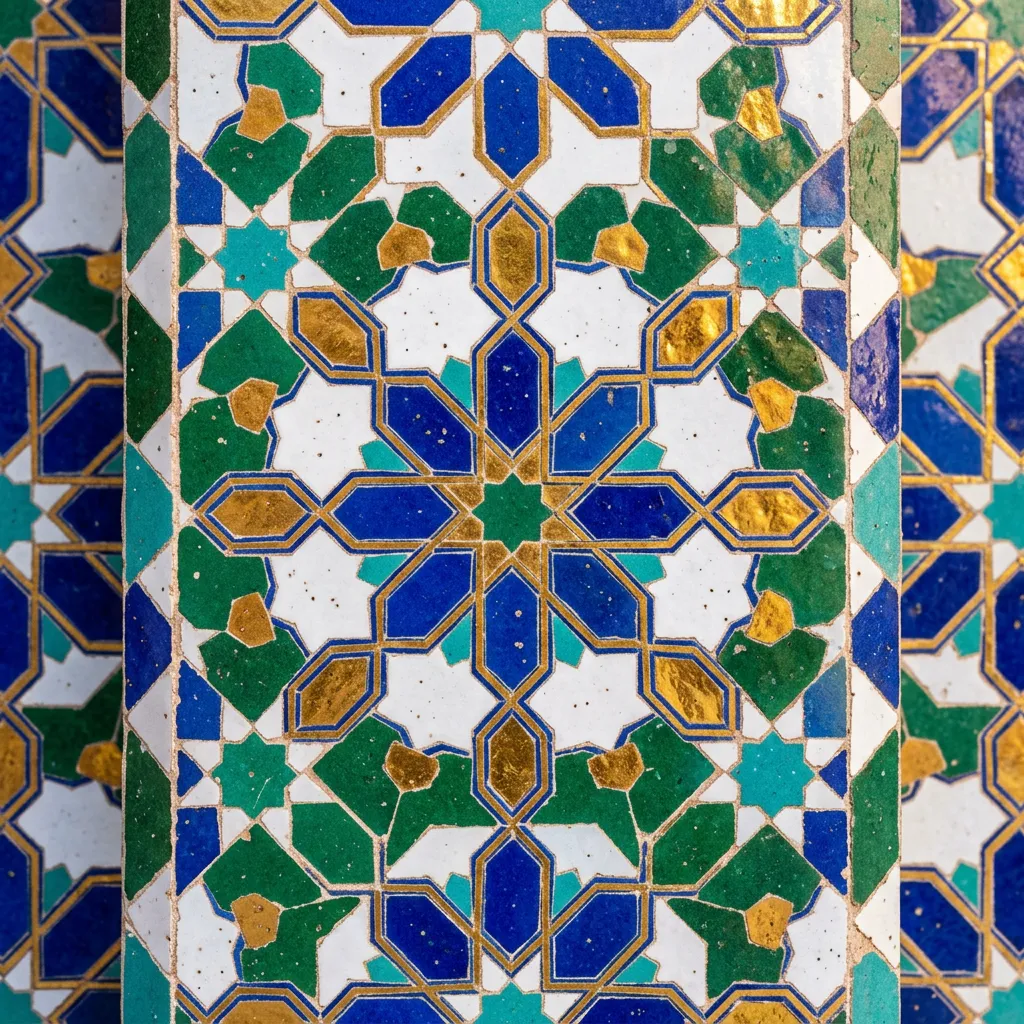
Zellige is the art of hand-cut geometric mosaic tilework that adorns fountains, walls, floors, and courtyards across Morocco. Each tiny tile chip is individually chiseled from larger glazed terracotta squares, then assembled face-down into intricate mathematical patterns of breathtaking complexity. The craft demands years of apprenticeship and an intuitive understanding of geometry. Fes remains the undisputed capital of zellige production, where master craftsmen (maalems) work in workshops that have operated continuously for centuries.
Zellige arrived in Morocco with the Andalusian Moors in the 10th century and reached its artistic zenith during the Marinid dynasty in the 14th century. The patterns are rooted in Islamic geometric art, which uses mathematical repetition to suggest the infinite nature of creation. UNESCO has recognized Moroccan zellige as an Intangible Cultural Heritage.
Buying tip: Visit workshops in the Fes medina near Bab el-Ghissa to see artisans at work. Small zellige pieces and coasters make portable souvenirs. Full tables and fountains can be custom-ordered and shipped.
Price range: 50-500 MAD for small pieces; 5,000-50,000+ MAD for tables and fountains

Marrakech
Tadelakt (Waterproof Plaster)
تدلاكت
Tadelakt is a luxurious, waterproof lime plaster technique unique to Morocco, traditionally used to line the walls and floors of hammams, riads, and palaces. The plaster is made from limestone sourced near Marrakech, applied in multiple layers, and polished to a lustrous sheen using flat river stones and black soap. The result is a seamless, marble-like surface that is naturally waterproof, antibacterial, and stunningly beautiful.
The technique dates back centuries and was traditionally used exclusively in hammams and the homes of the wealthy. The word tadelakt comes from the Berber verb "to rub" or "to knead." Today, it has gained international fame as an eco-friendly luxury wall treatment, with Marrakech craftsmen exporting their skills worldwide.
Buying tip: While you cannot buy tadelakt as a souvenir, you can commission small tadelakt bowls, soap dishes, and decorative objects from workshops in the Marrakech medina. These make elegant and unique gifts.
Price range: 100-500 MAD for small objects; custom installations priced per square meter
Fes, Marrakech
Leather Tanning
الدباغة
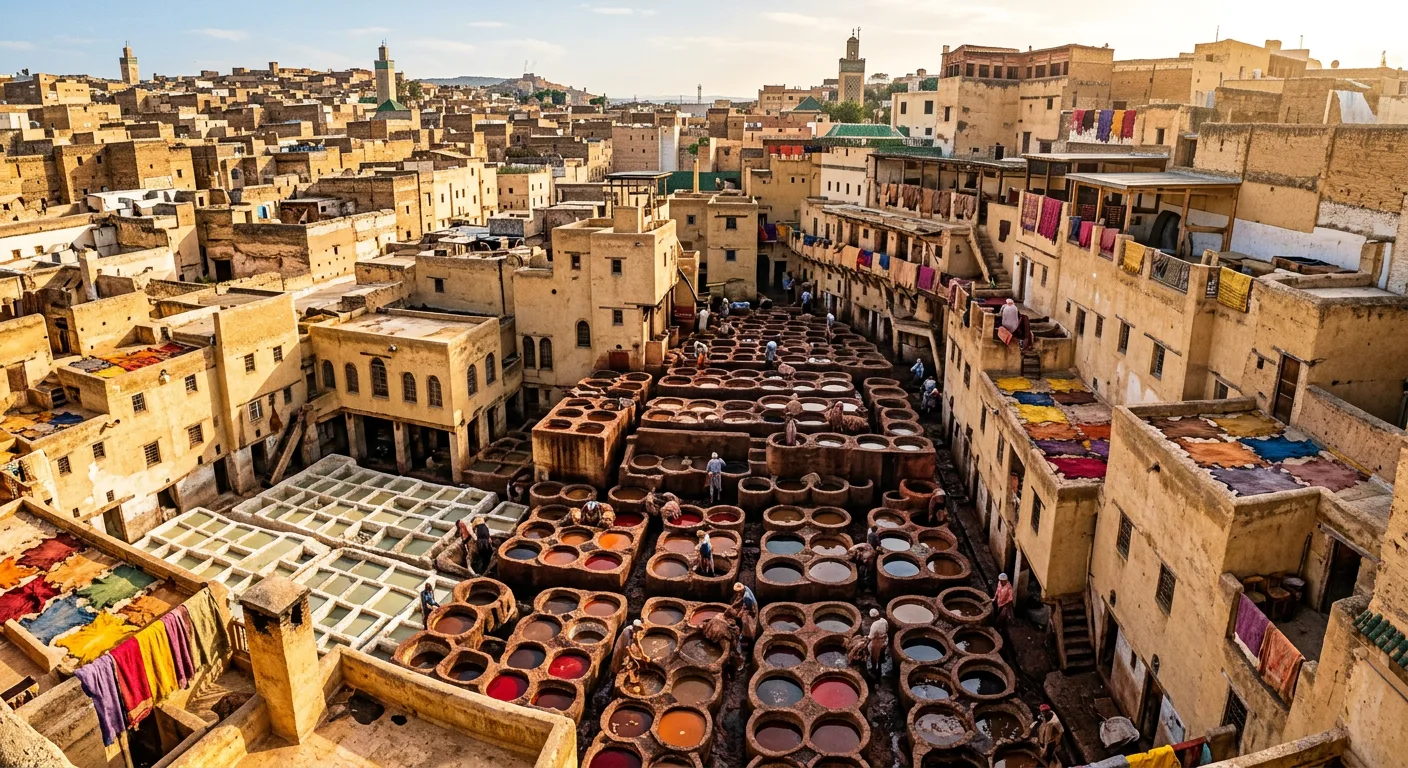
The leather tanneries of Fes are one of Morocco most iconic sights. The Chouara Tannery in the Fes medina has been operating since the 11th century, using the same techniques: raw animal hides are soaked in lime to remove hair, then submerged in vats of natural plant dyes including saffron (yellow), indigo (blue), poppy (red), and mint (green). Workers stand waist-deep in the stone vats, turning and kneading the leather by hand under the open sky.
Fes has been the center of Moroccan leather production since the founding of the city in the 9th century. The English word "cordovan" derives from the fine leather produced in Moorish Cordoba, a tradition that transferred to Fes. Moroccan leather was once exported across Europe and was prized for bookbinding, particularly in Renaissance Italy.
Buying tip: In Fes, buy directly from shops overlooking the tanneries for the best selection. Smell the leather: genuine vegetable-tanned leather has an earthy, cedar scent, while chemical-tanned leather smells like plastic. Quality bags, belts, and poufs are excellent purchases.
Price range: 100-800 MAD for bags; 400-1500 MAD for leather poufs

Middle Atlas, High Atlas, Nationwide
Carpet Weaving
الزربية
Moroccan carpets are among the most sought-after textiles in the world, with distinct styles varying by region and tribe. The three major types are Beni Ourain (cream-colored wool with bold black geometric patterns from the Middle Atlas), Boucherouite (colorful recycled fabric rugs from the High Atlas), and flat-woven kilims. Each rug is handmade on a traditional loom by Berber women, with patterns that encode tribal identity, spiritual protection, and personal stories.
Carpet weaving is a pre-Islamic Berber tradition that predates the Arab conquest of North Africa. For Berber women, weaving is both an art form and a form of cultural communication, with symbols representing fertility, protection, freedom, and the natural world. Each region and tribe has distinctive patterns passed through generations.
Buying tip: Examine the back of the carpet: handmade rugs have slight irregularities, while machine-made rugs are perfectly uniform. Ask about the wool origin and dye type (natural vs. synthetic). Visit cooperatives for fair-trade purchases. Beni Ourain rugs start at 2,000 MAD for small sizes.
Price range: 500-3000 MAD for small kilims; 2,000-20,000+ MAD for large Beni Ourain rugs
Fes, Safi
Pottery & Ceramics
الفخار
Moroccan pottery is instantly recognizable by its vibrant colors and geometric designs. Fes is famous for its cobalt blue and white ceramics, inspired by the city centuries-old connection with Andalusia and the Middle East. Safi, on the Atlantic coast, is the other great pottery center, known for its polychrome pieces in greens, yellows, and reds. Both cities have active potters quarters where you can watch artisans throw, paint, and fire ceramics in traditional wood-burning kilns.
Moroccan pottery traditions date back to the Neolithic period, but the distinctive glazed and painted ceramics developed during the Idrisid dynasty in the 9th century. Fassi blue-and-white pottery shows clear Chinese porcelain influence, transmitted via the Silk Road trade routes. The geometric patterns follow the same mathematical principles as zellige tilework.
Buying tip: Visit the pottery quarter (Ain Nokbi) in Fes or the Colline des Potiers in Safi for wholesale prices. Check that plates and bowls are food-safe if you plan to use them for dining. The best pieces have fine, detailed hand-painting and a smooth, even glaze.
Price range: 30-200 MAD for plates and bowls; 200-2000 MAD for large decorative pieces

Marrakech, Fes
Metalwork
النحاس
The coppersmiths and brass workers of Morocco produce some of the most exquisite metalwork in the Islamic world. From the pierced brass lanterns that cast mesmerizing shadow patterns to ornate tea sets, trays, and door knockers, Moroccan metalwork combines functionality with extraordinary decorative artistry. In the metalworking souks of Marrakech and Fes, the rhythmic hammering of artisans fills the air as they transform flat sheets of copper and brass into three-dimensional works of art.
Metalworking has been central to Moroccan craft traditions since the Berber kingdoms. The elaborate brass lanterns and chandeliers that define Moroccan interior design evolved during the Almohad and Marinid dynasties. The Place Seffarine in the Fes medina, the coppersmiths square, has been in continuous operation for over a thousand years.
Buying tip: Brass lanterns are the quintessential Moroccan metalwork purchase. Test the quality by checking the weight (heavier is better) and the precision of the pierced patterns. Ensure you get wiring compatible with your home country electrical system. Tea sets and trays also make excellent gifts.
Price range: 200-2000 MAD for lanterns; 150-800 MAD for tea sets and trays

Essaouira, Fes
Woodwork & Carving
النجارة
Morocco woodworking tradition splits into two distinct schools. Fes specializes in carved and painted cedar, used for the elaborate ceilings, doors, and screens that define Moroccan palace architecture. Essaouira is the capital of thuya wood, a rare, aromatic burl wood from the argan forest, which artisans turn into boxes, chess sets, furniture, and decorative objects using an ancient marquetry technique. The natural grain patterns of thuya create swirling, almost psychedelic designs.
Cedar carving in Fes reached its peak during the Marinid dynasty, when the finest craftsmen decorated palaces and madrasas with breathtaking wooden muqarnas (honeycomb vaulting). Thuya woodworking in Essaouira has been a specialty since the Phoenician era, when the wood was exported across the Mediterranean. The craft nearly died out in the 20th century but has been revived through artisan cooperatives.
Buying tip: In Essaouira, visit the woodworking cooperative near Skala de la Ville for fair prices and authentic thuya products. Smell the wood: genuine thuya has a distinctive sweet, resinous fragrance. Avoid pieces with cracks, which indicate the wood was not properly dried.
Price range: 50-300 MAD for small boxes; 500-5000+ MAD for chess sets and furniture
Tiznit, Anti-Atlas
Silver Jewelry
الحلي الفضية
Moroccan silver jewelry is primarily a Berber tradition, with designs that carry deep symbolic and protective meaning. The town of Tiznit in the Anti-Atlas is the historic capital of Moroccan silversmithing, where Jewish and Berber craftsmen developed distinctive styles featuring fibulae (large ornamental brooches), chunky bangles, talismanic pendants, and elaborate headpieces. Berber jewelry incorporates symbols of fertility, the evil eye, and natural elements like stars, moons, and geometric patterns.
Silver jewelry in Morocco has ancient Berber roots, but the craft was also profoundly influenced by Jewish silversmiths who lived in the mellah (Jewish quarters) of Moroccan cities for centuries. When most Moroccan Jews emigrated to Israel in the mid-20th century, the silversmithing traditions were passed to Muslim artisans. Today, Tiznit remains the center, though fine silver jewelry is found throughout the south.
Buying tip: Look for the 925 stamp indicating sterling silver. Berber jewelry is traditionally made from coin silver, which is lower purity but has historical value. Avoid pieces sold by weight without craftsmanship consideration. The best selection is in Tiznit souk and the silver section of Marrakech souks.
Price range: 100-500 MAD for bangles and small pieces; 500-5000+ MAD for elaborate necklaces

Fes, Marrakech
Babouche (Leather Slippers)
البلغة
The babouche is Morocco iconic leather slipper, recognized by its flat sole, pointed toe, and backless design that allows you to slip them on and off easily. Made from soft, hand-dyed leather, babouches come in every color imaginable, from classic camel and black to vivid saffron, cobalt, and fuchsia. Men traditional babouches tend to be simpler in design, while women versions may feature embroidery, sequins, or silk thread decoration.
The babouche has been the standard Moroccan footwear for centuries, perfectly adapted to the climate and lifestyle. The backless design makes them easy to remove when entering homes and mosques. Fes has been the principal production center since the medieval period, though today Marrakech also has major babouche souks. The craft remains entirely handmade in Morocco.
Buying tip: Buy babouches in Fes for the best leather quality and lowest prices. Test flexibility: good babouches bend easily without cracking. Check the stitching around the sole. Buy a half size smaller than your usual shoe size, as the soft leather stretches. Yellow babouches are the most traditional for men.
Price range: 60-150 MAD for basic pairs; 150-500 MAD for embroidered or designer versions

Souss-Massa, Essaouira
Argan Oil
زيت أركان
Argan oil is extracted from the nuts of the argan tree, which grows only in southwestern Morocco in a UNESCO-protected biosphere reserve. There are two types: culinary argan oil (from roasted nuts, with a rich, nutty flavor used in cooking and as a bread dip) and cosmetic argan oil (from unroasted nuts, used for skin and hair care). The oil is rich in vitamin E, essential fatty acids, and antioxidants. Women cooperatives in the Souss region produce most of Morocco argan oil using traditional stone-grinding methods.
The Amazigh (Berber) people have used argan oil for cooking, cosmetics, and medicine for centuries. The argan tree can live up to 200 years and is so vital to the ecosystem that UNESCO designated the argan forest a Biosphere Reserve in 1998. The rise of the women cooperative movement in the 1990s transformed argan oil production into a major source of rural female empowerment.
Buying tip: Buy from certified women cooperatives for guaranteed authenticity and fair trade. Cosmetic argan oil should be nearly odorless and pale gold; culinary oil is darker with a nutty aroma. Avoid vendors selling suspiciously cheap oil, which is often diluted with sunflower or olive oil.
Price range: 150-300 MAD per 100ml for cosmetic oil; 80-150 MAD per 250ml for culinary oil
Fes, Rabat, Sale
Embroidery
الطرز
Moroccan embroidery is a refined art form with distinct regional styles. Fes embroidery (terz fassi) features monochrome designs in deep blue or red on white linen, with reversible stitching so precise that both sides are identical. Rabat embroidery uses bold, colorful geometric patterns on silk or cotton. Sale specializes in delicate floral cross-stitch. Embroidered items include tablecloths, cushion covers, caftans, and napkins, all painstakingly stitched by hand.
Embroidery has been a cornerstone of Moroccan women domestic arts for centuries, with techniques and patterns passing from mother to daughter. Each city developed its own distinctive style, and a woman embroidery skill was once a key factor in marriage negotiations. The Fassi style is the most celebrated and was traditionally practiced by women of the aristocratic families.
Buying tip: Examine the back of embroidered items: hand embroidery has a neat but slightly irregular reverse, while machine embroidery has perfectly uniform backing. Fes embroidery on fine linen makes elegant tablecloths and napkin sets. Look for cooperatives that support women artisans.
Price range: 100-500 MAD for cushion covers; 500-3000 MAD for large tablecloths
Nationwide, Rif, Sahara
Basket Weaving
صناعة السلال
Basket weaving is one of Morocco oldest and most widespread crafts, practiced across every region using locally available natural materials. In the north and Rif Mountains, artisans weave with palm leaves and doum palm. In the south, date palm fronds are the primary material. Raffia, straw, and esparto grass are also used. Products range from practical household items like bread baskets, storage containers, and shopping bags to decorative wall hangings, lampshades, and fashion accessories that have become popular worldwide.
Basket weaving predates recorded Moroccan history and is found in archaeological sites dating back thousands of years. Every Berber community had its own weaving traditions, with patterns and techniques adapted to local materials. The craft has experienced a remarkable revival as Moroccan woven bags and home decor items have become global fashion trends.
Buying tip: The best woven bags and baskets come from Essaouira, the Rif region, and the Draa Valley. Check the tightness of the weave for quality. Raffia bags from Essaouira with leather handles are the most popular tourist purchase. Flat-woven bread baskets make practical and beautiful souvenirs.
Price range: 30-200 MAD for small baskets; 100-500 MAD for woven bags with leather trim
Fes, Meknes, Marrakech
Calligraphy & Illumination
الخط والزخرفة
Arabic calligraphy in Morocco is a refined visual art practiced by master calligraphers (khattatine) who train for decades to achieve the flowing perfection of Maghrebi script, a distinctive North African calligraphic style with rounded, sweeping forms. Moroccan illumination (tezhib) accompanies calligraphy with intricate geometric and floral borders painted in gold leaf, lapis lazuli blue, and vegetable-based pigments. Together, these arts adorn Qurans, royal decrees, architectural inscriptions, and decorative panels found in mosques, palaces, and madrasas throughout the kingdom.
The Maghrebi script developed in North Africa from the 10th century onward, diverging from the angular Kufic styles of the eastern Islamic world into a distinctive cursive form. Fes became the preeminent center of calligraphic art after the founding of the University of al-Qarawiyyin in 859 CE, the oldest continuously operating university in the world. Royal workshops (dar al-makhzen) maintained the highest standards, and today UNESCO recognizes Moroccan calligraphy as part of the broader Intangible Cultural Heritage of Arabic calligraphy.
Part of UNESCO-recognized Arabic Calligraphy heritage
Buying tip: Seek out calligraphy studios in the Fes medina near the al-Qarawiyyin mosque for authentic pieces. Hand-lettered works on handmade paper or vellum are far more valuable than printed reproductions. Ask to see the calligrapher work in progress as proof of authenticity. Custom commissions of names or phrases make deeply personal souvenirs.
Price range: 200-1000 MAD for small framed pieces; 2,000-15,000+ MAD for illuminated manuscripts
Marrakech, Fes, Ouarzazate
Textile Dyeing
صباغة النسيج
The dyers souk (souk des teinturiers) is one of the most visually spectacular sights in any Moroccan medina. Master dyers (sabbaghin) transform raw wool, cotton, and silk using an ancient palette of natural dyes extracted from plants, minerals, and insects. Saffron yields brilliant yellow, indigo produces deep blue, pomegranate rind creates gold, henna gives warm orange, and cochineal insects produce vivid crimson. The freshly dyed skeins of yarn are hung to dry on poles and lines above the narrow alleyways, creating cascading rainbows of color that have become iconic images of Morocco.
Natural textile dyeing in Morocco predates the Arab conquest, with Berber communities using local plants for millennia. The dyers guild in Fes was one of the most prestigious medieval trade organizations, with closely guarded secret formulas for color permanence. The introduction of synthetic dyes in the 19th century nearly destroyed the traditional craft, but a growing appreciation for natural, sustainable processes has sparked a significant revival, particularly among luxury textile producers and eco-conscious cooperatives.
Buying tip: Visit the dyers souk in Marrakech (near the Mouassine quarter) to see the process firsthand. When buying naturally dyed textiles, rub a damp white cloth on the fabric: natural dyes show minimal color transfer after proper fixing, while cheap synthetic dyes bleed immediately. Naturally dyed goods have subtler, more nuanced colors compared to the harsh brightness of synthetic dyes.
Price range: 100-500 MAD for naturally dyed scarves; 300-2000 MAD for dyed wool skeins and textiles

Fes, Tetouan, Essaouira
Musical Instrument Making
صناعة الآلات الموسيقية
Morocco has a rich tradition of handcrafting musical instruments that are central to the country diverse musical heritage. The oud (a pear-shaped stringed instrument), the guembri (a three-stringed bass lute sacred to Gnawa musicians), the bendir (a large frame drum), and the rebab (a single-stringed fiddle) are all built by specialized luthiers using centuries-old techniques. Each instrument requires specific tonewoods, animal skins, and gut strings, with the guembri traditionally made from a single carved piece of walnut or mahogany covered with dromedary camel skin.
Musical instrument making in Morocco reflects the country position at the crossroads of Arab, Berber, Andalusian, and Sub-Saharan African musical traditions. The guembri is sacred to the Gnawa Brotherhood, whose spiritual music traditions were inscribed on the UNESCO Representative List of the Intangible Cultural Heritage of Humanity in 2019. Andalusian-tradition instruments like the oud and rebab arrived with refugees from Islamic Spain, while drums and percussion instruments have deep Berber and African roots.
Gnawa instrument traditions recognized by UNESCO (2019)
Buying tip: The best guembris come from Essaouira, the spiritual home of Gnawa music. For ouds, visit the instrument makers near Bab Boujloud in Fes. Always play or listen to the instrument before buying; a well-made instrument has a warm, resonant tone. Mass-produced tourist versions lack proper resonance and are not suitable for actual performance.
Price range: 300-1500 MAD for bendirs and small drums; 1,500-8,000+ MAD for quality ouds and guembris
Fes, Marrakech, Meknes
Gebs (Carved Plaster)
الجبص
Gebs is the Moroccan art of hand-carved decorative plasterwork that transforms walls, ceilings, arches, and columns into lace-like masterpieces of geometric and arabesque beauty. Working with freshly applied wet plaster, artisans use small chisels and hammers to carve intricate patterns before the material sets, requiring exceptional speed, precision, and memorized pattern knowledge. The finished surface is often whitewashed or painted in subtle earth tones, creating a layered, three-dimensional effect that plays magnificently with natural light and shadow.
Carved plaster (gebs or gypsum work) has been a defining element of Moroccan architecture since the Almoravid period in the 11th century. The technique reached extraordinary refinement in the Marinid-era madrasas of Fes, particularly the Bou Inania and al-Attarine madrasas, where every surface is covered in interlocking carved plaster arabesques. The craft is typically combined with zellige tilework below and carved cedar woodwork above, forming the three tiers of classical Moroccan interior decoration.
Buying tip: While large-scale gebs work is architectural, small carved plaster panels, mirror frames, and decorative medallions are available in the souks of Fes and Marrakech. Visit the restoration workshops near the historical madrasas in Fes to see gebs artisans at work. Authentic pieces are carved from real plaster and have a soft, chalky weight, unlike lightweight resin reproductions.
Price range: 150-800 MAD for small decorative panels; 500-3000 MAD for mirror frames and larger pieces
Where to Buy: Best Souks by City
Ten cities, ten distinct shopping experiences. Each Moroccan souk has its own character, specialties, and atmosphere.
Marrakech
Jemaa el-Fnaa & Surrounding Souks
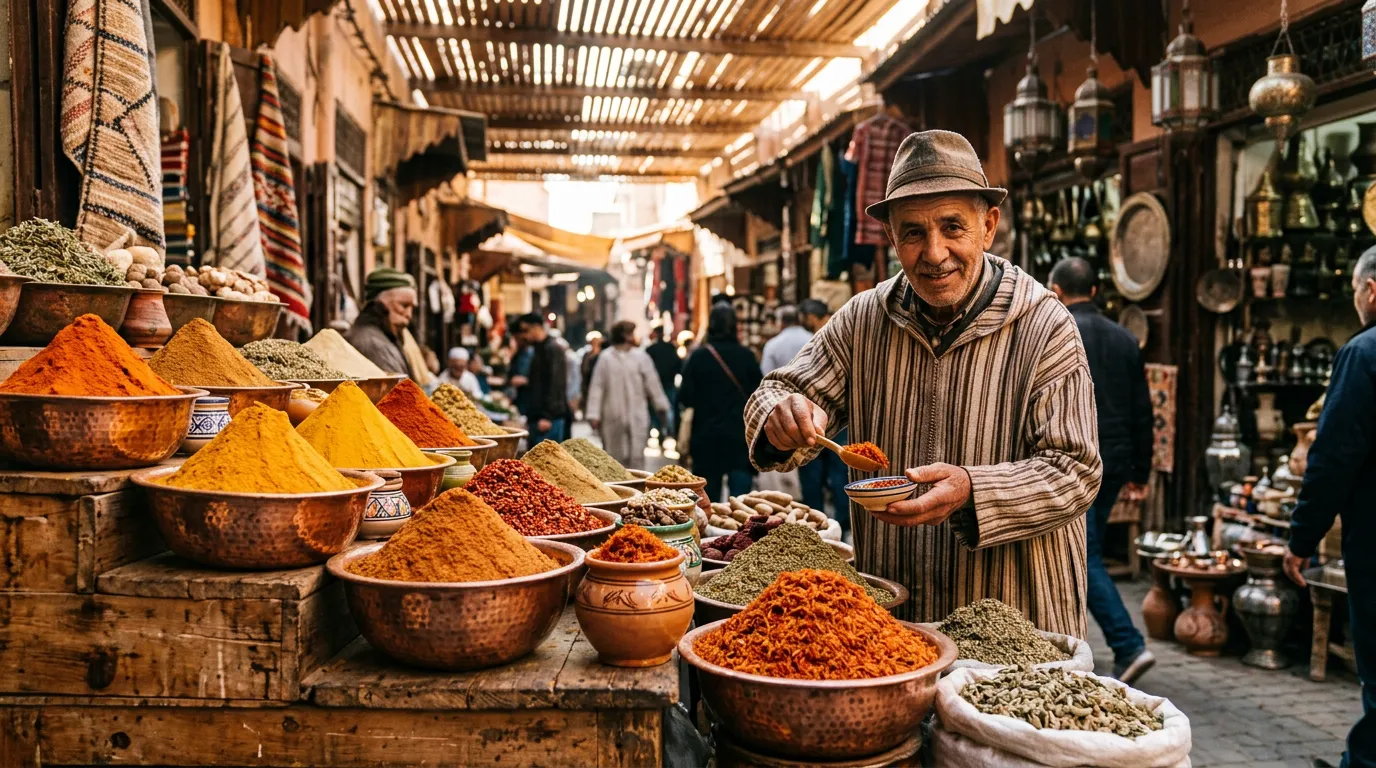
The largest and most famous souk complex in Morocco. Organized by trade: leather, spices, metalwork, carpets, and babouches each have their own alley. The Souk Semmarine is the main artery. Expect aggressive sellers and higher starting prices.
Leather goodsLanternsBabouchesSpicesCarpets
Fes
Fes el-Bali Medina
The world largest car-free urban area and Morocco most authentic souk experience. Artisans still work in centuries-old workshops. The pottery quarter (Ain Nokbi), tanneries (Chouara), and metalwork square (Place Seffarine) are highlights. Better craftsmanship and lower prices than Marrakech.
CeramicsLeatherZelligeEmbroideryMetalwork
Essaouira
Medina & Skala Artisan Market
A more relaxed, less pressured shopping experience than Marrakech or Fes. Essaouira specializes in thuya woodwork, silver jewelry, and woven goods. The woodworking cooperative near the Skala de la Ville offers fair fixed prices.
Thuya woodSilver jewelryWoven bagsArgan oilArt galleries
Chefchaouen
Medina Shops & Uta el-Hammam Square
The Blue City medina is compact and charming, with shops specializing in locally made woven blankets, goat cheese, and unique blue-washed pottery and crafts not found elsewhere in Morocco.
Woven blanketsLocal cheesePainted craftsPhotography
Tiznit
Souk of the Silversmiths
Morocco capital of silver jewelry. The dedicated souk of silversmiths inside the old walls offers the widest selection and best prices for Berber silver jewelry in the country. Less touristy and more authentic than buying silver in Marrakech.
Silver jewelryBerber ornamentsAntique pieces
Safi
Colline des Potiers (Potters Hill)
An entire hillside dedicated to pottery production, where you can watch artisans at every stage from throwing to painting to firing. Wholesale prices are the lowest in Morocco for ceramics. A must-visit for pottery lovers.
PotteryCeramicsTagine potsDecorative tiles
Meknes
Souk Nejjarine & Bab Mansour Area
Less touristy than Marrakech and Fes, Meknes souks offer excellent value and a more relaxed shopping experience. The city is known for its Damascene metalwork (inlaid silver on steel) and quality leather goods.
Damascene metalworkLeatherTextilesFood products
Ouarzazate
Taourirt Kasbah Market
The gateway to the Sahara Desert has a small but interesting market near the Taourirt Kasbah specializing in Berber crafts from the Draa and Dades valleys. Expect desert rose minerals, Berber carpets, and nomadic jewelry.
Berber carpetsDesert craftsNomadic jewelryFossils
Rabat
Rue des Consuls & Kasbah des Oudaias
The Rue des Consuls in the Rabat medina is a long, covered market street with high-quality carpet and antique dealers. The Kasbah des Oudaias area has upscale craft boutiques. Prices are fair and bargaining is less aggressive than in Marrakech.
CarpetsAntiquesEmbroideryUpscale crafts
Tangier
Grand Socco & Petit Socco
Tangier souks reflect the city international heritage with a mix of Moroccan crafts and European-influenced goods. The Grand Socco is the main market area, while the Petit Socco in the medina has atmospheric cafes and smaller artisan shops.
TextilesSpicesAntiquesLeather goods
The Art of Bargaining
Eight essential tips for successful negotiation in Moroccan souks. Bargaining is expected, respected, and even enjoyed.
1
Research Prices Before You Shop
Visit fixed-price cooperative shops first to establish baseline prices for the items you want. This gives you a realistic reference point for souk negotiations. Government-run Ensemble Artisanal shops in major cities sell crafts at regulated prices, providing excellent benchmarks.
2
Start at 30-40% of the Asking Price
The initial asking price in a souk is typically inflated by 2-3 times the expected selling price. Begin your counter-offer at roughly one-third of what the vendor asks. This leaves room for both sides to negotiate toward a fair middle ground, usually 50-70% of the first price.
3
Never Show Excessive Enthusiasm
If a seller senses you are desperate to buy, the price will stay high. Browse casually, show mild interest, and compare items at multiple shops before committing. The more indifferent you appear, the more leverage you have in the negotiation.
4
Walk Away Strategically
Walking away is the most powerful bargaining tool. If you cannot reach a price you are comfortable with, politely thank the seller and leave. If your offered price was reasonable, the seller will often call you back and accept. If they do not, you now know their floor price for the next shop.
5
Buy Multiple Items for Better Deals
Purchasing several items from the same vendor significantly increases your bargaining power. Sellers are much more willing to reduce per-item prices when they see a larger total sale. Group your purchases and negotiate a package price.
6
Keep It Friendly and Respectful
Bargaining in Morocco is a social exchange, not a confrontation. Smile, make conversation, accept the offered mint tea, and negotiate with good humor. Aggressive or disrespectful bargaining will not get you a better price and sours the experience for everyone.
7
Carry Small Bills and Exact Change
Once you agree on a price, pay with the exact amount or close to it. Handing over a large bill makes it psychologically harder for both parties if the seller claims they quoted a different price. Keep your money discreetly organized, and avoid flashing large amounts of cash.
8
Know When Not to Bargain
Fixed-price cooperatives, supermarkets, pharmacies, and restaurants with printed menus do not bargain. In very small village shops, where prices are already minimal, aggressive bargaining is inappropriate. Use your judgment: if the initial price seems fair and the item is handmade, the difference of 20-30 MAD matters more to the artisan than to you.
Authentic vs Mass-Produced
Six quality markers to help you distinguish genuine Moroccan handcraft from factory-made imitations.
Examine the Back and Inside
Authentic Handmade
Slight irregularities, hand-stitching, natural imperfections that show individual craftsmanship.
Mass-Produced
Perfectly uniform, machine-stitched seams, identical pieces with zero variation.
Check the Materials
Authentic Handmade
Natural materials: real leather (soft, warm to touch), genuine wool (smells faintly of lanolin), solid wood, hand-forged metal.
Mass-Produced
Synthetic materials: plastic-coated faux leather, acrylic yarn, MDF wood, stamped metal.
Weight and Feel
Authentic Handmade
Heavier than expected (solid wood, real brass, thick leather). Has a substantial, quality feel in hand.
Mass-Produced
Surprisingly lightweight (hollow metal, thin materials, plastic components). Feels flimsy.
Ask About the Artisan
Authentic Handmade
Seller can tell you who made it, where it was made, and explain the technique. Some shops display artisan photos.
Mass-Produced
Seller is vague about origins. "It comes from the factory" or evasive answers about craftsmanship.
Price as Quality Indicator
Authentic Handmade
Fair but not cheap. A genuine hand-knotted Berber rug cannot cost 200 MAD. If the price seems too good, it is.
Mass-Produced
Suspiciously cheap for what it claims to be. Mass production makes low prices possible but quality impossible.
Visit the Workshop
Authentic Handmade
If possible, visit the workshop where items are made. Seeing the production process is the ultimate proof of authenticity.
Mass-Produced
Seller discourages workshop visits or claims everything is made "in the back" without evidence.
Shipping Your Treasures Home
Practical advice on getting your Moroccan craft purchases safely back to your home country.
1
Use Established Shipping Companies
For large items like carpets, furniture, and fragile ceramics, use international shipping companies such as DHL, FedEx, or the Moroccan postal service (La Poste Maroc, specifically their Amana service). Many souk sellers have established relationships with shipping agents and can arrange door-to-door delivery to your home country. Get everything in writing, including tracking numbers.
2
Negotiate Shipping Separately from Purchase Price
Always negotiate the item price and the shipping cost as separate line items. Some sellers inflate the shipping cost to recover discounts given on the product. Get shipping quotes from independent companies to verify. For carpets, expect shipping costs of 300-800 MAD to Europe and 500-1200 MAD to North America.
3
Pack Fragile Items Yourself or Supervise
Moroccan ceramics, lanterns, and zellige pieces are fragile. If you are carrying items in your luggage, ask the seller to wrap them thoroughly in bubble wrap and newspaper. For shipped items, ensure proper crating for ceramics and lanterns. Consider buying packing materials in the medina hardware shops.
4
Understand Customs Regulations
Research your home country import regulations before buying. Most countries allow personal-use quantities of crafts duty-free. The EU allows up to 430 euros in goods duty-free for air travelers. The US allows $800. Leather goods, plant-based products (argan oil, straw baskets), and antiques may have specific import requirements. Keep all receipts.
5
Carpet Shipping Considerations
Large Berber carpets can be vacuum-compressed and shipped flat in waterproof packaging. Reputable carpet dealers offer worldwide shipping and often have experience with customs documentation for your specific country. Ask for a certificate of origin and a detailed receipt describing the carpet materials, dimensions, and production method.
6
Carry-On vs Checked Luggage
Small items like babouches, silver jewelry, argan oil (in checked luggage due to liquid restrictions), small ceramics, embroidered textiles, and spices are easy to pack in your suitcase. Wrap fragile items in your clothing for protection. Brass lanterns can often fit in checked luggage if properly padded. Always keep receipts accessible for airport security and customs.
Artisan Craft Gallery
A visual journey through Morocco's living heritage of handmade craftsmanship.
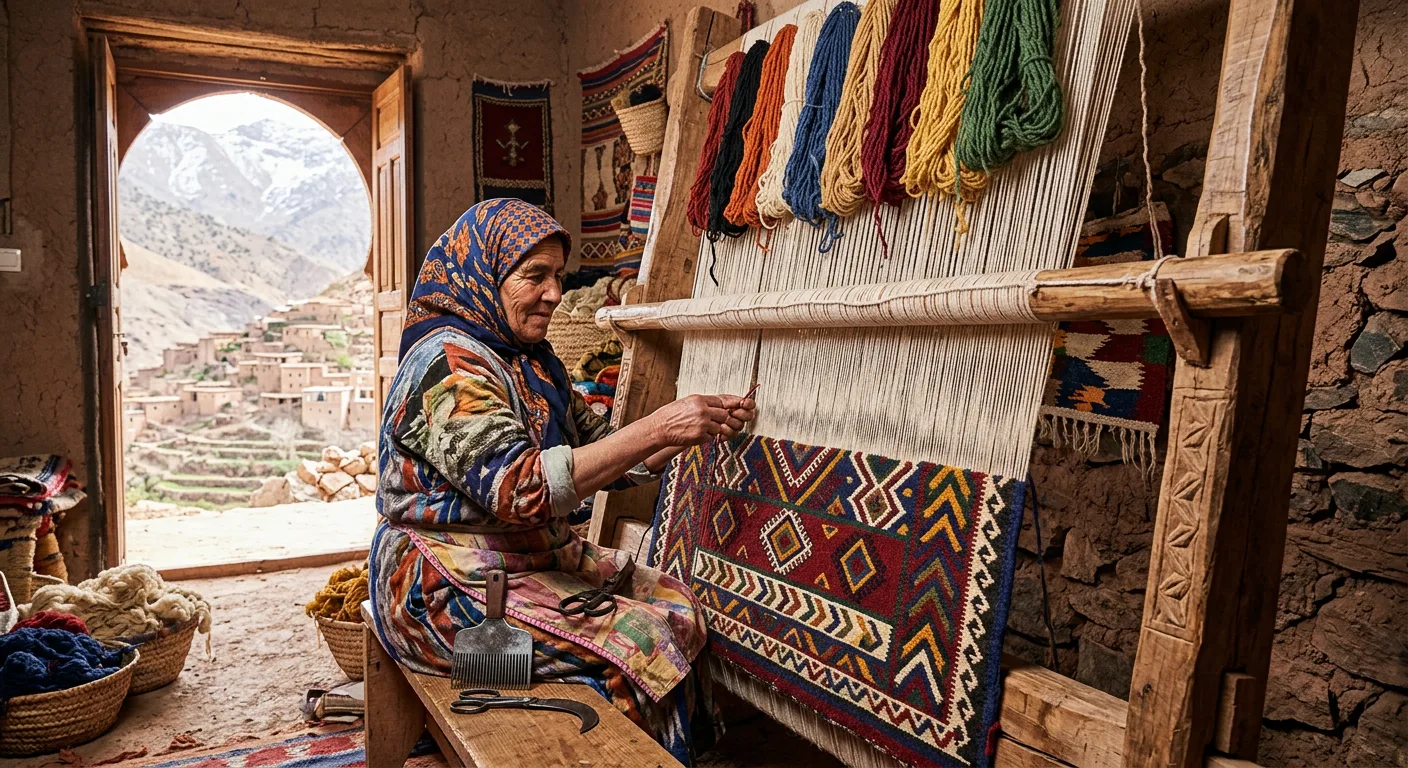
Berber artisan weaving a traditional carpet on a handloom in the Atlas Mountains
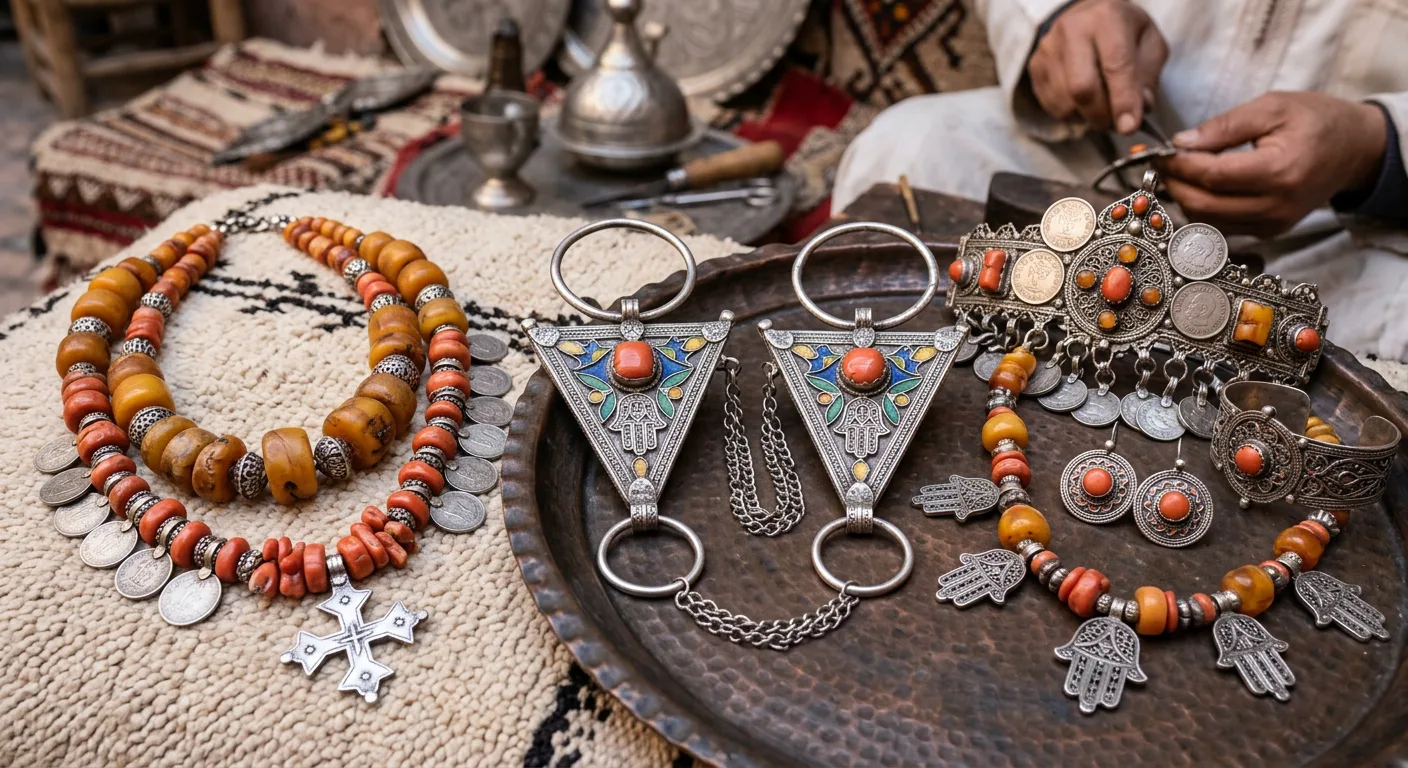
Handcrafted Moroccan silver jewelry with Berber symbols and semi-precious stones
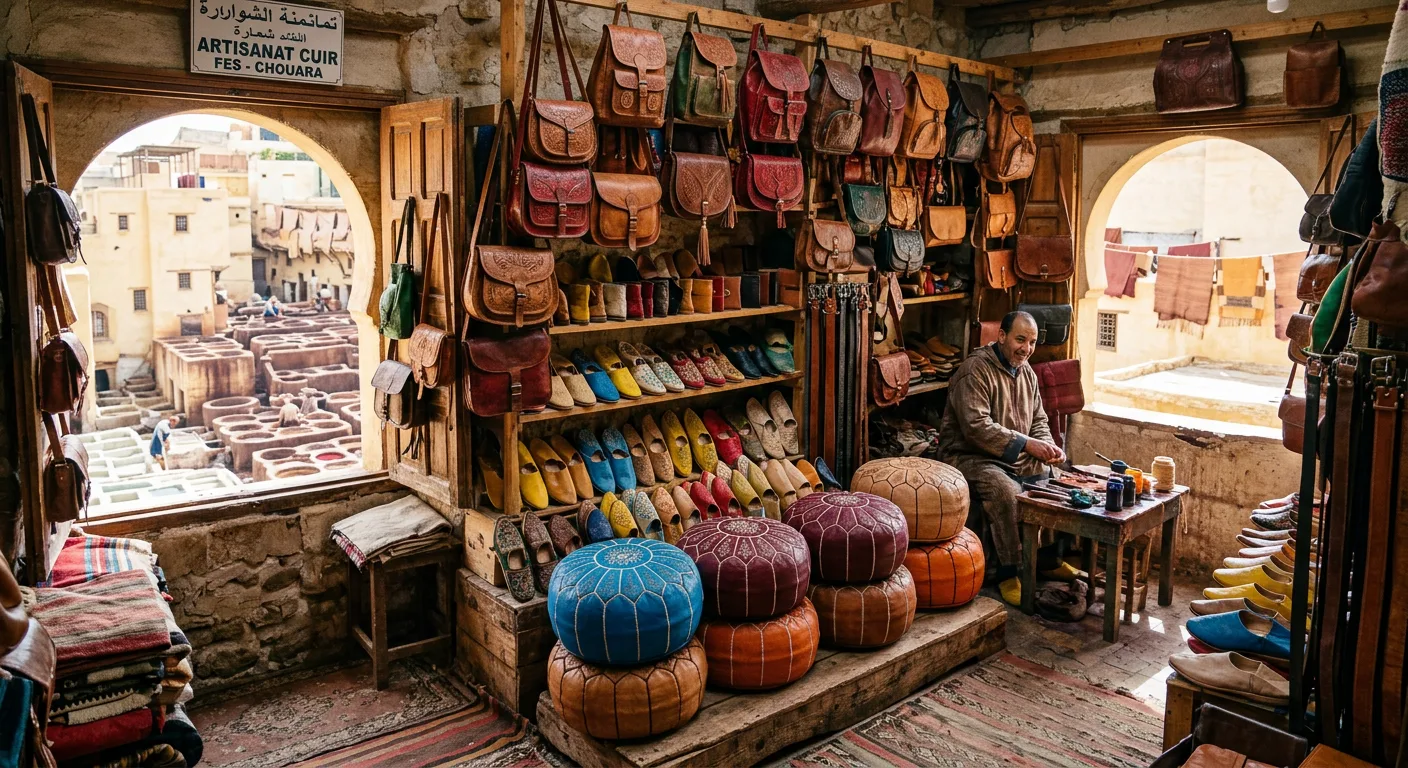
Moroccan leather goods including bags, belts, and babouche slippers in a souk
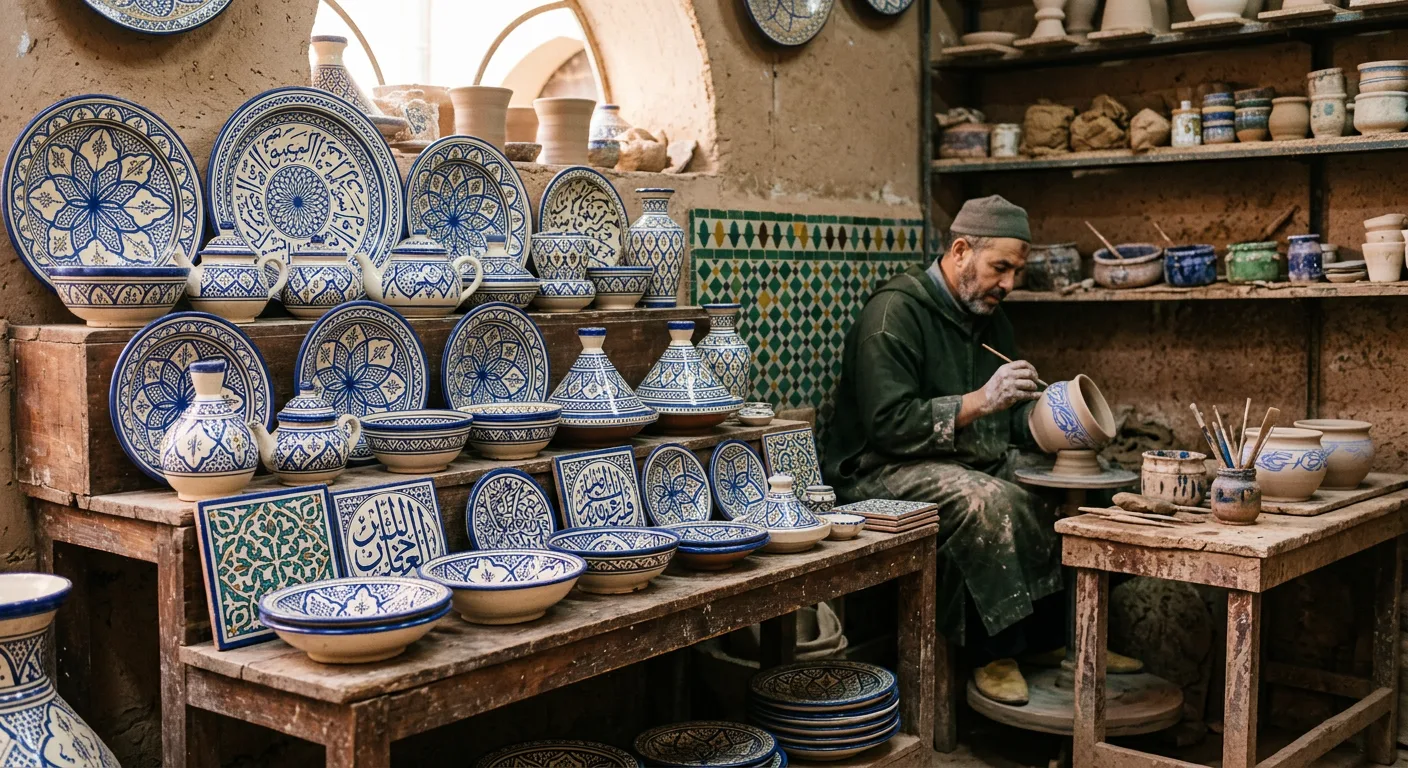
Colorful Moroccan pottery and ceramics displayed at a workshop in Safi
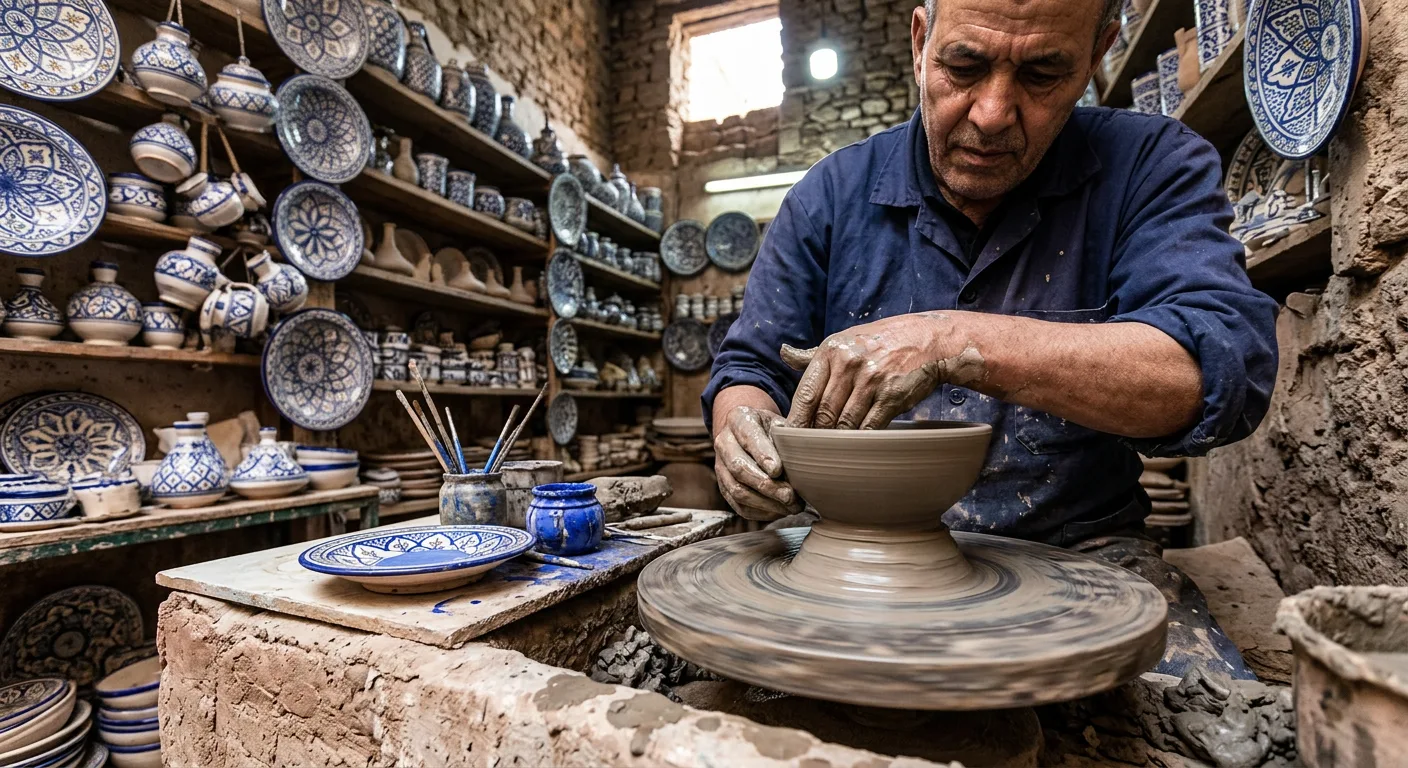
Potter shaping clay on a wheel at a traditional Moroccan pottery workshop
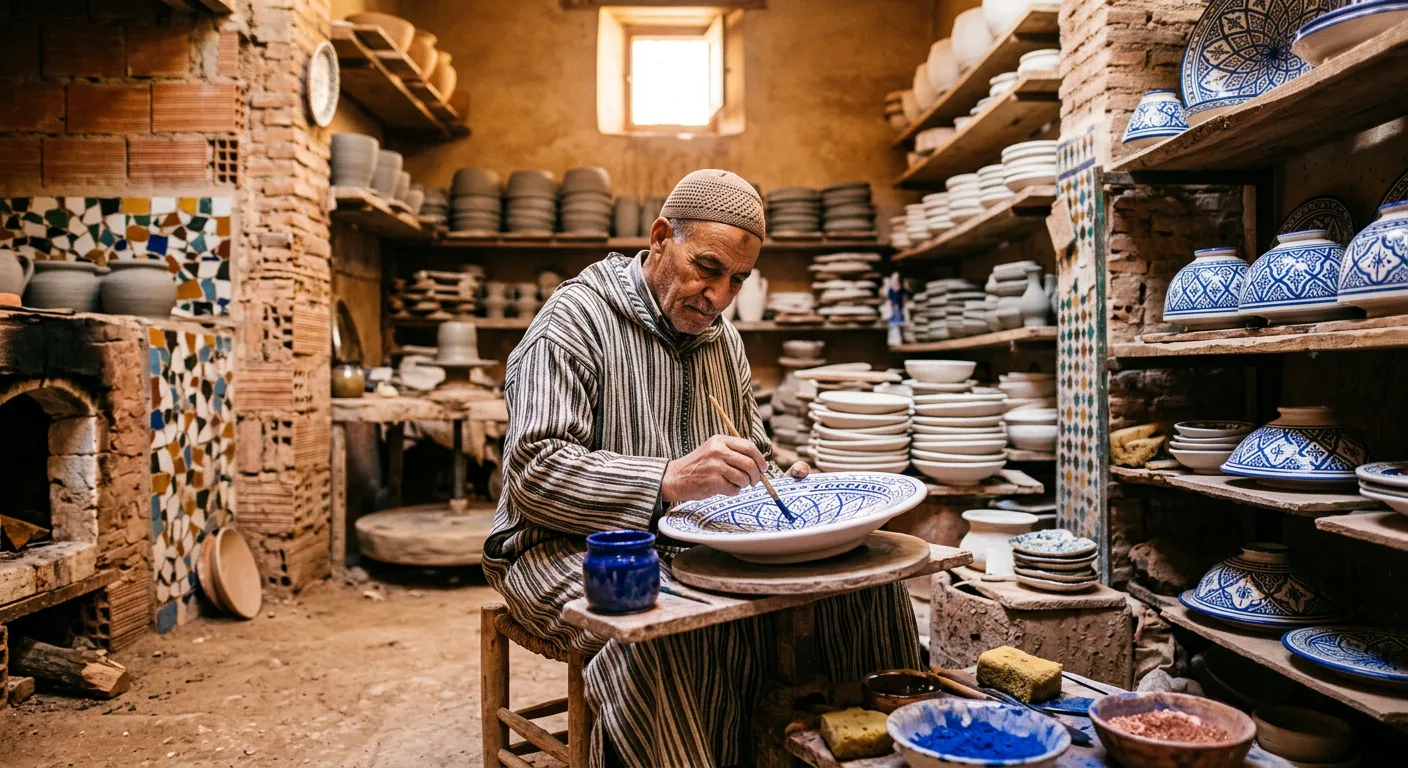
Artisan painting intricate blue and white patterns on pottery in Fes
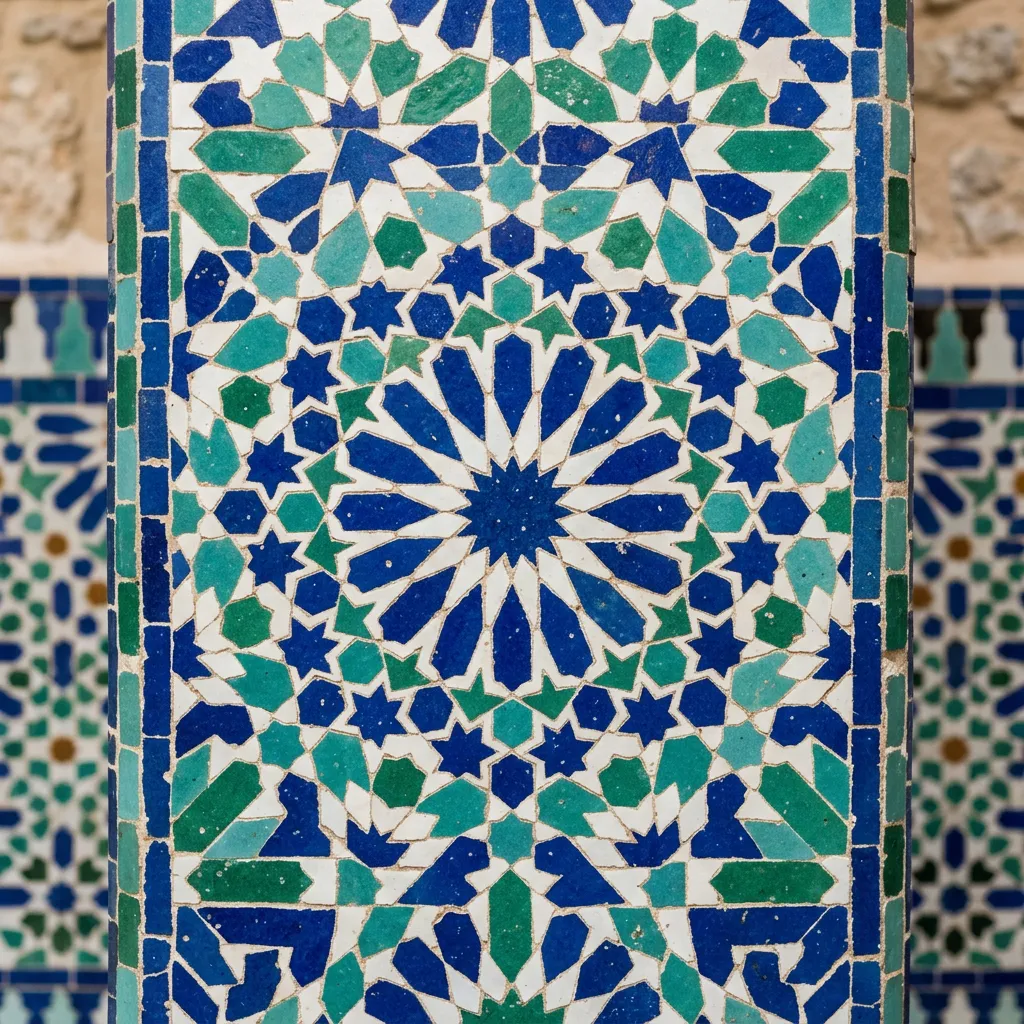
Geometric zellige mosaic tilework in traditional Moroccan patterns
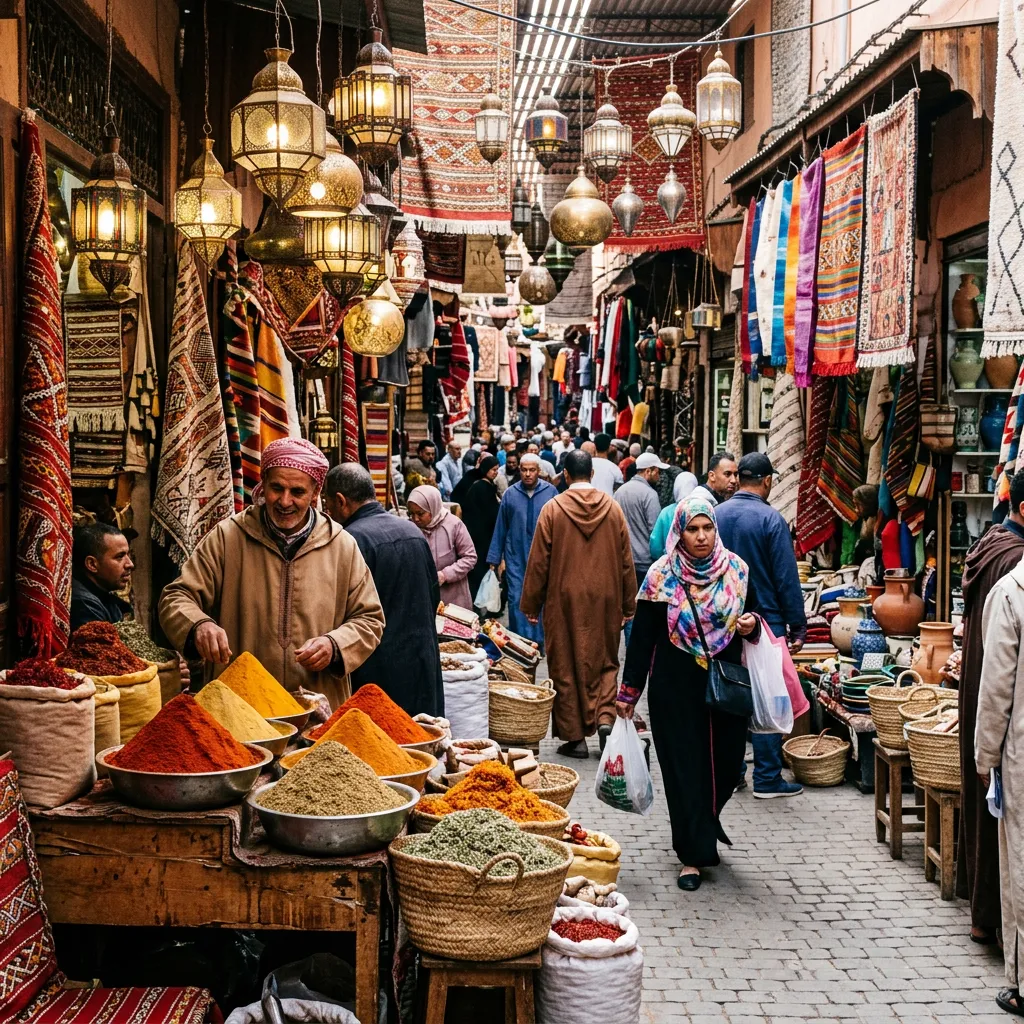
Vibrant Moroccan souk market stall with handcrafted goods and lanterns
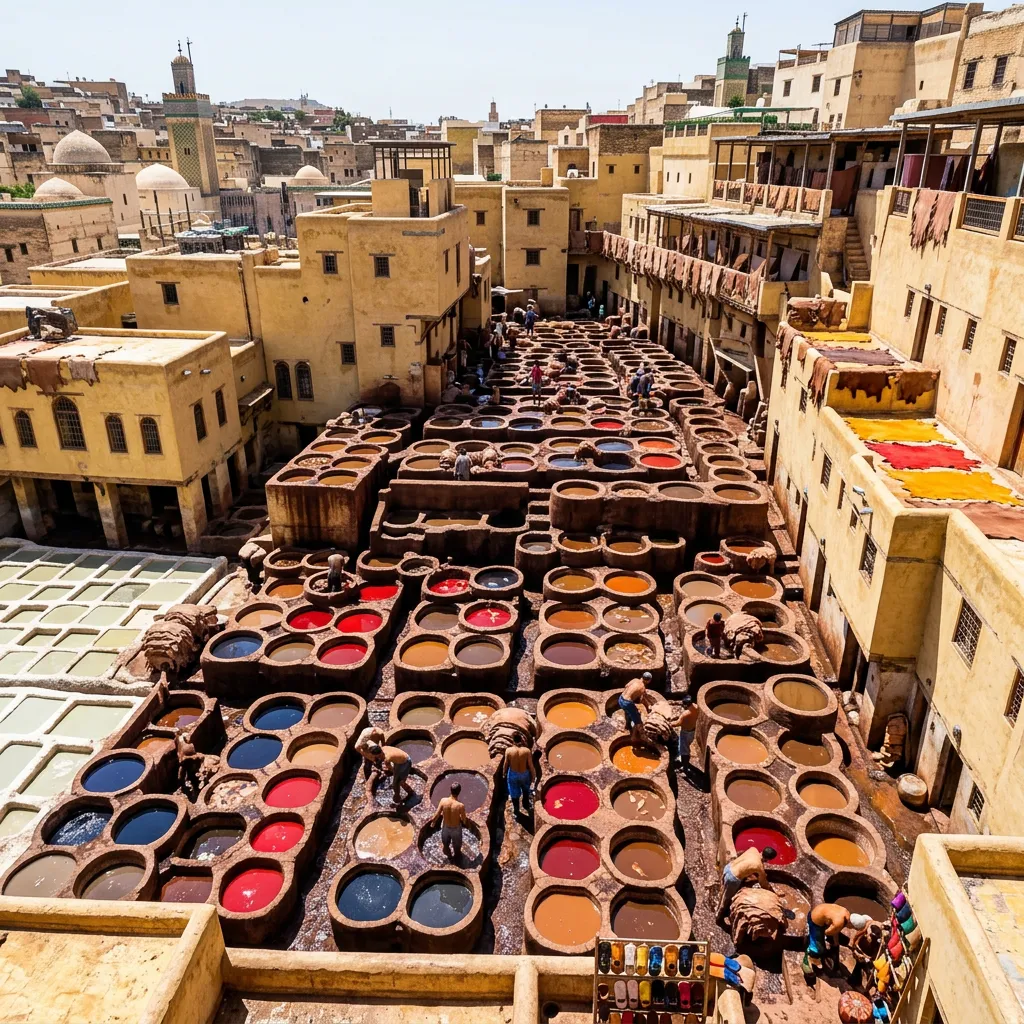
Leather tanning vats at the Chouara Tannery in Fes medina
Portrait of a master Moroccan artisan in their workshop
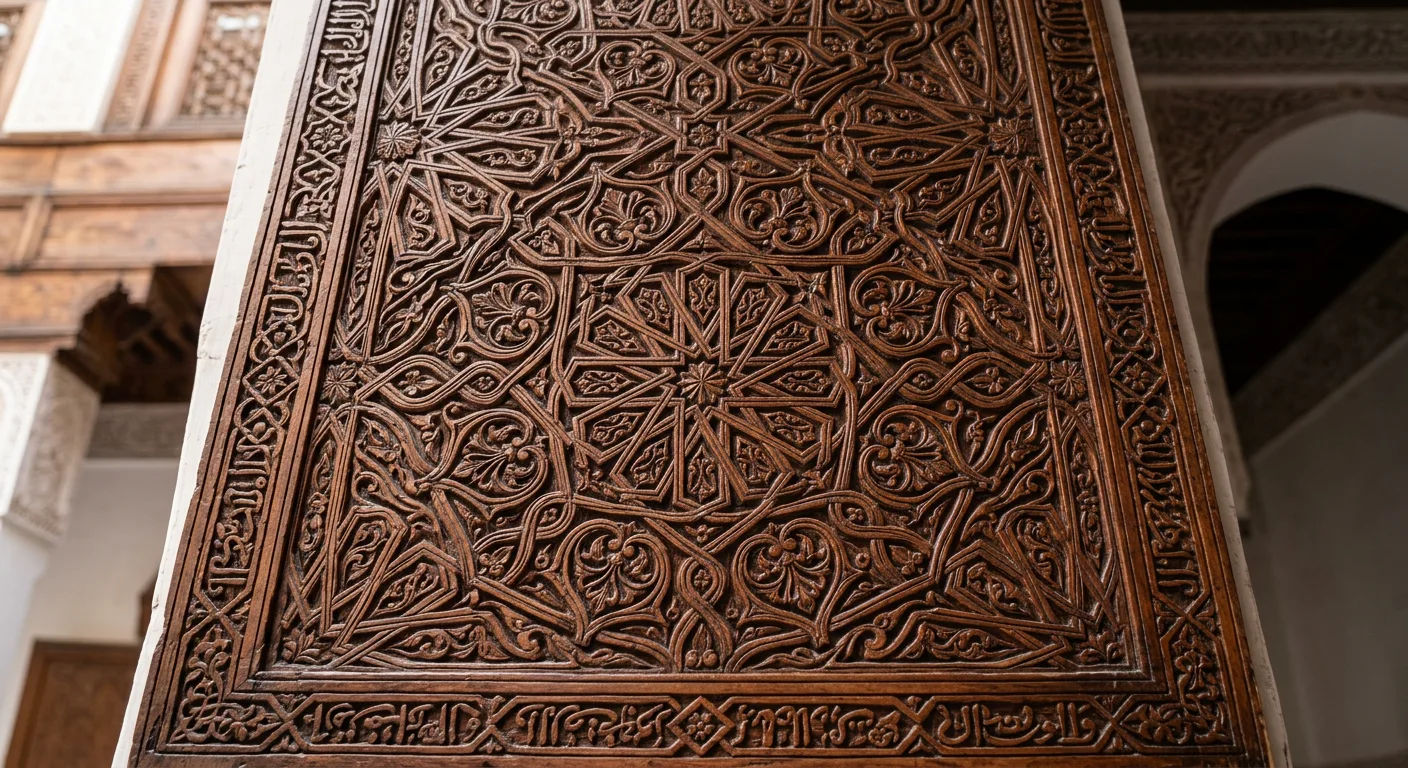
Intricate Moroccan woodwork with hand-carved geometric and floral designs
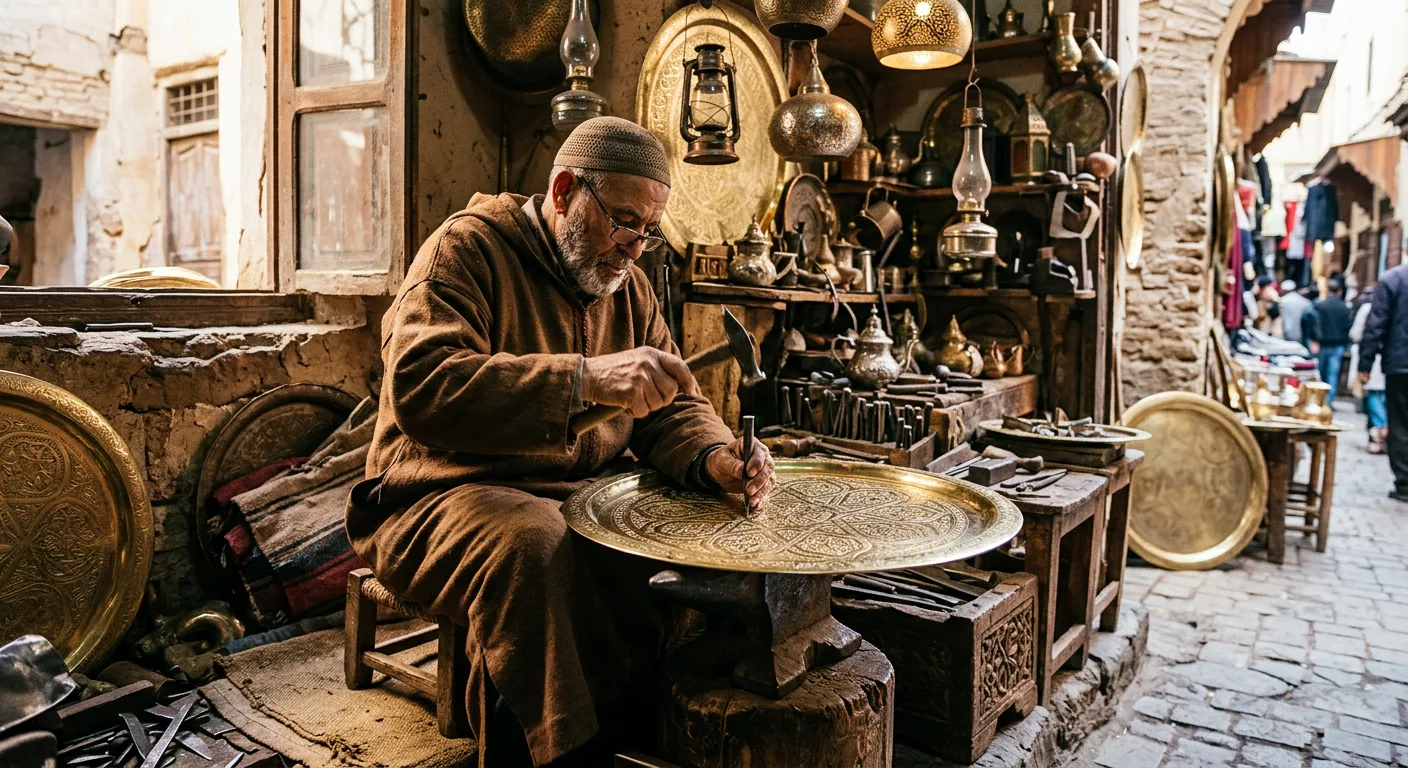
Moroccan brass lanterns and tea sets with hammered patterns
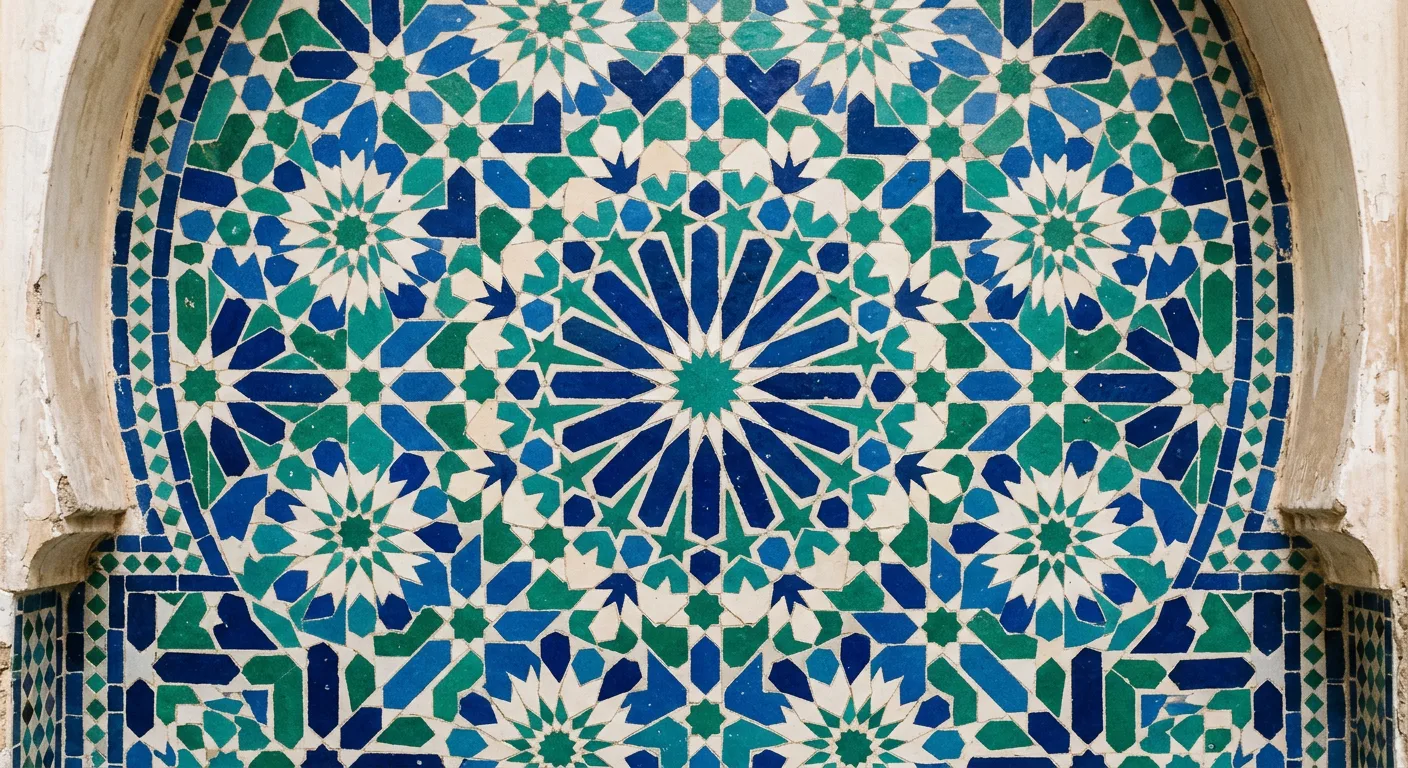
Hand-cut zellige tiles arranged in a star pattern by a Moroccan craftsman
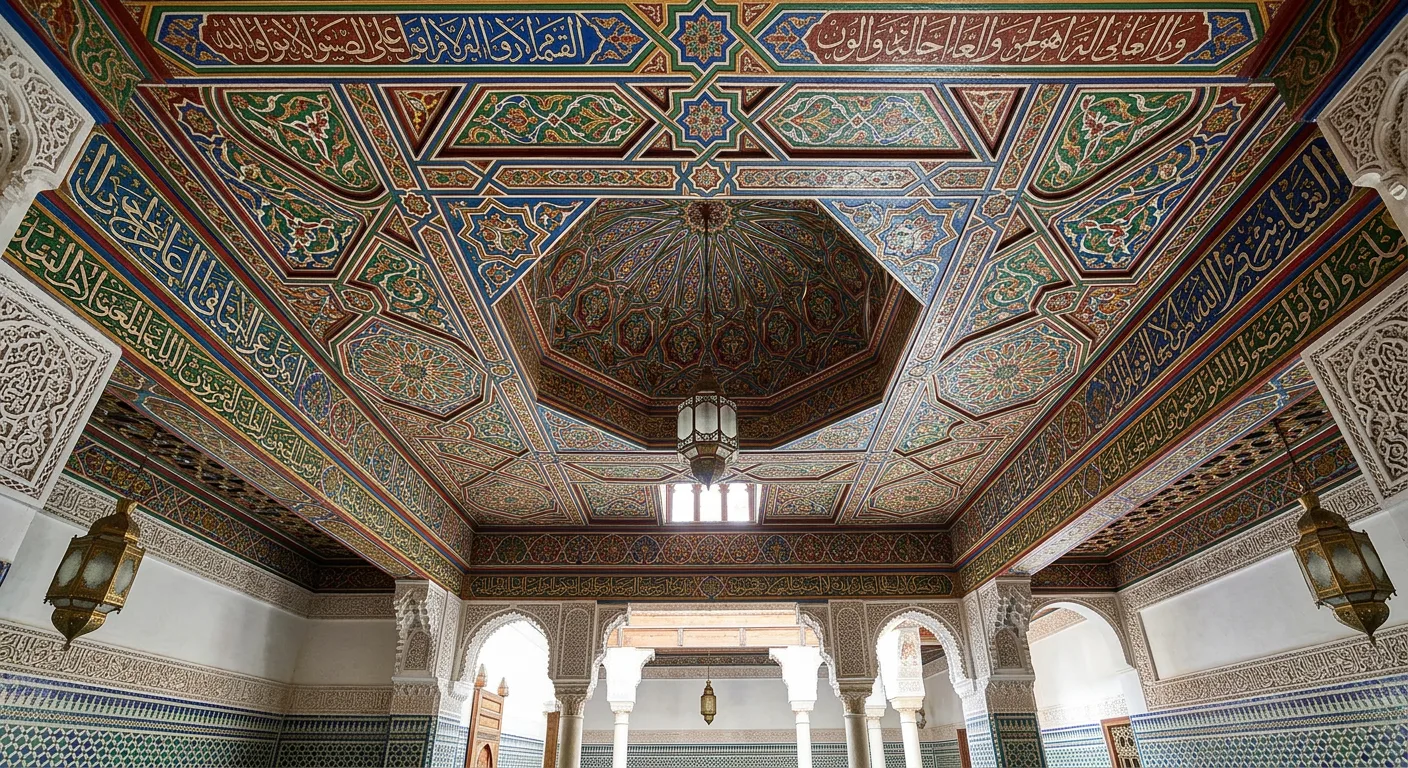
Painted zouak woodwork ceiling with traditional Moroccan geometric motifs
Ready to Discover Moroccan Craftsmanship?
Explore our city guides to plan your artisan trail, or browse activities to find guided souk tours and craft workshops.