Discovering...

Communication & Culture
Moroccan Arabic & Language Guide
Even a few words of Darija will transform your experience in Morocco. Learn the essential phrases, food vocabulary, pronunciation tips, and cultural context to connect with locals on a deeper level.
Morocco is one of the most linguistically diverse countries in the world. Most Moroccans speak at least two languages fluently, and many speak three or four. The primary language of daily life is Darija (Moroccan Arabic), a unique dialect that has absorbed vocabulary from Berber, French, Spanish, and even Portuguese over the centuries. Understanding this linguistic landscape is essential for meaningful travel.
You do not need to become fluent in Darija to have an extraordinary time in Morocco. But learning even a handful of phrases — "Salam," "Shukran," "Labas?" — will earn you genuine warmth, better prices in the souk, and doors opened that remain closed to those who only speak English. Moroccans deeply appreciate any effort to speak their language, and your attempts will be met with encouragement, smiles, and often enthusiastic language lessons from shopkeepers and taxi drivers alike.
Languages of Morocco
Morocco is a remarkably multilingual country. Most Moroccans speak at least two languages, and many speak three or four fluently. Understanding which language to use where will significantly enhance your travels.
Darija (Moroccan Arabic)
~30 million speakers
The mother tongue of most Moroccans. Darija is a dialect of Arabic that has absorbed Berber, French, and Spanish vocabulary over centuries. It differs significantly from Modern Standard Arabic (MSA) and from other Arabic dialects, so even Arabic speakers from the Gulf or Levant may struggle to understand it. Darija is the language of daily life, pop music, comedy, and the street. While MSA is used in formal media, education, and religious contexts, Darija is what you will hear in every market, cafe, and taxi ride.
Modern Standard Arabic (MSA)
Formal/official speakers
Modern Standard Arabic (Fusha) is one of Morocco's official languages and is used in government, formal media, religious sermons, and education. However, no Moroccan speaks MSA as their mother tongue. There is a significant gap between spoken Darija and formal MSA — think of the difference between spoken street Italian and classical Latin. If you have studied MSA, Moroccans will understand you, but they will reply in Darija. Learning Darija-specific vocabulary is far more useful for travelers.
Tamazight (Berber/Amazigh)
~10 million speakers
The language family of Morocco's indigenous Amazigh people, recognized as an official language in the 2011 constitution. Three main variants exist: Tarifit in the Rif Mountains of the north, Tamazight in the Middle Atlas, and Tashelhit in the High Atlas, Souss Valley, and Anti-Atlas. These variants differ enough that speakers of one may not fully understand another. The distinctive Tifinagh script is used on official signage throughout the country. Learning a few Amazigh words (such as "azul" for hello) is deeply appreciated in Berber-speaking regions.
French
~12 million speakers
Morocco's primary language of business, higher education, and government administration. A legacy of the French Protectorate (1912-1956), French remains the language of prestige and upward mobility. Most educated Moroccans are bilingual in Darija and French. Menus, road signs, and official documents are typically in both Arabic and French. Speaking basic French will open doors across the country. Many Darija words are borrowed directly from French: "tomobil" (car), "trottoir" (sidewalk), "la gare" (train station).
Spanish
~5 million speakers
Widely spoken in northern Morocco, particularly in the former Spanish Protectorate zones of Tangier, Tetouan, Nador, and the Spanish enclaves of Ceuta and Melilla. Many older residents in the north are fluent, and Spanish-language media is widely consumed. If you speak Spanish but not French, you will find it especially useful in the Rif region and along the northern coast.
English
Growing speakers
English proficiency is increasing rapidly among younger Moroccans, especially in tourism, tech, and international business. In major tourist areas like Marrakech, Fes, Essaouira, and Agadir, you will find English speakers at hotels, restaurants, and tour agencies. However, outside tourist zones and in rural areas, English is rarely spoken. Learning some Darija or French will significantly enrich your experience.
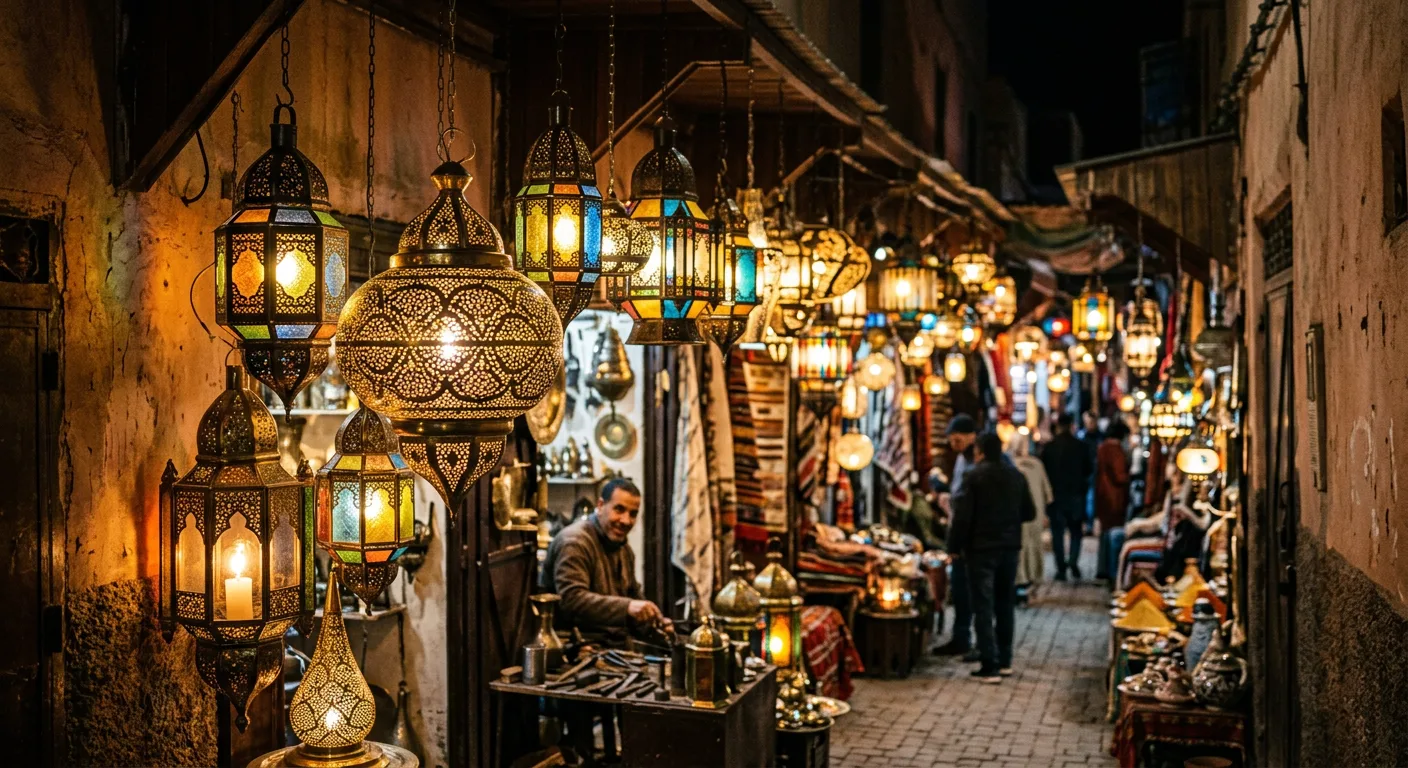
Language, like Moroccan lantern-work, is intricate, layered, and full of hidden beauty
Essential Darija Phrases
Over 60 phrases organized by situation. You do not need to memorize all of them — even learning salam, shukran, and bslama will earn you genuine warmth from every Moroccan you meet.
Greetings & Basics
| Darija | English | Usage Tip |
|---|---|---|
| Salam / Salam alaykum | Hello / Peace be upon you | Universal greeting, always appropriate |
| Wa alaykum salam | And peace be upon you (reply) | The proper response to salam alaykum |
| Labas? | How are you? / Are you well? | The most common greeting after salam |
| Labas, hamdullah | I'm fine, thank God | Standard reply, always include hamdullah |
| Kidayr(a)? | How are you? (m/f) | More informal version of labas |
| Mzyan | Good / Fine | General word for good |
| Shukran | Thank you | Essential, use constantly |
| Shukran bzaf | Thank you very much | For extra gratitude |
| Bslama | Goodbye | Literally: with safety |
| Tsbah ala kheir | Good night | Said when parting in the evening |
| Afak / 3afak | Please | Essential politeness word |
| Smeh li | Excuse me / I'm sorry | For apologies or getting attention |
| Iyyeh / Ah | Yes | Iyyeh is more formal |
| La | No | Short and direct |
| La shukran | No thank you | Polite refusal, use in souks constantly |
| Marhba | Welcome | Said to guests and visitors |
| Bsmillah | In the name of God | Said before eating, starting a journey |
| Hamdullah | Praise be to God | Said after eating, when asked how you are |
| Inshallah | God willing | Used for future plans and hopes |
Time-of-Day Greetings & Blessings
| Darija | English | Usage Tip |
|---|---|---|
| Sbah l'kheir | Good morning | Use before noon; response: "Sbah n-nur" (morning of light) |
| Msa l'kheir | Good afternoon / evening | Use after noon; response: "Msa n-nur" |
| Tsbah ala kheir | Good night (farewell) | When saying goodbye at night |
| Allah y3awnek | May God help you | Said to someone who is working |
| Bssa7a | To your health / Enjoy | Said after someone eats, bathes, or buys new clothes |
| Ramadan Mubarak | Blessed Ramadan | During the holy month |
| Aid Mabrouk | Blessed Eid/holiday | For religious celebrations |
| Mabrouk! | Congratulations! | For weddings, births, achievements |
Social & Conversational
| Darija | English | Usage Tip |
|---|---|---|
| Smiti ... | My name is ... | Introducing yourself |
| Shno smitk? | What is your name? | Asking someone's name |
| Mn fin nta/nti? | Where are you from? (m/f) | Common icebreaker question |
| Ana mn ... | I am from ... | Follow with your country name |
| Ka-n'tkellm shwiya d'l-3rbiya | I speak a little Arabic | Managing expectations |
| Ma fhemtsh | I don't understand | Polite way to say you're lost |
| Ka-t'tkellm l'ingliziya? | Do you speak English? | Ask in Darija before switching to English |
| 3afak, 3awed | Please, repeat that | When you did not catch what was said |
| Kul shi bikhir? | Is everything OK? | Checking in with someone |
| Inshallah | God willing / Hopefully | Used for anything in the future |
| Mashi mushkil | No problem | Very common phrase |
| Tbarkallah | Bless you / How wonderful | Complimenting something beautiful or impressive |
At the Market / Souk
| Darija | English | Usage Tip |
|---|---|---|
| Bshhal? | How much? | Point at the item and ask |
| Bshhal hada? | How much is this? | More complete version |
| Ghali bzaf! | Too expensive! | Your most important haggling word |
| Rkhis | Cheap | What you want the price to become |
| Nqes shwiya | Lower the price a bit | Polite way to start negotiating |
| Ma bghitsh | I don't want it | Walking away starts real negotiation |
| Akhir taman? | Last/final price? | Signals you are serious about buying |
| Wakhha | OK / Agreed | Seals the deal |
| Ana ghi kanshuf | I'm just looking | Useful to browse without commitment |
| 3nd wahd s-sahbi rkhis mn hna | My friend has it cheaper | Classic haggling leverage |
At Restaurants & Cafes
| Darija | English | Usage Tip |
|---|---|---|
| L'menu, 3afak | The menu, please | Many small places have no written menu |
| L'addition, 3afak | The check, please | Same word as in French |
| Bnayn! | Delicious! | Moroccans love to hear this about their food |
| Bezzaf | A lot / Enough | When your plate is overflowing |
| Shwiya | A little | Useful for spice level or portions |
| Ma fihsh l7em | Without meat | For vegetarians ordering |
| L'ma | Water | Always ask for bottled: l'ma dial l'qar3a |
| Atay | Mint tea | The national drink, offered everywhere |
| Saha! | Bon appetit! / Cheers! | Said before meals and when someone sneezes |
| Bghit ... | I want / I would like ... | Point at what you want and say this |
| Shbert | I'm full | Essential when your host keeps serving more |
Directions & Transportation
| Darija | English | Usage Tip |
|---|---|---|
| Fin ...? | Where is ...? | Most essential direction word |
| Fin l'hammam? | Where is the hammam? | Example usage |
| Fin l'funduq? | Where is the hotel? | Funduq or otel both work |
| L'yameen | Right | To the right |
| L'iser | Left | To the left |
| Seer nishan | Go straight | Literally: go direct |
| Qrib | Close / Nearby | Warning: Moroccan "close" can mean 20 minutes |
| B3id | Far | If they say this, take a taxi |
| Wqef hna | Stop here | Essential for taxis |
| Ddi-ni l ... | Take me to ... | For taxi rides |
| Fug / Lfoq | Up / Above | Useful in medina navigation |
| Lt7et / Lta7t | Down / Below | Useful in medina navigation |
| Hdaya | Next to / Beside | Hdaya l'mosque = next to the mosque |
Numbers (1-10, plus useful tens)
1Wahd
2Juj
3Tlata
4Rb3a
5Khmsa
6Stta
7Sb3a
8Tmnya
9Ts3ud
103shra
20Ashrin
30Tlatin
40Rb3in
50Khmsin
100Mya
Emergencies & Health
| Darija | English | Usage Tip |
|---|---|---|
| 3afak, 3awni! | Please, help me! | For urgent situations |
| Tabib | Doctor | Ask for tabib if you need medical help |
| Sbitar / Lopital | Hospital | Lopital from French "l'hopital" |
| Bolice | Police | Same as French/English, widely understood |
| Farmacien | Pharmacy | Look for the green cross sign |
| Mrid(a) | I'm sick (m/f) | Mrid for men, mrida for women |
| Serq-ni! | I've been robbed! | To report theft |
| Safara dial ... | Embassy of ... | For consular emergencies |
| L'7ariq! | Fire! | To alert people of fire |
| 3ndi 7asasiya | I have an allergy | Critical for food allergies |
Food & Drink Vocabulary
Moroccan cuisine is one of the world's great culinary traditions. Knowing these food words will help you navigate menus, order with confidence, and appreciate the dishes placed before you.
Essential Food & Drink Words
| Darija | English | Context |
|---|---|---|
| Khobz | Bread | The sacred staple, served with every meal |
| Tagine | Slow-cooked stew (and the conical pot) | Morocco's most famous dish |
| Kuskus / Seksu | Couscous | Traditional Friday lunch dish |
| Harira | Tomato-lentil soup | Traditional Ramadan iftar soup |
| L7em | Meat (general) | Usually means beef or lamb |
| Djaj | Chicken | The most common protein |
| Hut | Fish | Abundant on the coast |
| Khudra | Vegetables | Generic term for vegetables |
| Fakya | Fruit | Morocco has excellent seasonal fruit |
| Zeytun | Olives | Served at nearly every meal |
| Zit d'zeytun | Olive oil | Essential Moroccan ingredient |
| Tmar | Dates | From the Saharan oases |
| Lben | Buttermilk | Popular refreshing drink |
| Qahwa | Coffee | Usually served as cafe noir or noss-noss (half-half with milk) |
| Hlib | Milk | Noss-noss = half coffee, half milk |
| Ma ward | Orange blossom water | Used in pastries and drinks |
| Msemmen | Flaky layered flatbread | Common breakfast item |
| Baghrir | Spongy semolina pancakes | Served with honey and butter |
| Pastilla / Bastilla | Sweet-savory pastry (pigeon or chicken) | Specialty of Fes |
| Mechoui | Slow-roasted lamb | For celebrations and feasts |
| Chebakia | Flower-shaped sesame honey cookies | Essential during Ramadan |
| Ghriba | Crumbly almond cookies | Common with tea |
| Hrar / Harr | Spicy / Hot | Harr bzaf = very spicy |
| Hluw | Sweet | Moroccans love sweet tea and pastries |
Amazigh (Berber) Phrases
In Berber-speaking regions — the Atlas Mountains, the Souss Valley, the Rif — knowing even a few Amazigh words will earn enormous respect and genuine delight. "Azul" (hello) and "Tanemmirt" (thank you) are the two most important.
Essential Amazigh Phrases
| Amazigh | English | Usage Tip |
|---|---|---|
| Azul | Hello | Universal Amazigh greeting; use in Berber-speaking areas |
| Azul fellawen (m) / fellawent (f) | Hello to you (plural) | Greeting a group |
| Manzakin? / Matteggid? | How are you? | Varies by dialect |
| Labas, lhamdullah | Fine, praise God | Same structure as Darija response |
| Tanemmirt | Thank you | Essential in Berber communities |
| Oho / Yah | Yes | Varies by region |
| Uhu | No | Common across dialects |
| Ar tufat | Goodbye (see you tomorrow) | Literally: until tomorrow |
| Meqqar | Big / A lot | Useful for describing quantity |
| Imeddukal | Friends | A warm word to know |
Pronunciation Guide
Darija contains several sounds not found in English. Do not worry about perfection — Moroccans deeply appreciate any effort and will gently help you improve.
Kh
Kh (x)
kheir (good)
Like clearing your throat, similar to the Scottish "loch" or German "Bach." A harsh, guttural sound from the back of the throat. Not like English "k".
Gh
Gh (ghain)
ghali (expensive)
A gargling sound from deep in the throat, like the French "r" in "Paris" but deeper. Think of gargling water gently.
3
3 (ain)
3afak (please)
The number 3 represents the Arabic letter ain, a deep throat constriction with no English equivalent. Squeeze the back of your throat as if choking slightly. Practice saying "aaah" from deep in the throat.
7
7 (ha)
7amdullah (praise God)
A heavy, breathy "h" from deep in the throat, much stronger than English "h." Like fogging a mirror but with more force from the pharynx.
Q
Q (qaf)
qrib (close)
A "k" sound produced at the very back of the throat, deeper than regular "k." In some Moroccan dialects, this becomes a glottal stop (a catch in the throat).
R
R (rolled)
rkhis (cheap)
Always rolled/trilled, similar to Spanish "rr." Tap the tip of your tongue against the ridge behind your upper front teeth.
Sh
Sh
shukran (thanks)
Like English "sh" in "shoe." This one is easy for English speakers.
Double
Double consonants
bzzaf (a lot)
When you see double consonants, hold the sound longer. "Bzzaf" buzzes the "z" noticeably longer than a single letter would.
Haggling Phrases
Haggling in Moroccan souks is an art form and a social ritual, not a confrontation. Use these phrases with a smile, maintain good humor, and enjoy the exchange.
1
Bshhal hada?
How much is this?
Always ask before touching or showing too much interest
2
Ghali bzaf! Nqes shwiya.
Too expensive! Lower it a bit.
Look shocked at the first price, even if it seems fair
3
Ana ghi kanshuf.
I'm just looking.
Useful to browse without commitment
4
Ma 3ndish flus bzaf.
I don't have much money.
A classic haggling tactic understood worldwide
5
3nd wahd s-sahbi rkhis mn hna.
My friend has it cheaper.
Competition is real leverage in souks
6
Akhir taman, 3afak.
Final price, please.
Use when you are ready to seriously negotiate
7
Nkhelles ... dirham.
I'll pay ... dirhams.
Counter-offer at 30-40% of their asking price
8
Ila shrit juj, nqes li?
If I buy two, will you reduce?
Bulk discounts are common and expected
9
Shukran, ghadi nmshi.
Thanks, I'll leave.
Walking away is the most powerful move
10
Wakhha, mttafqin!
OK, deal!
Shake hands to seal the deal with a smile
French Useful Phrases
French is widely understood throughout Morocco. If you already speak French, these phrases will serve you well. If you speak neither Darija nor French, French is the easier backup to learn.
Essential French for Morocco
| French | English |
|---|---|
| Bonjour / Bonsoir | Good morning / Good evening |
| Merci beaucoup | Thank you very much |
| S'il vous plait | Please |
| Excusez-moi | Excuse me |
| Parlez-vous anglais? | Do you speak English? |
| Je ne comprends pas | I don't understand |
| Combien? | How much? |
| C'est trop cher | It's too expensive |
| L'addition, s'il vous plait | The check, please |
| Ou est ...? | Where is ...? |
| A gauche / A droite | To the left / To the right |
| Tout droit | Straight ahead |
| Je voudrais ... | I would like ... |
| La gare / L'aeroport | The train station / The airport |
| Je suis perdu(e) | I'm lost (m/f) |
| Appelez la police | Call the police |
| Une table pour deux | A table for two |
| Je suis vegetarien(ne) | I am vegetarian (m/f) |
Body Language & Gestures
Non-verbal communication carries enormous weight in Morocco. These 8 gestures and customs will help you avoid misunderstandings and show cultural respect.
1
Right Hand for Everything
Use your right hand for greetings, eating, giving and receiving items, and touching food. The left hand is considered unclean in Moroccan culture. This is one of the most important social rules to follow.
2
Hand on Heart After Handshake
After shaking hands, Moroccans often place their right hand over their heart. This gesture signifies sincerity and warmth. Mirroring this gesture shows cultural awareness and is deeply appreciated.
3
Touching Fingers to Lips
Bringing the fingertips together and touching them to the lips means the food is delicious. This non-verbal compliment to the cook is universally understood and always brings smiles.
4
Beckoning Palm Down
Moroccans beckon by extending the arm with the palm facing down and waving the fingers toward themselves. The Western palm-up beckoning gesture can seem rude or suggestive.
5
Personal Space
Moroccans stand closer together during conversation than most Westerners are accustomed to. Same-gender friends often walk arm-in-arm or hold hands, which is a sign of friendship and carries no romantic connotation.
6
Showing Shoe Soles
Avoid showing the soles of your shoes or feet to others, especially while sitting. The bottom of the foot is considered the dirtiest part of the body, and pointing it at someone is an insult.
7
Head Nod vs. Shake
A quick upward head tilt often means "no" in Morocco, which can confuse Westerners who interpret upward head movements as acknowledgment or agreement. A slow nod forward means yes.
8
Thumbs Up
The thumbs up gesture is generally understood as positive in Morocco, especially among younger people familiar with Western culture. However, in rural or conservative areas, it can occasionally be interpreted differently. A smile is always the safest universal positive signal.
Language Apps & Resources
Start learning before your trip. Even a few weeks of practice will make a dramatic difference in how deeply you connect with Morocco.
Audio Course
Pimsleur Moroccan Arabic
The gold standard for learning spoken Darija. Pimsleur's spaced-repetition audio method is ideal for travelers who want to learn conversational phrases. The Moroccan Arabic course covers greetings, shopping, dining, and travel scenarios.
Visit ResourceFlashcard App
Anki (Darija Decks)
Free, open-source flashcard app with community-created Moroccan Arabic decks. Search for "Darija" or "Moroccan Arabic" in the shared deck library. The spaced repetition system makes vocabulary stick.
Visit ResourceFree PDF
Peace Corps Darija Course
A comprehensive free course developed by the US Peace Corps for volunteers posted to Morocco. Covers Darija grammar, vocabulary, and cultural context. Available as a free PDF download.
Visit ResourceTutor Platform
Italki
Book one-on-one lessons with native Moroccan Arabic speakers. Even a few sessions before your trip can dramatically improve your pronunciation and confidence. Rates for Darija tutors are very affordable.
Visit ResourcePhrasebook
Moroccan Arabic Phrasebook (Lonely Planet)
A compact physical phrasebook you can carry through the medina. Covers essential phrases organized by situation (hotel, restaurant, shopping, emergencies) with phonetic pronunciations.
Visit ResourceRegional Dialects
Darija varies noticeably across Morocco. While all Moroccans understand each other, you may notice different vocabulary, accents, and loanwords depending on where you travel.
Casablanca & Rabat
The "standard" Darija that most Moroccans understand. Heavily influenced by French, with many French words integrated into daily speech. "Tomobil" (car), "trottoir" (sidewalk), and "la gare" (train station) are used interchangeably with Arabic equivalents.
Marrakech & Southern Morocco
Retains more Berber (Tashelhit) influence and vocabulary. Spoken slightly faster with distinct intonation patterns. Some Darija words differ: "seer" (go) may become "mshi," and vowel sounds tend to be more open.
Fes & Meknes
Considered the most "refined" Darija by some Moroccans due to the cities' roles as intellectual and cultural capitals. Closer to classical Arabic in some constructions. The Fassi accent is recognizable throughout Morocco.
Northern Morocco (Tangier, Tetouan)
Heavily influenced by Spanish rather than French. Many Spanish loanwords: "simana" (week, from semana), "kozhina" (kitchen, from cocina). The accent is distinct, with more emphasis on certain consonants. Tarifit Berber is also widely spoken in the Rif Mountains.
Eastern Morocco (Oujda, Nador)
Shows significant Algerian Arabic influence due to proximity to the border. Some words and expressions are shared with Algerian dialect and may puzzle Moroccans from the west. Tarifit Berber is the mother tongue of many people in this region.
Saharan Morocco (Errachidia, Zagora)
The Hassaniya dialect, related to Mauritanian Arabic, is spoken in parts of the deep south. Darija here has unique vocabulary and a slower, more melodic cadence. Berber (Tamazight) is widely spoken in oasis communities of the Draa and Ziz valleys.
Related Culture Guides
Darija Phrasebook
Go beyond the basics with our comprehensive Moroccan Arabic phrasebook featuring pronunciation audio, regional variations, and conversation scripts.
Etiquette Guide
Understand Moroccan social customs including greetings, dining etiquette, mosque visits, and the unwritten rules that earn you local respect.
Halal Travel Guide
Plan a halal-friendly trip with guidance on certified restaurants, prayer facilities, modest accommodation, and family-oriented activities.
Tipping Guide
Know exactly who to tip, how much, and when across restaurants, riads, guided tours, hammams, and everyday services in Morocco.
What to Wear
Practical dress code advice for every setting from sacred sites and conservative towns to coastal resorts and Sahara camps.
Avoiding Scams
Identify and avoid common tourist scams in Moroccan medinas, markets, and transport hubs with proven strategies from experienced travelers.
Ready to Connect With Morocco?
Language is the gateway to authentic cultural experiences. Pair your new phrases with our etiquette guide to travel Morocco with confidence and respect.