Discovering...

Events & Culture
Morocco Festival Calendar
From the Gnaoua Festival on the Atlantic coast to rose harvests in the Dades Valley, Morocco celebrates with music, food, and tradition throughout the year. Plan your trip around these extraordinary events.
All prices are approximate and may vary by season, location, and operator.
Events Covered
15+
Music Festivals
5 Major
Mawazine Attendance
2.5M+
Free Festivals
Most!
Month by Month
Festival Calendar 2025-2026
Click through each month to discover Morocco's vibrant festival scene. Religious holidays follow the Islamic lunar calendar and shift approximately 10-11 days earlier each year.
Jan
January
Marrakech
Marrakech Marathon
Late January
One of Africa's most scenic marathons. The route passes through the medina, past the Koutoubia Mosque, along the ramparts, and through the Palmerie. Full marathon, half marathon, and 10K options. Around 13,000 runners from 70+ countries participate. Registration opens September.
Tickets
from 200 MAD registration
Accommodation
Book 2+ months ahead -- hotels fill up quickly.
Feb
February
Tafraoute, Anti-Atlas
Almond Blossom Festival
Mid-February (when almond trees bloom)
The Anti-Atlas town of Tafraoute celebrates the annual almond blossom season with a week of Berber music, traditional dance, local produce markets, and cultural performances. The surrounding valley turns white and pink with blossoms against the dramatic red granite backdrop -- one of Morocco's most photogenic moments.
Tickets
Free entry to most events
Accommodation
Limited hotels in Tafraoute -- book early. Guesthouses and riads available.
Mar
March
Nationwide
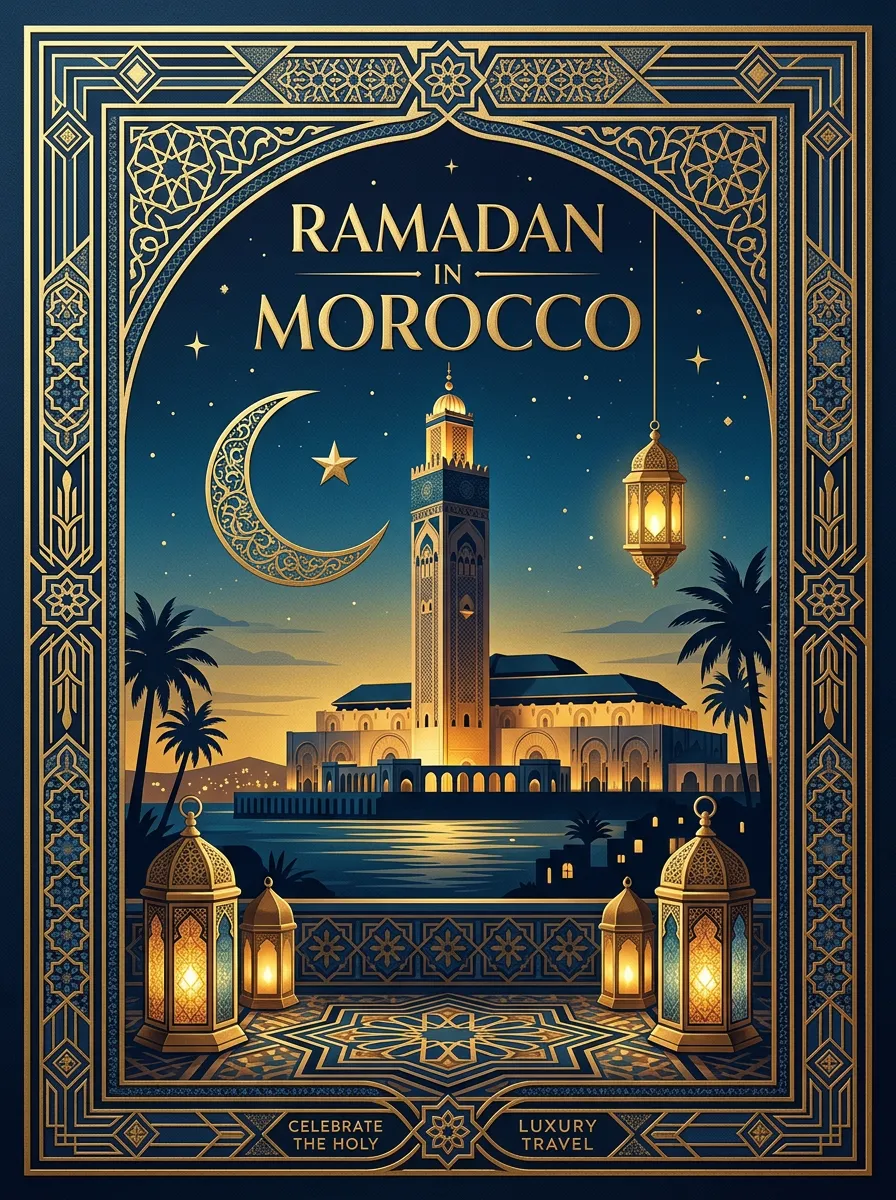
Ramadan (dates vary)
Approximately February 28 - March 30, 2025 / March 17 - April 16, 2026 (varies by moon)
The holy month of fasting from dawn to sunset. While not a festival, Ramadan transforms Morocco's daily rhythm. The streets empty by day and come alive after sunset when families break the fast (ftour) with harira, dates, chebakia, and elaborate meals. The atmosphere after sunset is magical -- streets fill with people, cafes buzz, and there is a sense of communal celebration.
Tickets
N/A
Accommodation
Normal pricing. Many restaurants close during the day but open for sunset.
Apr
April
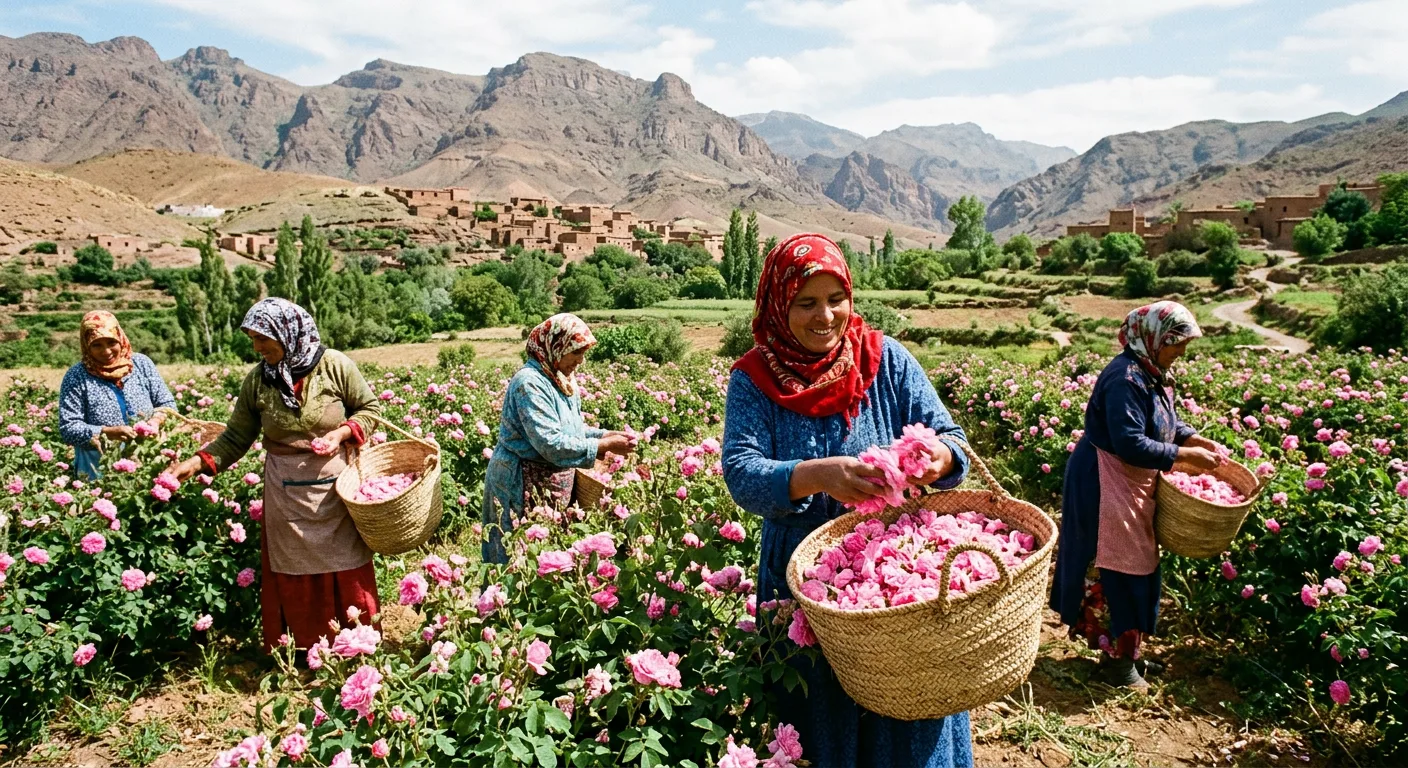
Kelaat M'gouna, Dades Valley
Rose Festival (Festival des Roses)
Late April / Early May
The Dades Valley, known as the "Valley of Roses," celebrates the annual rose harvest with a spectacular three-day festival. Local women pick Damascena roses at dawn, and the town hosts parades, Berber music, traditional dances, a Rose Queen competition, and markets selling rosewater, rose oil, and rose products. The entire valley is perfumed with roses.
Tickets
Free entry
Accommodation
Guesthouses in Kelaat M'gouna and nearby Boumalne Dades. Book 1 month ahead.
May
May
Fes
Fes Festival of World Sacred Music
Late May / Early June
Founded in 1994, this is one of Morocco's most prestigious cultural events. Musicians from across the globe perform sacred and spiritual music in the magnificent courtyard of the Bab Makina palace and at Dar Batha. Sufi qawwali from Pakistan, Gregorian chants, Jewish liturgical music, Hindu devotional songs, and Gnaoua all share the same stage. The night concerts in the medina are transcendent.
Tickets
from 200 MAD per concert (some free events)
Accommodation
Riads in the Fes medina fill up fast. Book 2 months ahead.
Jun
June
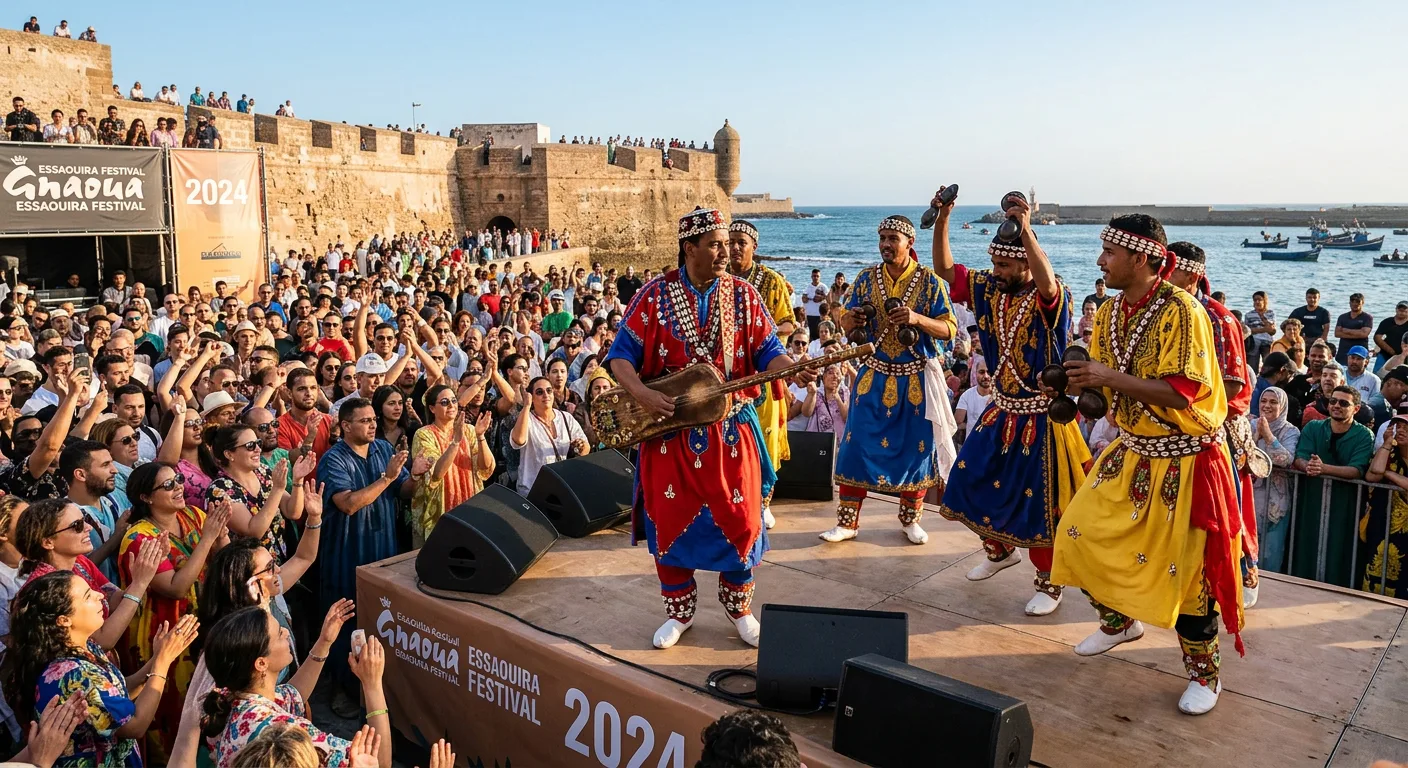
Essaouira
Gnaoua World Music Festival
Late June (4 days)
The biggest and most beloved music festival in Morocco. Gnaoua musicians -- spiritual healers whose music traces back to sub-Saharan African traditions -- collaborate with international artists (jazz, blues, rock, world) for electrifying fusion performances. Free outdoor stages on the beach and in Place Moulay Hassan, plus ticketed concerts. Over 500,000 attendees annually. The energy is indescribable.
Tickets
Main outdoor stages are FREE. Indoor concerts from 300 MAD.
Accommodation
Book 2-3 months ahead. Essaouira triples its prices during the festival.
Rabat
Mawazine Festival
Mid-June (5 days)
One of the largest music festivals in the world by attendance (2.5+ million). Massive international headliners (past acts: Rihanna, Elton John, Maroon 5, David Guetta) alongside Arabic pop stars and Moroccan artists. Multiple stages across Rabat. The OLM Souissi stage hosts international acts, while Nahda stage features Arabic and Moroccan artists.
Tickets
Most stages are FREE. VIP access available for select concerts.
Accommodation
Rabat has ample hotel capacity. Still book 1 month ahead for best options.
Jul
July

Marrakech
Festival of Popular Arts (Fantasia)
Early July
A celebration of Moroccan traditional arts held in the El Badi Palace ruins. Features Tbourida (fantasia) -- the spectacular cavalry charge where horsemen in traditional dress fire muskets in perfect unison. Also includes Gnaoua trance music, Berber dancers, Saharan performers, and traditional craftsmen from across the kingdom. A living showcase of Morocco's diverse cultural heritage.
Tickets
from 100 MAD
Accommodation
Marrakech has abundant accommodation. Moderate pricing in July.
Aug
August
Moulay Idriss Zerhoun
Moussem of Moulay Idriss
Late August / Early September
The largest and most important moussem (religious pilgrimage festival) in Morocco, honoring Moulay Idriss I, the founder of the first Moroccan dynasty and great-grandson of Prophet Muhammad. Pilgrims gather from across the country for prayer, Sufi brotherhood ceremonies, fantasia (Tbourida), markets, and communal meals. Non-Muslims can attend the outdoor celebrations but not enter the shrine.
Tickets
Free (outdoor events)
Accommodation
Limited in Moulay Idriss -- stay in nearby Meknes (30 min drive).
Sep
September
Tangier
Tanjazz Festival
Mid-September (4 days)
Tangier's international jazz festival brings world-class jazz, blues, and fusion musicians to intimate venues across the city. Concerts in historic palaces, rooftop terraces, and the Cervantes Theatre. Tangier's cosmopolitan heritage as a meeting point of cultures makes it the perfect backdrop for jazz. A more intimate, sophisticated alternative to the larger festivals.
Tickets
from 100 MAD per concert
Accommodation
Tangier has good hotel availability. Book 2 weeks ahead.
Oct
October
Erfoud, Ziz Valley
Date Festival (Festival des Dattes)
Late October (3 days)
The oasis town of Erfoud celebrates the annual date harvest with this unique festival. Dates are sacred in Moroccan culture -- the traditional food for breaking Ramadan fast. The festival features date tastings (Morocco has dozens of varieties, with Majhoul being the most prized), camel races, Berber music, folklore performances, and a date queen competition. Also a gateway to Sahara desert trips.
Tickets
Free entry
Accommodation
Desert camps and hotels in Erfoud and nearby Rissani. Book ahead.
Nov
November
Marrakech
Marrakech International Film Festival (FIFM)
Late November / Early December
Founded in 2001, the FIFM has become one of Africa's premier film festivals. International and Moroccan films screen at the Palais des Congres, and open-air screenings in Jemaa el-Fnaa attract thousands. Past guests include Martin Scorsese, Francis Ford Coppola, and numerous international stars. The red carpet events and tributes draw global media attention.
Tickets
Screenings from 30 MAD. Some free outdoor screenings.
Accommodation
Marrakech prices spike during the festival. Book 1-2 months early.
Dec
December
Marrakech, Casablanca, Tangier
New Year Celebrations
December 31
While Morocco is a Muslim country, New Year's Eve is widely celebrated in the major cities, especially in tourist areas. Upscale hotels and riads host gala dinners, Jemaa el-Fnaa fills with celebrators, and Casablanca's Corniche and clubs have major parties. Fireworks are common. Marrakech is the most popular destination for New Year's in Morocco.
Tickets
Hotel galas: from 800 MAD per person
Accommodation
Peak pricing everywhere. Book 2-3 months ahead, especially Marrakech.
Cultural Heritage
Traditional Celebrations & Holidays
Beyond the organized festivals, Morocco's calendar is punctuated by religious holidays and traditional celebrations that offer the most authentic cultural experiences.
Tbourida (Fantasia)
Year-round at regional moussems; July in Marrakech
A spectacular equestrian tradition where a line of horsemen in traditional dress charge at full gallop and fire their muskets simultaneously in a thunderous volley. Performed at moussems, national celebrations, and cultural festivals throughout the year. UNESCO Intangible Cultural Heritage since 2021. The most common in the Doukkala region and at the Marrakech Festival of Popular Arts.
Eid al-Fitr
The day after Ramadan ends (varies by lunar calendar)
The celebration marking the end of Ramadan. Three days of feasting, family visits, new clothes, and gifts. Streets fill with joy after a month of fasting. Special pastries (kaab el ghazal, briouats) are prepared, and families gather for elaborate meals. Banks and government offices close for 2-3 days.
Eid al-Adha
Approximately June 6-8, 2025 / May 26-28, 2026 (varies by lunar calendar)
The "Festival of Sacrifice" -- the most important religious holiday in Morocco. Every family that can afford it sacrifices a sheep, commemorating Abraham's willingness to sacrifice his son. The atmosphere in the days leading up is electric -- sheep markets appear everywhere. Families share the meat with neighbors and the poor. Banks and businesses close for 3-4 days.
Mawlid (Prophet's Birthday)
Approximately September 4, 2025 / August 24, 2026 (varies by lunar calendar)
The celebration of the birth of Prophet Muhammad. Families prepare special foods, children receive gifts, and mosques hold special prayers and Quran recitations. Processions with candles and lanterns in some cities. A public holiday with a festive, spiritual atmosphere.
Yennayer (Amazigh New Year)
January 13-14 annually (fixed date, not lunar)
The Berber/Amazigh New Year, celebrated on January 13 or 14. Recognized as a national holiday in Morocco since 2023. Traditional Berber foods are prepared (couscous with seven vegetables, dried fruits, tagine), families gather, and cultural performances celebrate Amazigh heritage. Particularly vibrant in the Atlas Mountains and Rif region.
Must-Attend
Gnaoua World Music Festival
If you can only attend one festival in Morocco, make it this one. For four days every June, the Atlantic-coast town of Essaouira becomes the world capital of Gnaoua music -- an ancient spiritual tradition rooted in sub-Saharan African heritage. International musicians collaborate with Gnaoua masters (maalems) for unique fusion performances that happen nowhere else. The main stages are free. The ocean breeze, the sunset concerts, the late-night trance sessions in the medina -- it is unforgettable.
UNESCO Heritage
Tbourida -- The Fantasia
One of Morocco's most spectacular traditions. A line of horsemen in flowing white robes and turbans, mounted on decorated horses, charge at full gallop and fire their muskets in perfect unison with a thunderous crack. Inscribed as UNESCO Intangible Cultural Heritage in 2021.
The Tbourida is performed at moussems (religious pilgrimages), national celebrations, and cultural festivals across the country. Each region has its own horsemen teams (sorbas), and competitions are fierce. The synchronization of the final volley is what judges look for.
Where to see Tbourida:
- Marrakech Festival of Popular Arts (July)
- Moussem of Moulay Idriss (August-September)
- Salon du Cheval, El Jadida (October)
- National Throne Day celebrations (July 30)
Special Season
Visiting During Ramadan
Ramadan is a special time to visit Morocco. While it requires some adjustment, the spiritual atmosphere and the nightly ftour (breaking of the fast) celebrations are deeply memorable.
Changed rhythms
Shops and restaurants may close during the day or have reduced hours. The pace of life slows. Many Moroccans nap in the afternoon. The real action begins at sunset.
Ftour (sunset meal)
The daily fast is broken at sunset with dates, harira soup, chebakia pastries, hard-boiled eggs, and juice. Restaurants set up special ftour menus. Being invited to a family ftour is a treasured experience.
Night comes alive
After ftour, the streets fill with people. Cafes buzz until late. Markets stay open past midnight. The atmosphere is festive and communal. A unique time to experience Moroccan culture.
Etiquette for visitors
Non-Muslims are not required to fast, but eating, drinking, and smoking in public during daylight hours is considered disrespectful. Tourist restaurants and riads serve meals discreetly.
Special foods
Ramadan brings unique foods: chebakia (honey-sesame cookies), harira, briouats (stuffed pastries), sellou, and special breads. The variety at sunset is extraordinary.
Practical impact
Some tourist sites may have reduced hours. Alcohol is harder to find. Transportation runs normally. Hotels and riads serve breakfast to guests. Travel is still perfectly feasible.
Be Prepared
Festival Planning Tips
Book accommodation early
Festival periods see hotel prices double or triple. Book 2-3 months in advance for Gnaoua, Mawazine, and the Marrakech Film Festival. Smaller festivals require less lead time.
Photography tips
Most festivals welcome photography. Ask before photographing individuals, especially at religious events. The light is best at golden hour. Bring a wide-angle lens for crowd shots and intimate portraits.
Check dates carefully
Islamic holidays follow the lunar calendar and shift each year. Music festival dates are announced 2-4 months in advance. Always verify current dates before booking flights.
Be respectful at religious events
At moussems and religious celebrations, dress conservatively, ask permission before entering areas, and follow local guidance. Non-Muslims are welcome at outdoor events but not at shrines.
Plan Your Festival Trip
Combine a festival with city exploration, desert adventures, or coastal relaxation for the ultimate Moroccan experience.
Continue Exploring Morocco
Discover more of what Morocco has to offer