Discovering...
Architecture & Design
Moroccan Architecture Guide:
Twelve Centuries of Design
From Almohad minarets and Marinid madrasas to Art Deco boulevards and contemporary galleries. A detailed survey of the buildings, techniques, and craftsmen that shaped Morocco.
Why Morocco Is an Architectural Masterclass
Morocco sits at the intersection of Africa, Europe, and the Arab world. Each civilization that passed through left its mark in stone, plaster, tile, and earth. Amazigh builders raised rammed-earth fortresses along Saharan trade routes before the 7th century. Umayyad and later Andalusian exiles imported horseshoe arches and zellige craftsmanship to Fes. Almohad sultans built minarets so influential their proportions were replicated in Seville and Rabat alike. French Protectorate architects fused reinforced concrete with Moroccan motifs to create Casablanca's Art Deco district, the largest in Africa.
What makes Moroccan architecture distinct is continuity. The same zellige workshops in Fes that supplied the Attarine Madrasa in 1325 still produce tiles today. Tadelakt plasterers in Marrakech use the same local lime and polishing stones their predecessors used in the 16th century. When Michel Pinseau designed the Hassan II Mosque in the 1980s, he employed 6,000 traditional artisans alongside modern engineers. Understanding these techniques transforms a visit from sightseeing into reading a 1,200-year manuscript written in geometry, light, and material.
Major Architectural Styles
Five distinct traditions, each rooted in a specific era and political context, define the built environment of Morocco.
Moorish-Andalusian
8th-15th centuryAfter the fall of Cordoba and Granada, Andalusian refugees brought refined building techniques to Fes, Meknes, and Tetouan. The style fuses Umayyad Spanish and North African traditions: horseshoe arches, intricate stucco carving, zellige mosaic floors, polychrome woodwork, and serene courtyard gardens with central fountains. The Bou Inania Madrasa in Fes (1351-1356), commissioned by Marinid Sultan Abu Inan Faris, is the finest surviving synthesis of these two traditions.
Key buildings: Bou Inania Madrasa (Fes), Attarine Madrasa (Fes), Bahia Palace (Marrakech)
Almohad Imperial
12th-13th centuryThe Almohad dynasty (1121-1269) brought monumental scale and geometric austerity to Moroccan architecture. Under Sultan Yacoub al-Mansour, massive gates, minarets, and mosques rose across the empire. The unfinished Hassan Tower in Rabat (begun 1195) was intended to crown the largest mosque in the western Islamic world. Almohad builders favored massive rammed-earth walls, darj-wa-ktarf (step-and-shoulder) merlon crenellations, and restrained exterior decoration that contrasted with lavish interiors.
Key buildings: Hassan Tower (Rabat), Koutoubia Mosque (Marrakech), Giralda (Seville, same architect)
Berber Vernacular
Pre-Islamic to presentAmazigh architecture responds directly to geography and climate. In the Draa and Dades valleys, rammed-earth kasbahs and ksour use thick walls for thermal insulation, with narrow windows to reduce heat gain. In the Rif Mountains, stone-and-timber construction handles heavier rainfall. Anti-Atlas agadirs (communal granaries) perch on hilltops for defense. Decoration consists of geometric reliefs pressed into wet mud plaster, and painted ceilings using natural pigments. Ait Benhaddou, built between the 14th and 17th centuries, earned UNESCO World Heritage status in 1987.
Key buildings: Ksar Ait Benhaddou, Kasbah Telouet, Agadir of Amtoudi
French Colonial & Art Deco
1912-1956During the Protectorate (1912-1956), French architect Henri Prost drafted Casablanca's urban plan, separating the medina from the Ville Nouvelle. Architects like Marius Boyer, Pierre Jabin, and Auguste Cadet designed hundreds of Art Deco buildings using reinforced concrete adorned with Moroccan motifs. Boyer alone designed over 100 buildings in Casablanca between 1919 and 1955. The Cinema Rialto (1930), Sacre-Coeur Cathedral (Paul Tournon, 1930), and the Quartier des Habous (Albert Laprade, 1917-1930s) exemplify this hybrid style.
Key buildings: Cinema Rialto, Sacre-Coeur Cathedral, Quartier des Habous (all Casablanca)
Contemporary & Neo-Moroccan
1980s-presentModern Moroccan architecture blends international methods with local craft. Michel Pinseau designed the Hassan II Mosque (completed 1993) with a retractable roof and 210-meter minaret, the tallest religious structure in Africa. The MACAAL contemporary art museum opened in Marrakech in 2016. The Grand Theatre de Casablanca, designed by Christian de Portzamparc and expected to open in 2025, deploys sweeping concrete shells inspired by drapery. Tarik Oualalou and Studio KO have led a generation of architects rethinking earthen construction with contemporary sensibility.
Key buildings: Hassan II Mosque (Casablanca), MACAAL (Marrakech), Grand Theatre (Casablanca)
Key Architectural Elements
The building blocks of Moroccan design: materials and techniques that have defined the country's architecture for a millennium.
Zellige Tilework
Hand-cut geometric mosaic tiles produced continuously in Fes since the 10th century. Artisans at workshops like the Fassi firm of Beldi chisel individual shapes from glazed terracotta, assembling them face-down into star-and-polygon patterns. A square meter can require over 1,000 pieces and days of labor. Colors traditionally included white, green, blue, yellow, black, and the prized bordeaux.
Where to see it: Bou Inania Madrasa (Fes), Bahia Palace (Marrakech), Royal Palace (Meknes)
Muqarnas Vaulting
Three-dimensional honeycomb vaulting that creates a stalactite effect through tiers of stacked concave cells. Moroccan muqarnas reached their peak under the Marinids (13th-15th century). Master builders calculated each cell in advance using geometric diagrams on paper. The Saadian Tombs in Marrakech (Hall of Twelve Columns, 1590s) contain carved cedar muqarnas gilded with 24-karat gold leaf.
Where to see it: Saadian Tombs (Marrakech), Bou Inania Madrasa (Fes), Attarine Madrasa (Fes)
Carved Plaster (Gebs)
Gypsum plaster is hand-carved in situ while still damp, producing flowing arabesques, Kufic calligraphy, and floral motifs. The technique allows walls to be covered from zellige wainscoting up to the cedarwood ceiling. Craftsmen (maalems) in Fes still apprentice for five or more years before working independently. The Bahia Palace in Marrakech, built by Grand Vizier Si Moussa in the 1860s and expanded by Ba Ahmed ibn Moussa through the 1890s, contains some of the most elaborate surviving gebs work.
Where to see it: Bahia Palace (Marrakech), Dar Si Said Museum (Marrakech), Glaoui Palace (Telouet)
Cedarwood Carving
Atlas cedarwood (Cedrus atlantica) is carved into mashrabiya screens, palace ceilings, doors, and minbars. The wood's natural oils resist insects, and its grain accepts fine detail. The minbar of the Koutoubia Mosque, created in Cordoba in 1137 and transported to Marrakech, required seven years of work by Andalusian craftsmen and contains over 1,000 individual inlaid pieces of ivory, bone, and precious woods.
Where to see it: Koutoubia Mosque minbar (viewable at Badi Palace museum), Bahia Palace, Fes medina foundouks
Horseshoe & Multifoil Arches
The horseshoe arch extends beyond a semicircle, enclosing about two-thirds of a full circle. It arrived in Morocco from Umayyad Spain and became the defining silhouette of Moroccan doorways and prayer niches. Multifoil (lobed) arches subdivide the curve into three, five, or more cusps. The Bab Mansour gate in Meknes (completed 1732 under Sultan Moulay Ismail) displays massive horseshoe arches framed in zellige.
Where to see it: Bab Mansour (Meknes), Bab Agnaou (Marrakech), Koutoubia Mosque (Marrakech)
Tadelakt Plaster
A waterproof lime plaster native to the Marrakech region, polished with flat stones and treated with olive oil soap to create a smooth, water-resistant finish. Used in hammams, fountains, and bathrooms for centuries. The technique requires specific lime from the Marrakech plateau and precise timing during application. Contemporary designers have adopted tadelakt for luxury interiors worldwide.
Where to see it: Traditional hammams, riad bathrooms, Bahia Palace surfaces
Iconic Buildings You Should Not Miss
Five structures that represent the pinnacle of Moroccan architectural achievement, from medieval madrasas to modern megaprojects.
Hassan II Mosque, Casablanca
Completed 1993Michel Pinseau
Built on a platform over the Atlantic Ocean, this is the largest mosque in Africa and the 5th largest in the world. Its 210-meter minaret is topped with a laser beam directed toward Mecca. The retractable roof opens to the sky, and the prayer hall holds 25,000 worshippers with space for 80,000 more in the courtyard. Over 6,000 Moroccan artisans produced the zellige, carved plaster, painted cedarwood, and marble. Total cost: approximately 800 million USD, funded largely by public donation.
Guided tours for non-Muslims daily except Friday. From 130 MAD.
Bou Inania Madrasa, Fes
Built 1351-1356Commissioned by Sultan Abu Inan Faris
The last and most ambitious of the Marinid-era madrasas. Unique among Moroccan madrasas for containing a minbar and serving as a Friday mosque in addition to a theological school. Every surface is ornamented: zellige mosaic from floor to mid-wall, carved stucco above, and painted cedarwood ceilings overhead. The bronze-and-brass water clock on the exterior, powered by hydraulics, is the only known surviving medieval example of its kind in Morocco.
Open to non-Muslims. Entry from 30 MAD.
Bahia Palace, Marrakech
Built 1860s-1900Grand Vizier Si Moussa (original), expanded by Ba Ahmed ibn Moussa
Spread across eight hectares, the Bahia ("brilliance") Palace was built to be the greatest palace of its time. Ba Ahmed assembled the finest maalems from Fes to execute carved cedarwood ceilings, zellige floors, and gebs walls. The Petit Riad section, with its intimate painted ceilings, contrasts with the Grand Riad's vast marble courtyard. The palace has no upper floors because Ba Ahmed, reportedly too heavy to climb stairs, insisted all rooms remain at ground level.
Open daily. Entry from 70 MAD.
Ksar Ait Benhaddou
14th-17th centuryCommunal Berber construction
A fortified village of interconnected rammed-earth dwellings on the Ouarzazate-Marrakech caravan route. Six families still live within the walls. The ksar earned UNESCO World Heritage status in 1987 and has served as a filming location for Lawrence of Arabia (1962), Gladiator (2000), and Game of Thrones (2013-2019). The earthen structures require constant maintenance, with the outer layer re-applied after each rainy season.
Free entry. Local guides from 100 MAD. 30 km from Ouarzazate.
Saadian Tombs, Marrakech
Built 1590sCommissioned by Sultan Ahmad al-Mansur
Sealed by the Alaouite dynasty after 1672 and rediscovered by a French aerial survey in 1917. The Hall of Twelve Columns contains the tomb of Ahmad al-Mansur beneath a cedar muqarnas dome gilded with imported Sudanese gold. Italian Carrara marble columns support horseshoe arches, and the surrounding walls carry some of the finest zellige and gebs work in Marrakech.
Open daily. Entry from 70 MAD.
Riad Architecture Explained
The riad is Morocco's most distinctive domestic building type. The word derives from the Arabic "ryad" (garden), and the form has shaped urban life in Fes, Marrakech, Meknes, and Essaouira for centuries.
Most historic riads date from the 17th to 19th centuries. Since the late 1990s, thousands have been restored and converted into guesthouses, bringing a global audience into direct contact with traditional Moroccan design.
Central Courtyard (Wust al-Dar)
The heart of the riad, open to the sky. Traditionally contains a marble fountain, citrus trees, and sometimes a plunge pool. The courtyard provides light, ventilation, and a private outdoor space shielded from the street. Rooms on all four sides open directly onto this space.
Inward-Facing Design
Riads present blank exterior walls to the street, with only a modest doorway. All windows face the courtyard. This design reflects Islamic principles of privacy (haya) and the separation of public and domestic life. A bent entrance passage (skifa) prevents passersby from seeing inside.
Rooftop Terrace
Every riad has a roof terrace for drying laundry, socializing, and sleeping during hot months. In converted guest riads, terraces now serve as dining areas and lounges with views across the medina roofscape toward minarets and mountains.
Tadelakt Walls & Zellige Floors
Lower walls and floors use zellige tilework for durability and beauty. Upper walls feature carved plaster or painted lime. Bathrooms and wet areas use tadelakt, the waterproof lime plaster polished to a marble-like sheen. Color palettes vary: Fes riads favor blue and white, Marrakech riads use warmer terracottas.
Cedarwood Ceilings & Doors
Ceilings display painted geometric patterns or exposed carved beams. Main doors are thick cedar planked with iron studs and fitted with traditional knockers: one heavy ring for men (producing a deep sound) and a lighter hand-shaped knocker for women (a higher pitch), allowing the household to know who is calling before opening.
Mashrabiya Screens
Turned-wood lattice screens cover upper-floor windows overlooking the courtyard. They allow residents to observe without being seen, circulate air while filtering direct sunlight, and demonstrate the woodworker's skill. Geometric star patterns are the most common motif.
Kasbahs & Ksour: Fortified Earth Architecture
Southern Morocco's kasbahs and ksour represent one of the world's great traditions of earthen construction.
Construction Technique: Pise (Rammed Earth)
Builders pack damp earth mixed with straw and small stones between parallel wooden forms (tabya), compacting it by hand or foot. Each course dries before the next is added. Walls taper from about 80cm thick at the base to 40cm at the top. The resulting structures have excellent thermal mass, staying cool by day and releasing stored warmth at night. Without maintenance, pise walls erode at roughly 1-2cm per year, which is why many abandoned kasbahs appear to be melting back into the landscape.
Social Organization
A ksar houses an entire community. Inside the defensive walls, narrow lanes connect family dwellings, a communal mosque, a grain storage area, and sometimes a Jewish quarter (mellah). Each family maintained its own rooms but shared responsibility for wall maintenance and gate security. The amghar (elected elder) coordinated communal labor. This cooperative structure reflects the Amazigh jemaa (council) system of governance, one of Africa's oldest forms of participatory decision-making.
Decoration
The upper facades of kasbahs display geometric motifs pressed into wet mud plaster: chevrons, diamonds, blind arches, and stylized floral patterns. Corner towers feature crenellated parapets. The Kasbah Telouet, seat of the Glaoui lords from the 1860s to 1956, contains interior rooms with zellige, carved plaster, and painted ceilings rivaling urban palaces, a striking contrast to its crumbling pise exterior.
Conservation Challenges
As families relocate to modern concrete housing, many kasbahs and ksour are deteriorating. CERKAS (the Centre for the Conservation and Rehabilitation of the Architectural Heritage of the Atlas and Sub-Atlas Zones), based in Ouarzazate, leads restoration efforts. International projects like the Aga Khan Trust for Culture have also intervened. Climate change, with increasing flash floods, accelerates erosion of unprotected structures.
French Colonial Architecture & Casablanca Art Deco
The French Protectorate (1912-1956) reshaped Morocco's urban landscape. Nowhere is this more visible than in Casablanca.
Resident-General Hubert Lyautey made a strategic decision: preserve the medinas and build modern villes nouvelles alongside them. He appointed Henri Prost to plan Casablanca, Rabat, Fes, and Meknes. Prost's Casablanca plan (1914-1917) created broad boulevards, public parks, and zoning regulations that attracted European architects eager to experiment with Art Deco on a scale impossible in Paris.
Marius Boyer arrived in Casablanca in 1919 and over the next 36 years designed more than 100 buildings, including apartment blocks, cinemas, and commercial buildings. Boyer and contemporaries like Pierre Jabin, Auguste Cadet, and Edmond Brion incorporated Moroccan elements: zellige panels, horseshoe arch windows, geometric stucco friezes. The result was a unique Mauresque-Deco hybrid found nowhere else.
Casamemoire: Preserving Casablanca's Heritage
The Casamemoire association, founded in 1995, campaigns for the preservation of Casablanca's 20th-century architectural heritage. They maintain an inventory of over 1,000 significant buildings, organize public walking tours, and lobby for heritage protection legislation. Their efforts led to the classification of several Art Deco buildings as national monuments. Monthly architecture walks (typically on Saturdays, from 50 MAD) are the best way to understand the city's built history.
Modern Morocco: Contemporary Architecture
A new generation of architects is reinterpreting Moroccan building traditions through contemporary lenses.
MACAAL, Marrakech (2016)
The Museum of African Contemporary Art Al Maaden opened in 2016 in a former residential villa redesigned for gallery use. It hosts rotating exhibitions of African contemporary art in clean, naturally lit spaces that contrast with Marrakech's historic aesthetic. Entry from 40 MAD.
Grand Theatre de Casablanca
Designed by Pritzker Prize-winning architect Christian de Portzamparc, this performing arts center features sweeping concrete shells and a translucent facade inspired by flowing fabric. Situated near the Hassan II Mosque, it is expected to become Casablanca's principal cultural venue upon completion.
Mohammed VI Museum of Modern Art, Rabat (2014)
Designed by Karim Chakor, this was Morocco's first major public museum of modern and contemporary art. The building integrates Hispano-Moorish arched porticos with minimalist white interiors. Its permanent collection spans Moroccan art from the 1950s to the present. Entry from 40 MAD.
Studio KO & New Earthen Architecture
The Paris-Marrakech firm Studio KO (Karl Fournier and Olivier Marty) designed the Yves Saint Laurent Museum Marrakech (2017), clad in terracotta-colored concrete that references Berber earthen construction. Tarik Oualalou, based in Marrakech, applies parametric design tools to rammed-earth construction, demonstrating that traditional materials can meet contemporary performance standards.
Architecture Tours Across Morocco
Guided tours provide context that self-guided visits cannot. Here are the principal options by city.
Fes: Medieval Madrasas & Foundouks
Walk through the 9th-century medina to visit the Bou Inania and Attarine madrasas, Qarawiyyin Mosque exterior (founded 859, making it the world's oldest continuously operating university), and restored merchant foundouks. Guides explain Marinid building techniques and zellige production.
Half day (3-4 hours)From 350 MAD with licensed guide
Marrakech: Palaces & Saadian Heritage
Cover the Bahia Palace, Badi Palace ruins, Saadian Tombs, Koutoubia Mosque exterior, and Ben Youssef Madrasa. Some tours include a visit to a zellige workshop in the Mellah district. Evening tours offer different light on carved plaster.
Half day (3-4 hours)From 400 MAD with licensed guide
Casablanca: Art Deco & Modern Architecture
The Casamemoire association organizes monthly walking tours through the Ville Nouvelle, covering Marius Boyer apartment buildings, the Sacre-Coeur Cathedral, Cinema Rialto, and Boulevard Mohammed V arcades. Private tours visit the Hassan II Mosque interior and the Quartier des Habous.
Half day (3-4 hours)From 300 MAD for Casamemoire group tours, from 1,500 MAD private
Ouarzazate & Draa Valley: Kasbahs & Earthen Architecture
Multi-day circuits cover Ait Benhaddou, Kasbah Telouet, Kasbah Taourirt, Skoura oasis palm grove kasbahs, and the Draa Valley ksour. Specialist guides explain rammed-earth construction, restoration challenges, and the social organization that produced these fortified villages.
Two to three days recommendedFrom 1,200 MAD per day for driver-guide
Meknes & Volubilis: Imperial & Roman Ruins
Combine Sultan Moulay Ismail's grandiose 17th-century capital, including the Bab Mansour gate and the Heri es-Souani grain stores, with the Roman ruins of Volubilis (founded 3rd century BC). The juxtaposition of Roman mosaics with Islamic tilework demonstrates two millennia of architectural dialogue.
Full day (7-8 hours)From 500 MAD with transport from Fes
Architecture Photography Tips
Practical advice for capturing Moroccan buildings and interiors at their best.
Shoot during golden hour and blue hour
Moroccan buildings glow warmest in the first and last hours of sunlight. The Koutoubia minaret at sunset and Ait Benhaddou at dawn are iconic for a reason. Blue hour (just after sunset) brings out the contrast between warm electric light and cool sky.
Use a wide-angle lens for courtyards
Riad courtyards and madrasa interiors are compact spaces packed with detail. A 16-35mm lens captures the full height of tilework, archways, and cedarwood ceilings in a single frame. Shoot from corners to maximize depth.
Look up at ceilings and muqarnas
Many visitors photograph walls and floors but miss the most spectacular elements overhead. Painted cedarwood ceilings in the Bahia Palace and muqarnas domes in the Saadian Tombs reward an upward camera angle. A tripod helps in dim interiors.
Photograph details at zellige workshops
In Fes, working zellige ateliers allow photography. Close-up shots of artisans chiseling individual tiles, the color-sorted tile bins, and the face-down assembly process tell a story that finished walls alone do not.
Respect mosque photography rules
Non-Muslims cannot enter most mosques in Morocco. The Hassan II Mosque in Casablanca is the primary exception, and photography is allowed inside during guided tours. For other mosques, photograph exteriors and doorways only. Always ask permission before photographing people at prayer.
Bring a polarizing filter for zellige
Glazed zellige tiles reflect harsh light and lose color saturation. A circular polarizing filter cuts glare and deepens the greens, blues, and yellows. It also darkens skies behind minarets for more dramatic exterior shots.
Moroccan Architecture in Focus
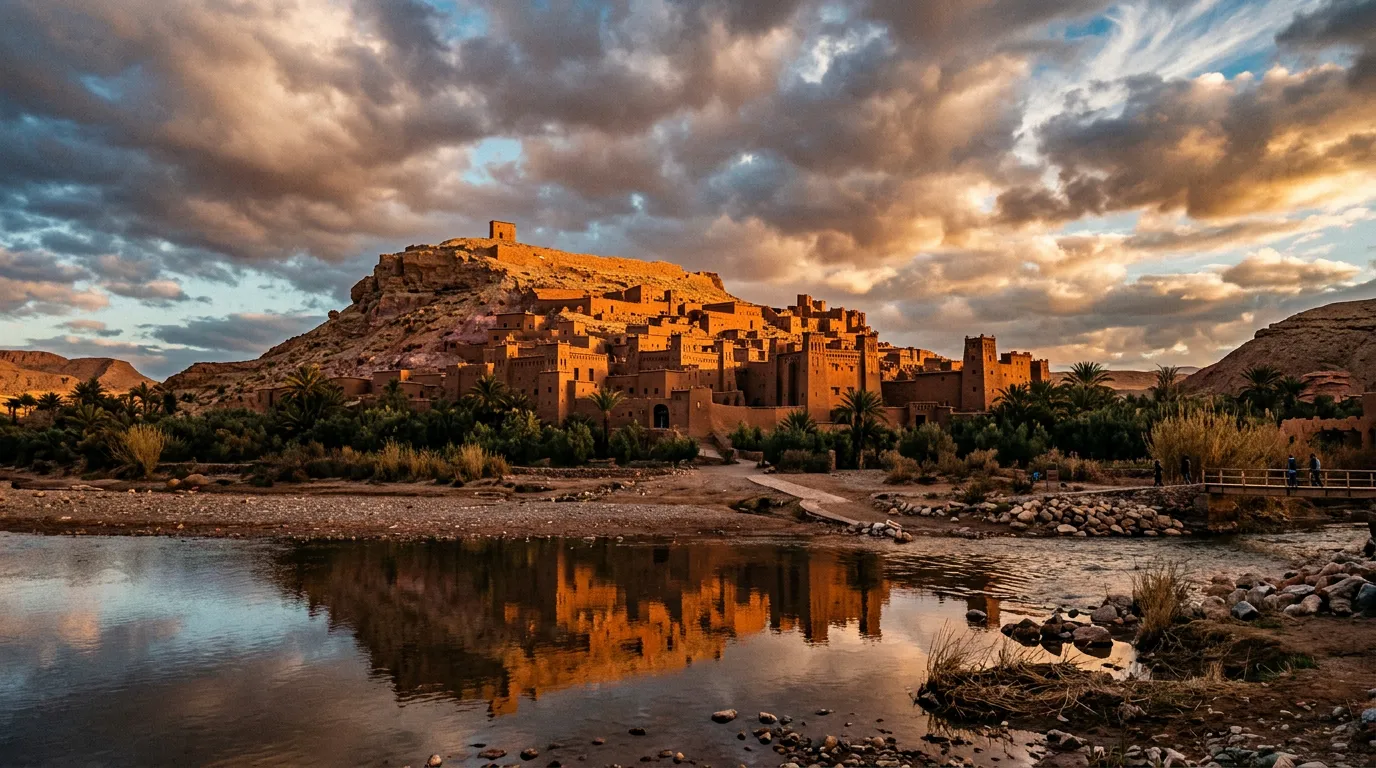
Kasbahs of the Draa Valley
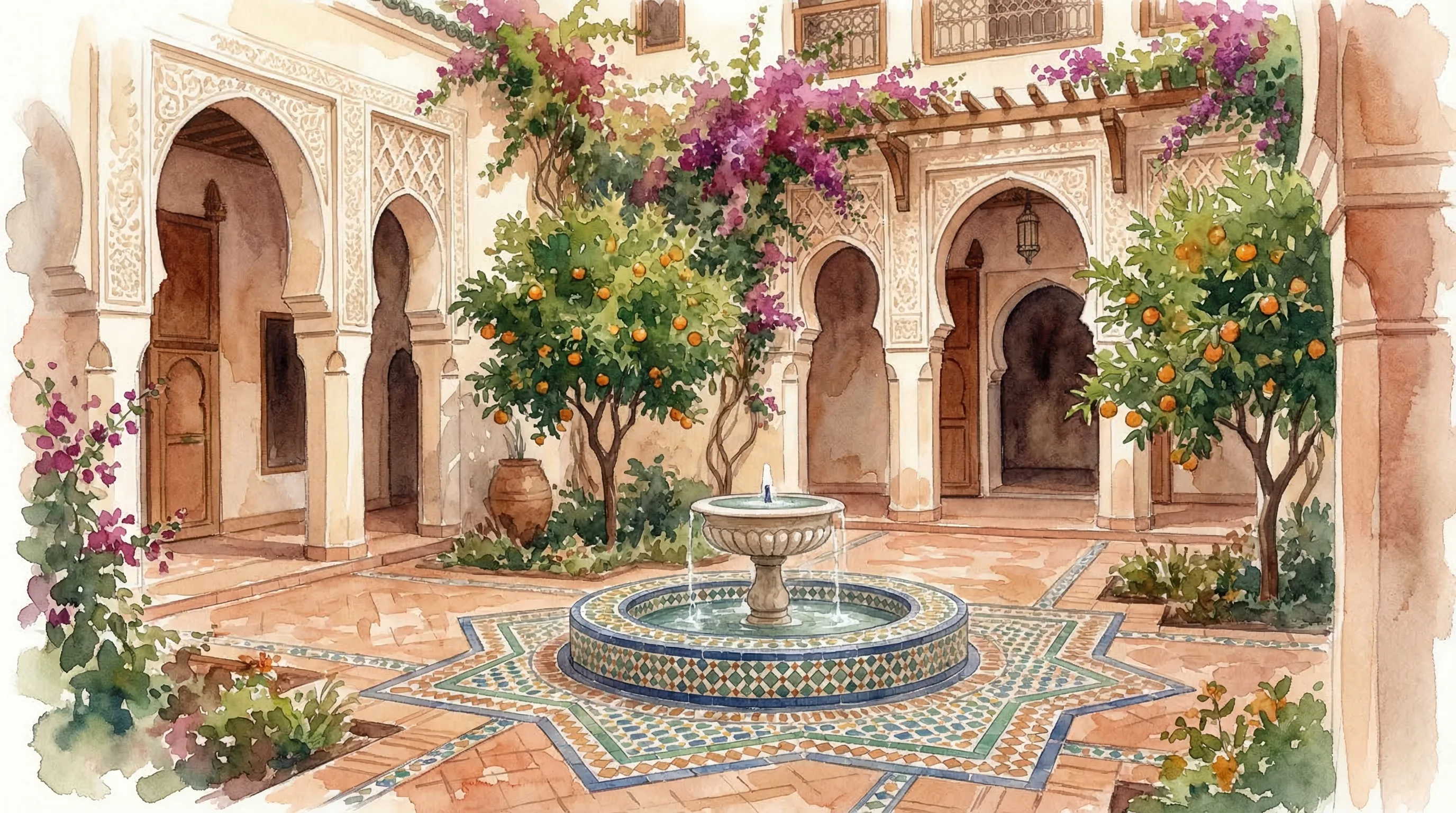
Riad Courtyard Design
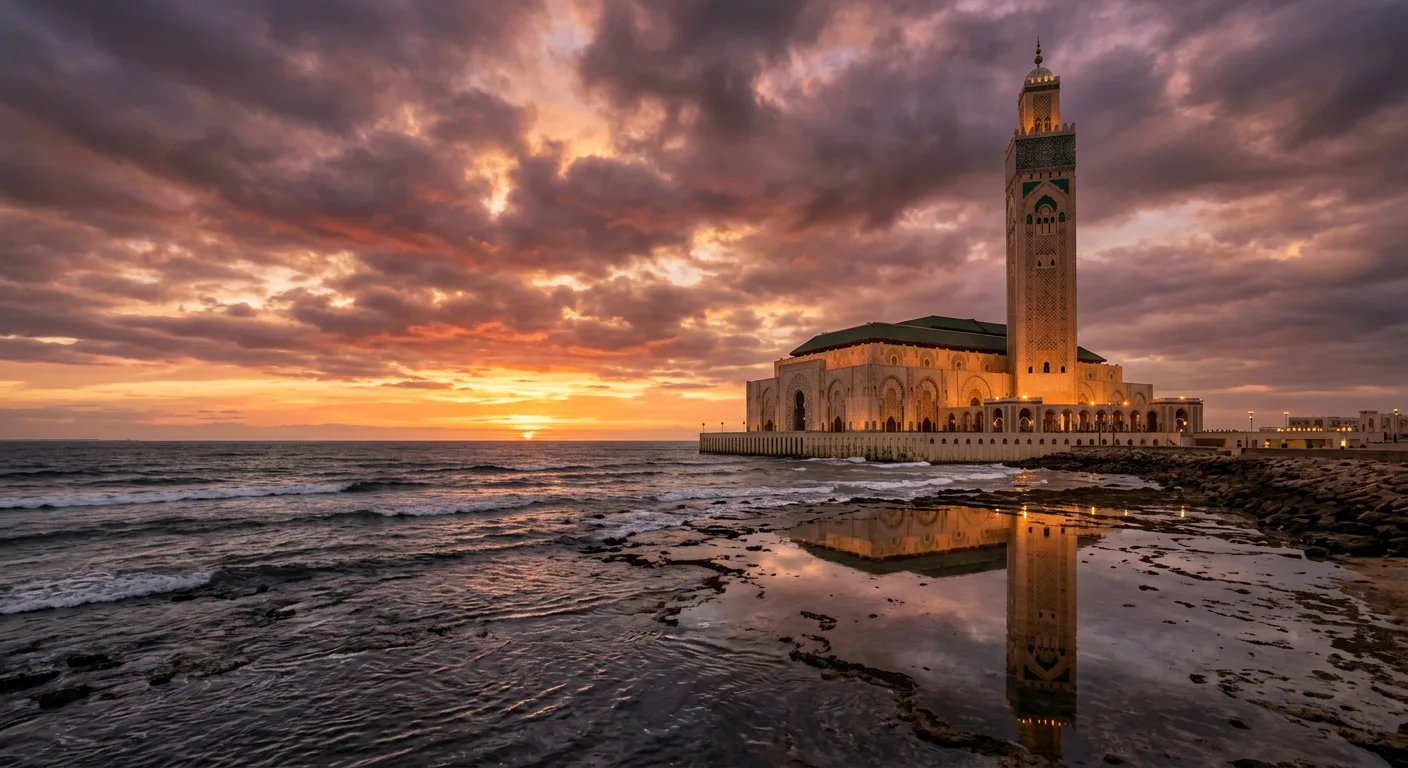
Hassan II Mosque
Frequently Asked Questions
What are zellige tiles and how are they made?
Zellige are hand-cut geometric mosaic tiles produced in Fes since the 10th century. Artisans chisel individual shapes from glazed terracotta squares, then assemble them face-down into star-and-polygon patterns. A single square meter can require over 1,000 pieces. The process remains almost entirely manual and takes years of apprenticeship to master.
What is the architectural layout of a traditional Moroccan riad?
A riad is an inward-facing house built around a central courtyard with a fountain or garden. Rooms open onto the courtyard, and windows face inward rather than onto the street. A rooftop terrace provides outdoor space. Walls use lime plaster (tadelakt), and floors feature zellige tiles. Most historic riads in Fes and Marrakech date from the 17th to 19th centuries.
Can I visit the Hassan II Mosque as a non-Muslim?
Yes. The Hassan II Mosque in Casablanca is one of the few mosques in Morocco open to non-Muslim visitors. Guided tours run daily except Friday at 10:00, 11:00, and 14:00 (with an additional 15:00 tour in summer). Tours last about one hour and cost from 130 MAD for adults. Modest dress is required.
What is the difference between a kasbah and a ksar?
A kasbah is a single fortified residence belonging to one family, with corner towers and decorated facades. A ksar (plural: ksour) is an entire fortified village of interconnected dwellings within a shared wall. Ait Benhaddou is technically a ksar. Both use rammed earth (pise) construction.
Where can I see Art Deco architecture in Morocco?
Casablanca has the largest concentration of Art Deco buildings in Africa. Key examples include the Cinema Rialto (1930, Pierre Jabin), Sacre-Coeur Cathedral (Paul Tournon, 1930), and buildings along Boulevard Mohammed V. The Casamemoire association runs guided architecture walks, typically on Saturdays from 50 MAD.
What is muqarnas and where can I see it?
Muqarnas are three-dimensional honeycomb vaulting that creates a stalactite-like decorative effect. Outstanding examples include the Bou Inania Madrasa in Fes (1351-1356), the Saadian Tombs in Marrakech (1590s), and the Attarine Madrasa in Fes (completed 1325).
Are there architecture tours available in Morocco?
Several cities offer dedicated architecture tours. Fes medina tours cover medieval madrasas and foundouks. Marrakech tours visit Saadian-era palaces. Casablanca's Casamemoire association runs Art Deco walking tours. Prices range from 300 MAD for group walks to from 1,500 MAD for private half-day tours with a specialist.
What building materials are used in traditional Moroccan architecture?
Traditional construction uses locally sourced materials. Rammed earth (pise) forms walls in southern kasbahs. Tadelakt, a waterproof lime plaster, lines hammams and bathrooms. Atlas cedarwood is carved for doors and ceilings. Zellige tiles cover floors and lower walls. Carved gypsum plaster (gebs) decorates upper walls. Marble from Meknes quarries is used for columns.
Continue Exploring Morocco
Moroccan Riads Guide
How to choose and book the right riad, from budget gems to luxury historic houses.
Read moreBerber Culture Guide
Amazigh heritage, crafts, music, food, and village experiences in the Atlas Mountains.
Read moreCasablanca City Guide
Art Deco district, Hassan II Mosque, modern dining, and the business capital.
Read moreKasbahs & Ksour Guide
Explore Morocco's fortified earthen architecture along the southern caravan routes.
Read moreReady to Explore Morocco's Built Heritage?
From the zellige-clad madrasas of Fes to the rammed-earth kasbahs of the Draa Valley and the Art Deco boulevards of Casablanca, twelve centuries of architecture await.