Discovering...
Morocco Fishing Guide 2026
Atlantic deep-sea charters, Mediterranean rock fishing, Atlas Mountain fly fishing for trout, big game marlin and tuna, traditional harbors, and the freshest fish markets in North Africa.
50+ Species Atlantic & Mediterranean Atlas Freshwater
Fishing Across Two Coasts and the Atlas Mountains
Morocco sits at the crossroads of the Atlantic Ocean and the Mediterranean Sea, with 3,500 km of coastline and a mountain interior laced with cold, spring-fed rivers. This geographic diversity produces fishing opportunities found in few other countries on earth. The Atlantic coast from Tangier to Dakhla delivers world-class deep-sea fishing for tuna, marlin, and swordfish. The Mediterranean shore from Nador to Al Hoceima offers calmer waters rich in grouper, dentex, and bream. And the Middle Atlas mountains, rising above the cedar forests of Ifrane and Azrou, hold wild trout in streams that rival anything in southern Europe.
Morocco's fishing industry employs over 700,000 people and the country ranks as Africa's largest fish producer. For visiting anglers, the infrastructure ranges from purpose-built sport fishing charters in Dakhla to local fishermen who will take you out in a traditional wooden boat for a morning. Prices remain a fraction of comparable experiences in Europe or the Caribbean.
Atlantic Coast
2,900 km of coastline. Deep-sea charters, big game fishing, and legendary ports from Tangier south to Dakhla.
Mediterranean
500 km of coastline along the Rif. Calmer waters, rocky shore fishing, and access to the rich Alboran Sea.
Atlas Freshwater
Trout streams, highland lakes, and reservoirs across the Middle and High Atlas ranges above 1,500 meters.
Atlantic Deep-Sea Fishing
Morocco's Atlantic coast is one of the most productive fishing grounds in the world, fed by the cold Canary Current and rich in pelagic species from April through November.
Prices shown are starting prices and may vary by season, boat size, and operator.
Dakhla
Southern SaharaSport Fishing Capital
From 8,000 MAD per charter day
The undisputed sport fishing capital of Morocco and one of Africa's premier big game destinations. Dakhla's protected bay and open Atlantic host an extraordinary concentration of pelagic species. The warm Canary Current sweeps nutrient-rich upwellings along this coast, sustaining enormous schools year-round. International tournaments draw anglers from across Europe and the Americas.
Yellowfin Tuna
Wahoo
Barracuda
Dorado (Mahi-Mahi)
Corvina
Meagre
Agadir
Souss-MassaDeep Sea Fishing Hub
From 3,500 MAD per half-day charter
Morocco's most accessible deep sea fishing port. Agadir's modern marina hosts dozens of charter operators running half-day and full-day trips. The continental shelf drops off steeply just 20 km offshore, creating prime conditions for big game species. This is Morocco's largest commercial fishing harbor, landing over 300,000 tonnes annually.
Bluefin Tuna
Swordfish
Blue Marlin
Dorado
Amberjack
Grouper
Essaouira
Atlantic CoastHeritage Port Fishing
From 2,000 MAD per half-day
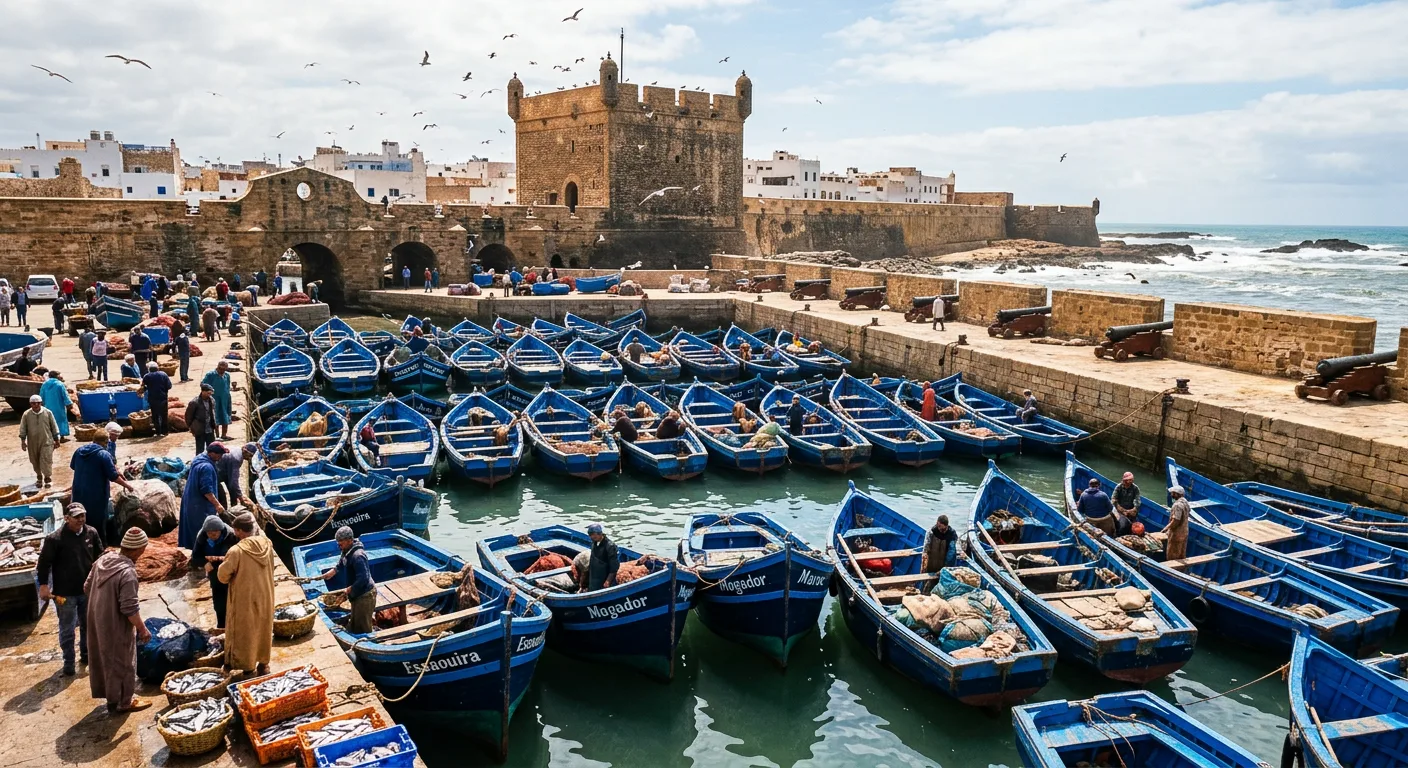
Essaouira's fishing port is one of the most photographed harbors in Morocco. Blue wooden boats depart at dawn daily, returning by midday with catches that feed the town's legendary grillside restaurants. Visitors can join local fishermen on coastal trips or book sport fishing excursions beyond the Mogador archipelago.
Sea Bass
Sea Bream
Sardines
Mackerel
Conger Eel
Octopus
Mediterranean Coast Fishing
Morocco's Rif coastline along the Mediterranean offers sheltered bays, rocky headlands, and access to the biologically rich Alboran Sea, where Atlantic and Mediterranean waters converge.
Al Hoceima
Rif CoastMediterranean Sport Fishing
From 2,500 MAD per half-day
Set along the dramatic Rif coastline within the Al Hoceima National Park marine reserve. Rocky headlands, deep drop-offs, and underwater canyons create diverse habitats teeming with Mediterranean species. Local fishermen use traditional handline methods passed down through generations, while charter operators target grouper, dentex, and amberjack along the park boundaries.
Grouper
Dentex
Amberjack
Red Mullet
Sea Bream
Bluefin Tuna
Nador
OrientalLagoon & Open Sea
From 2,000 MAD per half-day
Nador sits alongside the Mar Chica lagoon, one of the largest coastal lagoons in North Africa. The lagoon offers sheltered fishing for mullet, sea bass, and gilt-head bream, while the open Mediterranean beyond delivers access to deeper species. The Alboran Sea waters here are among the most biologically diverse in the Western Mediterranean.
Sea Bass
Gilt-head Bream
Mullet
Squid
Bluefish
Bonito
Freshwater Fishing & Fly Fishing
The Middle and High Atlas ranges hold Morocco's freshwater fishing treasures: wild trout streams, highland lakes, and massive reservoirs stocked with bass, pike, and carp.
Bin el Ouidane Reservoir
Middle AtlasLake Fishing
From 500 MAD per guided day
Morocco's most celebrated freshwater fishing destination. This massive reservoir in the Atlas foothills is stocked with black bass, pike, and carp. Red cliffs rise sharply from turquoise waters. Local guides know the productive coves and can arrange boat rentals for reaching the deeper sections where the largest bass hold.
Black Bass
Northern Pike
Common Carp
Barbel
Ifrane & Azrou Trout Streams
Middle AtlasFly Fishing
From 800 MAD per guided day
The cedar forests around Ifrane and Azrou conceal cold, spring-fed streams holding wild brown trout and stocked rainbow trout. The Tizguite River and tributaries of the Oum er-Rbia offer classic small-stream fly fishing through forested valleys. Water clarity is exceptional in summer. These are the only naturally occurring trout waters in Africa north of the Sahara.
Brown Trout
Rainbow Trout
Middle Atlas Lakes
Middle AtlasHighland Lake Fishing
From 400 MAD per guided day
Natural lakes and reservoirs scattered across the Middle Atlas plateau, including Aguelmame Azigza, Dayet Aoua, and Dayet Ifrah. These highland lakes sit above 1,500 meters and hold pike, carp, roach, and barbel. The surrounding cedar and oak forests make for peaceful fishing in mountain air.
Northern Pike
Common Carp
Roach
Barbel
Tench
Fly Fishing in Morocco: What to Know
Fly fishing in Morocco is a niche but growing pursuit. The primary quarry is brown trout in the streams around Ifrane, Azrou, and the headwaters of the Oum er-Rbia. The season runs March through September, with dry fly fishing at its best from May to July when mayfly and caddis hatches bring trout to the surface in the evening hours.
A 4-weight or 5-weight rod is ideal. Leaders should be 9 to 12 feet with fine tippets (5X or 6X) for the clear water. Effective patterns include Adams, Elk Hair Caddis, and Parachute BWO for dry flies, with Pheasant Tail and Hare's Ear nymphs for subsurface work. In early spring, small streamers in olive and brown produce well.
Local fly fishing guides can be arranged through hotels in Ifrane or outdoor operators in Azrou. Guided days start from 800 MAD including transport to the streams. Bring your own equipment, as quality fly tackle is difficult to source locally. Seasonal pricing can change based on demand.
Big Game Species
Morocco's Atlantic waters host some of the largest game fish in the eastern Atlantic. These are the trophy species that draw international anglers to Moroccan shores.
Bluefin Tuna
The most prized game fish in Moroccan waters. Atlantic bluefin migrate along the coast in summer, with fish exceeding 200 kg taken regularly off Agadir. Fights can last hours. Trolling with lures and live bait are the primary methods.
Max: Up to 300 kgJune - SeptemberAgadir, Dakhla, Al Hoceima
Blue Marlin
The apex predator of Morocco's offshore waters. Blue marlin appear when water temperatures peak in late summer. Most are caught trolling with artificial lures at speed. Catch and release is strongly encouraged for this species.
Max: Up to 500 kgJuly - OctoberAgadir, Dakhla
Swordfish
Swordfish patrol deeper waters beyond the continental shelf, targeted at night using deep-drop techniques or by slow-trolling at depth during the day. The meat commands premium prices at Moroccan fish markets.
Max: Up to 200 kgJuly - NovemberAgadir, Tan-Tan, Dakhla
Yellowfin Tuna
More abundant than bluefin, yellowfin are the bread-and-butter big game species in southern Moroccan waters. Schools feed aggressively on baitfish near the surface. Popping and jigging techniques are highly effective.
Max: Up to 80 kgYear-round in DakhlaDakhla, Agadir, Tan-Tan
Wahoo
One of the fastest fish in the ocean at speeds above 95 km/h, caught by high-speed trolling with diving lures. Razor-sharp teeth require wire leaders. The flesh is excellent for grilling.
Max: Up to 40 kgApril - NovemberDakhla, Tan-Tan
Traditional Fishing in Morocco
Fishing is woven into the cultural fabric of Morocco. Coastal communities have fished these waters for centuries using methods that remain largely unchanged.
Net Fishing (Chalutage)
Traditional seine nets are deployed from wooden boats along the Atlantic coast. Teams of fishermen haul the nets by hand on beaches from Larache to Sidi Ifni. In Essaouira, circular cast nets are still used in the harbor. Visitors can observe net hauling at dawn on most fishing beaches.
Wooden Boat Fleet
Morocco's artisanal fishing fleet numbers over 16,000 traditional wooden boats. Painted in brilliant blues, yellows, and greens, these vessels are built by hand in boatyards from Tangier to Dakhla. Each boat carries 2-4 fishermen and works within 5 km of shore using lines, traps, and small nets. Joining a local boat trip costs from 300 MAD per person.
Handline Fishing
Along the Mediterranean coast, handline fishing from rocks and jetties is a daily practice. Fishermen in Al Hoceima and Nador use simple rigs with natural bait (sardines, squid, bread) to catch bream, bass, and bluefish. This is the most accessible form of fishing for visitors. No equipment rental is needed; a hand reel and hooks cost from 50 MAD at any coastal hardware shop.
Fishing Villages to Visit
Imsouane (a tiny Atlantic cove between Agadir and Essaouira), Moulay Bousselham (a lagoon village north of Rabat), Sidi Ifni (a former Spanish colonial town), and Tafedna (a remote beach south of Essaouira) are among the most authentic fishing villages in Morocco. Each offers a glimpse into traditional coastal life far from the tourist circuits.
Catch and Release in Morocco
Conservation-minded fishing is gaining ground in Morocco, particularly for big game and freshwater species.
Catch and release is not yet a legal requirement in Morocco, but it is increasingly practiced by responsible charter operators and fly fishing guides. In Dakhla, several premium sport fishing operators have adopted a tag-and-release policy for marlin and large tuna, working with international fisheries research programs to track migration patterns.
For freshwater trout in the Atlas, catch and release with barbless hooks is encouraged by conservation organizations working to protect wild trout populations. Some sections of the Oum er-Rbia headwaters have been designated as catch-and-release zones, and local guides increasingly advocate for releasing fish, especially breeding adults during spring spawning.
Use circle hooks to reduce gut-hooking
Minimize time fish spend out of water
Wet hands before handling fish
Revive fish facing into the current before release
Carry long-nose pliers or a dehooking tool
Use barbless hooks for trout and bass
Fishing Seasons Calendar
Month-by-month guide to what is biting and where across Morocco's three fishing zones.
| Month | Atlantic | Mediterranean | Freshwater | Highlight |
|---|---|---|---|---|
| Jan | Shore fishing; rough seas | Rock fishing | Trout closed | Shore corvina |
| Feb | Pre-season; calm windows | Early bream | Trout closed | Squid in Nador |
| Mar | Dorado arriving | Spring run | Trout opens | First trout |
| Apr | Dorado and wahoo | All-round | Spring hatches | Mayfly hatches |
| May | Peak begins; tuna | Bluefin moving | Peak trout | Big game starts |
| Jun | Bluefin peak; marlin | Amberjack | Dry fly peak | Bluefin tuna |
| Jul | Full big game | Peak; calm seas | Evening rises | Swordfish |
| Aug | All species active | Best conditions | Low water | Dakhla tournaments |
| Sep | Tuna still running | Autumn run | Last trout month | Wahoo bonanza |
| Oct | Swordfish strong | Grouper peaks | Trout closes | Bin el Ouidane carp |
| Nov | Last charters | Shore fishing | Pike opens | Atlas pike |
| Dec | Off-season | Winter rock | Pike and carp | Shore sea bass |
Fishing Licenses & Regulations
Understanding Morocco's fishing regulations will keep you legal and help protect fish stocks for future generations.
Freshwater License
Required for all rivers, streams, lakes, and reservoirs. Issued by the Haut Commissariat aux Eaux et Forets (HCEF). Tourist licenses cost from 500 MAD per year. Apply at regional HCEF offices in Ifrane, Azrou, Beni Mellal, or Khenifra. Bring your passport and two photos. Processing takes 1-2 business days. Some fishing guides can arrange licenses in advance.
Sea Fishing
Shore fishing along the coast does not generally require a license for recreational anglers. Charter boats operate under commercial fishing permits that cover passengers. Spearfishing requires a separate permit from the local maritime authority (Delegation des Peches Maritimes) at from 300 MAD.
Closed Seasons & Limits
Trout season: March 1 to September 30. Bag limits for trout are typically 6 fish per day. No closed season for most sea fish, but there are periodic closures for specific species (notably octopus, which has annual closures to allow population recovery). Minimum sizes apply for most commercial species.
Protected Areas
Fishing is restricted or prohibited within national park marine zones, including Al Hoceima National Park and the Mogador Islands off Essaouira. Ifrane National Park has specific zones where fishing is permitted with a valid license. Check with park authorities for current boundaries and rules before wetting a line.
Charter Boats & Pricing
A breakdown of what to expect from Morocco's charter fishing operators, from budget coastal trips to premium big game expeditions.
All prices are starting rates. Seasonal pricing can change significantly during peak months (June-September).
Coastal Half-Day (4 hours)
Small boat, 2-4 anglers. Fishing within 10 km of shore. Tackle provided. Essaouira, Agadir, Tangier.
Deep Sea Half-Day (5 hours)
Medium boat with cabin, 4-6 anglers. Trolling and bottom fishing beyond the shelf. Agadir, Dakhla.
Full-Day Deep Sea (8-10 hours)
Large vessel, all equipment, lunch, drinks. Targeting tuna, swordfish, and marlin. Agadir, Dakhla.
Premium Big Game (full day)
Tournament-grade vessel, experienced crew, top tackle. Marlin, giant tuna. Dakhla specialists.
Multi-Day Expedition (3-5 days)
All-inclusive packages with accommodation, meals, airport transfers, and daily fishing. Dakhla, Agadir.
Best Fish Markets in Morocco
Even if you never pick up a rod, Morocco's fish markets are essential experiences. Many have on-site grill stalls where your purchase is cooked fresh within minutes.
Essaouira Port Market
Essaouira6:00 AM - 2:00 PM daily
The most atmospheric fish market in Morocco. Inside the working port, catches are auctioned each morning. Grill stalls cook your purchase on charcoal for from 20 MAD.
Sardines, sea bream, prawns
Agadir Souk el Had
Agadir6:00 AM - 1:00 PM (Tue-Sun)
The fish section of Morocco's largest covered souk. Atlantic species arrive from the adjacent commercial port. Prices are competitive and bargaining is expected.
Tuna, swordfish, shrimp
Casablanca Marche Central
Casablanca7:00 AM - 2:00 PM (Tue-Sun)
A colonial-era covered market where the city's top restaurants source their fish. Higher prices than coastal towns, but the quality and variety are exceptional.
Sole, turbot, lobster, oysters
Tangier Port Market
Tangier6:30 AM - 1:30 PM daily
Near the old port, serving catches from both the Atlantic and the Strait of Gibraltar. The mix of species makes it one of the most diverse markets in Morocco.
Anchovies, red mullet, sea bass
Al Hoceima Waterfront Market
Al Hoceima7:00 AM - 1:00 PM daily
A small but excellent Rif coast market. Mediterranean catches come straight off the boats. Prices are among the lowest in Morocco.
Grouper, red snapper, octopus
Practical Tips for Anglers
Weather & Conditions
Atlantic conditions can turn rough without warning, especially November through March. Check marine forecasts before booking. Summer water temperatures range from 18-22 degrees Celsius on the Atlantic to 24-27 degrees on the Mediterranean. Atlas rivers run coldest in spring from snowmelt and may shrink to trickles in late summer.
Booking Charter Operators
Reserve at least 1-2 weeks ahead during peak season (June through September). Verify the operator holds valid commercial fishing and safety licenses. Ask about the boat, the captain's experience, and what tackle is included. Payment is typically 50% deposit with the balance due on departure day. Seasonal pricing can change, so confirm rates when you book.
What to Do with Your Catch
Most charter operators will fillet and pack your catch on ice. For the drive home, a cooler bag keeps fish fresh for hours. Many hotels and riads will cook your catch at no extra charge or for a small fee. Restaurants near fishing ports also offer this service. Exporting fish requires customs paperwork and is not practical for tourists.
Tipping Etiquette
Tipping fishing guides and charter crews is customary. For good service, from 100-200 MAD per person is standard. For exceptional experiences or when the crew works especially hard, from 300-500 MAD is generous. Tips are given in cash at the end of the trip. Freshwater guides appreciate the same range relative to the cost of the outing.
Safety on the Water
Confirm your charter provides life jackets for all passengers. Carry a charged phone in a waterproof case. For shore fishing on rocky coastlines, wear boots with non-slip soles and stay aware of tidal changes. The Atlantic coast produces powerful waves and strong rip currents. Sun protection is critical; bring a hat, long sleeves, and reef-safe sunscreen.
What to Bring
Sea fishing charters generally provide all tackle. For freshwater fishing, bring your own equipment as rental options are limited. Polarized sunglasses are essential for sight fishing and reducing glare. Pack motion sickness tablets if you are prone to seasickness. A lightweight rain jacket is wise even in summer, as Atlantic weather shifts quickly.
Frequently Asked Questions
Do I need a license to fish in Morocco?
For sea fishing from shore, no license is generally required. For freshwater fishing in rivers, lakes, and reservoirs, you need a license from the Haut Commissariat aux Eaux et Forets (from 500 MAD for tourists). Charter boat fishing is covered by the operator's commercial permit. Spearfishing requires a separate permit from the local maritime authority. Always verify current regulations before your trip.
What is the best time of year for deep sea fishing in Morocco?
The peak season runs May through October. Bluefin tuna are most active June to September, swordfish July to November, and dorado April to October. Dakhla offers year-round sport fishing thanks to its warm southern waters and the Canary Current. Winter months bring rougher Atlantic conditions that limit charter boat departures from most ports.
Where is the best sport fishing in Morocco?
Dakhla is Morocco's sport fishing capital and one of Africa's premier destinations, with yellowfin tuna, wahoo, barracuda, and dorado in abundance. Agadir is the most accessible deep sea port with the widest selection of charters. On the Mediterranean, Al Hoceima offers excellent grouper and amberjack fishing. For freshwater sport fishing, Bin el Ouidane has outstanding bass.
Can I fly fish for trout in Morocco?
Yes. The cold, clear rivers of the Middle Atlas around Ifrane and Azrou hold brown trout and rainbow trout. The Tizguite River, tributaries of the Oum er-Rbia, and streams near Azrou are prime fly fishing waters. Season runs March to September. Dry flies and nymphs work best from May onward, with streamers more effective in early spring. Guided days start from 800 MAD.
How much does a deep sea fishing charter cost in Morocco?
Coastal half-day trips start from 2,000 MAD for a small boat. Deep sea charters run from 3,500 MAD (half day) to from 6,000 MAD (full day). Premium big game charters in Dakhla start from 8,000 MAD per day. Multi-day expedition packages with accommodation begin from 25,000 MAD. Peak season (June through September) commands the highest rates.
Is catch and release practiced in Morocco?
Catch and release is growing, particularly among sport fishing operators in Dakhla and fly fishing guides in the Atlas. Several premium charter operators practice tag-and-release for marlin and large tuna. For freshwater trout, catch and release with barbless hooks is encouraged, and some river sections have been designated as release-only zones.
What fish can I catch in Morocco's Mediterranean waters?
Morocco's Mediterranean coast around Al Hoceima and Nador yields bluefin tuna, amberjack, dentex, grouper, sea bream, red mullet, and squid. The Alboran Sea waters are especially productive where Atlantic and Mediterranean currents converge. Shore fishing from rocky headlands produces sea bass, bream, and bluefish. Mediterranean waters are generally calmer than the Atlantic, making them ideal for anglers who prefer steadier seas.
Where can I buy fresh fish in Morocco?
Every coastal city has a fish market (marche aux poissons). Top markets include Essaouira's port market, Agadir's Souk el Had fish section, Casablanca's Marche Central, Tangier's port market, and Al Hoceima's waterfront stalls. Prices start from 30 MAD per kilogram for sardines and from 120 MAD per kilogram for sea bass. Many markets have attached grill stalls that cook your purchase on charcoal for from 20 MAD per plate.
Related Guides
Dakhla Guide
Morocco's sport fishing capital. Desert bay, kitesurfing, Saharan adventures, and world-class angling.
Read moreEssaouira Guide
Iconic fishing port, blue-and-white medina, Atlantic beaches, and coastal Moroccan culture.
Read moreBeaches Guide
Morocco's best beaches along the Atlantic and Mediterranean, from surfing spots to hidden coves.
Read moreFood Guide
Moroccan cuisine from street food to fine dining, including the freshest seafood along the coast.
Read more