Discovering...
Shopping & Artisan Crafts
Morocco Rug Buying
Guide
Six major rug types, quality checks that take 30 seconds, fair prices from 800 MAD, haggling tactics that actually work, and how to get your rug home without getting scammed.
A Centuries-Old Craft, a Modern Buyer's Market
Moroccan rugs are among the most sought-after handcrafted textiles on earth. For centuries, Amazigh (Berber) women in the Atlas Mountains have woven rugs that serve as blankets, floor coverings, dowry pieces, and storytelling canvases. Each tribal region developed distinct patterns, materials, and weaving techniques, creating the extraordinary diversity of styles available to buyers today.
The global appetite for Moroccan rugs has exploded over the past decade. Interior designers from New York to Tokyo feature Beni Ourain rugs in magazine spreads. Boucherouite rag-rugs hang in contemporary art galleries. This demand has been good for Moroccan artisans but has also drawn in middlemen, fakes, and inflated pricing that can leave buyers unsure of what they are getting or what they should pay.
This guide arms you with the specific knowledge to buy confidently: how to identify the six major rug types and evaluate quality, what constitutes a fair price for each category, where to buy to maximize value and minimize risk, and how to get your purchase home safely. Seasonal pricing can change, but the fundamentals of quality and fair dealing do not.
Six Major Moroccan Rug Types
Each type has a distinct tribal origin, material, look, and price range. Knowing these categories prevents sellers from mislabeling a cheaper style as a premium one.
Beni Ourain
Middle Atlas Mountains (Beni Ourain tribe)
Material: 100% undyed natural sheep wool
Appearance: Cream or ivory base with minimalist black or dark brown geometric patterns -- diamonds, zigzags, abstract lines. Thick, plush pile up to 2.5 cm deep.
Typical Size: Typically large: 5x8 ft to 8x10 ft, originally made for tent floors
Price Range: From 3,000 MAD (small) to 15,000 MAD (large, high density)
Buyer Note: The most internationally recognized Moroccan rug. Popularized by mid-century modern designers in the 1960s. Genuine Beni Ourain rugs are made by women of the Beni Ourain confederation of 17 Amazigh tribes. Fakes are extremely common -- look for slight irregularities that prove handwork and wool that feels slightly oily from natural lanolin.
Azilal
Azilal Province, Central High Atlas
Material: Wool, sometimes with cotton accents
Appearance: Bold, colorful abstract designs with pinks, yellows, blues, reds, and oranges on cream or white backgrounds. Thinner pile than Beni Ourain. Often asymmetrical and free-form.
Typical Size: Small to medium: 3x5 ft to 5x8 ft
Price Range: From 1,500 MAD (small) to 8,000 MAD (large, complex)
Buyer Note: Each Azilal rug tells a personal story -- the weaver incorporates symbols representing fertility, protection, or life events. No two are alike. If a shop has ten identical-looking Azilal rugs, they are likely workshop copies. Authentic pieces have slight asymmetry and individual character.
Boucherouite
Various regions, primarily urban and semi-urban areas
Material: Recycled textiles -- cotton scraps, nylon, synthetic fabrics, old clothing
Appearance: Explosion of color and texture. Rag-rug style with dense, sometimes shaggy pile. Abstract patterns, checkerboards, and bold color blocking.
Typical Size: Small to medium: 3x5 ft to 5x7 ft
Price Range: From 800 MAD (small) to 4,000 MAD (large, dense)
Buyer Note: Born from necessity when wool became scarce or expensive, Boucherouite rugs transform discarded fabric into art. They are the most eco-friendly and most affordable Moroccan rug type. Art collectors increasingly prize them. Not ideal for high-traffic floors due to the mixed materials, but stunning as wall hangings.
Kilim (Hanbel)
Throughout Morocco, especially Middle Atlas and Rif Mountains
Material: Wool or wool-cotton blend
Appearance: Flat-woven (no pile), lightweight, reversible. Bold geometric stripes, diamonds, and tribal motifs in earth tones or bright primary colors.
Typical Size: All sizes, from small runners to room-sized
Price Range: From 600 MAD (small runner) to 5,000 MAD (large, fine weave)
Buyer Note: Kilims are flat-woven, not knotted, which makes them lighter and easier to transport. They work as floor coverings, wall hangings, table covers, and furniture throws. A kilim is the easiest Moroccan rug to pack in a suitcase. Hold a kilim up to the light -- tight, even weaving blocks light while loose weaving lets light through gaps.
Zanafi
Ouarzazate region, Southern Morocco
Material: Wool with natural or synthetic dyes
Appearance: Combines flat-woven kilim sections with raised pile sections in the same rug. Geometric patterns in deep reds, blacks, oranges, and creams. Distinctive two-texture feel.
Typical Size: Medium to large: 4x6 ft to 6x9 ft
Price Range: From 2,000 MAD (medium) to 10,000 MAD (large, high quality)
Buyer Note: Zanafi rugs demand exceptional skill because the weaver alternates between two techniques on the same piece. The contrasting textures create a three-dimensional effect. Less common in tourist shops and more often found at cooperatives near Ouarzazate or specialist galleries. Zanafi offers better value than comparable Beni Ourain pieces because international demand has not driven prices up as much.
Taznakht
Taznakht, Ouarzazate Province, High Atlas
Material: High-quality local wool, often with natural dyes
Appearance: Dense, tight weave with intricate geometric and diamond patterns. Rich saffron yellows, deep indigos, warm reds, and burnt oranges. Both pile and flat-weave varieties exist.
Typical Size: Medium: 4x6 ft to 6x9 ft
Price Range: From 2,500 MAD (medium) to 12,000 MAD (large, natural dye)
Buyer Note: Taznakht is one of Morocco's premier rug-producing towns, and the local cooperative is government-certified. These rugs are prized for their tight weave and natural dyes from local plants. A visit to Taznakht is possible as a day trip from Ouarzazate and gives you direct access to weavers. The Saturday souk in Taznakht is one of the largest carpet markets in the country.
The Art of Moroccan Rug Making

Traditional Loom Weaving
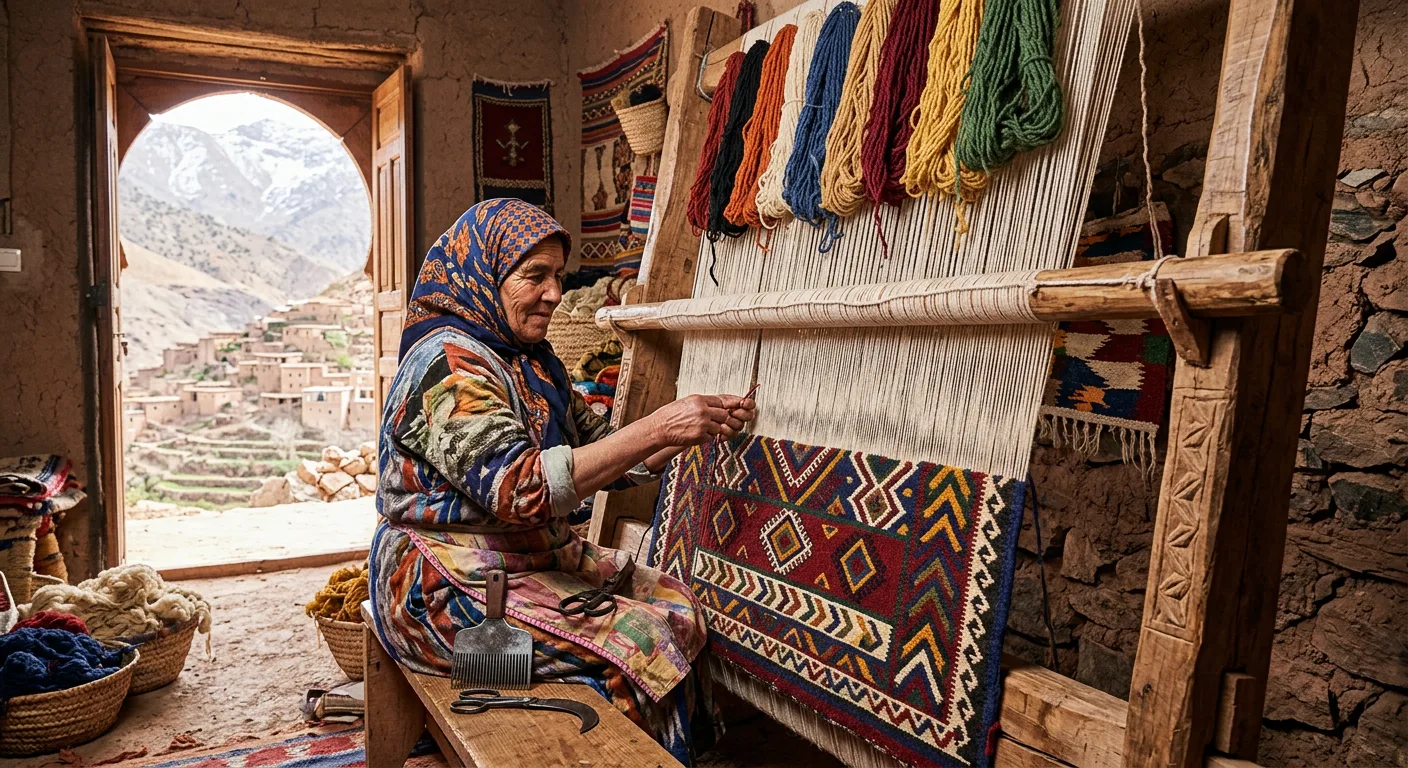
Hand-Knotting Process
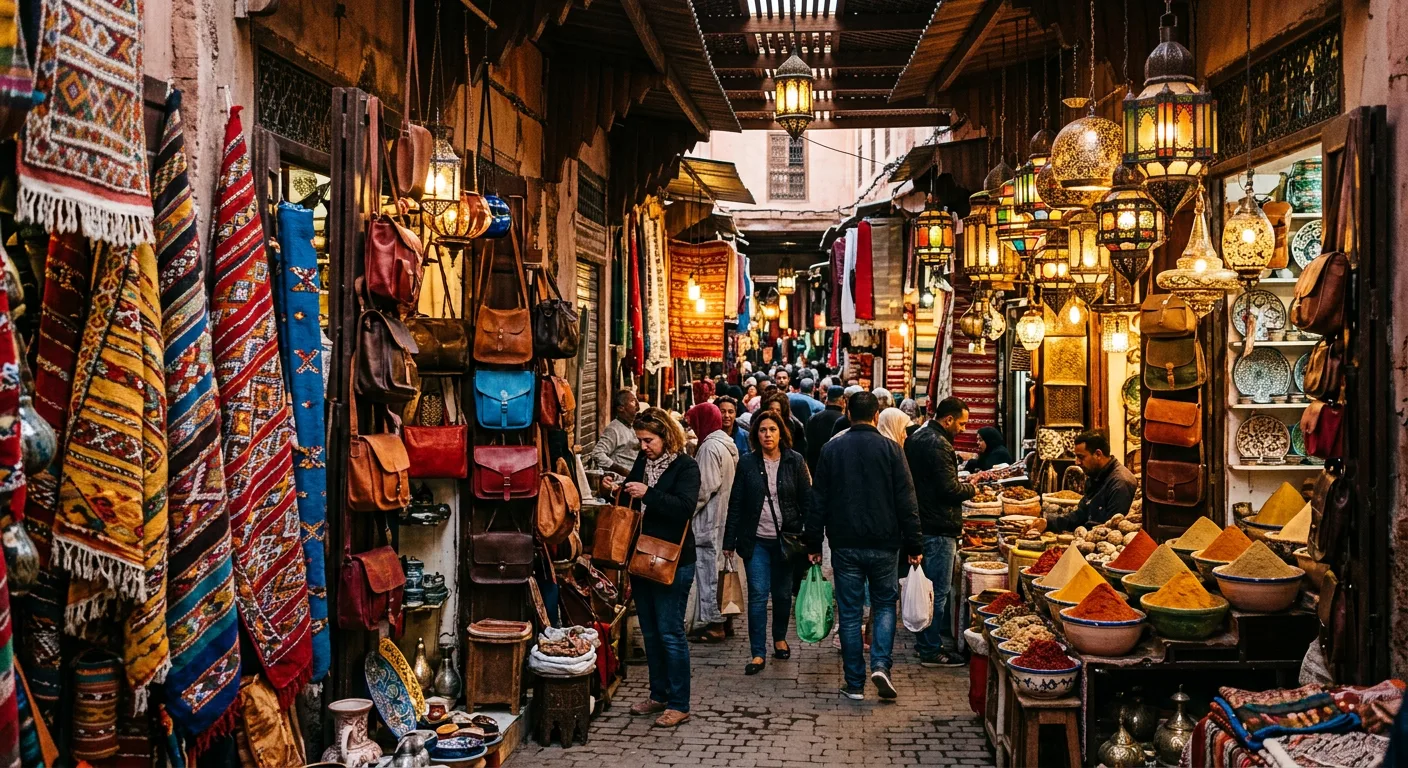
Souk Rug Display
Six Quality Checks in 30 Seconds
These quick tests separate genuine handwoven rugs from machine-made imitations. Perform all six before negotiating price.
Flip It Over
The back of a hand-knotted rug reveals the knot structure. You should see individual knots, slightly irregular, with the pattern visible but rougher than the front. Machine-made rugs show a uniform mesh or latex backing. This single check eliminates most fakes immediately.
Count the Knots
Knot density determines durability and detail. Count knots in a 1-inch square on the back. A good Moroccan rug has 30-60 knots per square inch. Fine pieces reach 80-120. Anything below 25 is coarse and will wear out quickly under foot traffic. Higher density means more labor and a higher fair price.
Check the Fringe
On authentic handwoven rugs, the fringe is the continuation of the warp threads -- it grows from the rug itself. On fakes, fringe is sewn or glued onto a machine-made rug. Pull gently on a fringe strand: it should be integral to the fabric, not a separate piece attached afterward.
Test the Dye
Dampen a white cloth and rub it firmly against the rug surface. Slight initial color transfer is normal for new natural-dye rugs and stops after the first wash. Heavy, vivid color transfer suggests cheap synthetic dyes that will bleed and fade. Well-set dyes, natural or synthetic, should show minimal transfer.
Feel the Wool
Quality Moroccan wool feels springy and slightly oily from natural lanolin. Squeeze the pile and it should bounce back. Cheap wool feels dry, stiff, or scratchy. The best wool comes from sheep raised at high altitudes in the Atlas Mountains, where cold winters produce dense, lanolin-rich fleece.
Smell the Rug
New handwoven rugs have a mild, pleasant wool scent. A strong chemical smell indicates synthetic dyes, glue, or chemical washing. A musty or damp smell on a "vintage" rug suggests poor storage and possible mold damage to the fibers. Trust your nose -- it catches problems your eyes miss.
Natural Dyes vs Synthetic Dyes
Understanding dyes helps you evaluate pricing claims and predict how a rug will age.
Natural Dyes
Sources: Saffron (yellow), indigo (blue), henna (orange-brown), pomegranate rind (gold), madder root (red), mint (green), walnut husk (dark brown), antimony (black).
Aging: Colors mellow and develop a warm patina over decades. Blues deepen, reds soften to terracotta, yellows warm to amber. This aging is considered desirable and increases value.
Cost Impact: Add 30-60% to the rug price. Natural dye extraction is labor-intensive, and some materials like saffron and indigo are expensive raw ingredients.
How to Identify: Natural dyes produce subtle color variations within the same hue called abrash -- slight shifts in shade from one section to another. This variation is a feature, not a defect. Colors have depth and warmth rather than neon brightness.
Synthetic Dyes
Sources: Industrial chemical dyes, widely available and inexpensive. Used in Morocco since the early 20th century. Modern formulations are significantly better than earlier versions.
Aging: Quality synthetic dyes are now colorfast and durable. Cheap synthetics fade unevenly -- reds turn pink, blues turn gray. Modern high-quality synthetics hold up well for decades if properly set.
Cost Impact: Standard pricing. Synthetic dyes do not add a premium to the rug price.
How to Identify: Colors are perfectly uniform throughout the rug with no abrash variation. Bright, saturated tones without depth. Not inherently bad -- many beautiful modern Moroccan rugs use quality synthetic dyes intentionally for their bold graphic impact.
The Six-Step Haggling Strategy
Rug haggling in Morocco follows a predictable pattern. Knowing the steps removes the anxiety and helps you reach a fair price every time.
1
Research Before You Enter the Souk
Visit a cooperative or the Ensemble Artisanal first to learn fixed prices. This gives you a baseline. A 5x8 ft Beni Ourain at a cooperative for 5,000 MAD means a souk seller asking 15,000 MAD for a similar piece is starting at 3x. Your target should be close to the cooperative price, acknowledging a small premium for the souk selection and experience.
2
Browse Without Buying on Day One
Walk through the souk, look at rugs, accept mint tea, but do not commit. Tell sellers you are "just looking today." This reduces urgency and lets you compare prices across multiple shops. Note which shops have the pieces you like and what prices they offer. Return the next day to negotiate seriously.
3
Let the Seller Name the First Price
Never reveal your budget. Ask "how much?" and listen. The opening price is the ceiling. Your counter should be 30-40% of that number. If the seller asks 10,000 MAD, counter at 3,000-4,000 MAD. The seller will act shocked -- this is theater, not genuine offense. Expect to settle at 40-60% of the opening ask.
4
Point Out Flaws Politely
Examine the rug carefully and note any imperfections: uneven edges, inconsistent color, visible repairs, lower knot density. These are legitimate reasons to justify a lower price. Do this respectfully -- you are not attacking the artisan's work, you are demonstrating that you understand quality and will not pay premium prices for standard work.
5
Use the Walk-Away
If negotiations stall above your target price, thank the seller sincerely and walk toward the door. In many cases, the seller will call you back with a lower number. If they do not, the price may genuinely be their floor, or another shop will have a similar piece for less. Never feel obligated to buy because you drank their tea.
6
Pay Cash for the Best Price
Cash gets you the lowest price. Credit card transactions cost the seller 3-5% in processing fees, which they add to your price. If you pay in euros or dollars, the seller sets the exchange rate, usually unfavorably. Pay in Moroccan dirhams for the cleanest transaction. Withdraw from ATMs in the medina before you start shopping.
A Note on Fair Pricing
A hand-knotted rug takes 2-6 months of daily work. When you negotiate, remember that the weaver -- usually a woman -- earned a fraction of the final price. A rug that costs 5,000 MAD (roughly 460 EUR or 500 USD) for months of skilled labor is a fair deal by any global standard. Haggle for a fair price, but do not grind a seller below a living wage. If you buy directly from a cooperative, the artisan receives the majority of what you pay.
Where to Buy: Four Options Compared
Each buying channel offers different trade-offs between price, selection, authenticity, and convenience.
Weaver Cooperatives
Fair fixed prices
Pros: Fixed prices with no haggling needed, money goes directly to artisans, you can watch rugs being made, certificates of authenticity often provided, educational experience with tea and weaving demonstrations.
Cons: Limited selection compared to large dealers, locations sometimes remote in the Atlas Mountains, less variety of styles in one place.
Best For: Ethical buyers who want to support artisans directly and avoid the stress of haggling.
Key Locations: Cooperative Feminine de Tapis (Taznakht), Cooperative Tissage (Ait Ben Haddou), cooperatives along the Tizi n'Tichka pass, Ensemble Artisanal (government-run, in every major city).
Medina Souks
Variable (haggling expected)
Pros: Enormous selection with hundreds of rugs in one shop, ability to compare many types side by side, the experience itself is memorable, some dealers are genuinely knowledgeable.
Cons: Prices start 2-3x above fair value, aggressive sales tactics in some shops, guides earn commissions that inflate your price by 20-40%, harder to verify claims about age and origin.
Best For: Experienced hagglers, travelers who enjoy the negotiation process, buyers looking for specific or unusual pieces.
Key Locations: Souk des Tapis (Marrakech), Souk Ain Allou (Fes), Rue des Consuls (Rabat), Petit Socco area (Tangier).
Galleries & Specialist Dealers
Premium (15-30% above cooperative)
Pros: Curated collections, authenticated pieces, professional shipping, some offer certificates and provenance documentation, air-conditioned comfort, no pressure sales.
Cons: Higher prices than cooperatives or souks, smaller selection, less authentic shopping experience.
Best For: Collectors, buyers who want certainty about authenticity, those with larger budgets who value convenience and expertise.
Key Locations: Galerie NOIR (Marrakech), Maison de l'Artisan (Casablanca), Coin Berbere (Marrakech), Soufiane Zarib (Essaouira).
Roadside Sellers & Village Markets
Lowest (direct from weaver)
Pros: The lowest prices anywhere, direct contact with the weaver or their family, authentic village experience, no intermediary markups.
Cons: Very limited selection, language barriers with Amazigh or Arabic only, no shipping assistance, quality is inconsistent, remote locations.
Best For: Adventurous travelers exploring rural Morocco, those on tight budgets, and buyers who speak some Arabic or Amazigh.
Key Locations: Weekly village souks throughout the Atlas Mountains, roadside stands along the N10 between Ouarzazate and Taznakht, Imilchil area.
Quick Price Reference
Fair cooperative prices for medium-sized rugs (approximately 5x8 ft). Souk prices start 2-3x higher. Seasonal pricing can change during peak tourist months.
| Rug Type | Small (3x5 ft) | Medium (5x8 ft) | Large (8x10 ft) |
|---|---|---|---|
| Beni Ourain | from 3,000 MAD | from 5,000 MAD | from 10,000 MAD |
| Azilal | from 1,500 MAD | from 3,500 MAD | from 7,000 MAD |
| Boucherouite | from 800 MAD | from 2,000 MAD | from 3,500 MAD |
| Kilim (Hanbel) | from 600 MAD | from 2,000 MAD | from 4,000 MAD |
| Zanafi | from 2,000 MAD | from 4,500 MAD | from 8,000 MAD |
| Taznakht | from 2,500 MAD | from 5,000 MAD | from 10,000 MAD |
Five Scam Red Flags and How to Counter Them
Most rug sellers are honest craftspeople and businesspeople. But every market has bad actors. Knowing these tactics protects you and rewards the honest dealers.
The "Closing Down Sale" or "Family Emergency"
A common tactic where the seller claims the shop is closing, a family member is sick, or they need urgent cash. The story creates emotional pressure to buy at what seems like a discount. The same shop runs the same "emergency" for years.
Your Defense: Ignore the story entirely. Focus on the rug quality and the price. A genuine deal stands on its own merits without a backstory.
Your Guide Gets a Commission
If a guide, taxi driver, riad owner, or "friendly local" takes you to a specific rug shop, that person earns 20-40% commission on your purchase. This commission is built into the price you pay. The seller and the guide split the markup between them.
Your Defense: Go to rug shops independently. If a guide brought you, understand that the price includes a hidden surcharge and negotiate harder. Better yet, visit cooperatives or Ensemble Artisanal shops on your own.
"This Is a 100-Year-Old Antique"
Aging a new rug is easy: wash it with bleach, leave it in the sun, or rub tea on it. Unless you are an expert, determining a rug's true age is difficult. Many "antiques" in the souks are 2-5 years old with artificial aging.
Your Defense: Buy a rug because you love its look and the price is fair, not because of age claims. If provenance matters, buy from a gallery that provides documentation.
Bait-and-Switch Shipping
You select a beautiful rug, pay, and arrange shipping. When it arrives at your home, a different and cheaper rug is inside the package. This happens when buyers do not photograph the rug and document the sale carefully.
Your Defense: Photograph the rug from multiple angles including close-ups of the back. Write a detailed description on the receipt. Some buyers mark the back of the rug with a discreet pen mark before handing it over for shipping.
"Fixed Price" That Is Not Fixed
Some shops display "fixed price" signs to create trust, but the posted prices are set 2-3x above market value. A fixed price means nothing if the fixed price itself is inflated. This tactic targets buyers who feel uncomfortable haggling and assume fixed prices must be fair.
Your Defense: Compare the "fixed" price against cooperative prices for similar rugs. The Ensemble Artisanal in each city is government-run with genuinely fair fixed prices -- use those as your benchmark before shopping anywhere else.
Shipping Your Rug Home
Four shipping methods compared. Your choice depends on rug size, budget, and how soon you want it.
Carry in Luggage
Free if within luggage limits, or from 500 MAD for oversize baggage fee
Timeline: Immediate
Best For: Small to medium rugs, kilims, and flat-weaves that roll compactly
Roll the rug tightly, secure with cord, and wrap in plastic. Most airlines accept a rolled rug as checked baggage if total dimensions stay under 158 cm combined. Small kilims fit inside a large suitcase. Ask the seller to vacuum-seal the rug for easier packing.
Dealer Shipping (Sea Freight)
From 500 to 1,500 MAD for a medium rug
Timeline: 4-8 weeks
Best For: Large or heavy rugs, multiple purchases
Most established dealers offer sea freight shipping. The rug is rolled, wrapped in protective plastic, and placed in a burlap sleeve. Get a written receipt with the rug description, agreed price, shipping cost, and estimated delivery date. Reputable dealers track the shipment and provide a tracking number.
Courier (DHL, FedEx, UPS)
From 1,500 to 4,000 MAD depending on weight and destination
Timeline: 5-10 business days
Best For: Buyers who want speed and tracking, valuable pieces
The most reliable option with full tracking, insurance, and door-to-door delivery. Some dealers have corporate courier accounts with discounted rates. DHL has offices in Marrakech, Fes, Casablanca, and Tangier. You can also ship independently by bringing the rug to a courier office.
La Poste Maroc
From 300 to 800 MAD, the cheapest shipping option
Timeline: 6-12 weeks (unreliable)
Best For: Budget buyers who are not in a rush and accept some risk
The Moroccan postal service offers international parcel post. Significantly cheaper than couriers but slower, with limited tracking and no insurance for high-value items. Packages can take up to 3 months. Best for inexpensive purchases where the shipping cost would otherwise exceed the rug value.
Customs Duties to Know
Most countries classify handwoven rugs as handicrafts, which may qualify for reduced duty rates. The EU charges 0% duty on hand-knotted rugs from Morocco under the EU-Morocco Association Agreement. The US charges 0-4.5% depending on material and construction under the Morocco-US Free Trade Agreement. Canada charges 0% on handmade carpets. Australia charges 5% on textile floor coverings. Always declare your purchase honestly at customs -- a receipt from a cooperative or reputable dealer serves as proof of value. Undeclared goods risk confiscation and fines.
Caring for Your Moroccan Rug at Home
A well-maintained handwoven rug lasts 50-100 years. These care basics protect your investment.
Vacuum Regularly, Gently
Vacuum your rug weekly on a low suction setting without the beater bar. For hand-knotted pile rugs, vacuum in the direction of the pile. Never use a robotic vacuum on a fringed rug -- the fringe will tangle in the brushes and pull threads loose.
Rotate Every 6 Months
Rotate the rug 180 degrees every six months to distribute foot traffic and sunlight exposure evenly. This prevents one side from fading or wearing faster than the other and keeps pile direction changes even.
Spot-Clean Spills Immediately
Blot (never rub) spills with a clean white cloth. Use a mild solution of water and white vinegar for most stains. For natural-dye rugs, test the solution on a hidden corner first. Professional cleaning once every 2-3 years is ideal.
Avoid Direct Sunlight
Prolonged direct sunlight fades both natural and synthetic dyes. If your rug is near a window, use curtains or UV-filtering film. Natural dyes fade more gracefully into a patina, but strong sun will damage any textile over time.
Use a Rug Pad
A non-slip rug pad protects the bottom from friction against hard floors, prevents slipping, and adds cushioning. Choose a natural rubber or felt pad. This is especially important for kilims and flat-weaves, which shift easily on smooth surfaces.
Store Properly If Needed
Roll the rug tightly -- never fold it, as folding cracks the foundation fibers. Wrap in clean cotton or muslin, never plastic which traps moisture and breeds mildew. Add cedar blocks or lavender sachets to repel moths. Store in a cool, dry space.
Frequently Asked Questions
Answers to the most common questions from first-time rug buyers in Morocco.
How much should I pay for a Moroccan rug?
Prices depend on size, type, age, and knot density. A small Boucherouite rug (3x5 ft) starts from 800 MAD. A medium Beni Ourain (5x8 ft) ranges from 3,000 to 8,000 MAD. Large vintage pieces with high knot counts can reach 15,000 to 40,000 MAD. Seasonal pricing can change during peak tourist months, and prices in tourist-heavy souks run 30-50% above cooperative prices.
How can I tell if a Moroccan rug is hand-knotted or machine-made?
Flip the rug over. A hand-knotted rug shows slightly irregular knots on the back, with the pattern visible but less defined than the front. Machine-made rugs have a perfectly uniform backing, often with a mesh or latex coating. Hand-knotted rugs also have minor imperfections -- slight asymmetry in patterns, small variations in color between rows -- that prove human hands made them. Pull the pile apart and you should see individual knots tied around the warp threads.
What is the difference between Beni Ourain and Azilal rugs?
Beni Ourain rugs come from the Middle Atlas and feature cream or ivory wool with minimalist black or brown geometric patterns such as diamonds, lines, and abstract shapes. They have a thick, plush pile. Azilal rugs come from a different tribal group in the same region and are thinner with bold, colorful abstract designs including pinks, yellows, blues, and reds on a lighter background. Azilal rugs tend to be more playful and less symmetrical.
Are natural dyes better than synthetic dyes in Moroccan rugs?
Natural dyes from saffron, indigo, henna, pomegranate, and madder root produce richer, more nuanced colors that age beautifully and develop a patina over decades. Synthetic dyes are brighter and more uniform but can fade unevenly. For investment pieces, natural dyes hold their value better. For everyday use, modern synthetic dyes are colorfast and durable. Natural-dye rugs cost 30-60% more than comparable synthetic-dye pieces.
How do I ship a Moroccan rug home safely?
Most reputable rug dealers offer shipping. The rug is rolled tightly, wrapped in plastic, then placed in a burlap or cotton sleeve. Sea freight takes 4-8 weeks and costs from 500 to 1,500 MAD for a medium rug. Air freight via DHL or FedEx takes 5-10 days but costs 2-4 times more. Get a written receipt with the dealer name, rug description, price paid, and shipping details. Always confirm whether the total cost includes customs duties.
How do I haggle for a rug in a Moroccan souk?
Start at 30-40% of the asking price and work upward. The final price typically lands at 40-60% of the opening ask. Be patient -- rug buying involves mint tea, conversation, and viewing many pieces. Walk away if the price does not feel right and the seller may call you back with a lower offer. Never reveal your maximum budget. Compare prices at 3-4 shops before buying. Cooperatives have fixed prices and are a good benchmark before souk haggling.
What are the most common rug scams in Morocco?
The most frequent scams include machine-made rugs sold as handmade (check the back for irregular knots), synthetic dyes claimed as natural (rub a damp white cloth on the rug and heavy color transfer suggests poor dye), inflated antique claims on new rugs that have been artificially aged, bait-and-switch where a different rug is shipped than the one you selected, and faux cooperatives run as regular shops with marked-up prices. Buying from verified cooperatives or established galleries reduces these risks.
Can I bring a Moroccan rug in my airline luggage?
Yes, for small to medium rugs. Roll the rug tightly and wrap it in plastic. Most airlines allow rugs as checked luggage if the total dimensions stay within the combined limit of typically 158 cm or 62 inches. A 5x8 ft rug rolls to roughly 90 cm long and 20 cm diameter, well within limits. Oversize fees apply if it exceeds the limit, usually from 500 to 1,500 MAD depending on the airline. For large rugs, dealer shipping is more practical.
Related Travel Guides
Morocco Shopping Guide
Complete guide to haggling in the souks, what to buy, fair prices for leather, ceramics, spices, and more.
Read GuideMarrakech City Guide
Full guide to Marrakech including the souks, Jemaa el-Fnaa, riads, day trips, and getting around the medina.
Read GuideMorocco Etiquette Guide
Dress code, tipping customs, greetings, and social norms for respectful travel in Morocco.
Read GuideMorocco Budget Travel
How to travel Morocco on a budget: accommodation, food, transport, and activities with real daily costs.
Read GuideMore Morocco Travel Resources
Morocco Souvenirs Guide
The best souvenirs to bring home from Morocco, from argan oil to zellige tiles, with buying tips and pricing.
Fes Travel Guide
Navigate the world's largest car-free urban area: Fes el-Bali medina, tanneries, workshops, and culinary gems.
Morocco Money Guide
Currency, ATMs, tipping, exchange rates, credit cards, and how to handle money across Morocco.
First Time in Morocco
Everything a first-time visitor needs to know: visa, safety, culture shock, itinerary planning, and practical tips.
Moroccan Cuisine Guide
Tagine, couscous, pastilla, street food, cooking classes, food tours, and the best regional dishes by city.
Luxury Morocco
The finest hotels, riads, restaurants, and premium experiences for luxury travelers in Morocco.