Discovering...
The Atlas Mountains
North Africa's rooftop. Trek to the summit of Toubkal, explore Berber villages hidden in high valleys, climb the gorges of Todra, and discover landscapes that shift from alpine meadows to Saharan foothills.
Morocco's Mountain Kingdom
Most visitors come to Morocco for the medinas, the desert, and the coast. But the Atlas Mountains, rising to over 4,000 meters just 90 minutes from Marrakech, offer an entirely different Morocco — one of snow-capped peaks, terraced valleys, rushing rivers, and ancient Berber villages where life has changed little in centuries.
Morocco has four distinct mountain ranges. The High Atlas is the dramatic heart, home to North Africa's highest peak (Toubkal, 4,167m) and the most popular trekking routes. The Middle Atlas is the green, forested interior with cedar groves, lakes, and Barbary macaques. The Anti-Atlas is the oldest and most geologically fascinating, with landscapes that would not look out of place on Mars. And the Rif Mountains in the north shelter the famous blue city of Chefchaouen amid lush forested peaks.
Whether you are a serious trekker aiming for the summit of Toubkal, a rock climber drawn to the walls of Todra Gorge, a casual hiker looking for a day trip from Marrakech, or a cultural traveler wanting to experience traditional Berber hospitality in a mountain village, Morocco's mountains have something extraordinary to offer at every level.
Four Mountain Ranges
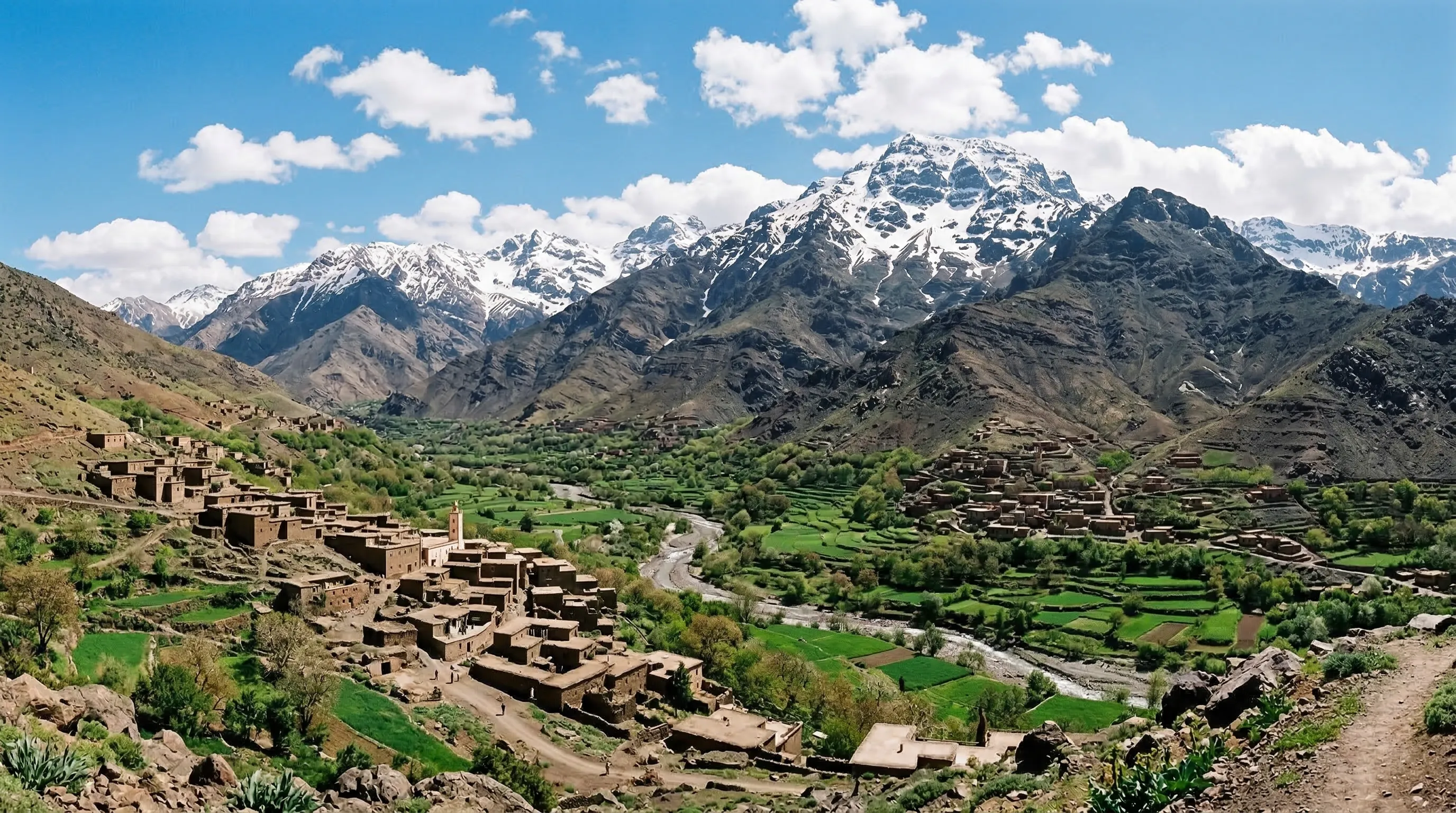
High Atlas
Idraren DrarenThe backbone of Morocco, stretching 1,000 km from the Atlantic coast near Agadir to northeastern Morocco. Home to North Africa's highest peak, Jebel Toubkal (4,167m), and dozens of peaks above 3,000m. The High Atlas divides Morocco into Mediterranean and Saharan climate zones, creating dramatically different landscapes on each side. This is where you will find the most popular trekking routes, the deepest gorges, and the most spectacular mountain scenery in North Africa.
Jebel Toubkal (4,167m)Dramatic gorges and valleysTraditional Berber villagesSnow in winter, wildflowers in spring
Best time: April-June, September-NovemberKey areas: Toubkal region, Dades Valley, Todra Gorge, M'Goun massif, Ourika Valley
Middle Atlas
Idraren n WammasThe lush, green heart of Morocco. The Middle Atlas is covered in cedar, oak, and pine forests and is home to the endangered Barbary macaque (the only African primate north of the Sahara). The region includes natural lakes, waterfalls, and the town of Ifrane, sometimes called "Little Switzerland" for its chalet-style French colonial architecture. Less dramatic than the High Atlas but more accessible, the Middle Atlas offers a gentler mountain experience with excellent wildlife viewing.
Cedar forests & Barbary macaquesIfrane & Azrou forestsOuzoud WaterfallsNatural lakes (Aguelmame Azigza, Dayet Aoua)
Best time: Year-round (skiing Dec-Mar, hiking Apr-Nov)Key areas: Ifrane, Azrou, Ouzoud, Beni Mellal, Taza
Anti-Atlas
Idraren n DernThe oldest mountain range in Morocco, with rocks dating back over 2 billion years to the Precambrian era. The Anti-Atlas rises south of the High Atlas and extends toward the Sahara, creating a surreal landscape of volcanic rock formations, painted gorges, and oasis valleys. Less visited than the High Atlas, it offers extraordinary geology, the famous almond blossoms of Tafraoute (February), and some of the most otherworldly terrain in Africa.
Ancient geological formationsTafraoute painted rocksAlmond blossoms (February)Ameln Valley
Best time: October-April (too hot in summer)Key areas: Tafraoute, Ameln Valley, Ait Mansour Gorge, Jebel Lkest

Rif Mountains
Idurar n ArifThe northernmost mountain range in Morocco, running along the Mediterranean coast from Tangier to the Algerian border. The Rif reaches 2,456m at Jebel Tidiquin and is best known as the home of Chefchaouen, the famous blue city. The western Rif is lush and green with thick forests, while the eastern Rif is more arid. The Talassemtane National Park near Chefchaouen offers excellent hiking through fir forests and past the dramatic Akchour waterfalls.
Chefchaouen (Blue City)Talassemtane National ParkAkchour WaterfallsGod's Bridge natural arch
Best time: March-June, September-NovemberKey areas: Chefchaouen, Akchour, Talassemtane, Al Hoceima
Top Trekking Routes
From two-day summit pushes to week-long traverses, the Atlas offers trekking for every level and ambition.
4,167m
Toubkal Summit
Guide mandatoryModerate-Challenging2-3 days~30 km round trip2,000-4,000 MAD for guided 2-day trek (includes guide, mule, meals, refuge)
The crown jewel of Moroccan trekking and the highest peak in North Africa. The standard route from Imlil (1,740m) follows the Mizane Valley through walnut groves to the village of Aremd (1,900m), then climbs steeply to the Toubkal Refuge (Les Mouflons) at 3,207m. Day two is the summit push: a demanding 960m ascent over scree and boulder fields to the top. On a clear day, you can see the Sahara to the south and the Atlantic to the west.
Detailed Route
Day 1: Imlil (1,740m) to Toubkal Refuge (3,207m), 10 km, 5-6 hours. Follow the Mizane Valley past Aremd and Sidi Chamharouch shrine. Day 2: Refuge to Summit (4,167m) and back to Imlil, 20 km, 8-10 hours total. Depart 5-6am for the summit via the south cirque route. The final 500m is loose scree requiring careful footing.
Highest peak in North AfricaPanoramic summit viewsToubkal Refuge overnightAccessible from Marrakech (90 min to Imlil)
Best season: April-June, September-November (winter summit requires crampons, ice axes, and alpine experience)
4,071m
M'Goun Traverse
Guide mandatoryChallenging5-7 days70-100 km3,000-6,000 MAD for guided 5-day trek (includes guide, mule team, all meals, camping)
Morocco's second-highest peak and one of the most rewarding multi-day treks in the country. The M'Goun Traverse crosses the High Atlas from north to south, passing through the spectacular M'Goun Gorge (the "Grand Canyon of Morocco" with walls 300m high), traditional Berber villages of the Ait Bouguemez Valley (the "Happy Valley"), and high alpine meadows above 3,500m. Less crowded than Toubkal and more of a true wilderness experience.
Detailed Route
Classic route: Start from Tabant in the Ait Bouguemez Valley. Day 1-2: Trek through the valley to Tarkeddit Plateau (3,200m). Day 3: Summit M'Goun (4,071m) via the north ridge, camp at Ouillim. Day 4-5: Descend through the M'Goun Gorge (wading through knee-deep river). Day 6-7: Exit via El Kelaa M'Gouna (the Valley of Roses).
M'Goun Gorge (Morocco's Grand Canyon)Ait Bouguemez "Happy Valley"Alpine meadows and wild campingRemote Berber villages
Best season: June-September (higher altitude means later snow melt; gorge requires low water levels)
2,712m
Jebel Saghro
Moderate3-6 days40-80 km1,500-3,500 MAD for guided multi-day trek
A spectacular volcanic massif between the High Atlas and the Sahara. Jebel Saghro offers dramatic pinnacles, basalt towers, and canyon landscapes that look like they belong on another planet. The trek passes through semi-nomadic Ait Atta Berber territory, and you camp wild among extraordinary rock formations. This is the best winter trek in Morocco because the lower altitude and southern exposure keep it warm when the High Atlas is snowbound.
Detailed Route
Most popular circuit: Tagdilt N'Bour to Bab n'Ali (the famous twin rock towers). Day 1: Tagdilt to Igli camp (1,800m). Day 2: Igli to Bab n'Ali (2,200m), the iconic gateway rock. Day 3-4: Cross the plateau of Kouaouch, visiting nomad camps. Day 5: Descend to N'Kob or Boumalne Dades.
Volcanic rock formationsNomadic Berber campsBest winter trek in MoroccoOtherworldly landscapes
Best season: October-April (the ideal winter alternative to High Atlas; too hot May-September)
3,500m max
Azzaden Valley
Easy-Moderate2-4 days25-50 km1,200-3,000 MAD for guided 3-day trek
A gentler alternative to the Toubkal summit that explores the beautiful Azzaden Valley south of Imlil. The trek winds through terraced fields, walnut groves, and Berber villages connected by ancient mule tracks. Stay in village gites (guesthouses) and experience authentic mountain hospitality with home-cooked tagines and fresh bread baked in communal ovens. Perfect for those who want the Atlas experience without the high-altitude challenge.
Detailed Route
Day 1: Imlil to Tinerhourhine (2,200m), 5 hours, through walnut forests. Day 2: Tinerhourhine to Azib Tamsoult (2,500m), 4 hours, past seasonal shepherd camps. Day 3: Optional climb to Tizi n'Mzik (3,489m) for views, then return to Imlil via a different valley.
Berber village homestaysTerraced agricultureGentler terrainCultural immersion
Best season: March-November (lower altitude means a longer season)
Trekking Difficulty Levels
Understanding what each difficulty level means in practice, so you can choose the right trek for your fitness and experience.
Easy
Examples
Ourika Valley, Setti Fatma waterfalls, Ouzoud Falls
Fitness Required
Any reasonable fitness. Suitable for families with children 6+.
Altitude
Below 2,000m
Terrain
Well-marked paths, some uneven ground, occasional steps
Guide
Optional but helpful for navigation and cultural context
Moderate
Examples
Azzaden Valley, Jebel Saghro, Akchour Waterfalls
Fitness Required
Regular exercise recommended. You should be comfortable walking 6-8 hours per day with a daypack.
Altitude
2,000-3,500m
Terrain
Mountain paths, some steep sections, river crossings, uneven terrain
Guide
Recommended for multi-day treks. Optional for day hikes near villages.
Challenging
Examples
Toubkal summit, M'Goun Traverse
Fitness Required
Good cardiovascular fitness required. You should be able to hike 8-10 hours over steep terrain with altitude effects.
Altitude
3,500m+
Terrain
Scree slopes, boulder fields, snow/ice in winter, high passes, some scrambling
Guide
Mandatory for Toubkal and M'Goun. Essential for safety at altitude and route-finding.
Gorges & Waterfalls
Morocco's mountains are carved by water into some of the most dramatic canyon landscapes in North Africa.
Near Tinghir, High Atlas
Todra Gorge
Morocco's most dramatic gorge: a 300m-deep slot canyon with sheer limestone walls just 10 meters apart at their narrowest point. The gorge is a world-class rock climbing destination with over 150 bolted routes (grades 4 to 8b French scale). For non-climbers, the 600m walk through the canyon floor is stunning, and several cafes sit at the gorge entrance. The morning light (9-11am) illuminates the canyon walls most dramatically.
Rock climbing (150+ routes, all grades)Canyon walk (30-60 min)Photography (morning light is best)Swimming in spring (seasonal river pools)
Getting There
From Tinghir: 14 km (20 min drive). From Marrakech: 9 hours via Ouarzazate. From Merzouga: 3.5 hours.
Tip: Climbing gear can be rented in Tinghir or from guides at the gorge entrance (100-200 MAD/day). Experienced climbing guides charge 400-600 MAD/day. Visit early morning to avoid tour bus crowds.
Near Boumalne Dades, High Atlas
Dades Gorge
A winding 25 km gorge carved through red and orange rock formations over millions of years. The lower gorge features the famous "monkey fingers" rock formations (eroded conglomerate pillars), while the upper gorge narrows dramatically with overhanging cliffs. The road through the gorge includes hairpin bends so tight they have become an Instagram sensation. Several excellent guesthouses perch on cliff edges with dizzying valley views.
Scenic driving (25 km gorge road)Hiking side canyonsRock climbing (developing scene)Mountain bikingPhotography (monkey fingers formations)
Getting There
From Boumalne Dades: 0 km (gorge starts at the town edge). From Ouarzazate: 115 km (1.5 hours). From Marrakech: 7-8 hours.
Tip: Stay overnight in the gorge for sunrise views. Auberge Le Festival and Chez Pierre are excellent mid-range options. The upper gorge road is unpaved and requires a 4x4 or sturdy walking legs.
Middle Atlas, near Beni Mellal
Ouzoud Waterfalls
The highest waterfalls in North Africa at 110 meters, cascading in three tiers into a gorge of red rock and olive trees. Wild Barbary macaques swing in the trees, and a permanent rainbow forms in the mist on sunny days. Take a small boat to the base (20 MAD) for the full experience. The area is a popular weekend escape for Moroccan families, creating a lively, festive atmosphere.
Waterfall viewing (multiple vantage points)Boat ride at the base (20 MAD)Barbary macaque spottingNatural swimming poolsHike the canyon rim trail (2-3 hours loop)
Getting There
From Marrakech: 150 km (2.5-3 hours via Beni Mellal). From Fes: 350 km (5 hours). No direct public transport; join a tour or hire a private driver.
Tip: Visit on a weekday to avoid weekend crowds. The trails down to the base are steep and slippery when wet. Wear proper shoes. Do not feed the macaques. Morning light creates the best rainbow effect in the mist.
Rif Mountains: Chefchaouen Area Hiking
The blue city is not just for photos. The surrounding Rif Mountains offer some of Morocco's best day hikes through forests, gorges, and to cascading waterfalls.
Akchour Waterfalls
11 km round trip4-5 hoursModerate
A beautiful river trail through Talassemtane National Park to the Big Waterfall (Cascade d'Akchour, 100m). The trail follows the Oued Farda river through forested gorges with swimming holes. A side trail leads to the extraordinary God's Bridge (Pont de Dieu), a natural rock arch spanning the canyon 25m above the river.
Jebel El Kelaa
8 km round trip3-4 hoursModerate
The mountain directly above Chefchaouen, topped with the ruins of a Spanish mosque. The trail starts from the southeast corner of the medina and climbs steadily through pine forest. The summit (1,616m) offers a stunning bird's-eye view of the blue city below and the Rif Mountains stretching to the horizon.
Talassemtane Forest Loop
15-20 kmFull dayModerate-Challenging
A full-day circuit through the Moroccan fir (Abies marocana) forests of Talassemtane National Park. This rare endemic tree species survives only in the western Rif. The trail passes through dense forest, crosses mountain streams, and reaches viewpoints above 2,000m. Hire a guide from Chefchaouen (300-500 MAD/day).
Cedar Forests of the Middle Atlas
Home to ancient cedars and Morocco's most charismatic wildlife: the Barbary macaque.
Azrou Cedar Forest (Foret de Cedres)
The most accessible Barbary macaque habitat in Morocco. Located 4 km south of Azrou on the road to Midelt, the forest is home to several troops of semi-wild macaques who are accustomed to visitors. The cedar trees here are magnificent, with some specimens reaching 40m tall and over 800 years old. The famous Gouraud Cedar (Cedre Gouraud) is a single tree with a 9m trunk circumference.
75 km from Fes (1 hour). Often combined with an Ifrane visit. Free entry.
Do not feed the macaques. They are wild animals and can bite. Keep food hidden. Do not make direct eye contact or show teeth, which they interpret as aggression.
Ifrane National Park
A 500 km2 protected area of cedar and holm oak forest, wetlands, and natural lakes. The park supports populations of Barbary macaques, Barbary stag (reintroduced), wild boar, golden jackal, and over 200 bird species. The lake of Dayet Aoua is an important birdwatching site, particularly for migratory species in spring and autumn. The park has marked hiking trails ranging from 2 to 20 km.
Park headquarters in Ifrane. 60 km from Fes. Small entry fee (20 MAD).
Ifrane holds the African cold temperature record: -23.9C in February 1935. Winters are harsh with regular snowfall. Bring warm clothing even in autumn.
Oukaimeden: Africa's Highest Ski Resort
The highest ski resort in Africa and one of only two in Morocco (the other being Michlifen near Ifrane). Located 75 km south of Marrakech in the High Atlas, Oukaimeden has been a winter sports destination since the 1940s when French colonists built the first lifts. Today it has 7 ski runs served by a chairlift and several T-bar lifts. The season is short and snow-dependent (December-March), and the infrastructure is basic by European standards, but the novelty of skiing in Africa with Atlas panoramas is hard to beat.
Winter Season
- season: December - March (snow dependent, often only January-February)
- lift Pass: 100-200 MAD/day
- rental: 150-250 MAD/day for full equipment
- runs: 7 runs: 2 green, 3 blue, 2 red. Longest run ~3 km.
- facilities: Basic cafes, equipment rental shops, small hotels. No fancy apres-ski.
Summer Season
- activities: Hiking, mountain biking, rock climbing, wildflower viewing, paragliding
- petroglyphs: Bronze Age rock carvings (2,000-3,000 years old) scattered across the plateau, depicting weapons, animals, and hunting scenes. Free to visit, follow signs from the village.
- highlight: The hike to Jebel Oukaimeden summit (3,258m) takes 2-3 hours from the village and offers 360-degree views of the High Atlas, including Toubkal on clear days.
Best Time for Trekking
The Atlas Mountains have distinct seasons that dramatically affect trekking conditions.
Spring (Apr-Jun)
15-25C
Ideal. Wildflowers bloom, snow melts on high passes, rivers are full. The best time for Toubkal and M'Goun. Ourika Valley is lush and green.
Autumn (Sep-Nov)
12-22C
Excellent. Clear skies, comfortable temperatures, harvest season in valleys. Second-best window for high-altitude treks. October is peak tourist season.
Winter (Dec-Mar)
-5 to 15C
Cold with snow above 2,000m. Toubkal requires full winter gear (crampons, ice axes). Jebel Saghro and Anti-Atlas are excellent alternatives. Ski season at Oukaimeden.
Summer (Jul-Aug)
25-40C
Hot at lower altitudes but pleasant above 2,500m. High passes are snow-free. Best for M'Goun and the highest routes. Lower valleys (Ourika, Dades) can be sweltering.
Altitude Sickness: What You Need to Know
Essential reading for anyone planning to trek above 3,000m, particularly for Toubkal and M'Goun.
What is Altitude Sickness?
Acute Mountain Sickness (AMS) can affect anyone above 2,500m, regardless of fitness. Symptoms include headache, nausea, dizziness, fatigue, and shortness of breath. On Toubkal (4,167m) and M'Goun (4,071m), AMS is a real concern because the typical 2-day itinerary involves rapid altitude gain.
Prevention
Ascend slowly when possible. Spend an extra night at the Toubkal Refuge (3,207m) to acclimatize before the summit push. Drink 3-4 liters of water per day. Avoid alcohol and sleeping pills. Eat carbohydrate-rich meals. Consider prophylactic Acetazolamide (Diamox, 125mg twice daily), available over the counter in Moroccan pharmacies for about 30 MAD per box. Start the day before ascent.
Warning Signs
Mild AMS (headache, tiredness) is common and usually manageable. Descend immediately if symptoms worsen to include confusion, severe headache that does not respond to painkillers, persistent vomiting, difficulty breathing at rest, or loss of coordination (ataxia). These indicate potentially life-threatening HACE (High Altitude Cerebral Edema) or HAPE (High Altitude Pulmonary Edema).
The Golden Rule
If you feel unwell at altitude, assume it is AMS until proven otherwise. The treatment is always descent. Never ascend further with symptoms. Your guide should carry a basic first aid kit and know the fastest descent routes. On Toubkal, the nearest medical facility is in Asni (1.5-2 hours from the refuge by mule).
Hiring a Mountain Guide
A licensed guide is mandatory for Toubkal and M'Goun, and strongly recommended for all multi-day treks.
Licensed Guides
Morocco requires mountain guides to be licensed by the Ministry of Tourism. Licensed guides carry an official ID card (ask to see it), have first aid and mountain rescue training, and speak at least French and Arabic (many speak English, Spanish, or German). Expect to pay 400-600 MAD per day for a licensed guide. The Bureau des Guides in Imlil is the most established outfit for the Toubkal region.
Mule Handlers (Muletiers)
For multi-day treks, a mule carries your heavy gear, food, and camping equipment. A mule and handler costs approximately 200-300 MAD per day. This is standard practice and makes the trek significantly more enjoyable. Mule handlers are typically local Berbers with extraordinary knowledge of the mountains, often more than the guides themselves.
Where to Hire
Guides can be hired through the Bureau des Guides in Imlil (for High Atlas), through your riad or hotel, or through certified trekking agencies such as Toubkal Guide, Discover Morocco Trekking, or Mountain Voyage. Avoid unlicensed guides who approach you on the street in Imlil. The best guides are often booked 2-4 weeks in advance during peak season (April-May, October).
What Is Included
A full-service guided trek typically includes the guide, mule support, all meals on the trail (breakfast, lunch, dinner, snacks), camping equipment (tents, mats, sleeping bags), cooking equipment, and refuge fees. You need to bring your own clothing, daypack, water, and personal items. Always confirm inclusions and price in writing before departure.
Berber Village Stays
Spending a night in a Berber mountain village is one of Morocco's most authentic and rewarding experiences. Here is what to know.
Accommodation
150-400 MAD/night including dinner and breakfastGites (guesthouses) are family homes with guest rooms. Expect mattresses on the floor with heavy blankets, shared squat toilets (sometimes Western), and hot water from a bucket or solar heater. Rooms are clean and basic. Most gites can accommodate 4-12 guests.
Meals
Included in gite price or 50-100 MAD separatelyHome-cooked Berber food is one of the highlights. Expect vegetable tagine with preserved lemons, freshly baked bread from the communal oven (tandir), harira soup, seasonal salads, couscous on Fridays, and endless mint tea. Meals are communal and eaten on the floor from a shared dish. The food is simple, fresh, and delicious.
Etiquette
Bring a small gift (not money for children)Remove shoes before entering a home. Accept mint tea when offered (it is rude to refuse). Eat with your right hand. Ask before photographing people. Dress modestly (cover shoulders and knees). A small gift for the family is appreciated: school supplies for children, fruit, sugar, or tea are always welcome.
What to Expect
PricelessMountain village life revolves around agriculture, animals, and the seasons. You may be invited to help with farming tasks, watch bread being made, or join a family for an evening of tea and conversation. Electricity is available in most villages but is unreliable. Wifi is rare. Mobile signal is patchy to nonexistent. This is the appeal: genuine disconnection.
Mountain Villages & Bases
1,740m
Imlil
The main gateway to Toubkal and the most popular mountain village in Morocco. A bustling little hub with guesthouses, cafes, equipment hire shops, and the Bureau des Guides. The starting point for most Atlas treks. Despite its popularity, the village retains its Berber character with stone houses and terraced gardens.
90 minutes by car (60 km via Asni)
Must do: Stay at Kasbah du Toubkal, a stunning hilltop lodge built on the ruins of a former kasbah with panoramic Toubkal views
1,900m
Aremd (Aroumd)
A traditional Berber village perched above Imlil with breathtaking views of the Toubkal massif. More authentic and quieter than Imlil, it is the last permanent settlement on the Toubkal trail. Stone houses cascade down the hillside amid walnut and cherry trees. The village is car-free and reached by a 45-minute uphill walk from Imlil or a shorter mule ride.
2 hours (90 min drive + 45 min walk from Imlil)
Must do: Overnight in a family-run gite, share a home-cooked tagine dinner, and wake to views of snow-capped Toubkal
1,290m
Setti Fatma
Located in the Ourika Valley, Setti Fatma is famous for its seven waterfalls and is one of the easiest Atlas experiences to access from Marrakech. On weekends, Moroccan families picnic along the river. The village hosts an annual moussem (festival) in August attracting pilgrims from across the region. The lower waterfalls are accessible to most fitness levels.
60 minutes by car (60 km)
Must do: Hike to the seven waterfalls with a local guide (50-100 MAD, 2-3 hours round trip) and swim in the natural pools
1,665m / 1,250m
Ifrane & Azrou
Ifrane is Morocco's "Little Switzerland," a clean, orderly town with red-roofed chalets built during the French Protectorate. It holds the African cold record (-23.9C in 1935). Nearby Azrou is a more traditional Berber market town sitting at the edge of a magnificent cedar forest. The forest between the two towns is the best place in Morocco to see wild Barbary macaques, the only primate species native to Africa's north.
5.5 hours via Beni Mellal (350 km). More commonly visited from Fes (75 km, 1 hour)
Must do: Walk the Azrou Cedar Forest (Foret de Cedres) to spot Barbary macaques. The cedars here are centuries old, with some specimens reaching 40m tall.
Mountain Accommodation
Mountain Gites
150-400 MAD/night (dinner + breakfast included)
Basic but charming village guesthouses, often family-run. Shared rooms with mattresses on the floor, communal meals, and extraordinary Berber hospitality. The most authentic mountain experience. Found in every trekking village.
Kasbah Hotels
800-3,000 MAD/night
Restored kasbahs (fortified houses) converted into boutique hotels. The finest is Kasbah du Toubkal in Imlil (1,200-2,500 MAD), a stunning hilltop lodge with Toubkal views. Kasbah Tamadot (Richard Branson's property) offers ultra-luxury above Imlil.
Mountain Refuges
100-200 MAD/night
Basic refuges on trekking routes. The CAF (Club Alpin Francais) Toubkal Refuge ("Les Mouflons") at 3,207m is the most famous: bunk beds, communal kitchen, basic meals available, and spectacular views. Book ahead in peak season. Essential for Toubkal summit attempts.
Wild Camping
Free - 100 MAD/night
Wild camping is generally permitted in the mountains above the village line. Organized campsites exist near popular trailheads. Your guide will know the best spots with water sources and wind protection. Multi-day treks like M'Goun and Saghro rely on wild camping.
Day Trips from Marrakech
You do not need to be a trekker to enjoy the Atlas. These day trips offer stunning mountain scenery without an overnight commitment.
Ourika Valley
Half day - Full day60 km from Marrakech
The closest Atlas escape from Marrakech. A fertile valley with a rushing river, Berber villages, and the Setti Fatma waterfalls. Visit a saffron farm (Safran de l'Ourika, 30 MAD entry), an argan oil cooperative, or a traditional Berber garden. The Monday souk in the lower valley is one of the most authentic mountain markets in the region.
Setti Fatma waterfallsSaffron farm visitTraditional Berber market (Monday)River-side lunch
300-800 MAD (guided); free if self-driving
Ouzoud Waterfalls
Full day150 km from Marrakech (2.5 hours)
The highest waterfalls in North Africa at 110 meters, cascading in three tiers into a gorge of red rock and olive trees. Wild Barbary macaques swing in the trees, and a rainbow forms in the mist on sunny days. Take a small boat to the base (20 MAD) for the full experience. Allow 3-4 hours for the complete canyon walk and boat ride.
110m cascading waterfallsBarbary macaquesBoat ride at the baseNatural swimming poolsCanyon rim hiking trail
500-1,200 MAD (guided)
Tizi n'Tichka Pass & Ait Benhaddou
Full day200 km to Ait Benhaddou
The highest road pass in Morocco at 2,260m, connecting Marrakech to the Sahara-side. The drive itself is the attraction: hairpin bends through ever-changing landscapes, from green valleys to barren mountain plateaus. Usually combined with a visit to the UNESCO-listed Ait Benhaddou kasbah, one of the best-preserved examples of traditional Moroccan earthen architecture.
Dramatic mountain pass (2,260m)Ait Benhaddou UNESCO siteArgan tree-climbing goats (seasonal)Ouarzazate film studios
600-1,500 MAD (guided)
Oukaimeden Ski & Hike
Full day75 km from Marrakech (1.5 hours)
Africa's highest ski resort at 2,600-3,258m, just 75 km from Marrakech. In winter (December-March), basic ski lifts operate when snow conditions allow. Equipment rental is available on-site (150-250 MAD/day). In summer, the area transforms into an excellent hiking zone with alpine meadows, petroglyphs (Bronze Age rock carvings), and wildflowers. The road up from Ourika Valley is scenic.
Africa's highest ski resortBronze Age petroglyphsSummer wildflower meadowsPanoramic High Atlas views
Self-drive + lift pass (100-200 MAD) or guided trip (500-1,000 MAD)
What to Pack
Footwear
- Broken-in hiking boots with ankle support (essential for Toubkal)
- Trail sandals for camp/village evenings
- Moisture-wicking hiking socks (2-3 pairs)
- Gaiter sleeves for scree slopes (Toubkal summit)
Clothing
- Moisture-wicking base layers (merino wool ideal)
- Insulating fleece or down jacket
- Waterproof shell jacket (Gore-Tex or similar)
- Hiking trousers (zip-off preferred for versatility)
- Sun hat and warm beanie
- Insulated gloves for altitude (Toubkal/M'Goun)
- Buff or neck gaiter (sun and wind protection)
Gear
- 30-40L daypack with hip belt
- Trekking poles (highly recommended for scree and descents)
- Headlamp with extra batteries
- Sleeping bag: 3-season for summer, 4-season for winter or Toubkal
- Water bottles or hydration bladder (2L minimum)
- Water purification tablets or Steripen
- Sunglasses (Category 3-4 UV protection)
Health & Safety
- Sunscreen SPF 50+ (reapply frequently at altitude)
- First aid kit with blister plasters (Compeed)
- Altitude sickness medication (Acetazolamide/Diamox)
- Personal medications (sufficient supply + prescription copy)
- Electrolyte sachets for hydration
- Lip balm with SPF
- Toilet paper and hand sanitizer (mountain toilets are basic)
Ready to Explore the Atlas?
Browse guided treks, day trips from Marrakech, and mountain accommodation options.