Trekker on a ridge in the Moroccan High Atlas Mountains
Head-to-head comparison

Atlas Mountains Trek vs Sahara Desert Tour

Two completely different adventures, both starting from Marrakech. Here is how they compare — and how to do both in a single trip.

By City Tours Morocco Editorial Team

Published 17 June 2026 Last updated 29 October 2026

The honest answer is that the Atlas Mountains and the Sahara are not really competing with each other — they are utterly different things. One is a physical challenge on cold high-altitude trails where Berber villages cling to ridges above the snowline. The other is a sensory spectacle of red dunes, camel silhouettes and a silence so complete it becomes its own sound. Most travellers who ask "Atlas or Sahara?" come back wishing they had done both.

That said, if your schedule only allows one, you need a clear-eyed comparison. Below you will find the key differences in effort, cost, duration and season — plus a frank answer on whether combining them is realistic without heroic logistics.

Atlas Mountains Trek

  • 2–4 days from Marrakech
  • Best Apr–Jun & Sep–Nov
  • From ~2,000 MAD / $200 pp
  • Toubkal summit: 4,167 m
  • Hikers, adventurers, trekking fans

Sahara Desert Tour

  • 2–3 days from Marrakech or Fes
  • Best Oct–Apr (avoid summer heat)
  • From ~2,500 MAD / $250 pp
  • Erg Chebbi dunes, Merzouga
  • All fitness levels, families, couples

Side-by-Side: What Actually Differs

The comparison table that cuts through the marketing language.

FactorAtlas TrekSahara Tour
Physical effortModerate–strenuous (6–8 hrs/day hiking)Low (30–45 min camel ride, mostly driving)
Duration2–4 days (Toubkal summit: 2 days)2–3 days from Marrakech or Fes
Best seasonMar–Jun, Sep–Nov (snow closes routes Dec–Feb)Oct–Apr (summer heat can exceed 45 °C)
Indicative cost ppFrom ~2,000 MAD / $200 (guide + mule + hut)From ~2,500 MAD / $250 (transport + camp + camel)
AltitudeToubkal summit: 4,167 m (acclimatisation needed)Near sea level (~900 m at Erg Chebbi)
AccommodationMountain refuge huts or Imlil guesthousesSahara camp (standard or luxury glamping)
Solo-friendlyYes, with a licensed local guide (legally required above refuge)Yes — private car + guide handles everything
PhotographyBerber villages, snow peaks, walnut valleysDune ridgelines at golden hour, star trails

All costs are indicative / from prices for private tours. Group tours are cheaper per head but less flexible.

The Atlas Mountains Trek: What to Expect

The classic entry point is Imlil, a village in the Mizane Valley about 70 km south of Marrakech (roughly 90 minutes by road). From there the standard two-day Toubkal circuit climbs to the Toubkal Refuge at 3,207 m on day one — a four-to-five-hour ascent through the Berber hamlet of Aroumd and across scree fields — then summits Africa’s highest peak at 4,167 m on day two before descending to Imlil. The trail is not technical, but the altitude gains are real.

You do not have to go for the summit. The valleys around Imlil offer superb day hikes at lower altitude: the Azzaden Valley walk to the village of Tizi Oussem is one of the most scenic in Morocco, passing through terraced fields and walnut orchards with the summits as a backdrop. For a softer version, an Imlil-based one-day hiking excursion from Marrakech gives a genuine taste of Berber mountain life without the altitude or multi-day commitment.

A licensed local guide is legally required above the refuge level and is worth every dirham below it too — trails fork, signage is minimal and guides often pull in to a family home for tea and conversation that never appears on any app. Mule hire (indicative: around 150–200 MAD per day) carries kit so you hike light.

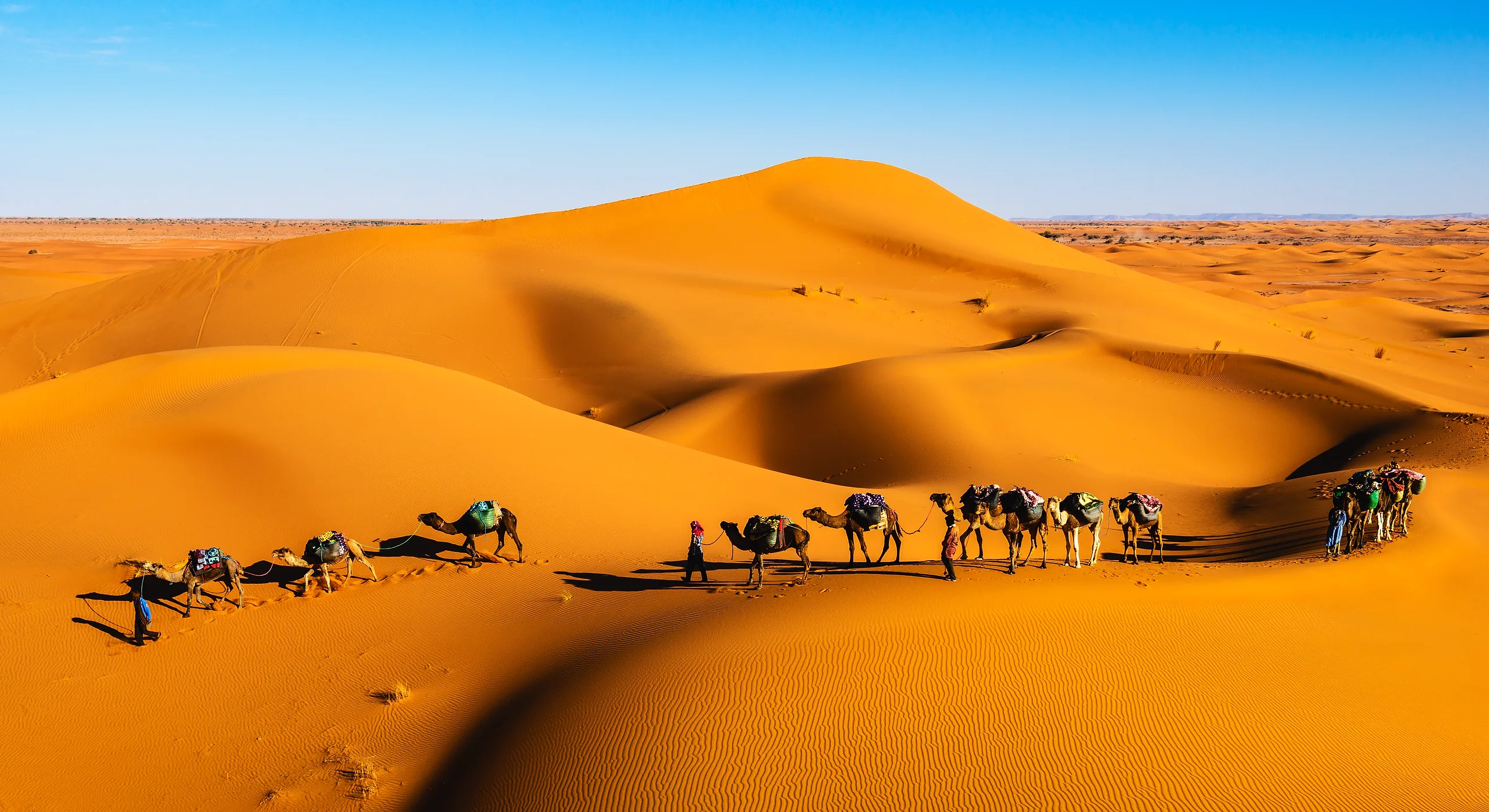
Camel caravan crossing the Erg Chebbi dunes at sunset near Merzouga

Erg Chebbi at sunset

The 150-metre dunes near Merzouga are the highest in Morocco and among the most photogenic in the Sahara.

The Sahara Desert Tour: What to Expect

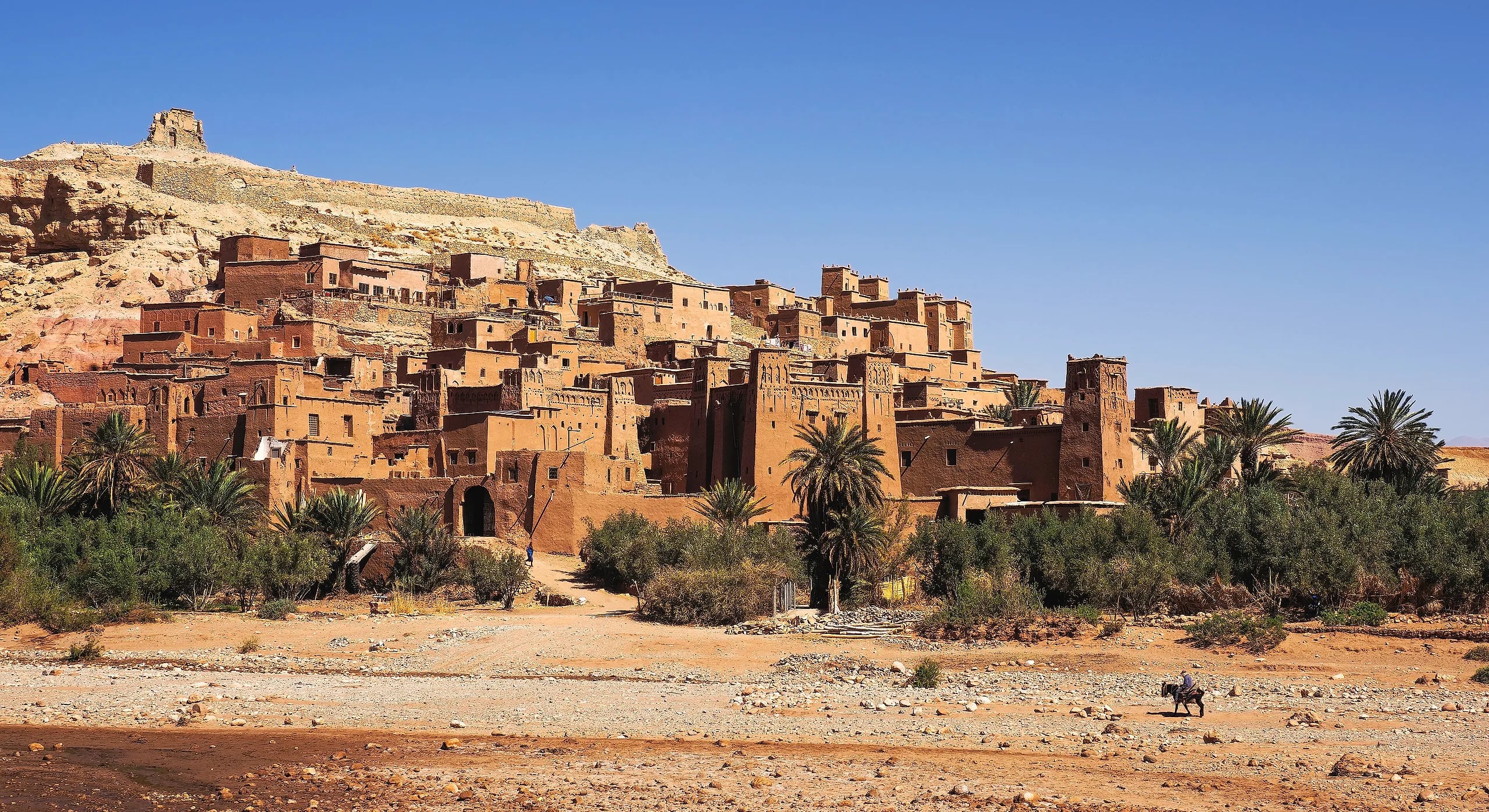
A Sahara tour from Marrakech covers roughly 560 km each way to the Erg Chebbi dunes near Merzouga — a nine-hour drive if you push straight through. Nobody does that: the stops between are half the point. The road passes over the Tizi n’Tichka pass in the High Atlas, drops to the ochre ksar of Aït Benhaddou (UNESCO, and you will recognise it from every sword-and-sandal epic ever filmed there), threads through the Dades and Todra gorges — the Todra narrows to barely eight metres wide, with 300-metre vertical walls — before opening out onto the pre-Saharan hammada that leads to the dunes.

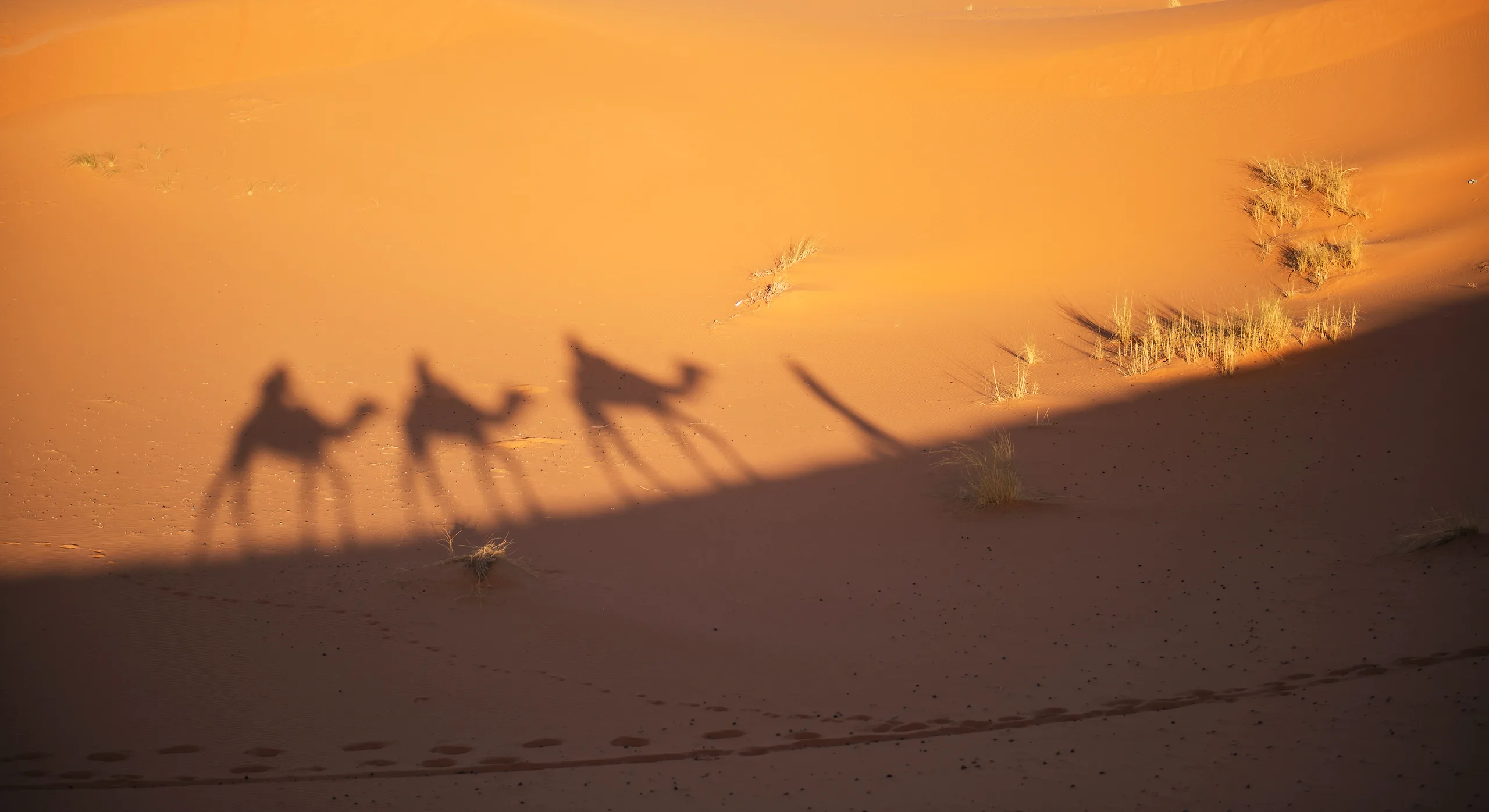
The desert experience itself centres on a 30–45 minute camel ride into the Erg Chebbi dunes at sunset. You dismount at camp, eat a tagine as the light fades, listen to Gnawa drumming, and step outside to a sky that city-dwellers can barely imagine: the Milky Way as a physical thing overhead. Next morning you climb a dune for sunrise, ride back to camp for breakfast, and the drive north begins.

Quad biking, sandboarding and 4x4 excursions into the dunes are bookable on the spot at Merzouga (expect to haggle a little). Camps range from basic bivouac tents with shared shower blocks to genuinely luxurious glamping with private ensuite bathrooms, king beds and electricity.
Combining Atlas and Sahara: A 5-Day Itinerary Sketch

Five days is the comfortable minimum if you want both the Toubkal area and the dunes without feeling you raced through everything.

1

Marrakech → Imlil (Atlas base)

Drive 70 km south to Imlil (1,740 m). Afternoon walk up the lower Mizane Valley to shake off any city stiffness. Overnight in a guesthouse in the village. The muezzin here echoes off granite rather than plaster — it sounds different.

2

Toubkal summit attempt or Azzaden Valley hike

A full day in the mountains. Strong walkers can reach the refuge and push for the summit; a more relaxed option crosses to the Azzaden Valley, a longer but lower circuit through walnut terraces and nomad pastures. Return to Imlil for dinner.

3

Imlil → Marrakech → Aït Benhaddou

Morning drive back to Marrakech, then immediately south again over the Tizi n’Tichka pass. Stop at Aït Benhaddou for a 90-minute wander through the ksar. Overnight in the Dades Valley — the road through the Valley of a Thousand Kasbahs at sunset justifies the drive on its own.

4

Dades → Todra Gorge → Merzouga

Walk the Todra narrows in the cool morning, then push on through Erfoud and Rissani to the dune field. Camel ride at sunset, camp dinner, drumming, stars. Overnight at Erg Chebbi.

5

Sunrise dunes → return to Marrakech or Fes

Up before dawn for the dune-top sunrise. Breakfast at camp, then the long drive back — either returning to Marrakech (arrival evening) or continuing north to Fes via the Ziz Valley if your flight is from there.

A private guided vehicle makes this route significantly more comfortable — you set the departure times, add stops at will and avoid the multiple taxi-and-bus connections a self-organised version requires. A private guided tour is the practical way to link these two experiences in five days.

Which One Is Right for You?

Choose the Atlas if…

  • You hike regularly and want a proper physical challenge
  • Summit altitude (4,167 m) is on your bucket list
  • You want immersive Berber village culture rather than a scenic drive
  • You are travelling in spring when desert is already heating up
  • You have 2–3 days but not 5

Choose the Sahara if…

  • You want maximum visual spectacle for minimum fitness demand
  • You are travelling with children or older family members
  • A sunset camel ride and stargazing night are non-negotiable
  • You are combining it with a Marrakech-to-Fes one-way route
  • You are visiting between October and April when dune temperatures are pleasant

Atlas Trek vs Sahara Tour: FAQs

Should I do the Atlas Mountains or the Sahara desert in Morocco?

It depends on what you want from the trip. The Atlas Mountains reward physical effort — you earn sweeping summit views over a two-day Toubkal trek and sleep in a refuge at 3,207 m. The Sahara is a sensory experience: golden dunes at sunset, drumming around a campfire and a sky full of stars. If you have five days or more, combining both is completely realistic. If you only have three days, choose the experience that excites you more — the desert wins for pure wow-factor immediacy, while the mountains suit hikers who want to feel they have properly earned something.

Can you combine a Sahara desert tour and Atlas Mountains trek in one trip?

Yes, and the geography actually makes it natural. Marrakech sits between the two: the High Atlas foothills start 45 minutes south of the city at Imlil, while the Sahara is roughly nine hours south-east at Merzouga. A realistic combined itinerary runs to five or six days — two days in the Atlas (Toubkal ascent and descent via Imlil), one rest night in Marrakech, then three days driving south through Aït Benhaddou to the dunes and back. A private guided vehicle makes this seamless and removes the logistics headache of buses and shared taxis.

How many days does a Morocco Sahara tour take versus an Atlas trek?

A Sahara tour from Marrakech takes a minimum of two days — one long drive down and one long drive back with a single desert night — though three days is far more comfortable and adds the gorges and kasbahs en route. An Atlas Mountains trek to the Toubkal summit takes two days at minimum (up on day one, summit and return on day two) but ideally three days to acclimatise properly and enjoy the Azzaden Valley. If you push hard you can do both experiences inside five days from Marrakech.

Is the Atlas Mountains trek suitable for beginners?

The standard two-day Toubkal route is graded as a moderate trekking route — there is no technical climbing or scrambling — but the altitude is serious. The summit stands at 4,167 m above sea level, and altitude sickness can affect even fit hikers. Beginners should spend a night in Imlil (around 1,740 m) before attempting the refuge at 3,207 m. A licensed Berber mountain guide is both legally required above the refuge level and genuinely useful for route-finding, pacing and local knowledge. Non-summiteers can enjoy excellent hiking in the valleys around Imlil at 1,700–2,500 m with far less risk.

Which is more physically demanding — the Atlas trek or a desert camel ride?

The Atlas trek is significantly more demanding. Toubkal days involve six to eight hours of uphill hiking on rocky trails with 1,500+ m of elevation gain; legs and lungs will feel it. The Sahara camel ride is a 30–45 minute scenic experience — enjoyable but not exercise. The desert part of a Sahara tour is mostly time in a comfortable vehicle. If you have any knee or cardiovascular concerns, the Sahara tour is the more accessible adventure. That said, even modest day hikes around Imlil give a genuine Atlas experience without summit demands.

What is the best month for a Morocco Atlas Mountains trek?

April to June is the sweet spot: snow has cleared from the main trails, wildflowers are out across the Azzaden and Mizane valleys, and daytime temperatures sit around 15–20 °C at altitude — cold at night, but manageable. September and October are the second-best window, with stable weather and crisp air. July and August are hot lower down but workable at altitude; December through February can see the Toubkal refuge buried in snow, making the summit dangerous or impassable without crampons and ice-axe experience. For a first trek, aim for May or October.

Plan it with a local expert

Travel Morocco with Serenity Morocco Tours

Crafting extraordinary journeys through Morocco's timeless landscapes. 100% private journeys, handcrafted around you.

  • Moroccan-owned
  • 100% Private Tours
  • 100% private tours since 2018
Sahara Desert Luxury Expedition — Marrakech → Erg Chebbi, Morocco

5 days Marrakech → Erg Chebbi

Sahara Desert Luxury Expedition

Essential Morocco: Imperial Cities Circuit — Marrakech · Fes · Meknes · Rabat, Morocco

7 days Marrakech · Fes · Meknes · Rabat

Essential Morocco: Imperial Cities Circuit

Sahara to Sea: Morocco Complete — Full-country circuit, Morocco

14 days Full-country circuit

Sahara to Sea: Morocco Complete

Browse the private tours, quoted on request →