Discovering...
Casablanca
Morocco's Modern Metropolis
Where Art Deco grandeur meets Moorish tradition on the shores of the Atlantic. Africa's most cosmopolitan city pulses with commerce, culture, and the monumental Hassan II Mosque rising from the ocean itself.
Economic Capital Atlantic Coast Art Deco Heritage 3.7 Million People
Casablanca at a Glance
Population
3.7 Million
Morocco's largest city
Timezone
GMT+1
Western European Time
Airport
CMN
Mohammed V International
Currency
MAD
Moroccan Dirham
The Cosmopolitan Heart of Morocco
Casablanca defies the expectations of travelers who arrive hoping for the romantic exoticism of the Humphrey Bogart film. What they find instead is something far more compelling: a living, breathing megacity where Morocco's past and future collide in spectacular fashion. This is the engine that drives the Moroccan economy, a city of five million in the greater metropolitan area where French colonial boulevards are flanked by soaring glass towers, where ancient medina walls give way to haute couture boutiques, and where the call to prayer echoes alongside the buzz of international commerce.
Founded as the small Berber settlement of Anfa, Casablanca was transformed by the Portuguese in the 15th century and reinvented again under the French Protectorate in the early 20th century. The French architect Henri Prost designed a European-style ville nouvelle that became a laboratory for Art Deco and Modernist architecture, resulting in one of the most remarkable collections of early 20th-century buildings anywhere on earth.
Today, Casablanca is a city of contrasts and energy. The monumental Hassan II Mosque rises directly from the Atlantic, its minaret piercing the sky at 210 meters. The Corniche beachfront buzzes with nightlife. The Maarif and Gauthier neighborhoods overflow with contemporary restaurants and art galleries. And through it all, the warmth and hospitality that defines Morocco shines through in every interaction.
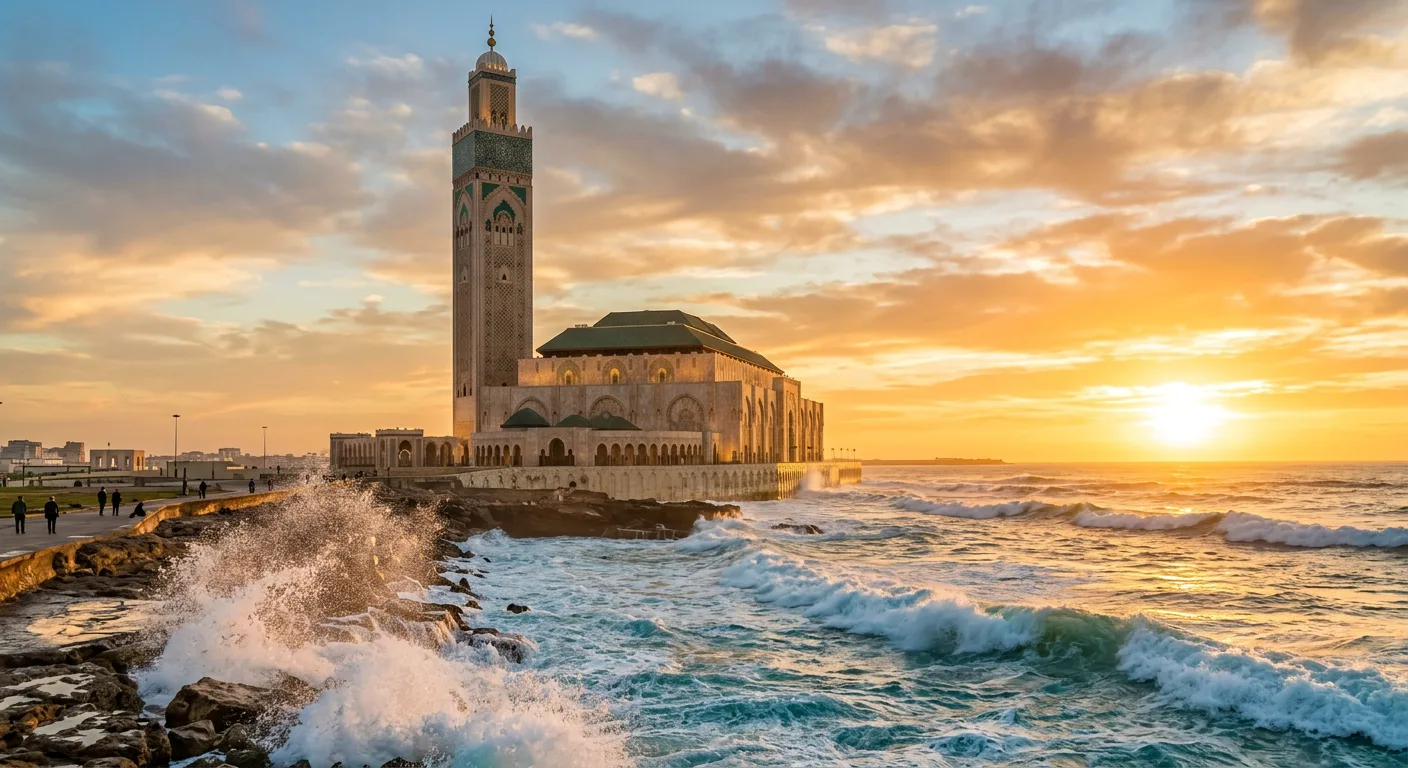
The Hassan II Mosque at the edge of the Atlantic Ocean
Hassan II Mosque
A Monument Built on the Sea
Commissioned by King Hassan II and completed in 1993, the Hassan II Mosque stands on a promontory overlooking the Atlantic Ocean, fulfilling the king's vision of a house of worship where the faithful could pray over God's sea. The mosque can accommodate 25,000 worshippers inside and another 80,000 in its vast esplanade, making it one of the largest religious structures in the world.
The craftsmanship is staggering. Over 6,000 Moroccan artisans spent six years creating the intricate zellige tilework, carved plaster, painted cedar wood ceilings, and marble floors. The 210-meter minaret is topped with a laser beam that shines toward Mecca, visible for 30 kilometers. Perhaps most spectacular is the retractable roof over the main prayer hall, which slides open to reveal the sky, and the glass floor panels that allow worshippers to see the ocean waves beneath their feet.
Visitor Information
- Tours: Sat-Thu at 9:00, 10:00, 11:00, and 14:00. Closed Fridays and during prayer times.
- Entry: 130 MAD for adults, 40 MAD for children (6-12). Free for children under 6.
- Dress Code: Modest clothing required. Knees and shoulders must be covered. Shoes removed inside. Scarves available at the entrance.
- Photography: Allowed inside during guided tours. No flash. Tripods not permitted.
- Tip: Arrive 15 minutes early. The 9:00 AM tour is the least crowded. The esplanade is free to visit anytime and offers stunning sunset photos.
Old Medina and Habous Quarter
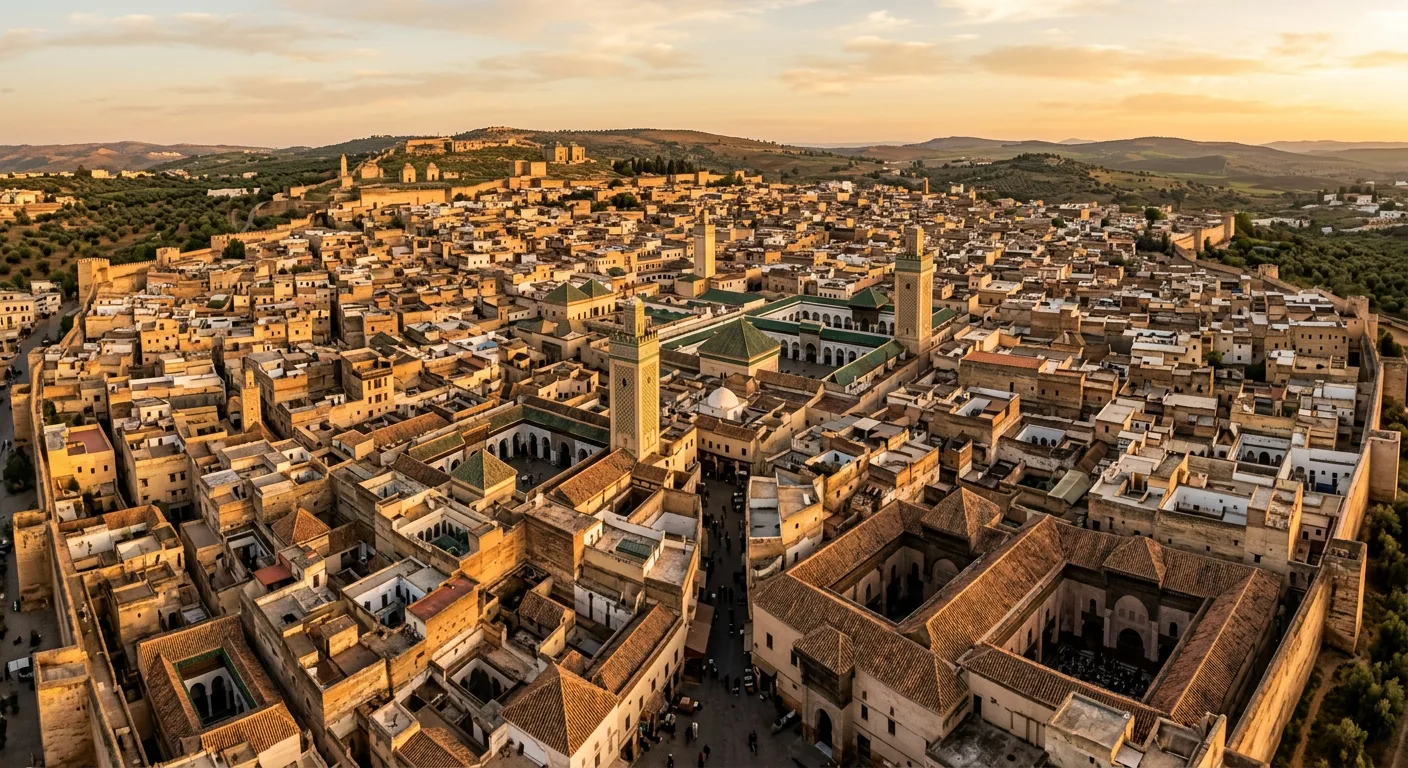
Old Medina
The Ancient Heart of Casablanca
Nestled between the port and Boulevard des Almohades, the Old Medina is the original Casablanca. Winding alleys open onto small squares filled with the scent of spices and leather. Unlike the medinas of Fes or Marrakech, this one is compact enough to explore in a few hours without a guide, though the experience of getting pleasantly lost is half the charm.
Key highlights include the Shrine of Sidi Allal El Karaouani, the Clock Tower (a remnant of Portuguese fortifications), and the many small artisan workshops where craftsmen produce leather goods, metalwork, and wooden items. The medina is also home to several excellent street food stalls serving fresh seafood, harira soup, and Moroccan pastries.
Free entry2-3 hours to exploreOpen daily

Habous Quarter
The New Medina with Old-World Charm
Built by the French in the 1930s as a model Moroccan quarter, the Habous (or Quartier des Habous) blends French urban planning with traditional Moroccan architecture. The result is a clean, orderly souk experience that feels both authentic and approachable. Arcaded walkways shade stalls selling everything from hand-embroidered kaftans to fragrant olive oil.
The Habous is particularly famous for its pastry shops, where you can find the finest cornes de gazelle (almond-filled pastry crescents), chebakia (honey-dipped sesame cookies), and briouat (flaky pastry triangles). The Mahkama du Pacha, a stunning Hispano-Moorish courthouse with 64 rooms of intricate zellige and carved cedar, is the architectural highlight.
Free entryBest for pastries and olivesMorning visits best
Art Deco Heritage
Between 1912 and 1956, French architects and Moroccan craftsmen created one of the world's most remarkable collections of Art Deco, Art Nouveau, and Neo-Moorish buildings. Casablanca's architectural heritage rivals that of Miami Beach or Buenos Aires, yet it remains largely unknown to international visitors.
Boulevard Mohammed V
The grand artery of Casablanca is lined with dozens of Art Deco facades. Notable buildings include the Glaoui Residence with its ornate balconies, the Cinema Rialto with its streamlined curves, and the Hotel Lincoln featuring geometric Moroccan patterns rendered in European Art Deco style. Walk the entire length from Place des Nations Unies to the Parc de la Ligue Arabe for the full experience.
Cathedral of the Sacred Heart
No longer a functioning church, this stunning 1930s cathedral is a masterpiece of Neo-Gothic and Art Deco fusion. Its soaring white towers and stained glass windows make it one of the most photographed buildings in the city. The interior hosts occasional cultural exhibitions and art installations. Entry is typically 20 MAD.
Villa des Arts
Housed in a beautifully restored 1934 Art Deco villa near the Parc de la Ligue Arabe, this foundation-run museum showcases contemporary Moroccan and international art in rotating exhibitions. The building itself is worth the visit, with its curved staircases, terrazzo floors, and period ironwork. Entry is free.
Self-Guided Art Deco Walking Tour
Start at Place des Nations Unies, the bustling central square. Walk south down Boulevard Mohammed V, admiring the Deco facades on both sides. Turn right at Rue Idriss Lahrizi toward the Marche Central (Central Market). Continue to the beautiful Parc de la Ligue Arabe and the Cathedral of the Sacred Heart. End at Villa des Arts for a cultural finish. Total distance: approximately 3 kilometers. Allow 2-3 hours with photo stops.
Tip: The Casamemoire association offers guided architectural tours on select weekends. Check their website for schedules. Tours cost around 100 MAD.
Corniche and Ain Diab
Casablanca's beach district stretches along the Atlantic coast west of the Hassan II Mosque. The Corniche is where the city comes to play, with a long oceanfront promenade, private beach clubs, restaurants, and nightlife venues.
Beach Clubs
The Corniche is dotted with private beach clubs offering pools, sun loungers, restaurants, and direct beach access. Popular options include Tahiti Beach Club, Miami Beach Club, and Boudoir Beach. Day passes typically cost 150-300 MAD per person, often redeemable against food and drinks. Most are open May through September.
Peak season: June-August
Oceanfront Dining
The Corniche offers some of Casablanca's most memorable dining experiences. Le Cabestan serves French-Mediterranean cuisine literally on the rocks, while La Corniche 123 and Chez Paul offer fresh seafood with Atlantic views. For casual bites, try the fish grills at Ain Diab or the crepe stands along the promenade. Expect to pay 200-500 MAD for a full meal with views.
Book ahead for sunset tables
The Promenade
The public promenade runs for several kilometers along the coast and is free to access at all times. It is Casablanca's favorite place for jogging, cycling, and evening walks. On weekends, families pack the walkway, vendors sell roasted corn and fresh juice, and the atmosphere is wonderfully festive. The lighthouse at El Hank marks the western end and offers panoramic views.
Best at sunset and weekends
Modern Shopping
Casablanca is Morocco's undisputed shopping capital, home to mega-malls, designer boutiques, and everything in between. Whether you seek international luxury brands or locally designed fashion, the city delivers.
Morocco Mall
Africa's largest shopping center is a destination in itself. With over 600 stores, an IMAX cinema, an indoor ice rink, a musical fountain, and a massive aquarium containing over 40 species of fish, Morocco Mall transcends the typical shopping experience. International brands like Zara, H&M, Galeries Lafayette, and Fnac sit alongside Moroccan designers and artisan boutiques.
600+ storesIMAX CinemaAquariumIce Rink
Open daily 10:00-22:00. Located in Ain Diab on the Corniche. Free parking. Accessible by taxi (around 50-80 MAD from city center).
Twin Center and Anfa Place
The Twin Center towers are Casablanca's most iconic modern landmark, rising 115 meters above the Maarif district. The commercial levels house upscale shops, a cinema, and the Kenzi Tower Hotel. Nearby Anfa Place Living Resort is a newer open-air shopping and dining complex with a distinctly upscale feel, featuring concept stores, gourmet restaurants, and a curated selection of Moroccan and international fashion labels.
Landmark towersUpscale shoppingRooftop dining
Twin Center: Maarif district, on Boulevard Zerktouni. Anfa Place: Boulevard de la Corniche. Both accessible by tram and taxi.
Rick's Cafe
"Of all the gin joints in all the towns in all the world, she walks into mine." The legendary line from the 1942 film "Casablanca" inspired American expatriate Kathy Kriger to open a real Rick's Cafe in 2004. Set in a beautifully restored courtyard riad near the Old Medina, the restaurant recreates the atmospheric ambiance of the fictional nightclub with remarkable attention to detail.
The interior features sweeping arches, carved wooden screens, brass lamps, a central courtyard with a fountain, and a grand piano where a live pianist performs nightly. The menu blends Moroccan and international cuisine, with highlights including pastilla, lamb tagine, and a selection of Moroccan wines. Cocktails are named after characters from the film.
Practical Details
- Main courses: 180-350 MAD. Cocktails: 90-130 MAD.
- Open daily 12:00-15:00 and 18:30-01:00. Live piano from 20:30.
- Reservations essential, especially for dinner and weekends.
- 248 Boulevard Sour Jdid, near Place du Jardin Public.
Top Attractions
Landmark
4.9
Hassan II Mosque
Rising from the edge of the Atlantic Ocean, this architectural masterpiece is the largest mosque in Africa and the third largest in the world. Its 210-meter minaret is the tallest religious structure on earth. Non-Muslim visitors can explore the lavish interior on guided tours.
Heritage
4.5
Old Medina
The historic walled quarter of Casablanca is a labyrinth of narrow alleys, bustling souks, and artisan workshops. Smaller and more manageable than the medinas of Fes or Marrakech, it offers an authentic glimpse into traditional Moroccan life within steps of the modern city.
Architecture
4.7
Art Deco District
Casablanca boasts one of the finest collections of Art Deco architecture in the world. Wander through Boulevard Mohammed V and surrounding streets to discover hundreds of ornate facades blending Moorish motifs with European modernism from the 1920s-1940s French Protectorate era.
Waterfront
4.6
Corniche Ain Diab
Casablanca's vibrant beachfront promenade stretches along the Atlantic coast, lined with beach clubs, restaurants, luxury hotels, and entertainment venues. At sunset, the Corniche comes alive with locals and visitors enjoying the ocean breeze and golden light.
Quarter
4.6
Habous Quarter
Built in the 1930s by the French as a "new medina," the Habous Quarter elegantly fuses French urban planning with traditional Moroccan architecture. Its clean orderly streets are perfect for shopping for pastries, olives, spices, and handcrafted goods.
Dining
4.4
Rick's Cafe
Inspired by the 1942 Humphrey Bogart film "Casablanca," this atmospheric restaurant-bar recreates the ambiance of the fictional nightclub. Set in a beautifully restored courtyard riad near the Old Medina, it features live jazz, fine cuisine, and classic film memorabilia.
8 Unforgettable Things to Do
Tour Hassan II Mosque
Join a guided tour of this awe-inspiring mosque where the ocean floor is visible through the glass floor and the retractable roof opens to the sky.
Walk the Art Deco Trail
Follow a self-guided walking tour through downtown to admire over 100 beautifully preserved Art Deco and Mauresque buildings.
Sunset at the Corniche
Stroll along the seaside promenade as the Atlantic sun sinks below the horizon, then settle into a beachfront cafe for mint tea.
Haggle in the Old Medina
Navigate the narrow alleys of the historic quarter to find leather goods, spices, lanterns, and handmade jewelry at local prices.
Dine at Rick's Cafe
Enjoy live jazz piano, classic cocktails, and refined Moroccan cuisine in the setting of cinema's most famous nightclub.
Explore the Habous Quarter
Browse the orderly "new medina" for Moroccan pastries, olive varieties, traditional clothing, and religious artifacts.
Visit Morocco Mall
Discover Africa's largest shopping mall complete with an aquarium housing thousands of marine species and an indoor ice rink.
Taste Casaoui Street Food
Try the local specialties: fresh seafood at the central market, bocadillos at corner stalls, and pastilla from Habous bakeries.
Where to Eat in Casablanca
Casablanca is Morocco's culinary capital, offering everything from Michelin-worthy fine dining to legendary street food stalls. The city's international character means you can enjoy world-class French, Japanese, Italian, and Lebanese cuisine alongside traditional Moroccan dishes.
La Sqala
Traditional Moroccan$$Old Medina
Set within the walls of a restored 18th-century fortification, La Sqala serves exceptional Moroccan cuisine in a garden courtyard dripping with bougainvillea. The breakfast pastilla and fresh orange juice are legendary among locals.
120-250 MAD per person
Le Cabestan
French-Mediterranean$$$Corniche
Perched on the rocks overlooking the crashing Atlantic waves, Le Cabestan is Casablanca's most dramatic fine-dining setting. The seafood platters and wine list are outstanding, and the terrace at sunset is unforgettable.
350-600 MAD per person
Brasserie La Tour
French Brasserie$$$Twin Center
Located in the iconic Twin Center towers, this elegant brasserie offers classic French dishes with a Moroccan twist, an extensive wine cellar, and panoramic city views from the upper floors.
300-500 MAD per person
Basmane
Modern Moroccan$$Maarif
A contemporary take on Moroccan gastronomy in the trendy Maarif district. Chef-driven seasonal menus reinterpret traditional tagines and couscous using locally sourced ingredients and modern plating techniques.
150-300 MAD per person
La Bodega
Spanish Tapas$$Racine
One of Casablanca's longest-running tapas bars, La Bodega brings Spanish warmth to the heart of the city. Enjoy patatas bravas, grilled calamari, and sangria in a lively atmosphere with live music on weekends.
100-200 MAD per person
Blend Gourmet Burger
Burgers and Grills$$Anfa
Casablanca's best burger destination serves premium beef, wagyu, and lamb burgers with creative toppings in a stylish industrial-chic setting popular with the city's young professionals.
80-180 MAD per person
Port de Peche
Fresh Seafood$Central Market
The freshest fish in town. Choose your catch from the market stalls and have it grilled to order at the tiny restaurants surrounding the fish market. A true Casablanca institution for budget-friendly seafood.
50-120 MAD per person
Iloli
Japanese Fusion$$$Gauthier
Casablanca's premier Japanese restaurant serves impeccable sushi, sashimi, and creative fusion dishes in an elegant minimalist setting. The omakase menu is considered one of the finest dining experiences in Morocco.
400-700 MAD per person
Street Food Guide
Central Market (Marche Central)
The best place for fresh seafood in Casablanca. Choose your fish from the stalls and have it grilled on the spot. A full seafood plate costs 40-80 MAD. Open mornings until early afternoon.
Derb Ghalef Area
Famous for its late-night snack stalls serving bocadillos (Moroccan sandwiches), brochettes (grilled meat skewers), and fresh juices. A filling meal costs just 20-40 MAD.
Habous Bakeries
The pastry shops of the Habous Quarter sell the finest traditional sweets in Casablanca. Try cornes de gazelle (15 MAD each), chebakia (10 MAD), and mlawi flatbreads (5 MAD) fresh from the oven.
Where to Stay
Casablanca offers a broad range of accommodation, from world-class luxury hotels to budget-friendly apart-hotels. The best neighborhoods for tourists are the city center (close to historic sites), the Corniche (beachfront), and Maarif (trendy dining and shopping district).
Four Seasons Hotel Casablanca
Luxury Hotel$$$ Corniche
The crown jewel of Casablanca hospitality, this oceanfront palace offers world-class service, stunning Atlantic views, a full-service spa, and multiple acclaimed restaurants. Rooms start from around 3,500 MAD per night.
Hyatt Regency Casablanca
Business Hotel$$$ Place des Nations Unies
Commanding a prime position in the heart of the city overlooking Place des Nations Unies, the Hyatt is the go-to hotel for business travelers. Modern rooms, excellent conference facilities, and rooftop dining. From 1,800 MAD per night.
Hotel and Spa Le Doge
Boutique Hotel$$$ City Center
A stunning Art Deco mansion converted into a five-star Relais and Chateaux boutique hotel. Each of the 16 rooms is individually designed, and the in-house spa and restaurant are exceptional. From 2,500 MAD per night.
Kenzi Tower Hotel
Business Hotel$$ Twin Center
Occupying the upper floors of the landmark Twin Center towers, the Kenzi offers sweeping city views, a rooftop pool, multiple dining options, and a prime business district location. From 1,200 MAD per night.
Sofitel Casablanca Tour Blanche
Luxury Hotel$$$ City Center
French luxury meets Moroccan elegance in this centrally located five-star hotel. The rooftop bar, refined restaurant, and signature MyBed concept make it a favorite among discerning travelers. From 2,000 MAD per night.
Melliber Appart Hotel
Apart-Hotel$ Maarif
Perfect for longer stays, Melliber offers spacious self-catering apartments in the vibrant Maarif neighborhood. Close to restaurants, shopping, and the tramway. Studios from 500 MAD per night.
Neighborhood Guide for Accommodation
City Center
Best for sightseeing. Walking distance to Art Deco district, Old Medina, and Hassan II Mosque. Budget: 400-2,500 MAD/night.
Corniche / Ain Diab
Best for beach and nightlife. Oceanfront hotels and clubs. Requires taxi to city center. Budget: 800-4,000 MAD/night.
Maarif / Gauthier
Best for dining and local life. Trendy restaurants, boutiques, and cafes. Near tramway. Budget: 500-2,000 MAD/night.
Anfa
Best for luxury and quiet. Upscale residential area with fine-dining options and elegant hotels. Budget: 1,000-3,500 MAD/night.
Getting Around Casablanca
Casablanca has the most developed public transport system in Morocco, including a modern tramway, abundant taxis, and ride-hailing apps. Here is how to navigate the city efficiently.
Tramway
Casablanca's modern tram system has two lines covering 47 km across the city. Line T1 connects Sidi Moumen to Ain Diab, passing through the city center. Clean, air-conditioned, and reliable.
Fare: 7 MAD per trip. Rechargeable card available for 5 MAD.
Petit Taxis (Red)
Small red taxis operate within the city limits and carry up to 3 passengers. Always insist on the meter. Minimum fare is about 7 MAD, with most rides within the center costing 15-40 MAD. After 8 PM, a 50% surcharge applies.
Tip: Always confirm the meter is running before departure.
Grand Taxis (White)
Large white Mercedes taxis operate shared routes between neighborhoods and to neighboring cities. They depart when full (6 passengers). Fixed routes and fares. Great for reaching the airport or nearby cities like Rabat.
Airport to center: approximately 250-350 MAD (private hire).
Airport Train
ONCF trains connect Mohammed V Airport (CMN) to Casa Voyageurs station every hour, taking approximately 45 minutes. From Casa Voyageurs, the Al Boraq high-speed train reaches Rabat in 50 minutes and Tangier in 2 hours 10 minutes.
Airport train: 70 MAD. Al Boraq to Rabat: 80 MAD first class.
Transport Tips
- Ride-hailing apps (InDrive, Careem) are widely used and often more reliable than hailing taxis on the street.
- Rush hour (7:30-9:30 AM and 5:30-7:30 PM) traffic is notoriously heavy. Plan accordingly or use the tram.
- Walking is pleasant in the city center and along the Corniche, but distances between major sites can be significant.
- Car rental is available at the airport and city center. Driving in Casablanca requires confidence due to aggressive traffic.
Day Trips from Casablanca
Casablanca's central location and excellent transport links make it an ideal base for exploring nearby attractions. These three destinations are easily accessible as day trips and offer a wonderful contrast to the big city.
Rabat
90 km (1 hour by train)
Morocco's elegant capital city is an easy day trip on the high-speed Al Boraq train. Visit the Kasbah des Oudayas, the Hassan Tower and Mohammed V Mausoleum, and the award-winning Mohammed VI Museum of Modern and Contemporary Art. The medina is a UNESCO World Heritage Site with a calmer atmosphere than Casablanca.
Kasbah des OudayasHassan TowerChellah RuinsMohammed VI Museum
80 MAD round-trip train
El Jadida
100 km (1.5 hours by car)
This charming Atlantic coastal town features the UNESCO-listed Portuguese Cistern, one of Morocco's most photographed interiors. Walk the 16th-century Mazagan fortress walls, relax on Sidi Bouzid Beach, and feast on the freshest seafood on the coast.
Portuguese CisternMazagan FortressSidi Bouzid BeachSeafood
60 MAD by bus / 150 MAD grand taxi
Azemmour
80 km (1 hour by car)
A hidden gem on the Oum Er-Rbia river, Azemmour is one of Morocco's most underrated destinations. Its whitewashed medina is decorated with vibrant street art, and the Portuguese ramparts offer sweeping river views. Far fewer tourists than any other destination in the region.
Street Art MedinaPortuguese RampartsOum Er-Rbia RiverHaouzia Beach
40 MAD by grand taxi
Nightlife and Entertainment
Casablanca has the most vibrant nightlife in Morocco. From sophisticated rooftop bars and speakeasy cocktail lounges to energetic nightclubs and live music venues, the city comes alive after dark. The Corniche and Gauthier neighborhoods are the epicenters of after-hours entertainment.
Sky 28
Rooftop BarTwin Center
The highest rooftop bar in Casablanca with panoramic city views. Craft cocktails, international DJs on weekends, and a sophisticated dress code.
Le Balcon
Lounge BarCorniche
Elegant oceanfront lounge with live music, premium spirits, and a terrace overlooking the Atlantic. A favorite for after-dinner drinks.
Maison B
Cocktail BarGauthier
A speakeasy-style cocktail bar hidden in the Gauthier district. Creative mixology, intimate atmosphere, and a curated wine list.
Le Village
NightclubCorniche
One of Casablanca's premier nightclubs featuring international and local DJs, VIP areas, and themed party nights. Opens late and runs until dawn.
Nightlife Tips for Casablanca
Timing
Dinner starts late (21:00-22:00). Bars fill up around 23:00. Clubs do not get going until midnight or later. Many venues are busiest on Thursday and Friday nights.
Dress Code
Most upscale bars and all nightclubs enforce a smart-casual dress code. Avoid sportswear and open-toed sandals for men. Some venues require reservations for table service.
Costs
Cocktails: 80-150 MAD. Beer: 40-70 MAD. Club entry: 100-200 MAD (often includes a drink). Wine by the glass: 60-120 MAD. Budget 300-500 MAD for a night out.
Business Travel in Casablanca
As Morocco's economic engine and home to the Casablanca Stock Exchange, the city is the primary destination for business travelers in North Africa. Modern infrastructure, international flight connections, and a growing conference scene make it an increasingly important hub for regional and international commerce.
Conference Venues
The Office des Foires et Expositions de Casablanca (OFEC) is the main exhibition center. Major hotels like the Hyatt Regency, Sofitel, and Four Seasons offer state-of-the-art meeting rooms and ballrooms. Casablanca Finance City (CFC) in the Anfa district is the dedicated financial hub with modern office and conference facilities.
Business Hotels
The Hyatt Regency (city center) and Kenzi Tower (Twin Center) are the top choices for business travelers, offering executive lounges, high-speed internet, and proximity to the business district. The Sofitel Tour Blanche and Movenpick are excellent alternatives. Corporate rates are widely available, typically offering 20-30% discounts on published rates.
Business Culture Tips
Meetings often start with extended greetings and mint tea. French is the primary business language, with Arabic and increasingly English used in international settings. Business cards are exchanged at the start of meetings. Punctuality is expected for scheduled meetings, though flexibility is appreciated. Business lunches are common and can extend to 2 hours.
Practical Tips for Visiting Casablanca
Best Time to Visit
April through June and September through November offer the most pleasant weather, with temperatures between 20-27 degrees Celsius. Summer (July-August) can be hot and humid, reaching 35 degrees. Winter (December-February) is mild (12-18 degrees) but can be rainy. The Atlantic breeze keeps coastal areas comfortable year-round.
Budget Guide
Budget traveler: 400-600 MAD/day (hostel, street food, public transport). Mid-range: 1,000-2,000 MAD/day (3-star hotel, restaurants, taxis). Luxury: 3,000+ MAD/day (5-star hotel, fine dining, private transport). Tipping: 10-15% in restaurants, 10-20 MAD for small services.
Safety
Casablanca is generally safe for tourists. Exercise normal big-city caution: watch for pickpockets in crowded areas, avoid poorly lit streets late at night, and use official taxis or ride-hailing apps. The tourist police can be found near major attractions. Emergency number: 19 (police) or 15 (ambulance).
Language
Moroccan Arabic (Darija) and French are the primary languages. French is widely spoken in business, restaurants, and hotels. English is increasingly common among younger people and in tourist-oriented establishments. Learning a few words of Darija or French will be greatly appreciated by locals.
What to Pack
Light, breathable clothing for warm months; a jacket for cool evenings (especially near the coast). Modest clothing for visiting the mosque. Comfortable walking shoes for the medina. Sunscreen and sunglasses year-round. Smart-casual attire for upscale restaurants and nightlife venues.
Connectivity
Wi-Fi is widely available in hotels, cafes, and restaurants. For mobile data, pick up a local SIM card at the airport from Maroc Telecom, Inwi, or Orange for around 30-50 MAD with 5-10 GB of data. Most international phones work on Moroccan networks. Morocco uses European-style Type C and E power plugs (220V).
Frequently Asked Questions
Everything you need to know before visiting Casablanca, Morocco's largest and most dynamic city.
1Is the Hassan II Mosque open to non-Muslims?
Yes. The Hassan II Mosque is one of the very few mosques in Morocco open to non-Muslim visitors. Guided tours are offered daily except Friday, with tickets costing 130 MAD for adults.
2How do I get from Casablanca airport to the city center?
The ONCF train from Mohammed V Airport (CMN) to Casa Voyageurs station runs every hour and takes about 45 minutes, costing 70 MAD. Grand taxis and ride-hailing apps are also available, typically costing 250-350 MAD.
3What is the best time to visit Casablanca?
The best time to visit Casablanca is from April to June or September to November when temperatures are pleasant (20-27 C). Summers can be hot and humid, while winters are mild but rainy.
4Is Casablanca safe for tourists?
Casablanca is generally safe for tourists. As with any large city, be aware of petty theft in crowded areas. Stick to well-lit streets at night, use official taxis, and keep valuables secure. The main tourist areas are well-policed.
5How many days do you need in Casablanca?
Two to three days is ideal for seeing Casablanca's highlights including the Hassan II Mosque, Old Medina, Art Deco district, Corniche, and enjoying the culinary scene. Business travelers often extend to explore nearby Rabat or El Jadida.
6What currency is used in Casablanca?
The Moroccan Dirham (MAD) is the official currency. ATMs are widely available throughout Casablanca, and many upscale hotels and restaurants accept credit cards. Exchange bureaus can be found in the city center and at the airport.
Experience Morocco's Greatest City
From the monumental Hassan II Mosque to the electric Corniche nightlife, Casablanca is a city that surprises, inspires, and rewards the curious traveler.
Continue Exploring Morocco
Discover more of what Morocco has to offer