Discovering...
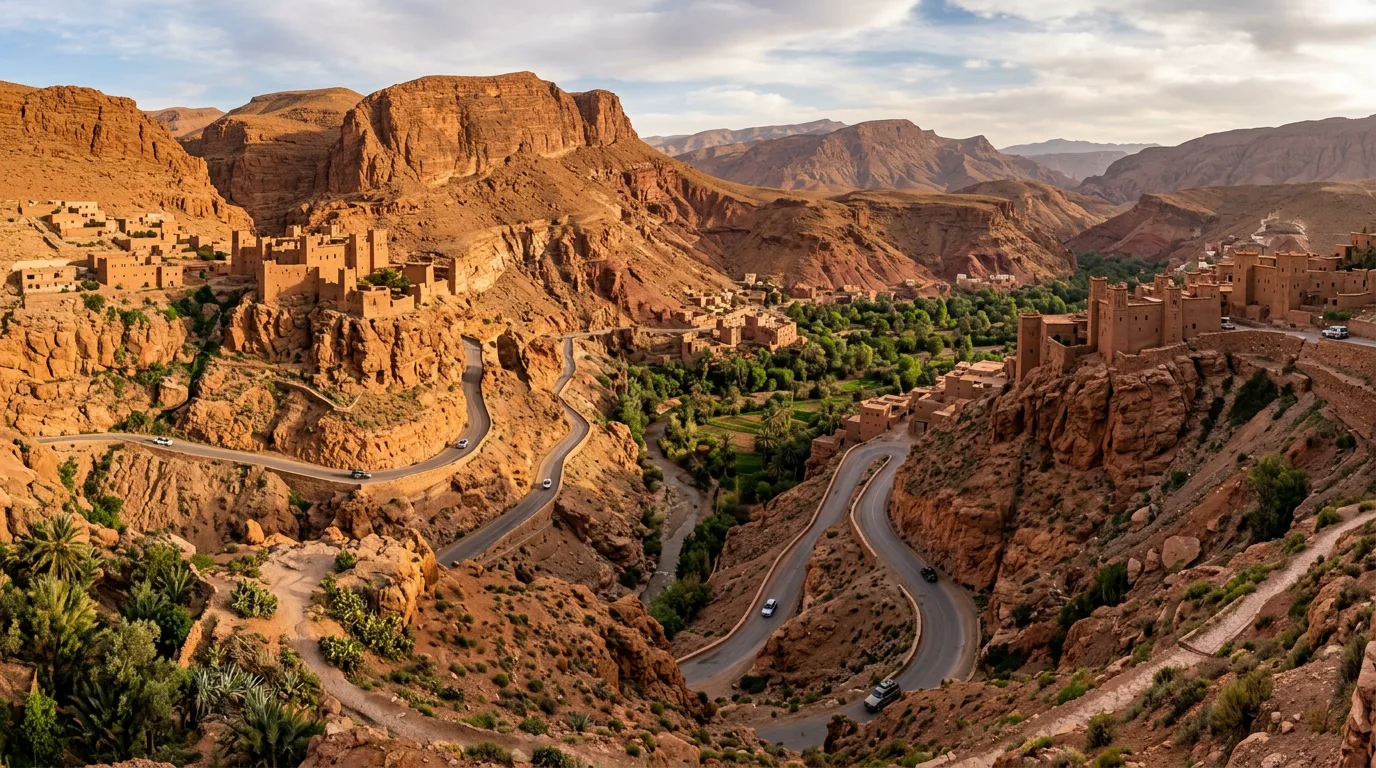
Complete Self-Drive Guide
Driving in Morocco: Complete Road Trip Guide
Everything you need to know about renting a car, road types, tolls, fuel, driving rules, mountain passes, police checkpoints, parking, and staying safe on Morocco's incredible roads.
Before You Drive
Requirements & Documents
What you need to legally drive in Morocco. Get these sorted before your trip to avoid any issues at the rental counter or police checkpoints.
Valid Driving License
Your home country driving license is accepted at most rental agencies, especially if it includes a photo and is in French, English, or Arabic. A license from the EU, US, Canada, Australia, or UK is fine as-is for rentals.
Carry your license at all times while driving. Police will ask for it at checkpoints.
International Driving Permit (IDP)
An IDP is strongly recommended but not legally mandatory for tourists renting a car. It translates your license into multiple languages and is recognized by Moroccan police. Get one from your local automobile association before you travel.
Costs about $20 in the US/UK. Takes 5 minutes at AAA offices. Valid for 1 year.
Minimum Age: 21 Years
Most rental companies require drivers to be at least 21 years old, with some premium categories requiring 25+. Drivers under 25 may face a young driver surcharge of 30-50 MAD/day.
Check age requirements before booking. Some local agencies are more flexible than internationals.
Insurance Coverage
Third-party liability insurance is mandatory in Morocco and included with all legitimate rentals. Collision Damage Waiver (CDW) is strongly recommended. Full coverage (CDW + theft protection) gives peace of mind on mountain roads.
Your credit card may offer rental car insurance. Check before paying for extra coverage at the counter.
Credit Card & Deposit
A credit card is required for the security deposit at pickup, typically 3,000-10,000 MAD blocked on your card. Some budget agencies accept cash deposits, but this is less secure. The hold is released upon return.
Use a credit card with no foreign transaction fees. Debit cards are rarely accepted for deposits.
Passport
Keep your passport with you while driving. You may need it at police checkpoints, especially in southern Morocco near the Sahara and in the Rif mountains region. A photocopy is sometimes accepted but the original is better.
Store a clear photo of your passport on your phone as backup.
Renting a Car
Car Rental Guide
From 250 MAD/day ($25). Everything you need to know about renting, inspecting, insuring, and returning a car in Morocco.
Rental Companies
Europcar
International300-600 MAD/day
Reliable fleet, airport desks at all major airports, English-speaking staff, good insurance options
Higher prices than local agencies, upselling at counter, slow pickup process
Book online weeks ahead for best rate. Decline extras at the counter.
Hertz
International300-650 MAD/day
Well-maintained vehicles, international standards, roadside assistance, multiple locations
Most expensive option, aggressive upselling, long queues at Marrakech airport
Hertz Gold members skip the queue. Join for free before your trip.
Avis
International280-600 MAD/day
Good mid-range option, decent fleet, airport and city locations
Some older vehicles in fleet, inconsistent service quality between locations
Their Marrakech and Casablanca offices are the best-managed.
Medocar / SureCar
Local Agency200-400 MAD/day
Significantly cheaper, flexible on age requirements, will deliver car to your riad, negotiable rates for longer rentals
Older vehicles, less comprehensive insurance, may not speak English, less professional
Inspect the car meticulously. Take photos of every scratch and dent BEFORE you drive off.
AutoRoute / Zotcar
Local Agency200-350 MAD/day
Budget-friendly, well-reviewed on Google, usually newer fleet than other locals, good for Dacia Logan/Sandero
Limited insurance, may charge extra for one-way drop-off, small office presence
Book directly on their website or via WhatsApp for the best rate. Avoid booking via aggregators.
Booking Aggregators
Online (Discover Cars, Rentalcars.com)250-500 MAD/day
Easy price comparison, free cancellation, multiple options, user reviews
Third-party booking complicates disputes, actual car may differ from listing, communication chain is longer
Read the fine print on insurance. Many aggregator policies have high excess amounts (10,000+ MAD).
Pre-Rental Inspection Checklist
Do this EVERY TIME before driving off. Takes 10 minutes. Saves you thousands.
1
Walk around the entire car and photograph every panel, bumper, and wheel
2
Check for existing scratches, dents, and chips on the windshield
3
Ensure all scratches are marked on the rental agreement form
4
Test all lights: headlights, brake lights, indicators, fog lights
5
Check the spare tire condition and confirm jack/wrench are present
6
Test the air conditioning (essential in summer)
7
Verify fuel level matches what the contract states
8
Check that the insurance documents and vehicle registration (carte grise) are in the car
9
Test the horn (you will need it in cities)
10
Confirm the mileage reading matches the contract
11
Take a video walking around the car with the rental agent present
12
Save the rental company emergency/roadside number in your phone
Insurance Options
Third-Party Liability (TPL)
IncludedDamage you cause to other vehicles, property, or people
Mandatory. Always included. Not optional.
Included
Collision Damage Waiver (CDW)
Damage to your rental car with an excess (deductible) of 5,000-15,000 MAD
Strongly recommended. Morocco roads are unpredictable.
50-120 MAD/day
Theft Protection (TP)
Theft of or damage from attempted theft, with excess of 5,000-10,000 MAD
Recommended if parking on streets overnight.
30-80 MAD/day
Super CDW (Zero Excess)
Same as CDW but with zero deductible. You pay nothing for damage.
Best peace of mind. Worth it for mountain/desert driving.
80-200 MAD/day
Windshield & Tire Coverage
Cracked windshield, flat tires, and undercarriage damage
Very useful for piste (dirt track) driving. Standard roads not necessary.
20-50 MAD/day
Personal Accident Insurance (PAI)
Medical expenses for driver and passengers in an accident
Skip if you have travel insurance with medical coverage.
20-40 MAD/day
Watch Out: Hidden Fees
One-Way Drop-Off
500-2,000 MADPicking up in one city and dropping off in another. Marrakech to Fes is the most common and most expensive. Some agencies waive it for rentals over 7 days.
Airport Surcharge
50-150 MADFee for picking up or returning at an airport location. Often hidden in the fine print. Ask specifically about this when booking.
Additional Driver
30-80 MAD/dayAdding a second authorized driver. Some agencies include one free additional driver. Always declare second drivers to maintain insurance validity.
Late Return
100-300 MAD/hourMost agencies allow a 30-60 minute grace period. After that, hourly charges or a full extra day fee applies. Return on time.
Fuel Policy
VariableFull-to-full is the fairest policy. Some budget agencies use full-to-empty (you pay for a full tank upfront, no refund for unused fuel). Always clarify the fuel policy.
Cross-Border Fee
Not AllowedMost rental agreements prohibit taking the car out of Morocco. This means no driving into Spain via the Ceuta/Melilla enclaves or ferry. Violation voids your insurance.
GPS Rental
40-80 MAD/dayDo not rent a GPS from the agency. Use Google Maps or Maps.me on your phone with a local SIM card. Much cheaper and more up-to-date.
Child Seat
30-60 MAD/dayBaby and child seats available but often in poor condition. Consider bringing your own for long trips. Request at booking time as supply is limited.
Road Conditions
Road Types in Morocco
From world-class autoroutes to terrifying mountain pistes. Morocco's roads cover the full spectrum.
Autoroutes (A-roads)
ExcellentMax: 120 km/hMorocco's toll motorways are genuinely excellent. Smooth tarmac, well-marked lanes, good signage in French and Arabic, rest areas with fuel and food every 50-80 km. The network connects Tangier, Rabat, Casablanca, Marrakech, Agadir, Fes, Meknes, and Oujda.
Examples: A1 (Rabat-Tangier), A3 (Casablanca-Marrakech), A7 (Casablanca-Agadir), A2 (Rabat-Fes)
Stay in the right lane except when overtaking. Speed cameras are frequent. Carry cash for tolls or get a Jawaz prepaid tag.
Routes Nationales (N-roads)
Good to VariableMax: 80-100 km/hThe backbone of Morocco's road network. Generally well-paved two-lane highways connecting major cities and towns. Quality varies: N1 along the coast is excellent, while N-roads in the south and east can be rougher with patched surfaces and the occasional pothole.
Examples: N1 (coastal highway), N8 (Marrakech-Beni Mellal), N10 (Ouarzazate-Errachidia), N13 (Fes-Oujda)
Expect slow trucks on uphill sections, especially in mountains. Overtake with extreme caution. Oncoming traffic may be in your lane during overtaking.
Routes Regionales (R-roads)
VariableMax: 60-80 km/hRegional roads connecting smaller towns and villages. Narrower than N-roads, often no center line markings, and surfaces range from decent tarmac to badly potholed. These roads offer the most authentic Moroccan driving experience.
Examples: R203 (Dades Gorge road), R307 (Ait Benhaddou loop), R105 (Tizi n'Test pass)
Drive slowly and stay alert. Expect animals, pedestrians, and cyclists around every bend. Honk before blind corners.
Mountain Passes
Good but ChallengingMax: 30-60 km/hMorocco's Atlas mountain passes are paved but extremely winding with tight switchbacks, steep drops, no guardrails in many sections, and heavy truck traffic. The scenery is world-class but the driving demands full concentration.
Examples: Tizi n'Tichka (N9, 2,260m), Tizi n'Test (R203, 2,092m), Tizi n'Talrhemt (N8, 1,907m)
Use low gear on descents. Honk before blind hairpins. Give trucks the right of way. Do not overtake on curves.
Pistes (Dirt/Off-Road Tracks)
Poor to Non-ExistentMax: 20-40 km/hUnpaved tracks found in the desert, remote mountain valleys, and between small villages. Range from packed gravel (manageable in a standard car in dry weather) to deep sand and rocky riverbed crossings requiring a true 4x4 with high clearance.
Examples: Lake Iriki piste, Erg Chigaga access road, Gorges du Todra to Gorges du Dades via Msemrir, Tata to Foum Zguid
NEVER attempt pistes in a standard rental car. Your insurance will not cover damage on unpaved roads. For serious off-road, rent a 4x4 with desert experience or hire a local driver.
Toll Highways
Toll Roads & Prices
Morocco's autoroute network is excellent and affordable. Here are the exact toll prices for major routes.
| From | To | Route | Distance | Drive Time | Toll |
|---|---|---|---|---|---|
| Casablanca | Marrakech | A7 | 240 km | 2h 30min | 120 MAD |
| Casablanca | Tangier | A1 | 340 km | 3h 30min | 200 MAD |
| Casablanca | Rabat | A3 | 90 km | 1h | 30 MAD |
| Casablanca | Fes | A2 | 300 km | 3h | 130 MAD |
| Casablanca | Agadir | A7/A3 | 460 km | 4h 30min | 190 MAD |
| Rabat | Tangier | A1 | 250 km | 2h 30min | 165 MAD |
| Rabat | Fes | A2 | 210 km | 2h 15min | 100 MAD |
| Rabat | Marrakech | A7 | 330 km | 3h 15min | 150 MAD |
| Marrakech | Agadir | A7 | 250 km | 2h 30min | 70 MAD |
| Fes | Meknes | A2 | 65 km | 40min | 20 MAD |
| Tangier | Fes | A1/A2 | 340 km | 3h 30min | 200 MAD |
| Casablanca | El Jadida | A3 | 100 km | 1h | 40 MAD |
Cash Payment
All toll booths accept cash in MAD. Keep small bills (20, 50, 100 MAD notes) handy. The booths usually give change. No credit cards accepted at toll booths. Approach the lanes marked with a hand symbol for cash payment.
Jawaz Prepaid Tag
Electronic toll tag for faster passage through dedicated Jawaz lanes. Available at ADM offices, some fuel stations, and online. Costs 50 MAD for the tag plus whatever balance you load. Worth it if you are driving extensively on autoroutes. Some rental cars come with a Jawaz tag (charges added to your bill).
Refueling
Fuel Prices & Stations
Fuel in Morocco costs approximately 12-16 MAD per liter. Stations are plentiful on main routes but sparse in the desert and mountains.
Fuel Types & Prices
Diesel (Gasoil)
12-14 MAD/liter
Most common fuel type. The majority of rental cars run on diesel. Cheaper than petrol and gives better range. Pumps labeled "Gasoil" or "Diesel".
Petrol (Essence/Sans Plomb)
14-16 MAD/liter
Unleaded petrol available at all stations. Pumps labeled "Sans Plomb 95" or "Essence". Some premium "Sans Plomb 98" available at larger stations.
Premium Diesel
14-16 MAD/liter
Premium diesel (Excellium at Total, V-Power at Shell) available at major stations. Not necessary for rental cars but cleaner burning.
Fuel Station Brands
Afriquia
Most widespreadMorocco's largest fuel station network. Found everywhere including small towns and remote areas. Reliable fuel quality. Many have attached convenience shops.
Shell
Major cities & highwaysInternational quality standards. V-Power premium fuel available. Clean facilities with good restrooms. Often has attached restaurants or cafes.
Total Energies
Major cities & highwaysGood coverage on autoroutes and in cities. Excellium premium fuel. Rest area stations often the best-maintained with shops and food options.
Winxo
Medium coverageMoroccan chain with competitive prices. Good coverage along national routes. Clean stations but fewer amenities than Shell or Total.
ZIZ
Southern MoroccoState-owned chain with strong presence in southern and eastern Morocco. Often the only option in remote areas. Reliable fuel, basic facilities.
Fuel in Remote Areas
Always fill up before entering remote areas. In the desert (south of Ouarzazate), the Atlas mountains, and the Rif, fuel stations can be 50-100+ km apart. Between Rissani and Merzouga (30 km), there are no stations. Between Tizi n'Tichka summit and Ouarzazate, options are limited. On the Tizi n'Test route, the nearest station after Marrakech may be 150+ km away. Never let your tank drop below half in remote regions.
Know the Rules
Driving Rules & Speed Limits
Morocco drives on the right. Speed limits are enforced by cameras. Here are the rules that matter for tourists.
Speed Limits
60
Urban / City Centers
Speed bumps are frequent and often unmarked. Slow down near schools, mosques, and souks.
100
Outside Cities / National Roads
Commonly 100 km/h on open N-roads, dropping to 80 km/h near towns. Watch for sudden speed reductions.
120
Autoroutes / Highways
Fixed and mobile speed cameras everywhere. Fines start at 300 MAD for 10 km/h over the limit.
60
Construction Zones
Temporary limits strictly enforced. Police often stationed at construction zone exits with radar.
Important Rules
Right-Hand Traffic
Morocco drives on the right side of the road, same as continental Europe and the Americas. If you are from the UK, Australia, or Japan, take extra care.
Seatbelts Mandatory
Front seat passengers must wear seatbelts at all times. Rear seatbelts are legally required where fitted. Fine: 300 MAD.
Roundabout Priority
Traffic already in the roundabout has priority. Yield before entering. In practice, Moroccan drivers often enter without yielding, so be defensive and ready to brake.
Priority to the Right
At unmarked intersections, vehicles coming from the right have priority. This catches many visitors off guard. Always slow down at intersections without signs.
Mobile Phone Use
Using a handheld phone while driving is illegal. Fine: 300-500 MAD. Use a phone mount and hands-free/Bluetooth if you need GPS navigation.
Drink Driving
Legal blood alcohol limit is 0.02% (essentially zero tolerance). Morocco is a Muslim country and drink-driving is taken very seriously. Fines from 5,000 MAD and possible imprisonment.
Headlights
Headlights must be on from sunset to sunrise and during poor visibility. Daytime running lights are not mandatory but recommended in mountains.
Horn Usage
Technically prohibited in cities (fine: 100 MAD), but universally used. A quick tap means "I am here." In mountains, honk before blind corners to alert oncoming traffic.
Overtaking
Only overtake on the left. Dashed center lines indicate overtaking is permitted. Solid lines mean no overtaking. In practice, other drivers may overtake dangerously, so always check mirrors before any maneuver.
Speed Cameras
Fixed cameras on autoroutes and mobile radar units on national roads. Fines are mailed to the rental agency and charged to your credit card. Use Waze app for real-time alerts.
Atlas Mountains
Mountain Passes
Driving the Atlas mountain passes is one of Morocco's greatest experiences. Here is what to expect on each major crossing.
Tizi n'Tichka
Moderate 2,260 m N9: Marrakech to Ouarzazate 200 km 4-5 hours
Morocco's highest major mountain pass and the most-driven Atlas crossing. The road is fully paved and well-maintained but features countless tight switchbacks, steep gradients, and no guardrails in many sections. Heavy truck traffic, especially in mornings. Stunning views of terraced Berber villages and snow-capped peaks in winter.
Driving Tips
- Start early (before 8 AM) to avoid truck convoys and afternoon clouds
- Use engine braking on descents; do not ride the brake pedal
- Stop at the summit for fresh orange juice from roadside vendors (5 MAD)
- Allow extra time in winter (November-March) when snow or ice is possible above 2,000m
- Fuel up in Marrakech; next reliable station is in Ouarzazate
Tizi n'Test
Difficult 2,092 m R203: Marrakech to Taroudant 220 km 5-6 hours
The more dramatic and far less touristy alternative to Tizi n'Tichka. An incredibly narrow road carved into cliff faces with vertiginous drops, single-lane sections, and minimal safety barriers. Not for nervous drivers. The reward is some of the most spectacular mountain scenery in North Africa and almost no other tourists.
Driving Tips
- Not recommended for large vehicles or nervous drivers
- The road is narrow enough that vehicles must sometimes reverse to let oncoming traffic pass
- Stop at the 12th-century Tin Mal Mosque ruins (one of only two mosques in Morocco non-Muslims can enter)
- Fill up in Marrakech; fuel stations are very sparse on this route
- Allow a full day for this route; it takes much longer than the map suggests
Tizi n'Talrhemt
Moderate 1,907 m N8: Marrakech to Beni Mellal (via Azilal) 190 km 4-5 hours
A less famous but beautiful pass through the central High Atlas. The road passes through Berber villages, walnut orchards, and dramatic gorge scenery. Gateway to the stunning Ouzoud Falls and the Ahansal Valley.
Driving Tips
- Combine with a stop at Ouzoud Falls (detour of 20 km)
- Road conditions are good but narrower than Tizi n'Tichka
- Less truck traffic than N9, making it a more pleasant drive
- Good fuel stations in Azilal and Beni Mellal
Dades Gorge Road
Difficult 1,600-2,200 m R704: Boumalne Dades into the gorge 65 km one-way 2-3 hours one-way
Not a pass in the traditional sense, but one of Morocco's most legendary drives. The road follows the Dades River deep into a gorge of towering red rock walls, passing through the famous "Road of a Thousand Curves" section with its insane hairpin bends stacked on top of each other. Beyond the curves, the road becomes a rough piste.
Driving Tips
- The famous hairpin section is about 25 km from Boumalne Dades
- Best photographed in late afternoon when the red rocks glow
- The paved road ends about 30 km in; beyond that you need 4x4
- Several excellent guesthouses along the gorge for overnight stays
- Watch for rock falls, especially after rain
Ziz Gorge
Easy-Moderate 1,200-1,650 m N13: Midelt to Errachidia 150 km 2.5-3 hours
The dramatic descent from the Middle Atlas into the Sahara via the Ziz Valley. The road is wide and well-maintained but winds through a deep gorge with the Ziz River and its palm-lined oasis far below. The Tunnel du Legionnaire carved through the rock is a highlight.
Driving Tips
- Stop at the panoramic viewpoint above the palm-filled valley
- The Hassan Addakhil Dam creates a striking turquoise lake
- Road is well-maintained and suitable for any car
- Good introduction to Atlas driving if Tichka feels intimidating
Stay Prepared
Police Checkpoints
Checkpoints are routine in Morocco. They are not a cause for alarm. Here is what to expect and how to handle them smoothly.
1
Where to Expect Checkpoints
Police checkpoints (controles) are common throughout Morocco, especially at city entrances/exits, between provinces, in the Rif mountains, and throughout southern Morocco. They are routine and not a cause for alarm. Gendarmes (rural police) handle roads outside cities; police handle urban areas.
2
What Happens at a Checkpoint
An officer will wave you to slow down or stop. They may simply wave you through after a glance, or they may ask to see your documents. Occasionally they will ask where you are from, where you are going, and where you are staying. The entire interaction typically takes under 2 minutes.
3
Documents to Have Ready
Keep these accessible (not buried in luggage): your passport, driving license, IDP if you have one, rental car insurance papers, and the vehicle registration document (carte grise, kept in the car by the rental agency).
4
Stay Calm and Friendly
Be polite, say "Bonjour" with a smile, and hand over documents when asked. Do not argue, do not get impatient, and do not film or photograph the checkpoint. Most officers are professional and friendly, especially to tourists.
5
If You Get a Fine
Fines for traffic violations (speeding, seatbelt, mobile phone) are issued on the spot. You receive a receipt. Common fines: speeding 300-600 MAD, no seatbelt 300 MAD, running a stop sign 400 MAD. Pay the fine and keep the receipt. Never offer a bribe.
6
Southern Morocco Specifics
Checkpoints are more frequent south of Ouarzazate and in the Western Sahara region. Officers may record your passport number, vehicle plate, and destination in a logbook. This is normal security procedure. Cooperate and you will be through in minutes.
Quick Reference: Documents to Keep Accessible
Passport (original)
Driving license
International Driving Permit
Rental car contract
Insurance papers
Vehicle registration (carte grise)
Parking
Parking & the Gardien System
Morocco has a unique informal parking attendant system. Understanding it makes parking stress-free. Never leave valuables visible in the car.
Street Parking with Gardien
5-10 MAD tipThe uniquely Moroccan parking system. Unofficial (but widely accepted) parking attendants in fluorescent vests claim sections of street. They guide you into a spot and watch your car. Pay 5 MAD for a short stop, 10 MAD for several hours, 20 MAD overnight. Not tipping is considered rude and your car may not be well-watched.
Always tip the gardien. It is cheap insurance. Give 5-10 MAD when you leave, not when you arrive.
Paid Parking Lots
5-20 MAD/hourOfficial paid parking (parking payant) is available in major cities, usually marked with blue-painted curbs and ticket machines or attendants with official ID badges. Rates are posted. Receipts are issued. Safer than street parking for longer stops.
Blue curbs = paid parking. Yellow curbs = no parking. Red and white curbs = absolutely no stopping.
Underground/Covered Parking
10-30 MAD/hour, 50-100 MAD/dayAvailable in Casablanca, Rabat, Marrakech (near Jemaa el-Fnaa), and other major cities. Most secure option. Gated, often with CCTV. Best choice for overnight parking in cities.
The underground lot near Jemaa el-Fnaa in Marrakech charges about 50 MAD/day and is the safest option for the medina area.
Hotel/Riad Parking
30-80 MAD/night or freeMany hotels offer secure parking. Outside the medina, hotels usually have their own lots. Medina riads often have arrangements with nearby paid lots or gardiens. Always ask your accommodation about parking before arrival.
If staying in a medina, you cannot drive to the door. Park outside and walk or arrange a porter. Ask your riad for specific parking instructions.
Never Leave Valuables in the Car
This cannot be stressed enough. Take laptops, cameras, phones, bags, and anything valuable with you. Even in a locked car with a gardien watching, break-ins happen, especially in tourist areas. If you must leave bags, lock them in the trunk out of sight. An empty, visible car interior is the best deterrent.
Best Drives
Top 10 Scenic Driving Routes
Morocco is one of the most visually stunning countries on Earth to drive through. These are the ten roads you should not miss.
#1
Tizi n'Tichka Pass
Marrakech to Ouarzazate (N9) 200 km 4-5 hours
The iconic Atlas crossing. Switchbacks climb from palm-dotted plains to 2,260m through Berber villages clinging to mountainsides. Descend into the red desert landscape of Ouarzazate. Detour to Ait Benhaddou for the most photogenic kasbah in Morocco.
Best time: Spring (April-May) for wildflowers and clear skies
#2
Dades Gorge Road
Boumalne Dades to Msemrir (R704) 65 km 2-3 hours
A jaw-dropping drive into a red-rock gorge with the famous hairpin bend section that looks like a snake climbing the cliff. Towering canyon walls, riverside kasbahs, and some of Morocco's most dramatic road engineering.
Best time: Late afternoon for golden light on red rocks
#3
Essaouira to Agadir Coastal Road
N1 Coastal Highway 180 km 2.5 hours
Sweeping Atlantic views, rugged cliffs, argan tree forests with goats climbing the branches, and the surf village of Taghazout. One of the most relaxing drives in Morocco with the ocean always beside you.
Best time: Year-round; best light in morning heading south
#4
Todra Gorge
Tinghir to Todra Gorge (R703) 15 km 30 minutes
A short but breathtaking drive into a canyon with 300-meter vertical limestone walls closing in to just 10 meters apart. The palm-lined oasis of Tinghir frames the entrance. Popular with rock climbers and photographers.
Best time: Morning when sunlight penetrates the gorge
#5
Ait Benhaddou to Telouet
CT1506 (back road) 45 km 2 hours (partially unpaved)
A spectacular back-road connecting two of Morocco's finest kasbahs. The piste crosses a high-altitude plateau with views of snow peaks and deep valleys. The abandoned Glaoui palace at Telouet is hauntingly beautiful.
Best time: Dry season only (April-October). Road may be impassable after rain.
#6
Tizi n'Test Pass
Marrakech to Taroudant (R203) 220 km 5-6 hours
The wild and lonely alternative Atlas crossing. Narrow cliff-edge roads, vertigo-inducing drops, and almost zero tourist traffic. The 12th-century Tin Mal Mosque ruins sit in a remote valley below the pass.
Best time: Summer and early autumn; avoid after heavy rain or in winter
#7
The Road of 1,000 Kasbahs
Ouarzazate to Tinghir (N10) 170 km 2.5 hours
A straight desert highway lined with crumbling kasbahs, palm oases, and the rose-growing village of Kelaat M'Gouna. The Dades Valley spreads out on both sides with pink-earth buildings against green palms.
Best time: Late April to mid-May during the rose harvest festival
#8
Chefchaouen to Akchour
Regional road to Akchour 30 km 1 hour
A winding Rif mountain road through pine forests and past terraced farms to the Akchour waterfalls trailhead. The road itself is an adventure with tight curves and stunning views over the blue city below.
Best time: Spring (March-May) when waterfalls are at full flow
#9
Anti-Atlas Loop
Taroudant to Tafraout to Tiznit 300 km 6-7 hours
The least-visited spectacular drive in Morocco. Pink granite mountains, prehistoric rock carvings, the painted rocks of Tafraout, and oasis villages where little has changed in centuries. Almost no other tourists.
Best time: February-March when almond trees are in bloom
#10
Ziz Valley Descent
Midelt to Errachidia (N13) 150 km 2.5 hours
The dramatic transition from Atlas mountains to Sahara. Descend through the Ziz Gorge with its palm-filled valley a thousand feet below, past the Tunnel du Legionnaire and the turquoise Hassan Addakhil reservoir.
Best time: Autumn (October-November) for date harvest and golden light
Critical Warning
Night Driving: Avoid If Possible
This is the single most important safety advice in this guide. Do not drive at night outside of cities. The risks are significantly higher than daytime driving.
Unlit Vehicles
Donkey carts, tractors, bicycles, and even some cars drive without lights at night. On rural roads, you may encounter completely dark vehicles with zero reflectors. This is the single most dangerous aspect of night driving in Morocco.
Animals on the Road
Donkeys, cattle, sheep, goats, dogs, and cats wander onto roads after dark. In rural areas, animals are often untethered at night. Hitting a large animal at speed can be fatal to both the animal and the driver.
Pedestrians in Dark Clothing
Pedestrians walking along or crossing unlit rural roads. Many wear dark djellabas (robes) that are nearly invisible. Morocco has one of the highest pedestrian fatality rates in the region.
Oncoming Headlight Blinding
Many drivers use full beam and do not dip for oncoming traffic. Combined with narrow two-lane roads, this can be temporarily blinding. Slow down when you see approaching headlights.
Unmarked Speed Bumps
Speed bumps on village approaches are often unpainted and invisible at night. Hitting one at speed can damage the car and your spine. If entering any village after dark, crawl through.
Mountain Roads
Mountain passes like Tizi n'Tichka at night are terrifying. No street lighting, no reflectors, tight switchbacks over cliffs in pitch darkness. Absolutely avoid mountain driving after sunset.
Instead of Night Driving
Plan your driving to finish before sunset (check sunset times for Morocco)
If delayed, stop at the nearest town and find a hotel for the night
On autoroutes (toll highways), night driving is much safer than on rural roads
If you must drive at night, reduce speed by 30-40% and stay on main roads
Use high beams on unlit roads but dip immediately for oncoming traffic
Watch for reflections of animal eyes in your headlights
Stay Alert
Common Hazards
Morocco's roads have unique challenges. Knowing what to expect makes all the difference. Drive defensively and stay focused.
Donkeys and Mules
High RiskStill used as primary transport in rural Morocco. They walk along road edges, sometimes in the road itself, and rarely have reflectors. Most common in the Atlas mountains, Rif, and farming regions.
Advice: Slow down in rural areas. Expect animals around every corner. Give them wide berth when passing.
Motorcycles and Mopeds
High RiskMorocco runs on small motorcycles. They weave between lanes, ride on shoulders, carry improbable loads, and frequently run red lights. In cities, they are everywhere. Many riders wear no helmet.
Advice: Always check mirrors before turning or changing lanes. They appear from nowhere. In cities, expect mopeds to fill any gap.
Pedestrians
High RiskPedestrians cross roads at any point, often without looking. Children dart into streets. People walk in the road where there are no sidewalks. Near markets and school zones, the road essentially becomes a pedestrian space.
Advice: Reduce speed dramatically near villages, schools, and markets. Honk gently to alert pedestrians of your approach.
Blind Corners and Overtaking
High RiskMoroccan drivers overtake aggressively, including on blind corners, over hill crests, and into oncoming traffic. You will encounter vehicles in your lane coming head-on. This is the biggest culture shock for foreign drivers.
Advice: Stay right, drive defensively, and be ready to brake or move to the shoulder at any time. Never assume your lane is clear.
Unmarked Speed Bumps
Medium RiskSpeed bumps (dos d'ane) at village entrances are often unpainted and hard to see, especially on dark road surfaces. They are aggressive: high and sharp, designed to force you to near-stop.
Advice: Approaching any village, assume there are speed bumps. If you see buildings ahead, start slowing. Look for the telltale flattened bump shape.
Trucks on Mountain Roads
Medium RiskHeavy trucks struggle on Atlas mountain gradients, crawling uphill and sometimes losing control of speed downhill. They swing wide on switchbacks, crossing the center line. You cannot see around them.
Advice: Never overtake a truck on a mountain bend. Wait for a straight section with clear visibility. Flash your lights to signal you want to pass.
Road Works with No Warning
Medium RiskConstruction zones may have no advance warning signs, no cones, and no flaggers. You might come around a corner to find half the road missing or a trench across the lane.
Advice: Drive at a speed where you can stop within your visible road distance. This is especially critical on regional (R) roads.
Gravel and Sand on Roads
Medium RiskWind-blown sand across desert roads and gravel on mountain roads reduce traction. After rain, mud and debris can make surfaces slippery. Road edges are soft and can trap a wheel.
Advice: Reduce speed on sandy/gravelly sections. Do not brake hard on loose surfaces. Keep a firm grip on the steering wheel in crosswinds.
Common Questions
Frequently Asked Questions
Honest answers to the questions travelers ask most about driving in Morocco.
Do I need an International Driving Permit for Morocco?
An IDP is recommended but not strictly required. Most rental companies accept a valid driving license from your home country, especially if it is in French or English. However, an IDP provides extra security at police checkpoints and in case of accidents. It costs about $20 from your local automobile association and is valid for 1 year. Get one before you travel; you cannot obtain one in Morocco.
How much does it cost to rent a car in Morocco?
Budget cars (Dacia Logan, Renault Clio) cost 250-350 MAD/day ($25-35). Mid-range cars (Dacia Duster, Peugeot 3008) cost 400-500 MAD/day. True 4x4s (Toyota Land Cruiser, Mitsubishi Pajero) for desert/off-road run 600-1,200 MAD/day. Weekly rates offer 10-20% discounts. Prices are higher in peak season (Easter, July-August, Christmas) and at airport locations. Book online 2-4 weeks ahead for the best rates.
Is driving in Morocco safe?
Driving in Morocco is safe if you drive defensively, stay alert, and follow the guidelines in this page. The autoroutes are as good as any in Europe. National roads require more attention due to mixed traffic (trucks, donkeys, mopeds, pedestrians). Mountain passes demand concentration. The main risks are aggressive overtaking by other drivers, animals on roads, and night driving. Avoid driving after dark and you eliminate the biggest dangers.
What side of the road do they drive on in Morocco?
Morocco drives on the right side of the road, same as France, Spain, the USA, and most of continental Europe. Vehicles are left-hand drive. If you are from the UK, Australia, Japan, or another left-hand-traffic country, take extra care at roundabouts, intersections, and when overtaking. Most people adjust within the first hour.
Should I rent a 4x4 for Morocco?
For most itineraries, no. A standard car handles all paved roads including the Atlas passes (Tizi n'Tichka, Tizi n'Test). You only need a 4x4 if you plan to drive unpaved pistes to Erg Chigaga dunes, remote oases, or off-road mountain tracks. If your trip is Marrakech-Fes-Desert (Merzouga via paved roads)-Coast, a regular car is fine. A Dacia Duster (compact SUV) is a good compromise: higher clearance but affordable.
Can I drive from Morocco to Spain?
You cannot drive directly from Morocco to Spain; the Strait of Gibraltar requires a ferry. However, most rental cars CANNOT be taken out of Morocco. The rental agreement prohibits cross-border travel. If you want to visit the Spanish enclaves of Ceuta or Melilla, you would need specific permission from the rental agency (usually denied) or walk across the border. For Spain, return the car in Morocco and take the ferry as a foot passenger.
How are the roads between Marrakech and Fes?
There are two main routes. The autoroute via Casablanca (A7/A3/A2) is 570 km, takes 5-5.5 hours on excellent highway, and costs about 250 MAD in tolls. The scenic route via Beni Mellal and Azrou (N8/N13) is 530 km through the Middle Atlas with cedar forests and Barbary macaques but takes 7-8 hours on two-lane roads. The highway is faster; the scenic route is more rewarding if you have time.
What happens if I have an accident?
Stop immediately, do not move the vehicles, and turn on hazard lights. Call the police (190 from a landline or mobile). Exchange information with the other driver. Take photos of everything. Contact your rental company. Police will file a report (constat) which you need for insurance claims. Do not admit fault or sign any document you do not understand. If there are injuries, call emergency services (150 for ambulance).
Is there Uber in Morocco?
Uber does not operate in Morocco. The most popular ride-hailing apps are inDrive (negotiate your fare) and Careem (fixed prices, Uber-style). Both work well in Casablanca, Marrakech, Rabat, Tangier, and Fes. For areas without app coverage, use petit taxis (city) or grand taxis (between cities).
How do I handle a flat tire or breakdown?
Contact your rental company roadside assistance number immediately. Move the car off the road if possible. Turn on hazard lights and place the warning triangle 50m behind the vehicle. In cities, help usually arrives quickly. In remote areas, Moroccan drivers are incredibly generous: flag someone down and they will almost certainly stop to help. Most roadside tire shops (vulcanisateurs) can fix a flat for 20-50 MAD.
10 Essential Tips for Driving in Morocco
Print this list or screenshot it. These ten rules will keep you safe on Moroccan roads.
1
Drive defensively. Assume every other driver will do something unexpected.
2
Never drive at night outside cities. The risks multiply exponentially after dark.
3
Fill up fuel whenever you see a station in remote areas. Do not gamble on the next one.
4
Photograph your rental car thoroughly before driving. Every scratch, every dent.
5
Keep documents accessible at all times. Passport, license, insurance, car papers.
6
Use Google Maps with downloaded offline maps. Buy a local SIM card for data.
7
Tip the gardien (parking attendant) every time. 5-10 MAD is cheap car security.
8
Start mountain passes early in the morning. Better visibility, less traffic.
9
Honk before blind corners in mountains. It is expected and could save your life.
10
Stay calm at police checkpoints. Be polite, show documents, and you will be through in minutes.
Scenic Roads of Morocco
From winding mountain passes to endless desert highways -- Morocco's roads are as spectacular as the destinations.
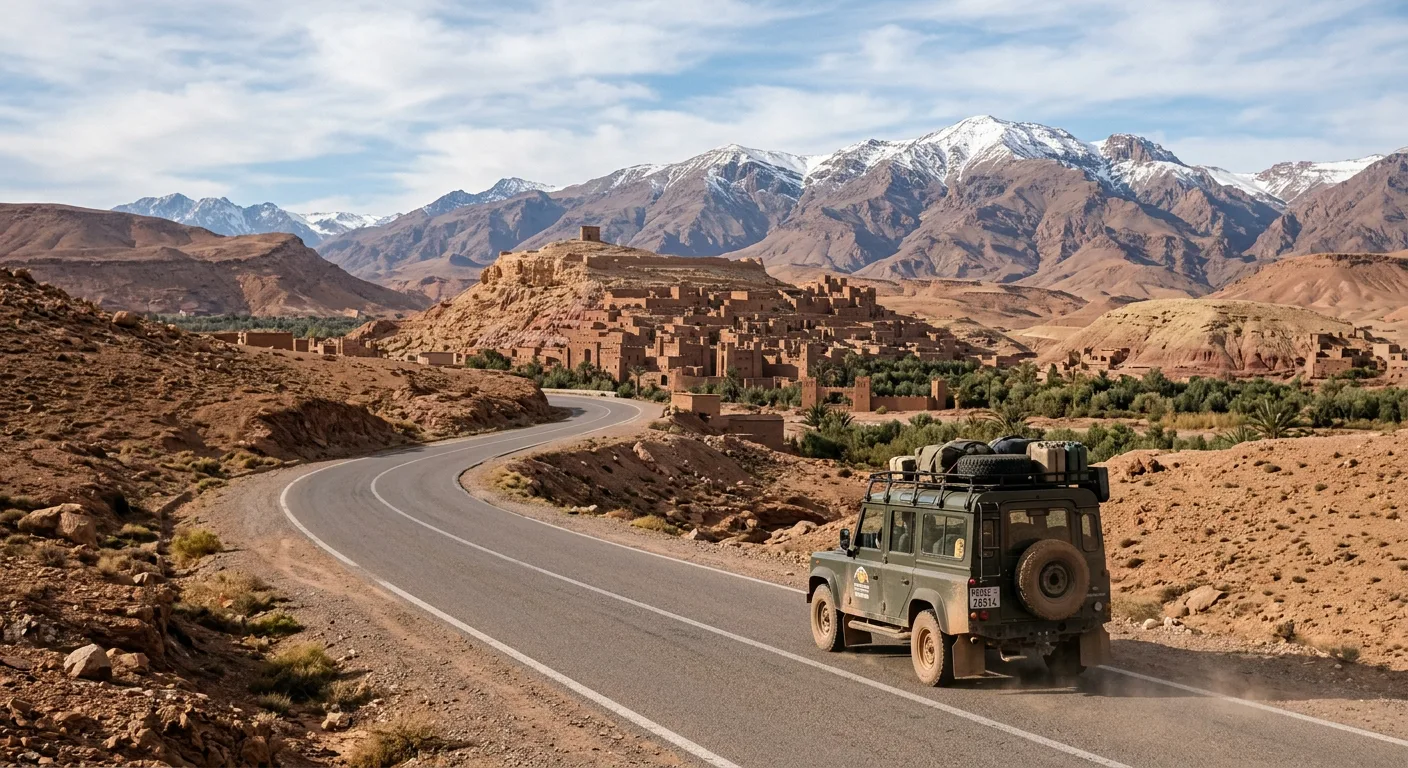
The open road -- driving through Morocco's varied landscapes
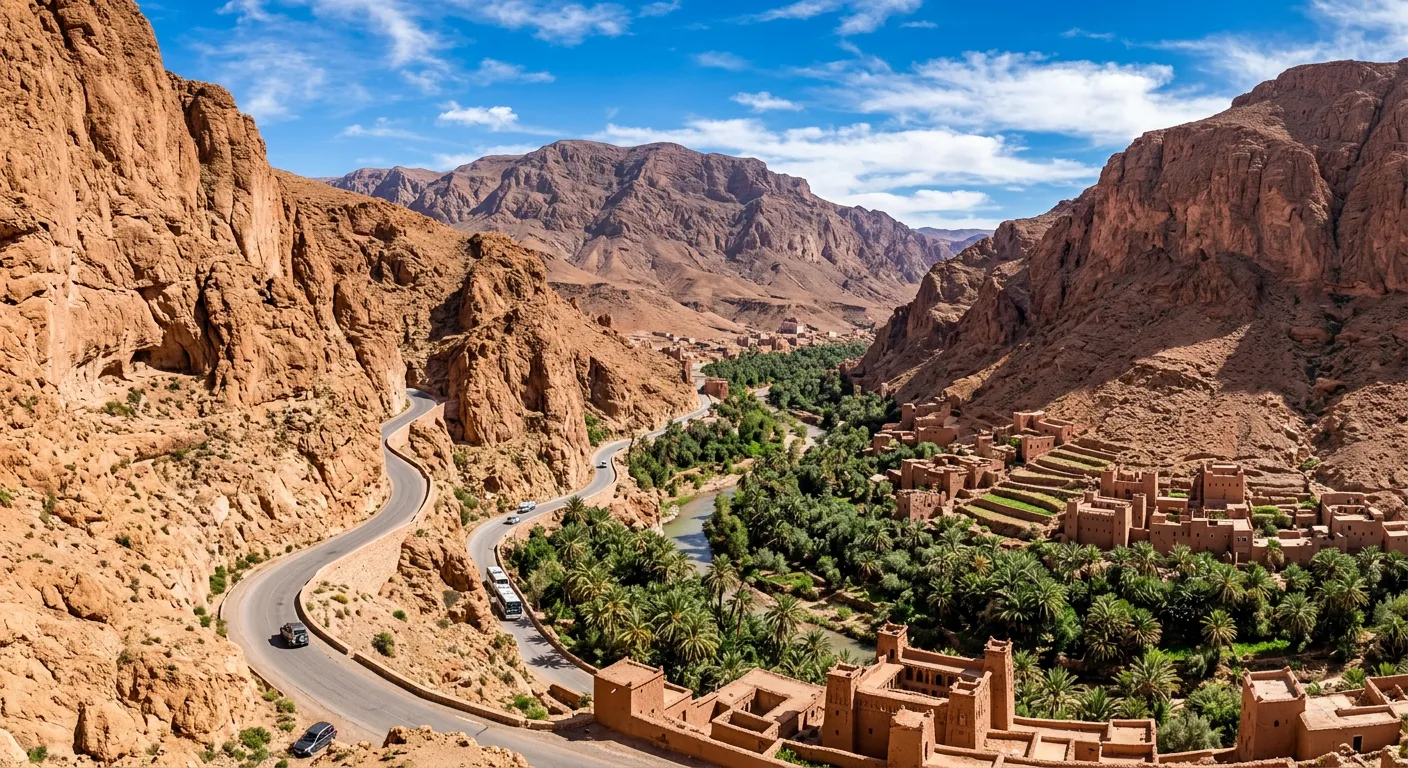
The Dades Gorge switchbacks -- one of Morocco's most iconic driving routes
Related Travel Guides
Morocco Road Trip Routes
Pre-planned scenic routes from coast to desert, with stops, distances, and timing.
Read GuideMorocco Airports Guide
All major airports, transfers, car rental desks, and arrival tips.
Read GuideMorocco Train Routes
High-speed Al Boraq, intercity ONCF services, and scenic rail journeys.
Read GuideReady to Hit the Road?
Plan your Moroccan road trip with our destination guides, scenic route planner, and complete transport information.