Discovering...
Nature & Luxury
Sahara Desert Glamping
Sleep beneath a billion stars in a luxury tented camp among the towering golden dunes of the Sahara. An experience that transforms every traveler who surrenders to the silence and vastness of the desert.
$150-500
Per Night
1-3
Nights
4.9
Rating
Why the Sahara Changes Everything
There is a moment, somewhere between the last traces of civilization and the first towering dunes, when the Sahara begins to work on you. The noise of daily life fades, replaced by a silence so complete it becomes a sound of its own. The horizon stretches without interruption in every direction. The sky above is larger and deeper than anything you have experienced. This is the moment that draws over a million travelers to Morocco's desert each year.
Sahara glamping has evolved dramatically over the past decade from basic Berber bivouacs to some of the most sophisticated tented accommodations on the planet. Today, you can sleep in a king-sized bed with Egyptian cotton sheets, shower under hot water in a marble-tiled bathroom, dine on a five-course meal prepared by a private chef, and stargaze through a professional telescope -- all while surrounded by an ocean of golden sand dunes that have remained unchanged for millennia.
The two primary destinations for this experience are Erg Chebbi near Merzouga and Erg Chigaga near M'hamid. Each offers a distinct personality. Erg Chebbi is more accessible, with towering dunes that glow vivid orange at sunrise. Erg Chigaga is wilder and more remote, requiring a proper 4x4 expedition to reach, but rewarding visitors with a sense of genuine isolation that is increasingly rare in the modern world.
Whether you choose a mid-range camp with comfortable private tents or an ultra-luxury property with butler service and heated plunge pools, the fundamental magic remains the same: the Sahara strips everything back to essentials. Fire, stars, silence, sand, and the profound realization of how vast and beautiful the natural world truly is. It is, without exaggeration, one of the most transformative travel experiences available anywhere on Earth.
Your Desert Journey
A Night in the Sahara
Here is what a typical one-night glamping experience looks like, from afternoon arrival to morning departure.
Day 1 - Afternoon
Arrival & Camel Trek
Arrive at the meeting point in Merzouga or M'hamid, where you transfer to camel or 4x4 for the journey into the dunes. The camel trek typically takes 1-1.5 hours, during which you cross the stone desert before the golden dunes appear on the horizon. As the sun begins to descend, the dunes transform from gold to deep amber to burnt sienna.
Day 1 - Sunset
Dune Sunset & Camp Welcome
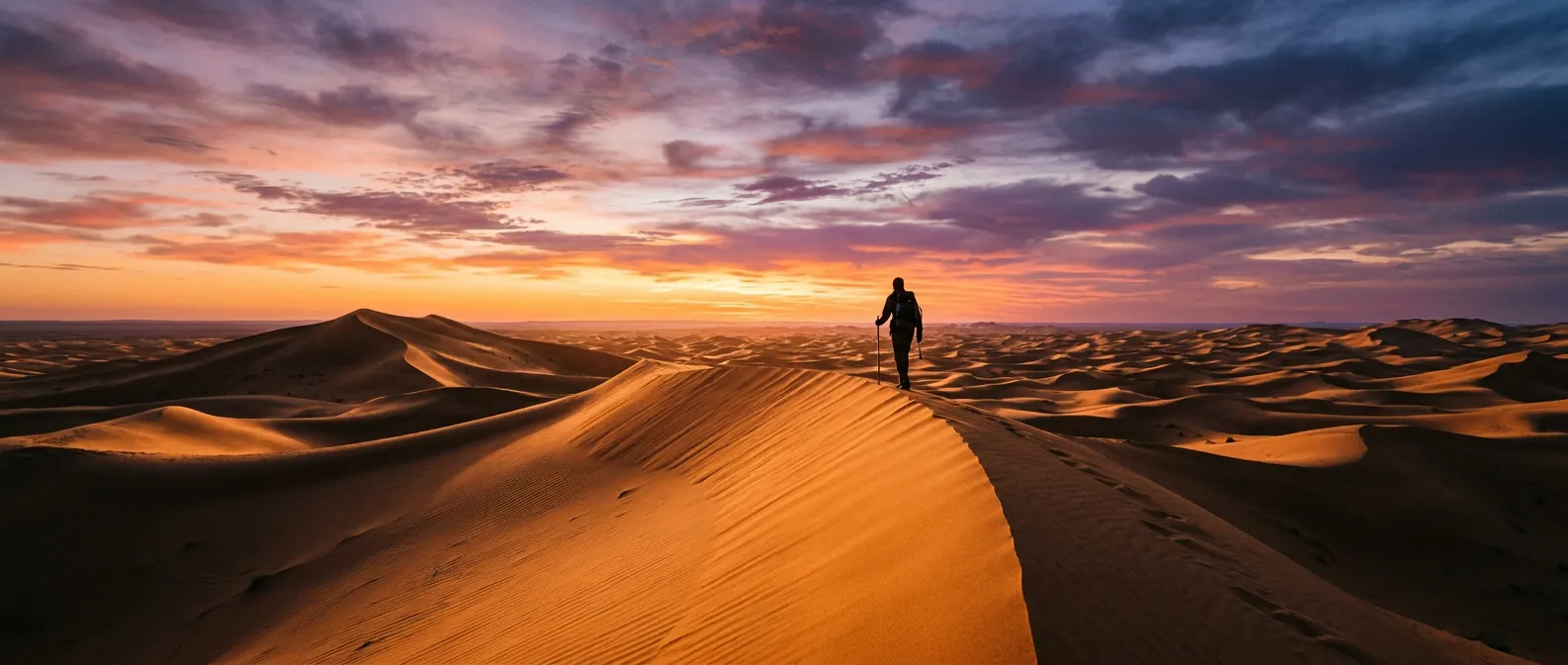
Climb a high dune near camp for the sunset panorama. Watch the endless sea of sand shift through every warm color as the sun drops below the horizon. Return to camp for a welcome glass of mint tea and settle into your tent as the camp is illuminated by lanterns and candles.
Day 1 - Evening
Dinner & Berber Music
A multi-course Moroccan dinner is served under the stars, typically starting with salads and harira soup, followed by a tagine or mechoui (slow-roasted lamb), and finishing with fruit and pastries. After dinner, Berber musicians gather around the campfire, playing traditional drums and singing songs that have echoed across the Sahara for centuries.
Day 1 - Night
Stargazing
With zero light pollution, the Sahara sky is one of the clearest on Earth. The Milky Way stretches from horizon to horizon in vivid detail. Premium camps provide telescopes and stargazing guides who identify constellations, planets, and deep-sky objects. Many guests describe the desert night sky as the most unforgettable part of the entire experience.
Day 2 - Dawn
Sunrise Over the Dunes
Wake before dawn for a short climb up the nearest high dune. Watch the Sahara come alive as the first rays of sunlight create dramatic shadows between the dune ridges and paint the sand in shades of pink, gold, and copper. This is the moment that defines a Sahara trip -- silence, beauty, and the profound solitude of the desert at dawn.
Day 2 - Morning
Breakfast & Return
Return to camp for a traditional Moroccan breakfast of msemen flatbread, Berber crepes, honey, jam, fresh fruit, and mint tea or coffee. Pack your belongings and begin the return journey by camel or 4x4. Most guests depart by mid-morning, though extended stays and multi-night options are available.
Where to Go: Two Iconic Dune Fields
Morocco's two great sand seas each offer a distinct personality and level of remoteness.
Erg Chebbi (Merzouga)
The most famous and accessible dune field in Morocco, Erg Chebbi rises up to 150 meters above the surrounding hamada (rocky desert) and stretches roughly 28 kilometers from north to south. The dunes glow a vivid orange at sunrise and sunset, creating the quintessential Saharan panorama that defines Morocco's desert identity. The gateway town of Merzouga is approximately 9 hours by road from Marrakech or 6 hours from Fes, making it an ideal destination for multi-day tours. Most luxury camps are concentrated along the western edge of the dune field, offering easy access to the tallest dunes while remaining reachable by camel or 4x4 from the town. Erg Chebbi is also the epicenter of Saharan tourism infrastructure in Morocco, meaning you will find the widest range of camp options from budget to ultra-luxury.
Access: 9 hours from Marrakech, 6 hours from Fes by road. Also reachable by flight to Errachidia airport (1.5 hours from Merzouga).
Best for: First-time visitors, those wanting variety of camp options, accessible luxury
Tallest dunes in Morocco (up to 150m)Widest range of campsSunrise camel treksGnaoua music festivalsNearby Khamlia village
Erg Chigaga (M'hamid)
For travelers seeking a wilder, more remote desert experience, Erg Chigaga is Morocco's other great sand sea. Located about 60 kilometers from the frontier town of M'hamid el Ghizlane, it can only be reached by 4x4 across flat stony desert, which gives the journey itself an expedition feel. The dune field is even larger than Erg Chebbi, stretching roughly 40 kilometers, and the sense of isolation is dramatically more intense. Far fewer tourists make it here, so you are more likely to have entire sections of dunes to yourself. The camps at Erg Chigaga tend to be more exclusive and intimate, often accommodating fewer than 20 guests. The surrounding landscape includes ancient lake beds, fossilized seabeds, and the dry Draa River valley, making the approach as memorable as the destination.
Access: 1.5-2 hours by 4x4 from M'hamid el Ghizlane. M'hamid is approximately 9 hours from Marrakech.
Best for: Experienced travelers, those seeking solitude and remoteness, luxury seekers
Largest dune field in MoroccoExtreme remoteness & solitudeFewer touristsAncient fossil sitesDramatic 4x4 approach
Camp Tiers & Pricing
From authentic budget bivouacs to ultra-luxury private camps, there is a Sahara experience for every budget and style.
Standard Desert Camp
$30-80/night
Basic Berber-style bivouac with shared tents, foam mattresses, and communal facilities. Authentic and affordable, these camps deliver the core Sahara experience without luxury frills. Expect simple blankets, a shared bucket shower, and meals around a communal campfire. Perfect for budget travelers and backpackers who want the genuine desert experience.
Shared tents (4-8 beds)
Foam mattresses & blankets
Communal dining tent
Campfire with Berber music
Shared bathroom facilities
Basic camel trek included
Best for: Budget travelers, backpackers, groups
Mid-Range Luxury Camp
$150-250/night
Comfortable private tents with proper beds, en-suite bathrooms, and curated dining experiences. These camps strike the perfect balance between authenticity and comfort. Expect real mattresses, hot water showers, atmospheric lighting, and multi-course dinners served under the stars. Most camps in this range are located in the Erg Chebbi dune field near Merzouga.
Private tents with real beds
En-suite bathrooms with hot water
Multi-course Moroccan dinner
Sunrise & sunset camel treks
Berber music & campfire
Sandboarding included
Best for: Couples, families, comfort seekers
Most Popular
Premium Glamping
$250-500/night
Five-star desert lodges with plush king beds, luxury linens, private terraces, and gourmet dining. These exclusive camps offer a level of refinement that rivals any boutique hotel, set against the dramatic backdrop of towering sand dunes. Expect air conditioning or heating, rainfall showers, curated wine lists, private stargazing sessions, and personalized itineraries.
King beds with luxury linens
Private terrace with dune views
Air conditioning/heating
Gourmet multi-course dining
Private stargazing with telescope
Spa treatments available
Best for: Honeymooners, luxury travelers, special occasions
Ultra-Luxury Private Camp
$500+/night
Bespoke, completely private camps set up exclusively for your party in a remote dune location. Every detail is customized, from the menu to the entertainment to the location of your camp. Butler service, vintage champagne on the dunes, private musicians, and helicopter transfers are all possible. This is the Sahara at its most exclusive and theatrical.
Fully private camp setup
Butler & concierge service
Custom gourmet menu
Helicopter or private 4x4 transfer
Exclusive dune location
Customized activities & entertainment
Best for: VIP travelers, proposals, milestone celebrations
Best Time for Sahara Glamping
The desert has extreme seasonal variations. Choosing the right month dramatically impacts your comfort and enjoyment.
October - November
15-28C (59-82F)
The ideal window. Days are warm but not scorching, nights are cool but not freezing, and the autumn light creates extraordinary photographic conditions. The busy tourist season has not yet reached its peak, so prices are reasonable and camps are not overcrowded.
March - April
18-30C (64-86F)
Spring brings mild temperatures and occasionally dramatic skies as the last winter weather systems pass through. Wildflowers may appear in the surrounding oases. Another excellent shoulder-season window with moderate crowds.
December - February
5-20C (41-68F)
Crystalline night skies make this the best season for stargazing, and the low-angle winter light is spectacular for photography. However, nights can be genuinely cold, dropping below freezing in December and January. Luxury camps with heating are strongly recommended.
May - September
30-45C+ (86-113F+)
Summer heat is extreme, often exceeding 45C (113F). Most reputable camps close or operate at reduced capacity. While some budget camps remain open, the experience is physically demanding and potentially dangerous. Not recommended for most travelers.
What to Bring
Warm layers for night
Desert temperatures can drop below 5C (41F) in winter, even 0C in December/January
Sunscreen & sunglasses
UV exposure is intense in the open desert, even in cooler months
Headscarf or shemagh
Protection from sun, wind, and sand. Your camp may provide traditional turbans
Comfortable closed shoes
For walking on rocky terrain. Sandals are fine at camp but not for hikes
Camera with extra batteries
Cold desert nights drain batteries fast. A phone power bank is essential
Small flashlight or headlamp
Useful for navigating camp at night. Red light mode preserves night vision for stargazing
Toiletries & medications
Basic camps may have limited supplies. Bring any prescription medications you need
Cash in Moroccan dirhams
For tips to camp staff and camel handlers. 50-100 MAD per person is customary
Important Note
Most luxury camps provide towels, toiletries, and warm blankets. Budget camps typically do not. Confirm what is included when you book. All camps are off-grid, so charge your devices fully before departure. Premium camps may have solar-powered charging stations.
Booking Tips
Practical advice to help you choose the right camp and get the best experience.
Book Direct When Possible
Many camps offer better rates and complimentary upgrades when you book directly through their website or WhatsApp rather than through an OTA. You also get more flexibility to customize your itinerary and add special requests like birthday celebrations or private dining.
Consider a Multi-Day Package
While one night delivers the core experience, two nights allows you to truly unwind and explore. You can take a longer camel trek to remote dunes, try sandboarding, visit a nearby oasis or nomad camp, and experience the desert at different times of day.
Book Transport Together
Most camps offer package deals that include transport from Marrakech or Fes, often via scenic stops at Ait Benhaddou, the Dades Gorges, and the Todra Gorge. These multi-day routes (typically 2-3 days each way) transform the journey into an adventure of its own.
Read Recent Reviews
Camp quality can change significantly between seasons. Check reviews from the past 3-6 months on Google Maps, TripAdvisor, and Booking.com. Pay particular attention to comments about food quality, bathroom cleanliness, and the authenticity of the Berber music experience.
Related Experiences
Combine your desert adventure with these other unforgettable Moroccan experiences.