Discovering...
Morocco Travel Guide 2026
Morocco Gardens Guide
From Jardin Majorelle's cobalt walls to the khettara-fed orchards of Agdal, twelve gardens across four cities reveal a thousand years of Islamic horticulture, Andalusian geometry, and botanical ambition. Plan your visits with entry fees, hours, and combined tour routes.
Gardens
12 Featured
4 cities
Best Season
Mar - May
Spring bloom
Design Heart
Water
Sacred element
Top Pick
Majorelle
Most visited
Entry Fees
Free - 150 MAD
6 free gardens
Photography
Permitted
Most gardens
Why Morocco Gardens Matter
In a country where the Sahara pushes north and summer temperatures routinely pass 40 degrees Celsius, a garden is not a luxury. It is a statement of will, engineering, and faith. The Almohad dynasty channeled Atlas snowmelt through underground khettara tunnels stretching 30 km to fill the basins of Menara and Agdal eight centuries before modern plumbing. That water still flows today.
Moroccan garden design draws from Persian, Andalusian, and Amazigh traditions but has developed its own vocabulary: zellige tilework around basins, tadelakt-polished fountains, orange groves arranged in geometric symmetry, and the riad courtyard that turns an entire house into an enclosed garden. The result is a living tradition where a 12th-century irrigation system and a 21st-century public Wi-Fi park can coexist on the same boulevard.
For travelers, gardens serve a practical purpose. They are shade, quiet, and orientation between the sensory overload of the medina and the sprawl of the nouvelle ville. Knowing which garden to visit at which hour, and understanding what you are looking at when you get there, transforms a pleasant walk into an education in Moroccan civilization.
12 Must-Visit Morocco Gardens
Organized by city with entry fees, hours, and what sets each garden apart from the rest.
Marrakech#1
Jardin Majorelle
Morocco's single most visited garden and one of the most recognized botanical spaces in Africa. The intense Majorelle Blue walls set against towering cacti, bougainvillea, and tropical palms create a visual contrast that has drawn artists, designers, and travelers since the 1920s.
What stands out: The twelve-acre garden was painted in Jacques Majorelle's signature cobalt blue in 1937 and restored by Yves Saint Laurent and Pierre Berge after 1980. Over 300 species from five continents grow among bamboo groves, lily ponds, and shaded pathways. The on-site Berber Museum houses 600 artifacts tracing Amazigh heritage across North Africa.
Rue Yves Saint Laurent, Gueliz
9:00 AM - 6:00 PM daily (extended to 6:30 PM May-September)
from 150 MAD garden, from 30 MAD Berber Museum, from 100 MAD YSL Museum
Early morning (9-10 AM) to avoid peak crowds
Marrakech#2
Menara Gardens
One of the oldest gardens in Marrakech, centered around a vast rectangular reflecting pool backed by the High Atlas range. The peaceful olive orchards and open sky make it the opposite of the dense medina, offering visitors a wide horizon and quiet.
What stands out: The Almohad dynasty built the basin in the 12th century as an irrigation reservoir fed by underground channels stretching 30 km to the Atlas Mountains. The green-tiled Saadian pavilion reflected in still water with snowcapped peaks behind is one of the most photographed scenes in Morocco. Olive groves surrounding the basin are over 700 years old.
Avenue de la Menara, Hivernage
8:00 AM - 5:00 PM daily
Free (from 10 MAD for the pavilion)
Late afternoon for golden light on the Atlas Mountains backdrop

Marrakech#3
Le Jardin Secret
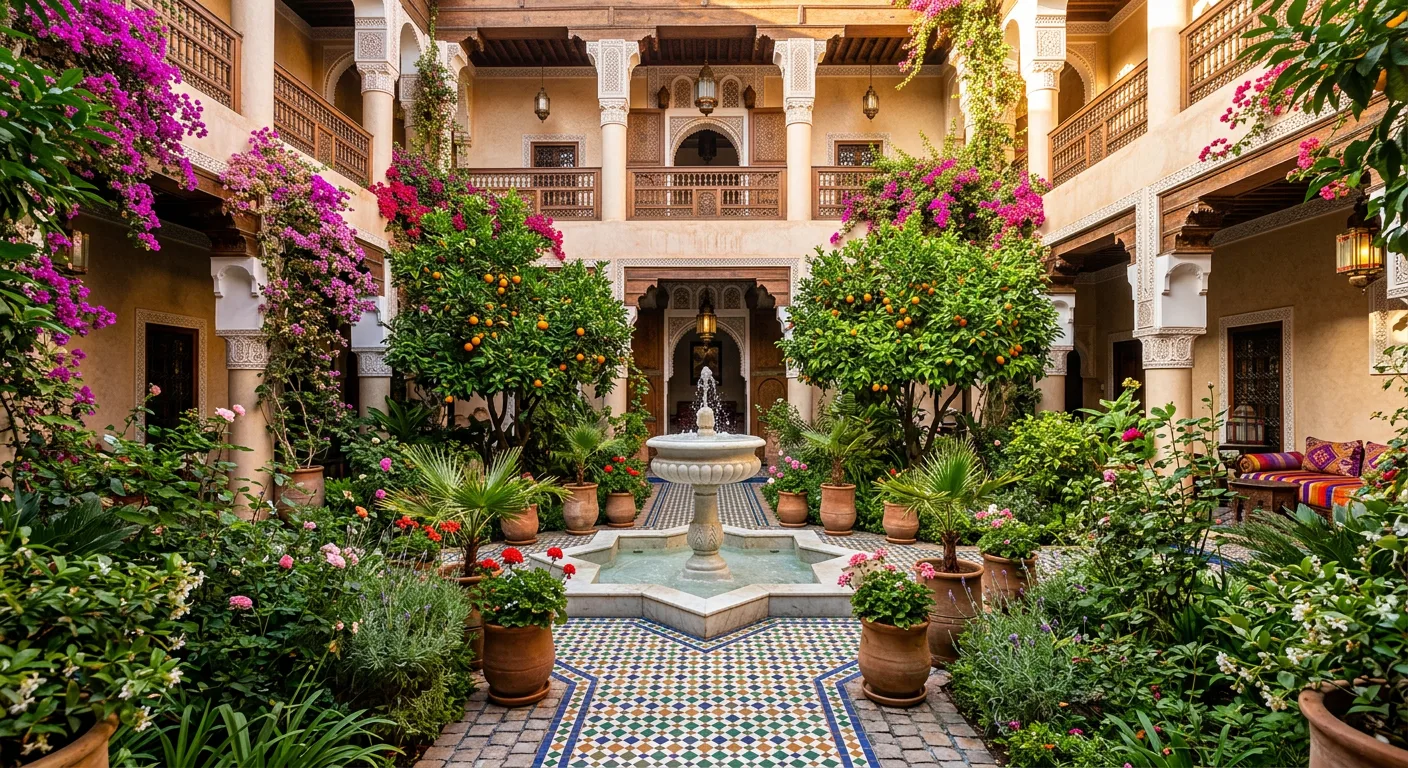
Tucked behind an unremarkable medina door, Le Jardin Secret is a meticulously restored courtyard garden that demonstrates both Islamic paradise garden philosophy and modern botanical curation in a single compound. It reopened in 2016 after years of conservation.
What stands out: Two distinct garden concepts occupy a single restored 16th-century Saadian palace: an exotic garden with tropical species from around the world, and an Islamic garden with geometric water channels representing the four rivers of paradise. The climbable tower provides panoramic views across the medina to the Atlas Mountains.
121 Rue Mouassine, Marrakech Medina
9:30 AM - 6:30 PM (Feb-Sep), 9:30 AM - 5:30 PM (Oct-Jan)
from 80 MAD garden, from 120 MAD garden + tower
Midday as a cool retreat from the medina heat
Marrakech#4
Cyber Park Arsat Moulay Abdeslam
Marrakech's most accessible green space, bridging the gap between old medina and modern Gueliz. The eight-hectare park combines centuries-old plantings with contemporary amenities, making it a gathering place for residents and travelers at no cost.
What stands out: Originally an 18th-century royal garden, Cyber Park was renovated by the Mohammed VI Foundation in 2005 as a free public park with Wi-Fi hotspots and multimedia kiosks. Olive, orange, and palm trees shade broad walkways and fountains, creating an urban oasis between the medina walls and the nouvelle ville.
Avenue Mohammed V, between Gueliz and the Medina
7:30 AM - 7:00 PM daily (closes at 6:00 PM in winter)
Free
Morning for joggers and birdsong; evening for local families

Marrakech#5
Agdal Gardens
The largest historic garden in Marrakech and among the oldest continuously cultivated royal gardens in the Islamic world. Access is restricted to two days per week and suspended during royal visits, making each visit feel like a private tour of a nine-century-old landscape.
What stands out: Founded in 1157 by Almohad Caliph Abd al-Mu'min, the 400-hectare walled garden holds orange, fig, pomegranate, apricot, and olive orchards irrigated by a khettara system carrying Atlas snowmelt over 30 km. The Dar al-Hana pavilion overlooks a monumental basin that once supplied the entire palace complex.
South of the Royal Palace, Marrakech
Friday and Sunday only, 9:00 AM - 5:00 PM (closed when the King is in residence)
Free
Friday mornings when crowds are thinnest

Rabat#6
Andalusian Gardens
A walled garden perched within the ancient Oudaias Kasbah overlooking the Atlantic. The Moorish layout captures the spirit of Al-Andalus, and the scent of orange blossoms in spring fills the narrow streets of the surrounding kasbah quarter.
What stands out: Built inside the 12th-century Kasbah of the Udayas during the French Protectorate, the garden follows Andalusian-Moorish conventions: citrus trees, purple bougainvillea, jasmine, and cypress hedges framing geometric pathways around a central marble fountain. Views over the Bou Regreg river to Sale are part of the experience.
Kasbah des Oudaias, Rabat
8:00 AM - 6:00 PM daily
Free
Late afternoon for warm light on whitewashed walls
Fes#7
Jnan Sbil
The finest public park in Fes, spanning 7.5 hectares of shaded walks, flowing water, and flowering beds. A place where locals gather to read, talk, and escape the summer heat, and where travelers rediscover silence after the labyrinth of the old city.
What stands out: Originally created as a royal garden by Sultan Moulay Abdallah in the 18th century, Jnan Sbil was restored and reopened to the public with over 3,000 trees, formal flower beds, intricate water channels, ornamental lakes, and bamboo groves. Its location beside Bab Boujeloud (the Blue Gate) makes it the natural decompression zone after the sensory intensity of the Fes medina.
Avenue Moulay Hassan, near Bab Boujeloud
8:00 AM - 6:00 PM daily
Free
Morning for birdsong and fewer visitors
Rabat region#8
Exotic Gardens of Bouknadel
A tropical botanical garden on the Rabat-Kenitra road that feels transported from another hemisphere. Each themed section replicates a different ecosystem, making a single visit a botanical tour through five continents in under two hours.
What stands out: French horticulturist Marcel Francois planted these gardens in 1951 with over 1,500 species organized by continent of origin: Polynesia, South America, the Caribbean, China, Japan, and sub-Saharan Africa. Bamboo forests, giant ferns, water lily ponds, and rare orchids fill narrow walkways. The gardens receive a fraction of the visitors that Jardin Majorelle draws despite holding one of North Africa's richest plant collections.
Route de Kenitra, Bouknadel (17 km north of Rabat)
9:00 AM - 6:30 PM daily
from 20 MAD
Spring (March-May) for the densest vegetation
Marrakech#9
Arsat Moulay Abdeslam
A living fragment of Marrakech's agricultural past, Arsat Moulay Abdeslam preserves an 18th-century royal orchard within a modern urban park. Walking beneath its ancient olives gives a sense of the garden city Marrakech once was.
What stands out: The historic core of what is now Cyber Park, this 18th-century arsat (orchard) was commissioned by Sultan Sidi Mohammed ben Abdallah. Mature olive trees over 250 years old line gravel avenues, and traditional seguia channels still run between the beds. It is the last surviving arsat of the dozen that once ringed Marrakech's walls.
Boulevard Mohammed V, Marrakech (within Cyber Park grounds)
7:30 AM - 7:00 PM daily
Free
Evening for strolling under lantern light
Islamic Garden Design Principles
Six core ideas that shape every traditional garden in Morocco, from royal palace grounds to the smallest riad courtyard.
Chahar Bagh (Four-Part Layout)
The garden is divided into four quadrants by water channels intersecting at a central fountain. The four sections represent the four rivers of paradise described in the Quran: water, milk, wine, and honey. This layout governs gardens from the Alhambra to the Taj Mahal, and its Moroccan expression is visible at Le Jardin Secret and in riad courtyards across the country.
Water as Sacred Element
Every Moroccan garden is built around water. Fountains, basins, and narrow channels called seguias provide cooling sounds, humidity, and a visual axis. In a landscape where much of the terrain is arid, the ability to channel and display water is both a practical triumph and a spiritual act representing abundance.
Enclosure and Inwardness
Islamic gardens are enclosed by high walls, turning attention inward rather than outward. The boundary between the ordered garden and the chaotic world outside is fundamental. Inside the walls, geometry replaces wilderness. This principle shapes the riad courtyard, where a private paradise exists behind a plain exterior door.
Geometric Symmetry
Zellige tilework, clipped hedges, symmetrical tree rows, and repeating arch forms create mathematical patterns that represent the infinite nature of creation. The patterns are not decoration for its own sake: they reflect a worldview in which the underlying order of the natural world can be made visible through careful human arrangement.
Sensory Layering
Moroccan gardens engage every sense. The sound of running water, the fragrance of jasmine and orange blossom, the shade of citrus canopies, the texture of carved stucco, and the color contrasts of zellige tile against green foliage are all designed to work in combination, creating an environment that is immersive rather than merely visual.
Shade and Microclimate
Tall trees, colonnaded walkways, and the proportions of courtyard walls are calculated to maximize shade during summer heat. The ratio of courtyard width to wall height determines how much direct sunlight reaches the ground, and experienced garden builders manipulate this ratio to create temperatures significantly cooler than the streets outside.
Best Time to Visit Morocco Gardens
Season-by-season breakdown of what blooms, what the weather does, and which gardens reward each period most.
March - May (Peak)
Orange blossom, jasmine, roses, bougainvillea, irises, wisteria
The top season for every garden on this list. Temperatures stay between 18-28 degrees Celsius in Marrakech. Water channels run full from winter rain. Jardin Majorelle is busiest but most photogenic. April brings the Rose Festival near Kelaat M'Gouna. Book Majorelle tickets online to skip queues.
June - August
Oleander, hibiscus, lantana, cactus flowers
Marrakech temperatures regularly exceed 40 degrees Celsius. Visit gardens only before 10 AM or after 5 PM. Menara and Agdal offer open space but minimal shade. Cyber Park and Le Jardin Secret have walled enclosures that trap cooler air. Jnan Sbil in Fes is a reliable refuge from the heat.
Sep - Nov (Strong)
Second rose bloom, late bougainvillea, pomegranate fruit, date harvest
October and November rival spring for comfortable temperatures. Crowds thin significantly after September. Agdal Gardens' fruit orchards are at their most productive. The Exotic Gardens of Bouknadel have rich green canopy from late-summer growth. This is the period many repeat visitors prefer.
Dec - Feb
Citrus fruit, poinsettia, winter jasmine, almond blossom (February)
Winter gardens are green and quiet. Rain keeps vegetation lush but can close some paths at Agdal. Menara reflections are crisp on cold, still mornings. Almond blossom starts in late January around Tafraoute. Fewest tourists of the year and lowest accommodation prices.
Garden Photography Tips
Practical techniques to capture Morocco gardens at their best, from timing your visit to composing strong images.
1
Arrive at Opening for Clean Compositions
Jardin Majorelle can see 2,000 visitors per day. Arriving at 9 AM gives you roughly 45 minutes before the first tour buses. Menara Gardens at 8 AM offers mirror-still reflections before the wind picks up. The difference in image quality between 9 AM and 11 AM is dramatic.
2
Use Archways and Doorways as Natural Frames
Moroccan garden architecture provides built-in framing devices: horseshoe arches, mashrabiya screens, and carved doorways. Position yourself so the arch creates a border around the garden scene beyond. This technique adds depth and a sense of discovery.
3
Capture Water Reflections from a Low Angle
Get close to the surface of basins and seguia channels to capture reflections of architecture and sky. A polarizing filter helps control glare. Perfectly still mornings at Menara Gardens produce the best mirror effects in the large basin.
4
Shoot Bold Color Contrasts
Majorelle Blue against terracotta pots, magenta bougainvillea on white walls, green palms against red earth: Moroccan gardens thrive on high-contrast color combinations. Compose to fill the frame with two or three dominant colors rather than trying to capture everything.
5
Focus on Detail and Texture
Close-up shots of zellige tilework, patinated brass fountain heads, water droplets on jasmine petals, or sunlight filtering through carved screens often convey the feel of a garden more powerfully than wide establishing shots.
6
Respect the Rules
Tripods and professional gear may require advance permission at Jardin Majorelle. Drone photography across Morocco requires a government permit and is restricted in most urban areas. Always ask before photographing individuals, especially in public gardens used daily by local families.
Combined Garden Tour Itineraries
Three tested routes that combine multiple gardens into a single day, with estimated budgets and timing. Seasonal pricing can change.
Marrakech Full-Day Garden Route
Stops: Jardin Majorelle, Cyber Park, Le Jardin Secret, Menara Gardens
Duration: 7-8 hours with lunch
Budget: from 400 MAD (entry fees + taxi transfers)
Start at Jardin Majorelle at 9 AM when it opens. Walk south along Avenue Yves Saint Laurent to reach Cyber Park by 11 AM (free entry, Wi-Fi, shade). Take a taxi or walk into the medina for lunch and visit Le Jardin Secret at 1 PM. End the day at Menara Gardens for the 4-5 PM golden hour when the Atlas Mountains glow behind the reflecting pool.
Rabat Garden & Kasbah Day
Stops: Andalusian Gardens, Exotic Gardens Bouknadel
Duration: 5-6 hours with transport
Budget: from 120 MAD (entry + grand taxi)
Begin at the Kasbah des Oudaias in Rabat, exploring the Andalusian Gardens and the kasbah viewpoints in the morning. Take a grand taxi north on the Kenitra road (17 km) to the Exotic Gardens of Bouknadel after lunch. The combination covers Moorish formal design and tropical botanical diversity in a single day.
Fes Medina & Garden Escape
Stops: Jnan Sbil, Fes Medina Riad Courtyards
Duration: 4-5 hours
Budget: Free (Jnan Sbil) + riad courtyard visits from 50 MAD
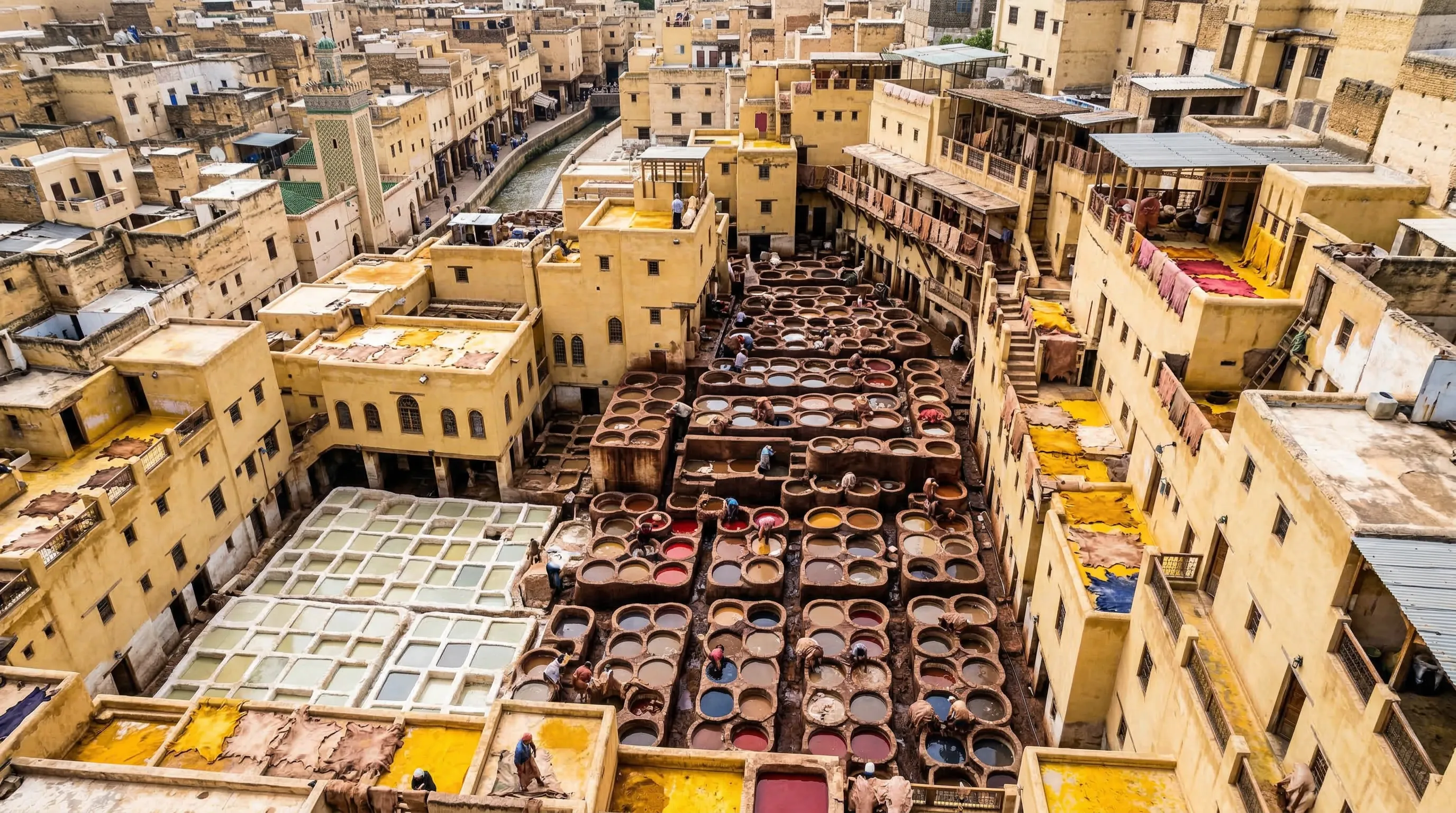
Enter the Fes medina through Bab Boujeloud (the Blue Gate) and explore the tanneries, souks, and madrasas through the morning. At midday, exit through Bab Boujeloud and cross into Jnan Sbil for shade, water sounds, and botanical calm. Return to the medina in the afternoon to visit riad courtyards open to the public (Riad Rcif, Dar Batha).
Practical Tips for Garden Visitors
Arrive at Opening
Jardin Majorelle sees 2,000+ daily visitors in peak season. The first hour after opening offers peaceful paths and clean photographs. This applies to Le Jardin Secret and Exotic Gardens Bouknadel as well.
Check Agdal Access
Agdal Gardens open only on Fridays and Sundays and close without notice when the King is in residence at the adjacent palace. Ask your riad or hotel before planning a visit.
Bring Water
Several gardens, including Menara and Agdal, have no refreshment stands inside. Carry at least 1 liter per person, especially from May through September when temperatures in Marrakech gardens can exceed 38 degrees Celsius.
Respect Local Use
Cyber Park, Jnan Sbil, and Arsat Moulay Abdeslam are used daily by Moroccan families for exercise, socializing, and children's play. Keep voices moderate, avoid blocking pathways for photos, and remember these are community spaces first.
Dress Modestly
While gardens are relaxed settings, Morocco is a Muslim-majority country. Shoulders and knees covered is a respectful default, especially in public parks used by local families. Tourist-oriented gardens like Majorelle are more relaxed.
Carry Small Bills
Ticket booths at smaller gardens may not have change for large notes. Keep from 20 MAD and from 50 MAD bills ready. Tipping garden guides is appreciated (from 20 MAD) and helps maintain these spaces.
Frequently Asked Questions
Answers to the most common questions travelers ask about visiting gardens in Morocco.
What is the best time of year to visit Morocco gardens?
March through May is the peak season for Morocco gardens. Spring brings orange blossoms, jasmine, roses, and bougainvillea into full bloom. Temperatures are comfortable for walking, and irrigation channels run at their fullest after winter rains. October and November are a strong second choice with fewer crowds and mild weather.
How much does it cost to visit Jardin Majorelle in 2026?
Jardin Majorelle charges from 150 MAD for garden entry, from 30 MAD for the Berber Museum, and from 100 MAD for the Yves Saint Laurent Museum. Seasonal pricing can change during peak tourist months. Children under 12 pay reduced rates. Arrive before 10 AM to avoid the longest queues.
Can I visit multiple Marrakech gardens in one day?
Yes. A practical route starts at Jardin Majorelle in Gueliz at 9 AM, then walks to Cyber Park by 11 AM, takes a taxi to Le Jardin Secret in the medina for lunch, and finishes at Menara Gardens for sunset. Agdal Gardens are only open Fridays and Sundays. Budget from 400 MAD total for entry fees and taxis.
Are Morocco gardens accessible for wheelchair users?
Jardin Majorelle and Cyber Park have paved pathways that accommodate wheelchairs. Le Jardin Secret has ground-floor access but the tower is stair-only. Menara Gardens are mostly flat gravel paths. Agdal Gardens have uneven terrain. Jnan Sbil in Fes has smooth walkways on the main circuit. Contact gardens in advance for current accessibility details.
What is the difference between Islamic and European garden design in Morocco?
Islamic gardens follow the chahar bagh (four-part) layout divided by water channels representing paradise, with geometric symmetry, enclosed walls, and an emphasis on shade, fragrance, and the sound of water. European colonial gardens like Cyber Park and parts of Jardin Majorelle use open vistas, specimen plantings, and decorative flower beds. Many Morocco gardens blend both traditions.
Is photography allowed in Morocco gardens?
Photography is allowed in all public gardens covered in this guide. Tripods and professional equipment may require permission at Jardin Majorelle. Drone photography is restricted across Morocco and requires a government permit. Flash photography should be avoided near delicate plants. Always ask before photographing other visitors.
Which Morocco gardens are free to visit?
Menara Gardens, Agdal Gardens, Cyber Park, Andalusian Gardens in Rabat, Jnan Sbil in Fes, and Arsat Moulay Abdeslam in Marrakech are all free to enter. Together they offer a full day of garden exploration without any entry fees. The Menara pavilion charges from 10 MAD separately.
What should I wear when visiting Morocco gardens?
Wear comfortable walking shoes with good grip since paths can be gravel or uneven stone. Bring a sun hat and sunscreen since shade varies between gardens. Light layers work well as walled gardens trap heat. Modest clothing is recommended as a general courtesy in Morocco. Carry a water bottle since some gardens lack refreshment stands.
Related Guides
Moroccan Architecture Guide
Riads, kasbahs, madrasas, and the building traditions that shape Morocco's gardens.
Read guideBest Time to Visit Morocco
Month-by-month climate, crowds, and pricing to plan the right season for your trip.
Read guideMarrakech City Guide
Medina, souks, riads, and all the gardens in context of a full Marrakech itinerary.
Read guideHammam & Spa Guide
Traditional hammam rituals, etiquette, and the best spas to complement your garden day.
Read guidePlan Your Morocco Garden Tour
From Marrakech's cobalt courtyards to Fes's bamboo-shaded walks, Morocco's gardens reward the traveler who arrives early, stays late, and looks closely. Start planning your route today.