Discovering...
Built Heritage
Moroccan Architecture Guide
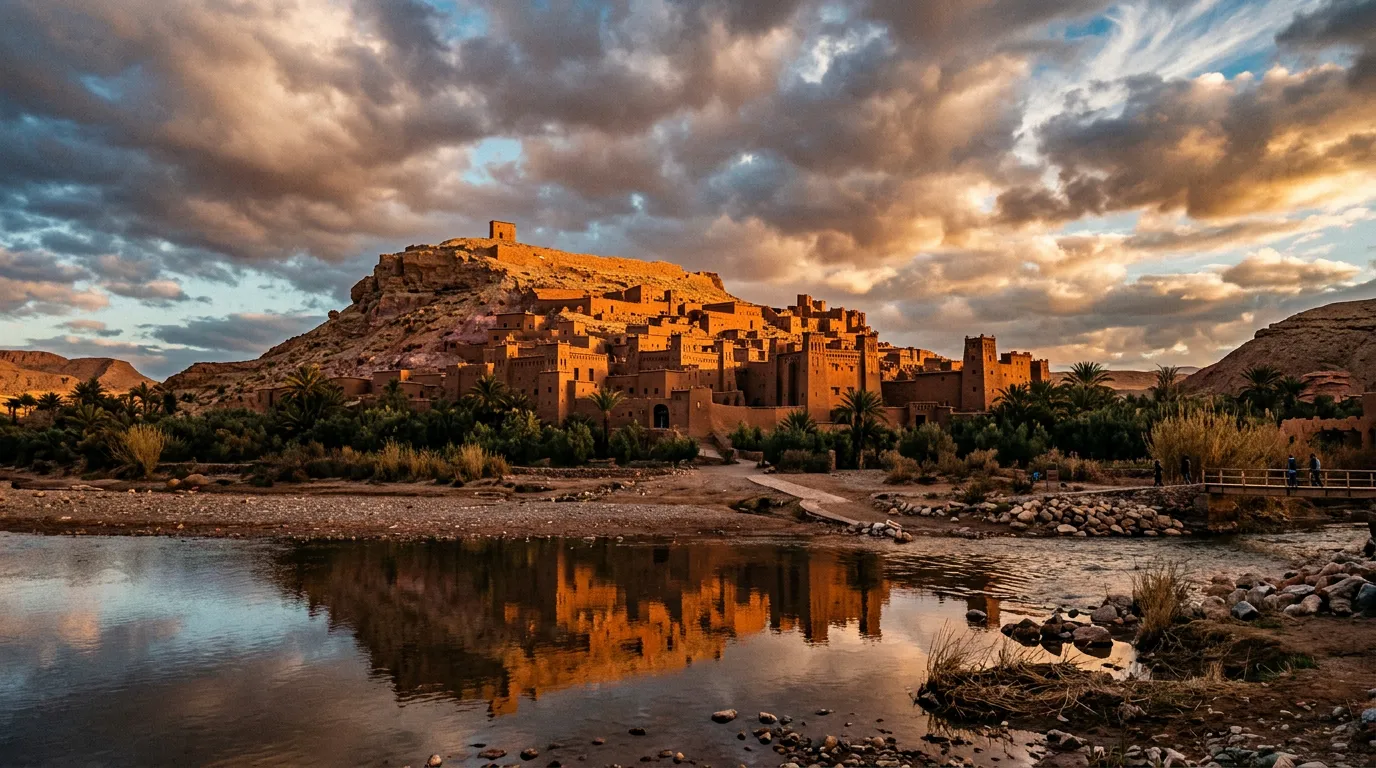
A thousand years of building mastery. From Berber kasbahs carved from desert earth to the soaring Hassan II Mosque over the Atlantic, discover the architecture that makes Morocco one of the most visually extraordinary countries on earth.
Styles
8 Major
Over 1000 years
Masterpieces
16 Must-See
Across Morocco
UNESCO Sites
9 Listed
Architectural heritage
Elements
12 Key
Design vocabulary
Dynasties
6 Major
Builder patrons
Top Site
Hassan II Mosque
Casablanca
1000 Years of Moroccan Architecture
From prehistoric cave dwellings to cutting-edge modern design, Morocco's built heritage is a continuous thread connecting ancient Berber traditions to the 21st century.
Morocco's architectural story is one of extraordinary layering. Each dynasty, each wave of cultural influence, each era of trade and conquest has added new elements to the built environment without erasing what came before. The result is a living architectural palimpsest where Roman columns support Islamic arches, Berber earthen construction techniques coexist with Art Deco concrete, and thousand-year-old mosques stand alongside buildings by Pritzker Prize-winning architects.
~700,000 BCE
Prehistoric
First human settlements and cave dwellings in Morocco
~800 BCE
Phoenician
Phoenician trading posts along the coast (Lixus, Mogador)
40 CE - 285 CE
Roman
Volubilis becomes provincial capital; Roman urban planning
680 CE
Islamic
Arab conquest brings mosque and medina architecture
789
Idrisid
Fes founded; Qarawiyyin Mosque established (859)
1040-1147
Almoravid
Marrakech founded (1062); first great Moroccan dynasty
1121-1269
Almohad
Koutoubia, Hassan Tower, monumental gates and walls
1244-1465
Marinid
Golden age of madrasas; decorative arts peak in Fes
1549-1659
Saadian
El Badi Palace, Saadian Tombs, Ben Youssef Madrasa
1631-present
Alaouite
Moulay Ismail's Meknes; Mohammed V Mausoleum
1912-1956
Protectorate
Art Deco Casablanca; Ville Nouvelle urban planning
1986-present
Modern
Hassan II Mosque; Yves Saint Laurent Museum; Grand Theatre
Architectural Styles Through History
Eight distinct architectural traditions that have shaped Morocco's built heritage over a millennium, from Berber indigenous building to international modernism.
Prehistoric - Present
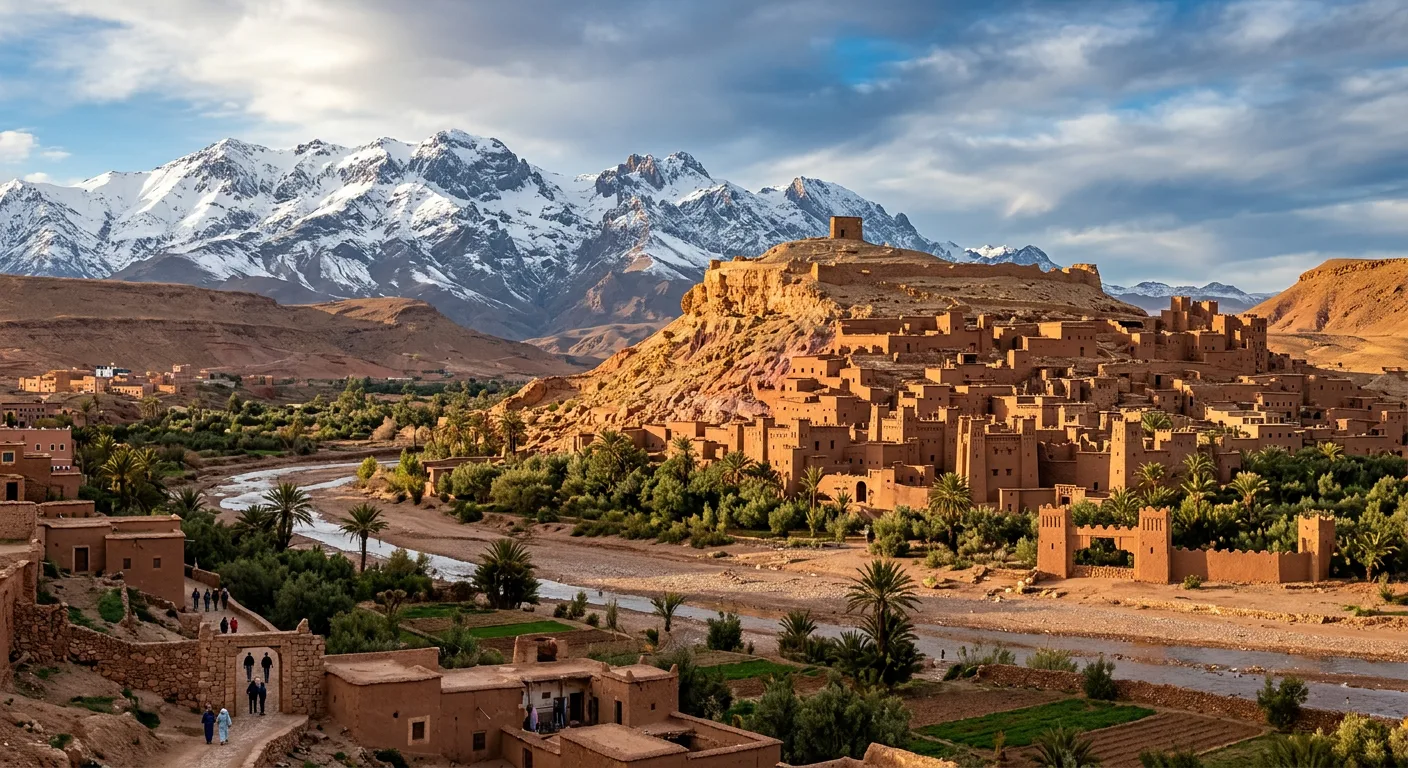
Berber / Amazigh
The indigenous architecture of Morocco's original inhabitants, the Amazigh (Berber) people. This tradition produced the dramatic kasbahs and ksour (fortified villages) of the Draa and Dades Valleys, built from pise (rammed earth) that blends seamlessly with the desert landscape. Berber architecture is defined by its harmony with terrain, using locally sourced materials and responding to extreme climate conditions. The multi-story kasbahs with their crenellated towers and geometric pise decoration are among the most visually striking buildings in all of Africa.
Key Features
Pise (rammed earth) constructionCrenellated watchtowersGeometric earth decorationsFortified granaries (agadirs)Climate-responsive thick walls
Examples
Ait Benhaddou (UNESCO)Kasbah Taourirt, OuarzazateTamnougalt Kasbah, Draa ValleyTizourgane Agadir, Anti-Atlas

8th - 15th Century
Moorish / Andalusian
When the Moors were expelled from Al-Andalus (Spain and Portugal), they brought with them a refined architectural tradition that profoundly shaped Moroccan building. Moorish architecture is characterized by horseshoe arches, intricate stucco carving (gebs), zellige tilework, lush courtyard gardens with central fountains, and an emphasis on interior beauty over exterior display. The medinas of Fes, Tetouan, and Chefchaouen are living museums of Andalusian architectural influence, where every door, fountain, and courtyard echoes the lost splendor of Cordoba and Granada.
Key Features
Horseshoe and multifoil archesCentral courtyard with fountainZellige geometric tileworkCarved stucco (gebs)Whitewashed exterior, ornate interior
Examples
Chefchaouen MedinaTetouan Medina (UNESCO)Qarawiyyin Mosque, FesAndalusian Mosque, Fes
1121 - 1269
Almohad Dynasty
The Almohad dynasty produced some of Morocco's most monumental architecture, characterized by massive scale, austere grandeur, and sophisticated geometric decoration. The Almohads built the great minarets that define the Moroccan skyline: the Koutoubia in Marrakech, the Hassan Tower in Rabat, and (their influence extending to Spain) the Giralda in Seville. All three share a distinctive square plan and ascending decorative registers that move from simple arches to elaborate interlacing patterns. Almohad architecture established the template that would influence all subsequent Moroccan building.
Key Features
Monumental square minaretsAscending decorative registersSebka (diamond lattice) patternsMassive defensive walls and gatesAustere grandeur and scale
Examples
Koutoubia Mosque, MarrakechHassan Tower, RabatBab Oudaia gate, RabatTin Mal Mosque, High Atlas

1244 - 1465
Marinid Dynasty
The Marinids elevated decorative arts to their absolute zenith in Morocco. While politically weaker than the Almohads, they were unrivaled patrons of architecture, founding a series of madrasas (theological colleges) in Fes, Meknes, and Sale that rank among the finest buildings in the Islamic world. Marinid architecture is defined by astonishing intricacy: every surface is covered with zellige tilework, carved stucco, and painted cedar wood in layers of mathematical complexity that can take years of study to fully appreciate. The Bou Inania Madrasa in Fes represents the peak of this decorative genius.
Key Features
Extraordinary surface decorationThree-layer ornament (zellige, stucco, cedar)Madrasa architecture perfectedMuqarnas (honeycomb) vaultingMarble courtyard floors
Examples
Bou Inania Madrasa, FesAl-Attarine Madrasa, FesMadrasa Abu al-Hassan, SaleChellah Necropolis, Rabat

1549 - 1659
Saadian Dynasty
The Saadians brought a new opulence to Moroccan architecture, drawing on Marinid decorative traditions while adding influences from Ottoman Turkey and Renaissance Europe. Their greatest surviving works are the Saadian Tombs and the ruins of El Badi Palace in Marrakech. The Saadian Tombs, rediscovered in 1917, contain some of the most lavish interior spaces in Morocco, with Italian Carrara marble columns, exquisite muqarnas ceilings, and zellige of extraordinary refinement. El Badi Palace, though now in ruins, was once described as the eighth wonder of the world.
Key Features
Lavish use of imported marbleGold and onyx ornamentationRefined muqarnas ceilingsGrand palace complexesSynthesis of Moroccan and Ottoman elements
Examples
Saadian Tombs, MarrakechEl Badi Palace ruins, MarrakechBen Youssef Madrasa, MarrakechMoulay Ismail's early works
1631 - Present
Alaouite Dynasty
The ruling Alaouite dynasty has shaped Moroccan architecture for nearly four centuries, beginning with the colossal building projects of Sultan Moulay Ismail in Meknes. Alaouite architecture is characterized by grand scale, the integration of traditional Moroccan decorative arts with new influences, and during the 20th-century French Protectorate period, a deliberate blend of Moroccan and European elements. Royal palaces, grand mosques, and monumental gates (babs) demonstrate the dynasty's commitment to architectural splendor as an expression of political power.
Key Features
Monumental royal complexesIntegration of gardens and architectureGrand processional gates (babs)Franco-Moroccan colonial fusionContinued patronage of traditional crafts
Examples
Dar el-Makhzen, MeknesRoyal Palace, FesBab Mansour, MeknesMohammed V Mausoleum, Rabat
1912 - 1956
Art Deco
During the French Protectorate, Casablanca became one of the world's great Art Deco cities. French architects, given a blank canvas in the rapidly growing commercial capital, designed hundreds of buildings that blended European Art Deco geometry with Moroccan decorative motifs: zellige-inspired facade patterns, Moorish arches rendered in concrete, and balconies with Islamic geometric railings. The result is a unique architectural style found nowhere else in the world. The Ville Nouvelle of Casablanca contains one of the largest and most coherent collections of Art Deco architecture outside of Miami and Mumbai.
Key Features
Geometric facades blending Deco and Islamic motifsReinforced concrete constructionMoorish arches in modern materialsOrnamental balconies with iron railingsCinema palaces and commercial buildings
Examples
Cinema Rialto, CasablancaSacre-Coeur Cathedral (now cultural center), CasablancaHotel Lincoln, CasablancaQuartier Habous (New Medina), Casablanca
1986 - Present
Modern
Contemporary Moroccan architecture seeks to honor the country's extraordinary heritage while embracing global modernism. The Hassan II Mosque in Casablanca (completed 1993) is the defining work: the world's tallest minaret at 210 meters, a retractable roof over an ocean-facing prayer hall, and the finest traditional craftsmanship applied at unprecedented scale. More recent projects like the Mohammed VI Theatre in Rabat by Zaha Hadid Architects and the Yves Saint Laurent Museum in Marrakech by Studio KO demonstrate a new generation of architecture that is confidently Moroccan and unapologetically modern.
Key Features
Traditional craftsmanship at modern scaleRetractable and innovative structuresInternational architects with local sensitivitySustainable desert-adapted designCultural institutions as architectural statements
Examples
Hassan II Mosque, CasablancaMohammed VI Theatre, RabatYves Saint Laurent Museum, MarrakechONCF Kenitra Station
Zellige, Carved Stucco & Cedar Woodwork
The three layers of Moroccan decorative art that transform bare walls into some of the most ornate interiors in the Islamic world.
Zellige Tilework: The Mathematical Art
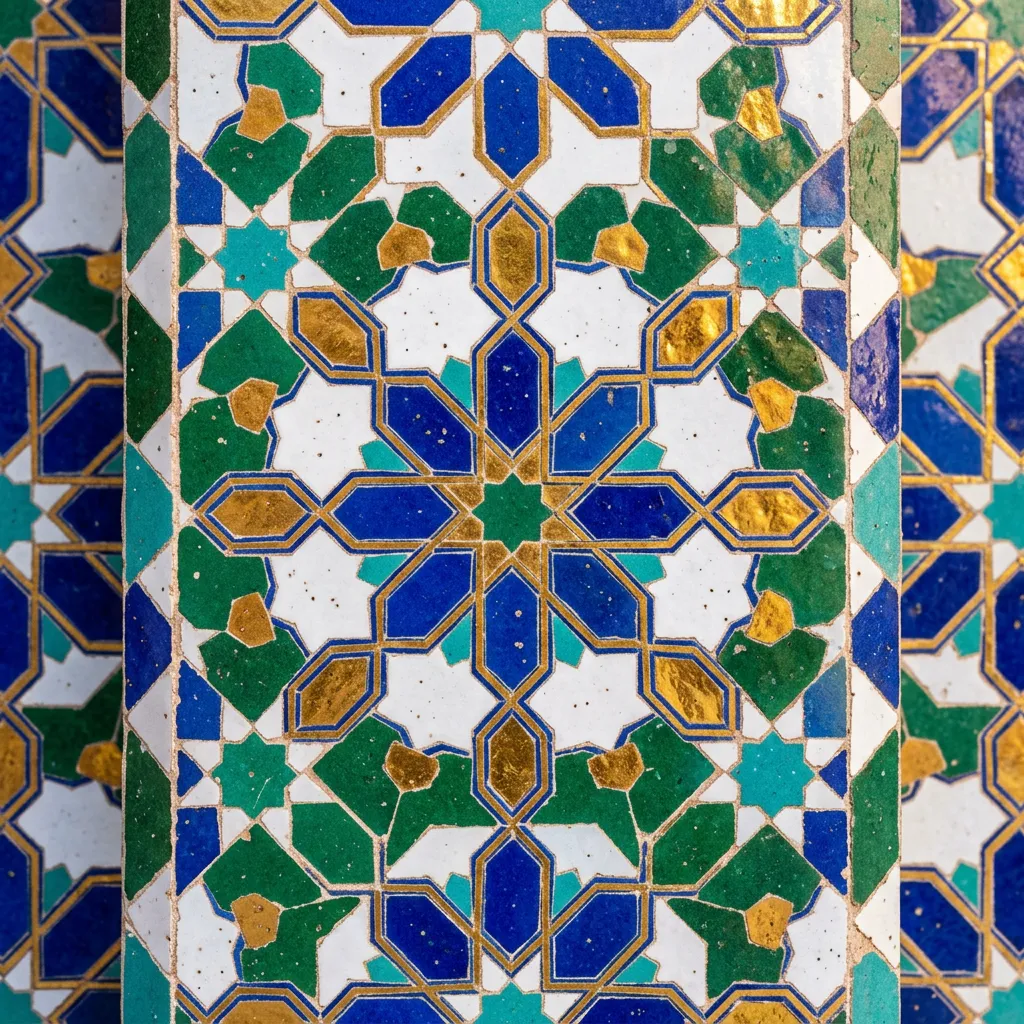
Zellige begins with square terracotta tiles glazed in a single color. The maalem (master craftsman) places a tile face-down on a cushion and chips it with a sharp hammer into one of hundreds of possible geometric shapes. These individual pieces are assembled face-down into complex patterns on a bed of sand, then set with plaster to form panels. A single square meter can contain over 1,000 hand-cut pieces. The geometric patterns are based on mathematical principles of symmetry and tessellation, incorporating 17 possible wallpaper groups long before Western mathematicians codified them. Fes remains the center of zellige production, with workshops in the medina producing tilework for palaces, mosques, and riads worldwide.
Carved Stucco (Gebs): Frozen Lace in Plaster
Carved stucco occupies the middle register of the traditional Moroccan decorative scheme, above the zellige dado and below the cedar ceiling. Artisans work with freshly applied plaster, carving intricate floral arabesques, interlacing geometric patterns, and Kufic calligraphic inscriptions using simple hand tools. The work must be completed before the plaster sets, requiring extraordinary speed and precision. Master stucco carvers train for 10 to 15 years. The finest examples, in the Marinid madrasas of Fes, achieve a complexity that approaches the limits of what the human hand can execute. Unlike zellige, which is geometric and abstract, gebs frequently incorporates organic floral motifs and flowing calligraphy.
Cedar Woodwork: The Crown of the Interior
The ceiling is the climax of the Moroccan decorative program. Atlas cedar, prized for its fragrance, honey color, and natural resistance to insects, is carved into geometric panels, assembled into complex coffered ceilings, and painted in rich polychrome (zouak). The most elaborate cedar ceilings use interlocking geometric frameworks that echo the zellige below, creating a sense of architectural unity from floor to sky. Cedar is also used for doors (which can weigh over 200 kg and feature massive bronze knockers), window screens, balustrades, and the elaborate minbars of mosques. The Ben Youssef Madrasa in Marrakech and the Qarawiyyin in Fes contain some of the most extraordinary cedar ceilings in existence.
Mosque Architecture
From the Qarawiyyin (founded 859) to the Hassan II Mosque (completed 1993), Moroccan mosque architecture represents over a millennium of spiritual and artistic achievement.
The mosque is the most important building type in Moroccan architecture, and its design has been refined over twelve centuries. Moroccan mosques are distinguished by their square minarets (unlike the round minarets common in the eastern Islamic world), their hypostyle prayer halls with forests of horseshoe arches, and their lavish decoration in zellige, stucco, and cedar. The three greatest Moroccan mosques — the Qarawiyyin in Fes, the Koutoubia in Marrakech, and the Hassan II in Casablanca — each represent a different era and scale of achievement, yet all share a common vocabulary of form and ornament.
The Hypostyle Prayer Hall
Moroccan mosques follow the hypostyle plan: a vast hall of parallel aisles created by rows of arches resting on columns, oriented toward the qibla wall facing Mecca. The Qarawiyyin Mosque in Fes contains over 270 columns creating a mesmerizing forest of horseshoe arches that seems to extend infinitely.
The Square Minaret
Unlike the round or octagonal minarets of the eastern Islamic world, Morocco developed a distinctively square minaret form. Each face is decorated with increasingly complex geometric patterns as the eye travels upward, symbolizing the ascent from the earthly to the divine. The minaret is crowned by a lantern (jamour) topped with brass orbs.
The Mihrab
A niche in the qibla wall indicating the direction of Mecca, the mihrab is the focal point of the mosque and receives the most elaborate decoration. In Moroccan mosques, the mihrab is typically framed by layers of carved stucco, zellige, and calligraphy, often with a muqarnas half-dome above.
The Sahn (Courtyard)
The open courtyard serves as both an ablution area and an extension of the prayer hall for overflow crowds during Friday prayers and festivals. Moroccan mosque courtyards are paved in marble or zellige and often feature a central fountain or ornamental basin.
The Minbar (Pulpit)
The wooden pulpit from which the imam delivers the Friday sermon. Moroccan minbars are among the most elaborate in the Islamic world, carved from precious woods and inlaid with ivory, ebony, and marquetry. The Koutoubia minbar, now in the Badi Palace Museum, took eight years to complete.
Ablution Fountains
Ritual washing before prayer requires accessible water, and Moroccan mosques feature elaborate ablution fountains in their courtyards and surrounding streets. Public fountains (sebils) near mosques are often decorated with zellige and carved marble, serving both a religious and civic function.
Kasbah & Ksar Architecture of the South
The dramatic earthen fortifications of southern Morocco, where Berber communities built some of the most visually stunning architecture on the African continent.
The valleys south of the High Atlas — the Draa, the Dades, the Todra, the Ziz — contain one of the world's great concentrations of earthen architecture. For centuries, Berber communities built fortified villages (ksour) and family compounds (kasbahs) from the red and ochre earth of the surrounding landscape, creating structures that seem to grow organically from the desert itself.
The Route of a Thousand Kasbahs between Ouarzazate and Errachidia passes dozens of these remarkable structures, many still inhabited, others crumbling poetically back into the earth from which they were built.
Ksar (Fortified Village)
A ksar (plural ksour) is a fortified communal village built from rammed earth, typically surrounded by high walls with corner watchtowers. Families lived in individual houses within the protective perimeter, sharing communal granaries, wells, and mosques. Ait Benhaddou is the most famous surviving ksar.
Kasbah (Fortified House)
A kasbah is an individual fortified dwelling belonging to a single family or clan leader. Multi-story structures with crenellated towers, narrow slit windows for defense, and elaborate geometric earth decoration on the upper floors, kasbahs are the signature architecture of southern Morocco's Draa, Dades, and Todra valleys.
Agadir (Fortified Granary)
A collective fortified storehouse found primarily in the Anti-Atlas and Souss regions. Each family in the community had a designated storage chamber for grain, oil, and valuables. The tiered cells, accessed by steep ladders, create a dramatic honeycomb effect. Agadir Oufella in Agadir and Igherm's granaries are on the UNESCO Tentative List.
Rammed Earth Construction
Southern Moroccan builders perfected the pise technique: a mixture of local earth, straw, water, and sometimes lime is compacted in wooden formwork layer by layer. Walls can be a meter thick, providing excellent insulation. The earth colors range from deep rose-red in the Dades Valley to honey-gold near Ouarzazate.
Climate Adaptation
Every element of kasbah design responds to the extreme desert climate. Thick walls absorb daytime heat and release it slowly at night. Narrow windows reduce solar gain. Internal courtyards create shade and channel breezes. Towers catch wind for ventilation. Water channels irrigate interior gardens.
Decorative Earthwork
Despite using humble materials, kasbah builders created sophisticated decoration. Geometric patterns are formed by projecting or recessing rows of bricks within the pise walls, creating shadow patterns that change throughout the day. The upper floors, being the most public-facing, receive the most elaborate decoration.
Key Architectural Elements
The twelve essential building blocks of Moroccan architecture, from geometric tilework to underground water engineering.
Zellige
Hand-cut geometric mosaic tilework made from glazed terracotta. Each tiny piece is individually chiseled and assembled into infinite mathematical patterns. The art form originated in 10th-century Fes and remains one of Morocco's most iconic decorative traditions.
Tadelakt
A luxurious, waterproof lime plaster polished with flat river stones and black soap to create a seamless, marble-like surface. Traditionally used in hammams and palaces, this ancient technique produces surfaces that are both beautiful and naturally antibacterial.
Mashrabiya
Intricately carved wooden lattice screens that cover windows and balconies. They allow air circulation and diffused light while providing privacy. The geometric patterns cast mesmerizing shadow patterns that shift throughout the day.
Muqarnas
Three-dimensional honeycomb vaulting made from carved plaster or wood, used in ceilings, domes, and transitional zones between walls and ceilings. Muqarnas create a cascading, stalactite-like effect that symbolizes the infinite complexity of creation.
Horseshoe Arches
The signature arch form of Moroccan architecture, where the curve extends beyond the semicircle to create a keyhole or horseshoe shape. Developed during the Umayyad period, horseshoe arches appear in mosques, palaces, gates, and domestic architecture.
Riads
Traditional urban houses built around a central open-air courtyard with a fountain and garden. The inward-facing design provides privacy, natural ventilation, and a private paradise in the heart of the dense medina. Riad architecture is a masterclass in climate-responsive design.
Minarets
The square minaret is distinctly Moroccan and North African, in contrast to the round or octagonal minarets found elsewhere in the Islamic world. Moroccan minarets feature ascending tiers of decoration, topped by a lantern and brass orbs (jamour).
Bab (Monumental Gates)
Grand fortified gates that served as both defensive structures and expressions of royal power. Moroccan babs feature massive horseshoe arches, decorative zellige panels, and carved stone. Bab Mansour in Meknes is considered the finest gate in North Africa.
Gebs (Carved Stucco)
Intricate plaster carving that covers walls above the zellige dado. Artisans carve floral arabesques, geometric patterns, and Kufic calligraphy into wet plaster using hand tools. The finest gebs work is found in Marinid madrasas.
Painted Cedar
Carved and painted cedarwood used for ceilings, doors, brackets, and screens. Cedar is prized for its fragrance, durability, and resistance to insects. The geometric and floral patterns are painted in rich polychrome, creating the third layer of traditional Moroccan interior decoration.
Pise (Rammed Earth)
Walls built by compressing layers of earth, clay, straw, and lime into wooden forms. Pise construction is naturally insulating, keeping interiors cool in summer and warm in winter. The technique produces the distinctive rose-red and ochre tones of southern Moroccan kasbahs.
Khettara (Underground Channels)
Ancient underground water channels that carry snowmelt from mountains to cities and gardens over distances of up to 30 kilometers. While not visible architecture, the khettara system is the hidden engineering that made Morocco's great gardens and cities possible.
16 Must-See Architectural Masterpieces
The sixteen buildings every architecture lover must experience in Morocco, spanning two thousand years of building tradition from Roman ruins to contemporary museums.
Casablanca#1
Hassan II Mosque
The largest mosque in Africa and the third-largest in the world. Its 210-meter minaret is the tallest religious structure on earth. Built over the Atlantic Ocean with a glass floor revealing the sea below and a retractable roof that opens to the sky, it combines cutting-edge engineering with 10,000 master artisans' traditional craftsmanship.
Why visit: The only mosque in Morocco open to non-Muslim visitors. Guided tours reveal 53,000 square meters of hand-carved marble, zellige, and painted cedar.
Marrakech#2
Koutoubia Mosque
The defining symbol of Marrakech and the masterwork of Almohad architecture. The 77-meter square minaret, visible from across the city, established the template for Moroccan minarets including the Hassan Tower in Rabat and the Giralda in Seville. The ascending decorative registers on each face are a textbook of Almohad geometric art.
Why visit: While the interior is closed to non-Muslims, the minaret and surrounding gardens are essential viewing, especially at sunset when the warm light illuminates the stone.
Fes#3
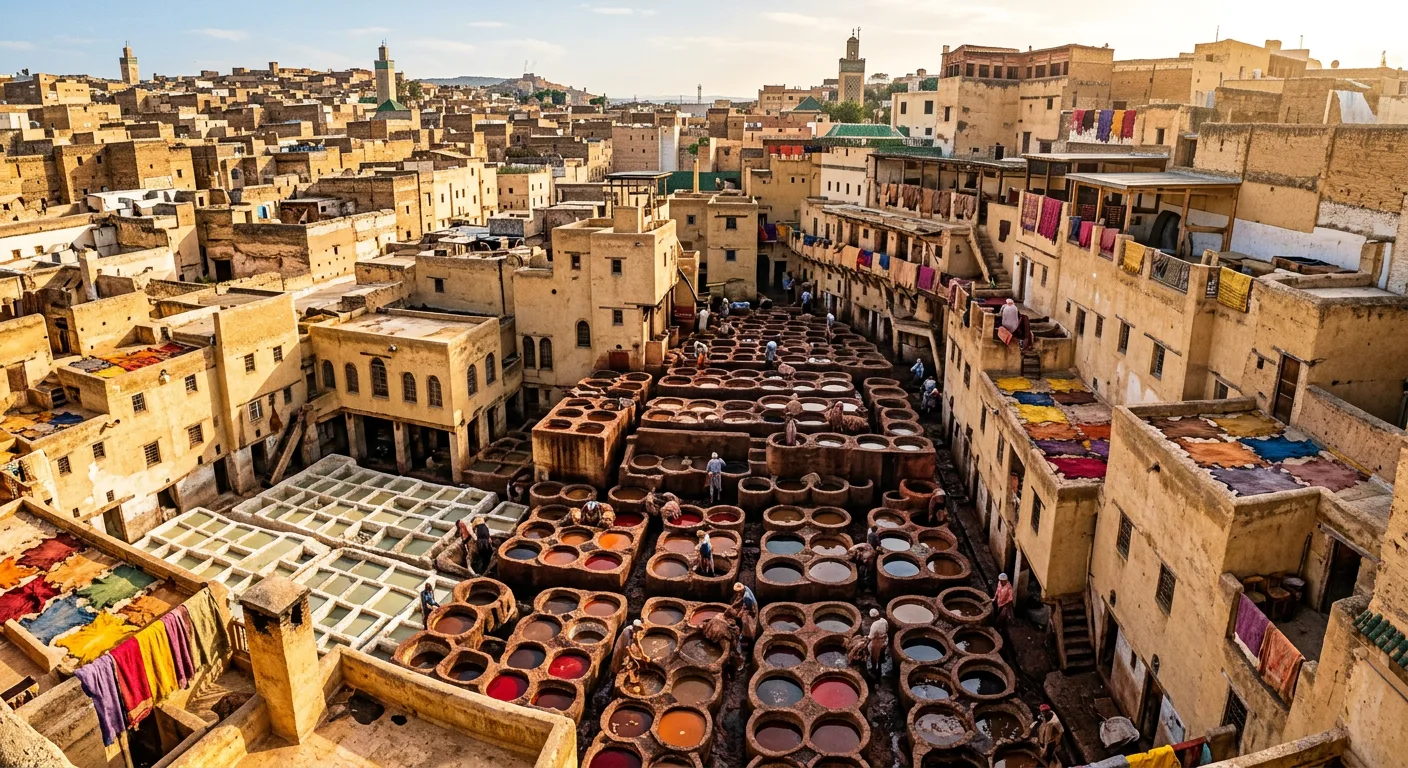
Qarawiyyin Mosque & University
Founded by Fatima al-Fihri in 859 CE, the Qarawiyyin is recognized by UNESCO and Guinness World Records as the oldest continuously operating university in the world. The mosque complex has been expanded and embellished by every dynasty since the Idrisids, creating a layered architectural palimpsest that spans over a thousand years of Moroccan building. The prayer hall can accommodate 20,000 worshippers and features an extraordinary forest of horseshoe arches.
Why visit: While the interior is closed to non-Muslims, the exterior, doorways, and courtyard glimpses through open doors are extraordinary. The surrounding medina streets offer multiple vantage points.
Fes#4
Bou Inania Madrasa
The pinnacle of Marinid decorative art and arguably the most beautiful building in Morocco. Every surface is covered with three layers of ornament: zellige tilework below, carved stucco in the middle, and painted cedar above. The marble courtyard with its central ablutions fountain and water clock mechanism is a masterpiece of medieval Islamic architecture.
Why visit: Open to non-Muslims (rare for a functioning mosque-madrasa). The level of decorative detail is staggering and rewards extended, careful observation.
Ouarzazate#5
Ait Benhaddou
A UNESCO World Heritage fortified village (ksar) of dramatic pise kasbahs rising above the Ounila River. The cluster of earthen towers and buildings against the barren landscape is one of the most photographed scenes in Morocco and has served as a backdrop for dozens of films including Gladiator, Game of Thrones, and Lawrence of Arabia.
Why visit: The most accessible and photogenic example of traditional Berber earthen architecture. Climbing to the summit provides panoramic views of the surrounding desert landscape.
Marrakech#6
Saadian Tombs
Rediscovered in 1917 after being sealed by the Alaouite dynasty, these royal mausolea contain some of the most exquisite interior spaces in Morocco. The Hall of Twelve Columns features Italian Carrara marble pillars, a breathtaking muqarnas cedar ceiling, and zellige tilework of supreme refinement. The intimate garden courtyards are tranquil and beautiful.
Why visit: One of the few Saadian structures to survive intact, offering a glimpse into the extraordinary opulence of the dynasty. Go early to avoid crowds in the small chambers.
Rabat#7
Hassan Tower
The unfinished minaret of what was intended to be the largest mosque in the world. Sultan Yacoub al-Mansour's death halted construction, leaving the 44-meter tower surrounded by 200 stone columns that mark the prayer hall's planned footprint. Adjacent stands the exquisite Mohammed V Mausoleum (1971), a masterpiece of Alaouite architecture.
Why visit: The juxtaposition of the medieval unfinished tower and the modern mausoleum tells 800 years of Moroccan architectural history in a single site.
Meknes#8
Bab Mansour
Widely considered the finest monumental gate in North Africa, Bab Mansour was built by Sultan Moulay Ismail using marble columns recycled from the Roman ruins of Volubilis and the Saadian El Badi Palace. The massive horseshoe arch is framed by elaborate zellige panels and carved green tile decorations of extraordinary scale and refinement.
Why visit: The sheer scale and decorative ambition of the gate is best appreciated in person. The Place el-Hedim square in front provides excellent viewing angles.
Marrakech#9
Ben Youssef Madrasa
The largest madrasa in Morocco, once housing 900 students. The central courtyard is a symphony of zellige, carved stucco, and cedar, with a large marble ablutions basin reflecting the decorated walls. The 132 student dormitory cells surrounding the courtyard offer a rare glimpse into the daily life of medieval Islamic scholarship.
Why visit: Recently reopened after extensive restoration, the madrasa offers one of Morocco's most immersive architectural experiences. The interplay of light, water, and decoration changes throughout the day.
Near Meknes#10
Volubilis Roman Ruins
The best-preserved Roman ruins in North Africa, featuring remarkably intact mosaic floors, a triumphal arch, the Basilica, and the Capitol Temple. Volubilis demonstrates that Morocco's architectural heritage predates the Islamic period by many centuries. The site sits on a fertile plain with views to the holy city of Moulay Idriss.
Why visit: The mosaics alone justify the visit. The Labours of Hercules and Orpheus mosaics are among the finest Roman floor mosaics surviving anywhere in the former empire.
High Atlas Mountains#11
Tin Mal Mosque
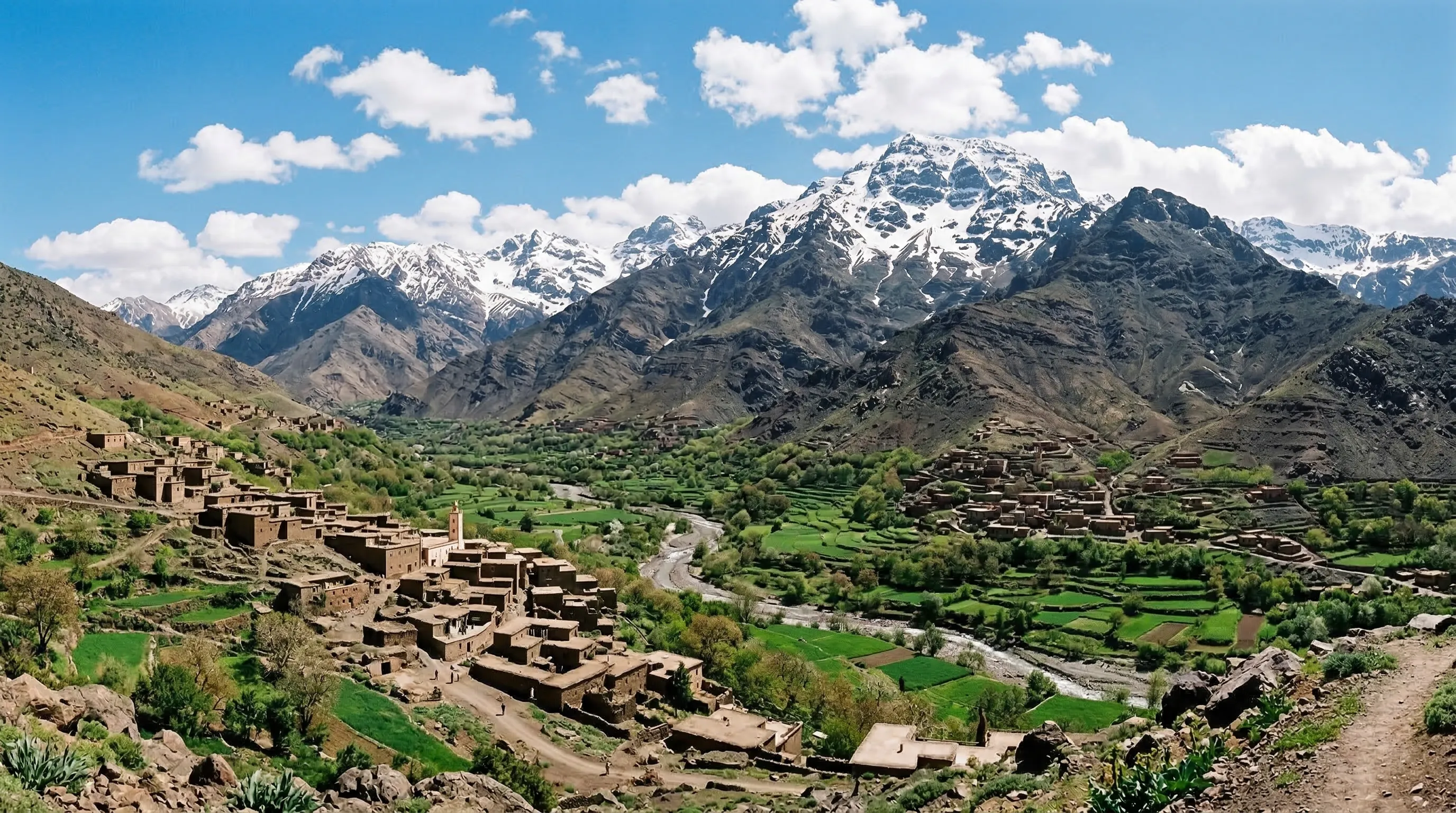
Perched at 1,200 meters in a remote High Atlas valley, the Tin Mal Mosque is the birthplace of the Almohad movement and one of only two mosques in Morocco open to non-Muslims. Though partially ruined, the soaring nave, massive horseshoe arches, and the remnants of exquisite stucco decoration convey the austere power that characterized early Almohad architecture. The dramatic mountain setting is unforgettable.
Why visit: One of only two mosques in Morocco open to non-Muslims. The remote mountain journey along the Tizi n'Test pass is an adventure in itself, and the isolation heightens the spiritual atmosphere.

Marrakech#12
Bahia Palace
A sprawling 19th-century palace built by Grand Vizier Si Moussa and his son Ba Ahmed. The name means "Palace of the Beautiful" and the interior lives up to it: a sequence of painted reception rooms, intimate riads, and grand courtyards decorated with the finest zellige, carved cedar, and stucco work that the best artisans of the period could produce. The gardens, including an immense central courtyard paved in marble, are among the most serene spaces in Marrakech.
Why visit: The most accessible and photogenic palace in Marrakech. The interplay of indoor and outdoor rooms illustrates how Moroccan architecture dissolves the boundary between building and garden.
Rabat#13
Chellah Necropolis
A hauntingly beautiful site where Marinid royal tombs were built atop the ruins of the Roman city of Sala Colonia. The monumental Marinid gateway opens onto a garden of ruins where crumbling minarets, carved marble tombs, and Roman columns are overgrown with fig trees and inhabited by nesting storks. It is one of the most atmospheric places in Morocco.
Why visit: The layering of Roman, Islamic, and natural elements in a single garden-ruin creates a timeless, contemplative atmosphere found nowhere else. Visit at sunset when the golden light transforms the ruins.
Marrakech#14
Yves Saint Laurent Museum
Designed by Studio KO, this terracotta-clad museum is a masterclass in contemporary Moroccan architecture. The exterior is composed of interlocking cubes sheathed in a lace-like terracotta pattern that references zellige tilework, while the interior galleries are cool, minimal, and bathed in natural light. The building demonstrates how Moroccan architectural DNA can be reinterpreted for the 21st century.
Why visit: Beyond the fashion exhibitions, the architecture itself is the attraction. The building is a conversation between Moroccan tradition and global contemporary design, set within a garden that connects to the nearby Jardin Majorelle.
Marrakech#15
El Badi Palace Ruins
Once the most lavish palace in the Islamic world, El Badi ("The Incomparable") was built by Sultan Ahmad al-Mansur to celebrate his victory at the Battle of the Three Kings. Italian marble, Sudanese gold, Irish granite, and Indian onyx were used in its construction. Though stripped of all decoration by Moulay Ismail a century later, the vast sunken gardens, massive walls, and sheer scale of the ruins still convey the staggering ambition of the Saadian golden age.
Why visit: The immense scale of the ruins and the annual Marrakech Popular Arts Festival held within the walls create an experience that connects past grandeur to living culture.

Rabat#16
Kasbah of the Udayas
Perched on a cliff above the mouth of the Bou Regreg River, this fortified kasbah is one of the most perfectly preserved Almohad structures in Morocco. The grand Almohad gateway, the narrow blue-and-white streets of the residential quarter (added later by Andalusian refugees), and the serene Andalusian garden overlooking the Atlantic create a layered architectural experience spanning eight centuries.
Why visit: The combination of Almohad fortifications, Andalusian domestic architecture, formal gardens, and ocean views makes this one of the most rewarding short visits in Morocco.
Riad Architecture & Interior Design
The riad is Morocco's most distinctive domestic architecture: an inward-facing paradise of courtyard, water, and light hidden behind blank medina walls.
The word riad comes from the Arabic ryad, meaning "garden." A true riad is a traditional Moroccan townhouse built around a central garden courtyard, typically with a symmetrical plan and at least two stories. The riad is one of the most sophisticated examples of climate-responsive urban architecture ever developed, solving the challenges of privacy, ventilation, light, and heat management in the dense fabric of the medieval medina.
Construction follows time-tested methods: thick walls of lime, stone, and earth provide thermal mass; the central courtyard acts as a natural chimney, drawing hot air upward and pulling cooler air in at ground level; the fountain provides evaporative cooling; and the planted trees and vines create shade and release moisture. The result is an interior environment that can be 10 to 15 degrees cooler than the street outside, achieved without any mechanical systems.
Inward-Facing Design
A riad presents blank exterior walls to the street, revealing its beauty only to those who enter. This inward orientation reflects Islamic values of privacy and modesty while creating a controlled interior environment shielded from the noise, dust, and heat of the medina.
Central Courtyard (Wust al-Dar)
The courtyard is the heart of the riad, an open-air room that serves as the primary living space. Its proportions are carefully calculated so that the surrounding walls provide shade for most of the day while allowing sunlight to reach the garden and fountain below.
Fountain and Water Features
A marble or zellige-tiled fountain at the center of the courtyard provides cooling evaporation, pleasant sound, and spiritual symbolism. Running water represents paradise and purity in Islamic tradition. Larger riads may have multiple fountains and water channels.
Four Rooms off the Courtyard
The classic riad has four rooms opening directly onto the courtyard through tall doorways, one on each side. Each room serves a different function: reception, family living, sleeping, and cooking. The tall, narrow proportions channel breezes from the courtyard.
Rooftop Terrace
The roof terrace serves as a private outdoor space with views over the medina. Traditionally used for drying laundry and sleeping on hot summer nights, today riad terraces often feature dining areas and plunge pools. The terrace is the riad's connection to sky and cityscape.
Natural Climate Control
The thick walls, central courtyard, water features, and vegetation create a passive cooling system that can maintain interior temperatures 10-15 degrees below the street outside. In winter, the same thermal mass retains warmth. The riad is a masterclass in pre-electric climate engineering.
Colonial French Architecture
The French Protectorate (1912-1956) left a remarkable architectural legacy in Casablanca and Rabat, where Art Deco geometry met Moorish decorative tradition.
Under Resident-General Lyautey, the French adopted a unique approach to colonial urbanism: rather than demolishing existing cities, they built new towns (villes nouvelles) alongside them. In Casablanca, this produced one of the 20th century's great experiments in architectural fusion, where French architects blended Art Deco modernism with Moroccan Islamic motifs to create a style found nowhere else on earth. Today, Casablanca contains over 12,000 Art Deco buildings, making it one of the largest collections in the world.
Cinema Rialto
Casablanca · 1930
A stunning Art Deco cinema with a streamlined facade, geometric reliefs, and a soaring interior. Designed by Pierre Jabin, it is one of the finest surviving examples of Casablanca's golden age of cinema architecture and has been restored as a cultural venue.
Casablanca Cathedral (former Sacre-Coeur)
Casablanca · 1930
Designed by Paul Tournon, this striking Neo-Gothic cathedral blends European structural forms with Moroccan decorative motifs. Decommissioned as a church after independence, it now serves as a cultural center. The twin towers and geometric stained glass are distinctly Art Deco.
Quartier Habous (New Medina)
Casablanca · 1917-1955
A fascinating experiment in Franco-Moroccan urbanism: a completely new medina designed by French architects using traditional Moroccan building forms and materials. The arcaded streets, central mosque, and residential quarters replicate the organic feel of a historic medina within a planned framework.
Bank al-Maghrib Building
Rabat · 1930
The central bank headquarters, designed by Edmond Brion, exemplifies the Protectorate-era blend of Mauresque and Art Deco styles. Classical columns sit alongside Moorish arches, and the grand banking hall features zellige-inspired floor patterns executed in marble.
Hotel Lincoln
Casablanca · 1916
One of the earliest Art Deco buildings in Casablanca, the Hotel Lincoln features a distinctive curved corner facade with ornamental ironwork balconies and geometric relief panels. It established the template that hundreds of subsequent Casablanca buildings would follow.
Ville Nouvelle, Rabat
Rabat · 1912-1930s
Planned by Henri Prost under Resident-General Lyautey, Rabat's new town was designed as a garden city with wide boulevards, public parks, and administrative buildings in a restrained neo-Moorish style. Lyautey's policy of preserving the existing medina while building the new city alongside it was revolutionary for colonial urbanism.
Modern Moroccan Architects & Projects
A new generation of architects is reinterpreting Moroccan building traditions for the 21st century, creating structures that honor the past while embracing innovation.
Grand Theatre of Rabat
Zaha Hadid Architects · 2019-ongoing
A flowing, organic form that emerges from the landscape like a sand dune sculpted by wind. The 1,800-seat theatre on the banks of the Bou Regreg River uses parametric design to create sweeping curves that reference both Atlantic waves and the draped forms of Moroccan textiles. It represents Morocco's ambition to become a hub for international performing arts.
Musee Yves Saint Laurent
Studio KO (Karl Fournier & Olivier Marty) · 2017
A terracotta and concrete museum whose interlocking cubic volumes reference traditional Moroccan earthen architecture at a contemporary scale. The exterior lace-like terracotta cladding evokes zellige patterns, while the interior galleries use controlled natural light to create serene exhibition spaces. Studio KO are among the most influential architects working in Morocco today.
ONCF Kenitra Station
Silvio d'Ascia Architecture with Omar Kobbite · 2019
Morocco's high-speed rail station, designed as a gateway for the Al Boraq TGV line. The undulating white canopy, perforated with geometric patterns that cast dappled shadows below, reinterprets the mashrabiya screen at an urban infrastructure scale. It demonstrates how traditional Moroccan design principles can inform 21st-century transport architecture.
Mohammed VI Museum of Modern and Contemporary Art
Karim Chakor · 2014
Rabat's first major art museum, designed by Moroccan architect Karim Chakor, features a restrained modern exterior in travertine stone that sits respectfully alongside the historic ville nouvelle. The interior is organized around a central atrium flooded with natural light, echoing the riad courtyard tradition translated into museum architecture.
Africa Institute, Sharjah (by Moroccan team)
Tarik Oualalou & Associates · 2023
While not in Morocco, this project by Moroccan architect Tarik Oualalou exemplifies the new generation of Moroccan architects working globally. Oualalou's practice bridges traditional Moroccan spatial concepts like the riad, the fondouk, and the derb (alley) with contemporary architectural thinking.
Green Energy Park, Benguerir
Various (IRESEN campus) · 2017
Part of Morocco's ambitious renewable energy program, this research campus near Marrakech integrates solar architecture, passive cooling, and sustainable materials. The buildings use rammed-earth walls, natural ventilation towers inspired by traditional windcatchers, and locally sourced stone, demonstrating that Morocco's architectural future is rooted in its sustainable past.
Architecture Walking Tours
Six curated walking routes in Morocco's most architecturally rich cities, from Marinid masterpieces in Fes to Art Deco Casablanca.
Fes
Marinid Masterpieces Walking Tour
Duration: 4-5 hours
Walk through the medieval heart of Fes el-Bali to experience the finest Marinid architecture. Begin at Bab Bou Jeloud and wind through the dense medina to the great madrasas, pausing to admire carved stucco, zellige, and cedar at every turn.
Highlights
Bou Inania MadrasaAl-Attarine MadrasaQarawiyyin Mosque exteriorFondouk NejjarineChouara TanneriesDar Batha Museum
Marrakech
Dynastic Splendor Walking Tour
Duration: 4-6 hours
Trace the architectural legacy of four dynasties across Marrakech. From Almohad monuments to Saadian opulence and Alaouite grandeur, this route covers the essential masterpieces with time to appreciate the decorative details.
Highlights
Koutoubia MosqueSaadian TombsEl Badi PalaceBahia PalaceBen Youssef MadrasaMaison de la Photographie rooftop
Casablanca
Art Deco Heritage Walk
Duration: 3-4 hours
Discover Casablanca's extraordinary collection of Art Deco architecture, the largest in Africa. The route moves from the Place Mohammed V administrative ensemble through the commercial district's geometric facades to the Franco-Moroccan experiment of the Quartier Habous.
Highlights
Place Mohammed VCinema RialtoHotel LincolnWilaya BuildingQuartier HabousHassan II Mosque
Rabat
Capital Through the Ages Walk
Duration: 3-4 hours
Rabat uniquely layers Almohad fortifications, Roman ruins, Marinid tombs, French Protectorate urban planning, and contemporary government architecture in a single walkable circuit. This route covers 2,000 years in one morning.
Highlights
Kasbah of the UdayasHassan TowerMohammed V MausoleumChellah NecropolisMohammed V AvenueParliament Building
Meknes
Imperial City Architecture Walk
Duration: 3 hours
Explore Moulay Ismail's monumental vision for his imperial capital. The walk takes you through the grandest gate in North Africa, into vast granaries and stables built for 12,000 horses, and through the imperial palace precinct.
Highlights
Bab MansourPlace el-HedimMoulay Ismail MausoleumHeri es-SouaniRoyal StablesDar Jamai Museum
Ouarzazate & Dades Valley
Kasbah Road Drive & Walk
Duration: Full day (driving)
Follow the Route of a Thousand Kasbahs through the dramatic landscapes of southern Morocco. Each stop reveals a different aspect of Berber earthen architecture, from compact fortified granaries to towering multi-story clan houses.
Highlights
Kasbah TaourirtAit BenhaddouSkoura Palm Oasis kasbahsDades Gorge kasbahsKasbah AmridilTamnougalt Kasbah
UNESCO Architectural Sites in Morocco
Nine UNESCO World Heritage sites that collectively tell the story of Morocco's extraordinary architectural diversity.
Medina of Fes
Inscribed 1981The world's largest car-free urban area, containing over 9,400 buildings, 14 gates, 6,000 streets, and hundreds of mosques, madrasas, and fondouks spanning over a thousand years.
Medina of Marrakech
Inscribed 1985Founded by the Almoravids in 1062, containing the Koutoubia Mosque, Saadian Tombs, Ben Youssef Madrasa, and miles of traditional souks within massive Almohad walls.
Ksar of Ait Benhaddou
Inscribed 1987A striking fortified village of traditional pre-Saharan earthen architecture, with kasbahs, towers, and collective granaries built in dramatic pise construction.
Historic City of Meknes
Inscribed 1996Sultan Moulay Ismail's imperial capital with monumental gates, vast royal stables, granaries, and gardens demonstrating the grandeur of 17th-century Alaouite power.
Medina of Tetouan
Inscribed 1997The most complete and best-preserved medina of Andalusian character in Morocco, built by refugees from the Reconquista with distinctly Spanish-Moorish architecture.
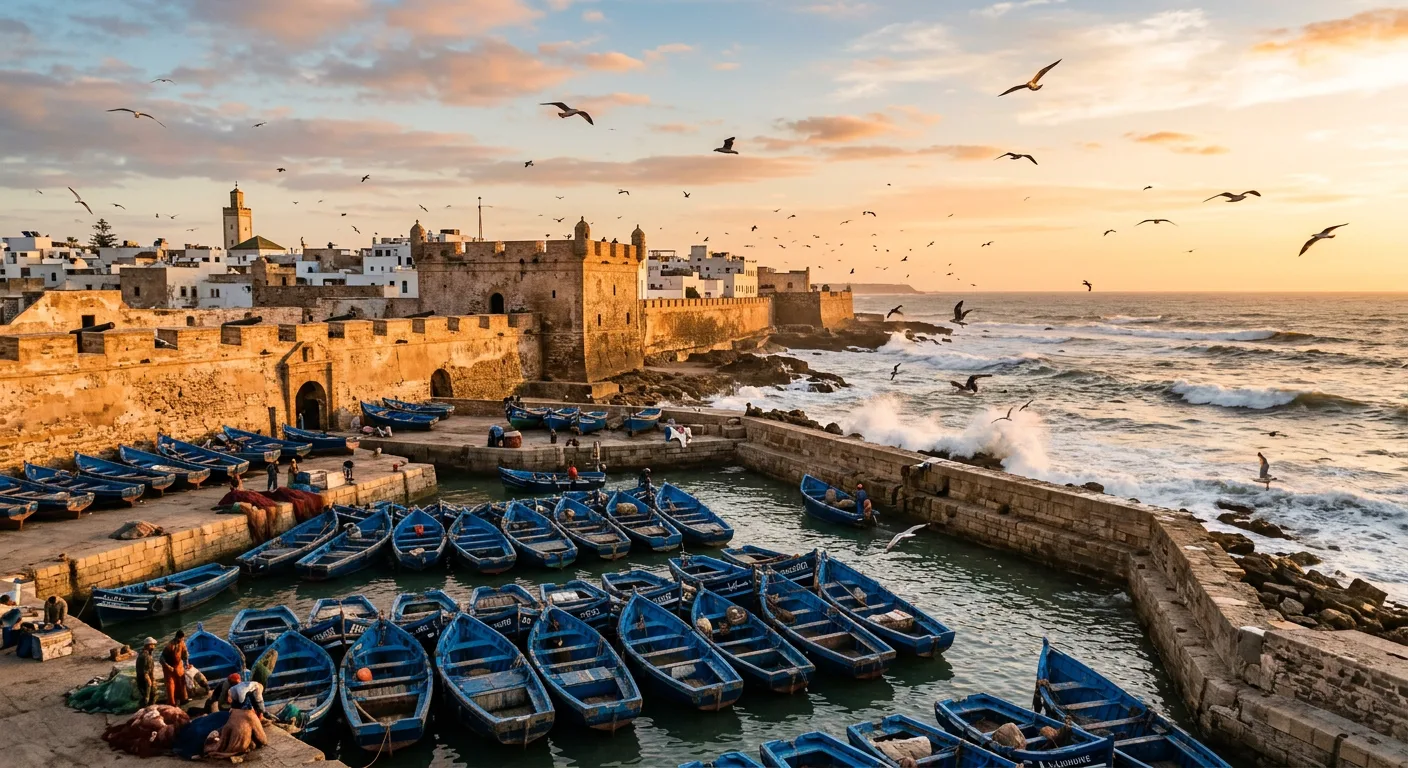
Medina of Essaouira (Mogador)
Inscribed 2001An 18th-century fortified port city designed by French architect Theodore Cornut, blending European military engineering with North African urban traditions.
Portuguese City of El Jadida (Mazagan)
Inscribed 2004A 16th-century Portuguese fortress with its remarkable Gothic cistern, blending European and Moroccan architectural traditions in a unique Atlantic port.
Archaeological Site of Volubilis
Inscribed 1997Extensive Roman ruins with exceptional mosaics, monumental arches, and public buildings demonstrating Morocco's pre-Islamic architectural heritage.
Rabat, Modern Capital and Historic City
Inscribed 2012Recognized for its blend of Arab-Muslim heritage and Western modernism: the Hassan Tower, Chellah, Kasbah of the Udayas, and French Protectorate-era city planning.
Glossary of Moroccan Architectural Terms
An essential vocabulary for understanding and appreciating Morocco's built heritage, from agadir to zouak.
Agadir
Fortified collective granary found in the Anti-Atlas and Souss regions, used by communities to store grain, oil, and valuables.
Bab
Monumental gate in a city wall or palace complex. Literally "door" in Arabic.
Borj
Tower or bastion, especially in fortification walls. Used for defense and surveillance.
Dar
House or dwelling. A dar is typically a more modest urban house compared to a riad, often without a central garden.
Derb
A narrow residential alley or cul-de-sac in the medina. Derbs branch off main streets and serve as semi-private neighborhood passages.
Fondouk
A caravanserai or merchants' inn built around a central courtyard. The ground floor housed animals and goods; upper floors provided sleeping quarters.
Gebs
Carved plaster stucco, the middle layer of the traditional Moroccan decorative trinity (zellige below, gebs in the middle, cedar above).
Hammam
Public bathhouse, an essential element of Moroccan urban architecture. The domed steam rooms use tadelakt plaster and heated marble floors.
Jamour
The brass orbs stacked on top of a Moroccan minaret, symbolizing the three mosques of Mecca, Medina, and Jerusalem.
Kasbah
A fortified residential complex or citadel, typically the seat of a local chief. In southern Morocco, a multi-story earthen dwelling with crenellated towers.
Khettara
Underground water channel (qanat) that uses gravity to transport groundwater over long distances without evaporation.
Koubba
A small domed shrine or mausoleum housing the tomb of a holy man (marabout). Often whitewashed with a simple hemispherical dome.
Ksar
A fortified village, especially in the pre-Saharan south. Plural: ksour. An entire community enclosed within defensive walls.
Madrasa
A theological college attached to a mosque. Marinid madrasas are the finest examples, with student dormitory cells surrounding a decorated courtyard.
Mashrabiya
An intricately carved wooden lattice screen used on windows and balconies for privacy, ventilation, and light filtration.
Medersa
Alternative French-influenced spelling of madrasa, commonly used in Moroccan tourist signage.
Medina
The historic walled old city, predating colonial development. Moroccan medinas are characterized by dense, organic street patterns and car-free alleyways.
Mellah
The historic Jewish quarter of a Moroccan city, typically located near the royal palace and featuring distinctive balconied houses with exterior-facing windows.
Mihrab
A niche in the qibla wall of a mosque indicating the direction of Mecca. The most decorated element of mosque interior architecture.
Minbar
The pulpit from which the Friday sermon is delivered. Moroccan minbars are elaborate carved wooden structures, often with inlay work.
Moucharabieh
French term for mashrabiya. Carved lattice woodwork screens, widely used in Moroccan domestic architecture.
Muqarnas
Three-dimensional honeycomb or stalactite vaulting used in domes, niches, and transitional ceiling zones. Carved from plaster or wood.
Pise
Rammed earth construction technique. A mixture of earth, straw, and water is compacted in wooden forms to create thick, insulating walls.
Riad
Traditional Moroccan townhouse organized around a central garden courtyard. From Arabic "ryad" meaning garden.
Sebka
A diamond-shaped interlacing pattern characteristic of Almohad architecture, used extensively on minarets and gates.
Tadelakt
Waterproof lime plaster polished with river stones and black soap, creating a glossy, marble-like surface. Traditional to Marrakech.
Zellige
Hand-cut geometric mosaic tilework from glazed terracotta. Individual pieces are chiseled to shape and assembled face-down on a pattern before being set.
Zouak
Painted wood decoration, particularly on ceilings and eaves. Geometric and floral designs are painted in polychrome on carved cedar surfaces.
Architectural Details Gallery
The beauty of Moroccan architecture lives in the details -- every arch, fountain, and garden tells a story.
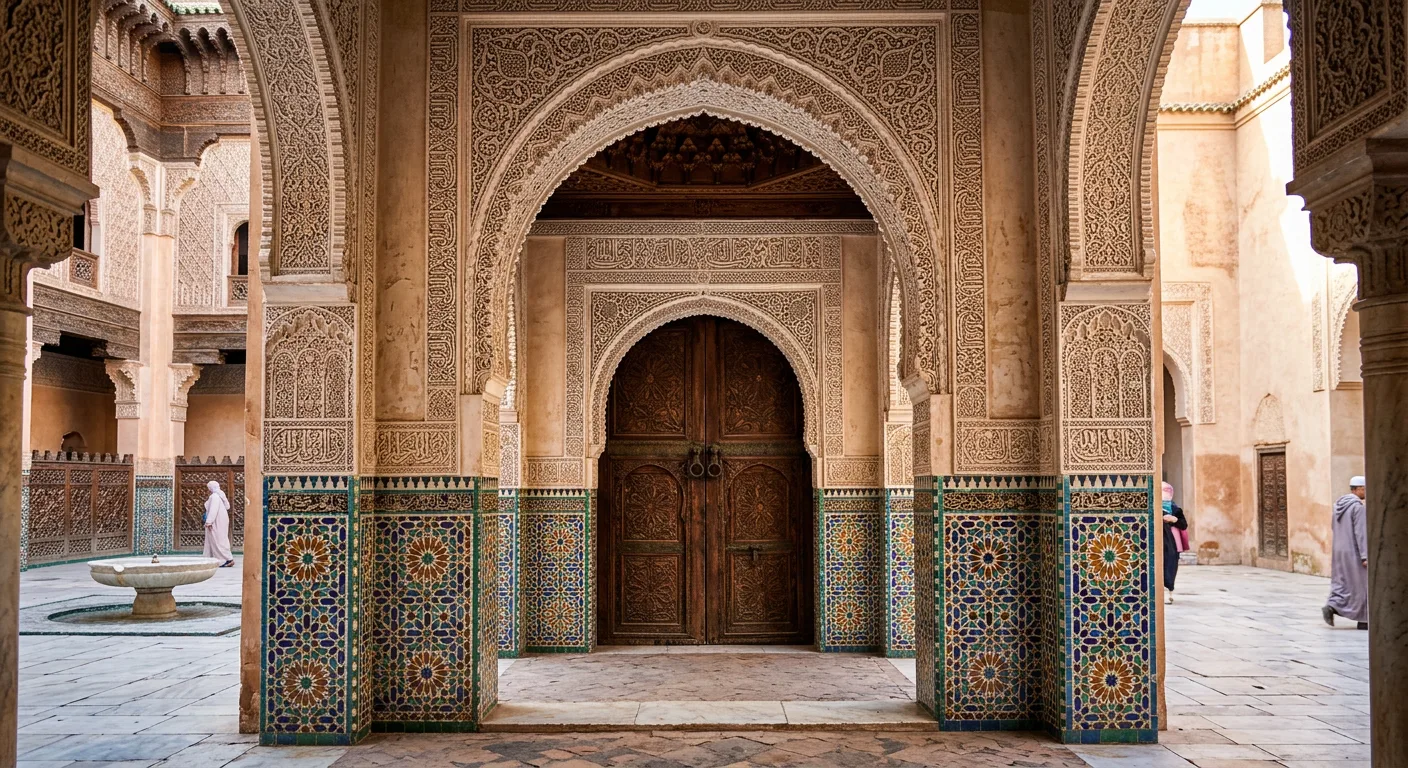
Ornate horseshoe arch with carved stucco decoration in a Moroccan palace
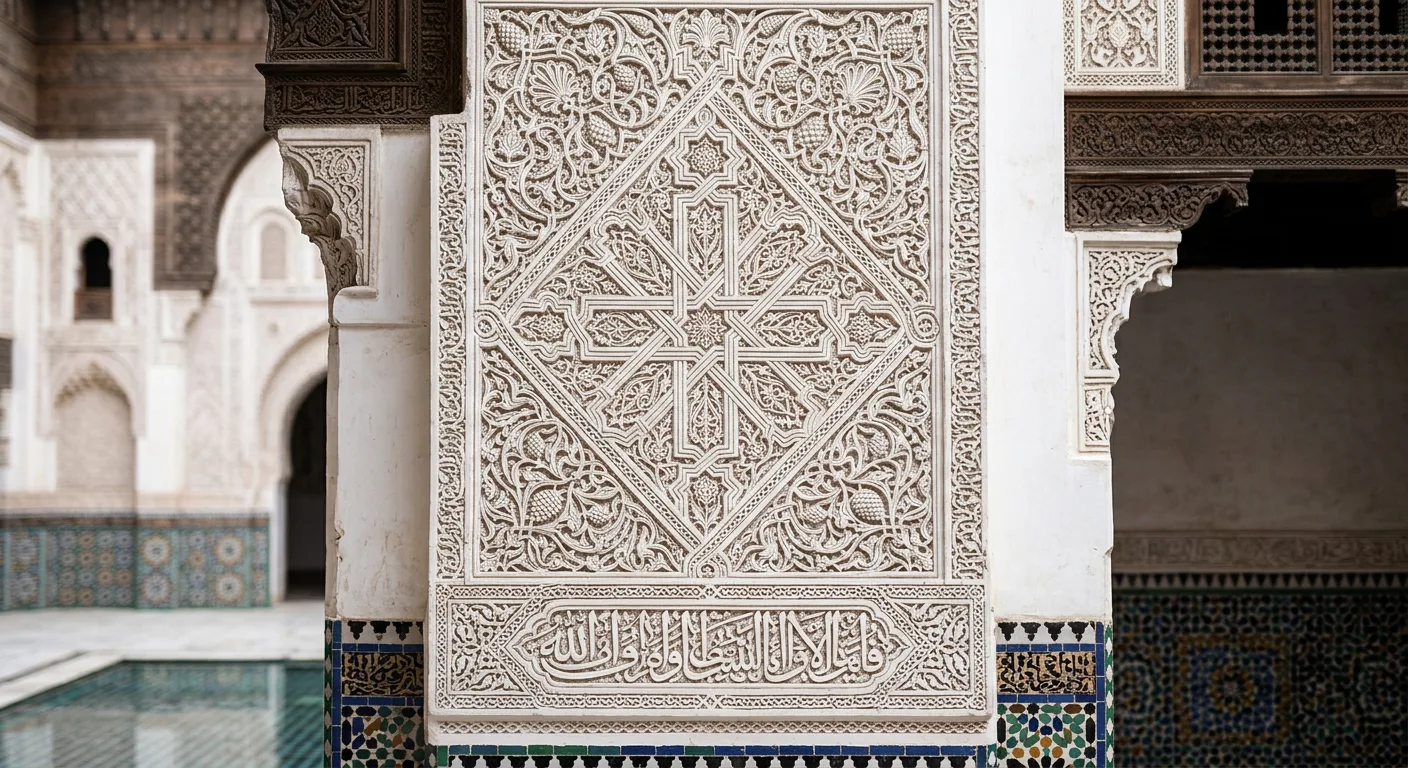
Detailed carved stucco plasterwork with geometric and floral arabesques
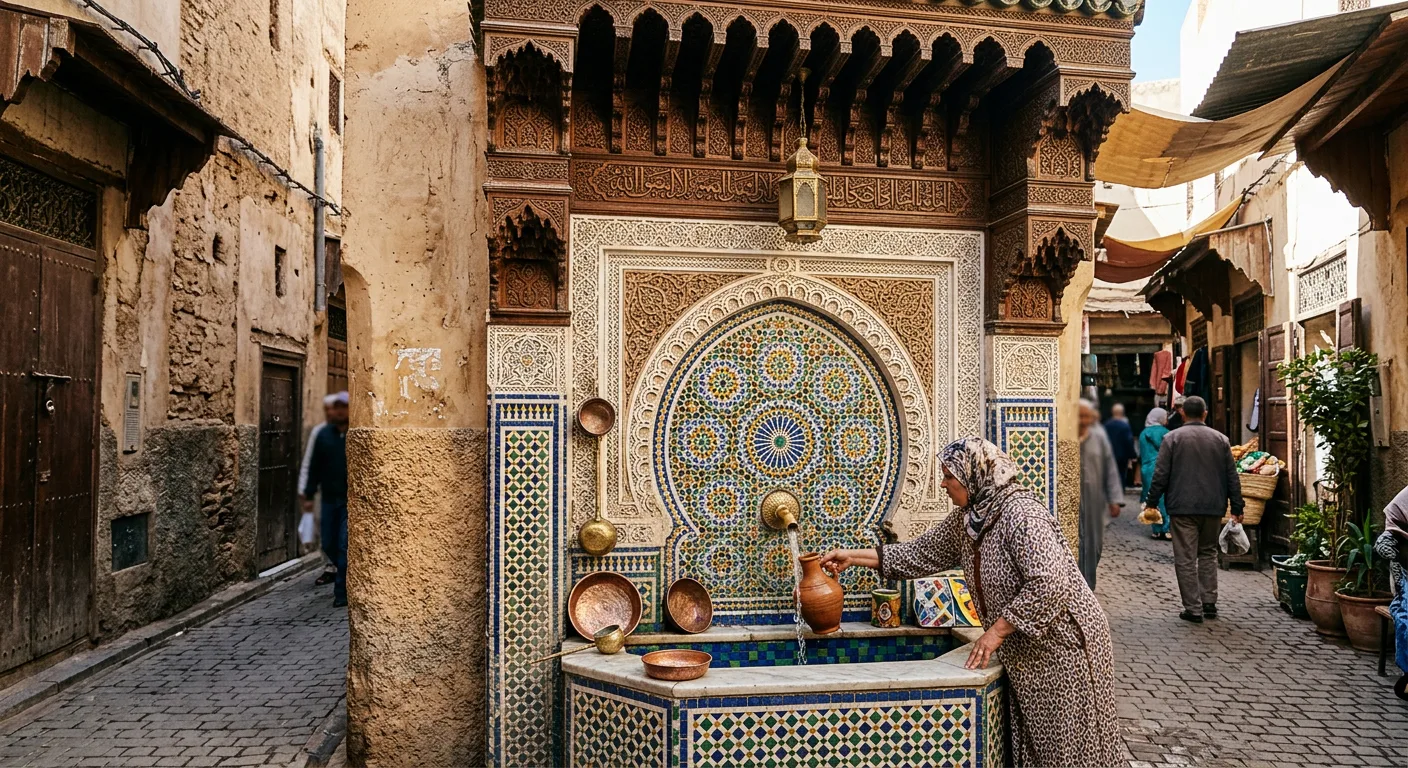
Traditional zellige-tiled Moroccan fountain with intricate mosaic patterns
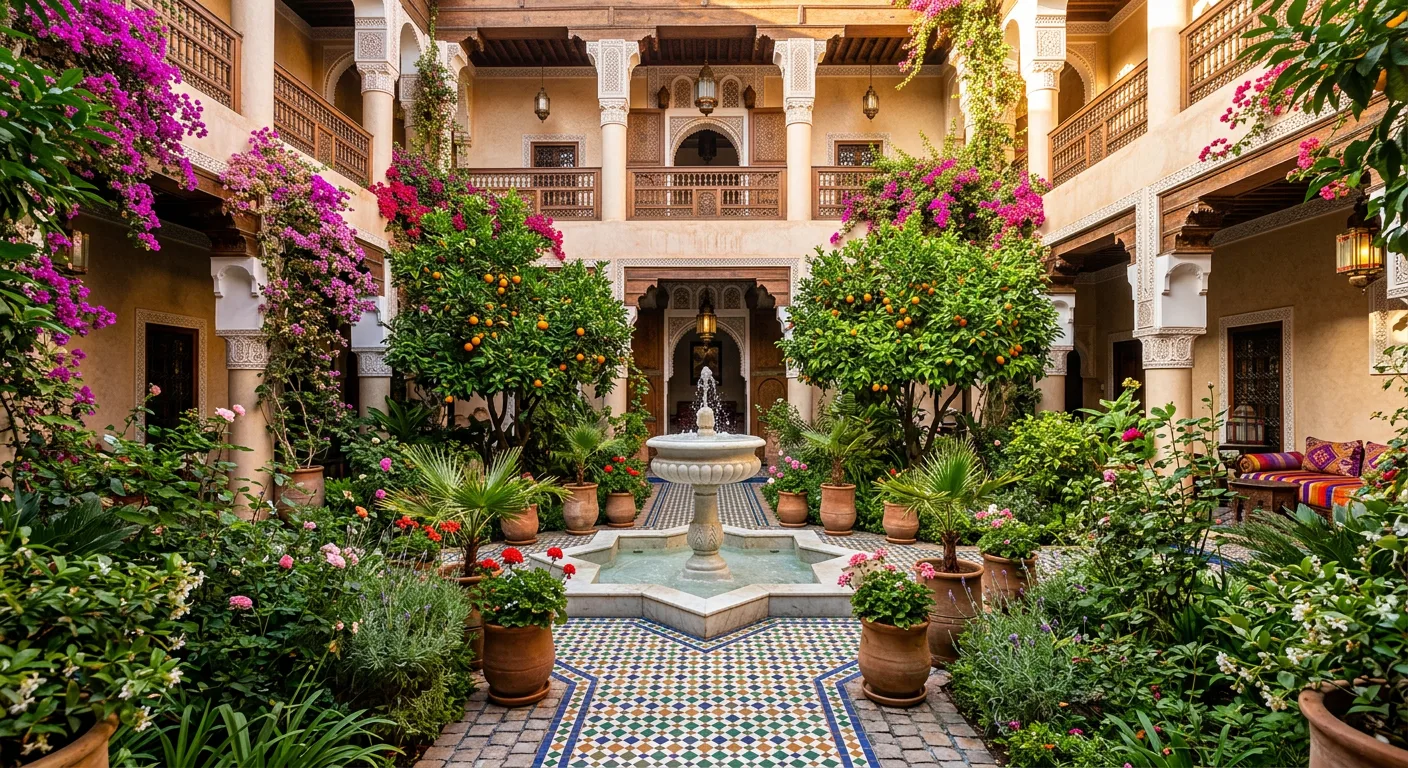
Lush Moroccan riad garden with orange trees, fountains, and tiled pathways
Explore More of Morocco
Architecture is just one facet of Morocco's extraordinary cultural heritage. Discover gardens, crafts, cuisine, UNESCO sites, and more.