Discovering...
Self-Drive Travel
Morocco Road Trip
Guide 2026
From the Atlantic coast to the Sahara dunes, through mountain passes and ancient cities. Everything you need to plan a self-drive adventure across Morocco.
Why Drive Morocco Yourself
A road trip is the single best way to experience Morocco beyond the medinas. The country packs an absurd amount of geographic variety into a territory the size of California: Atlantic surf beaches, snow-capped mountains over 4,000 meters, river gorges cut through red limestone, and the vast sand seas of the Sahara. Public transport connects the major cities but misses the spaces between them -- and those spaces are where Morocco is most striking.
Morocco's road infrastructure has improved dramatically in the past decade. A modern autoroute (toll highway) network now links Tangier, Rabat, Casablanca, Marrakech, Fes, and Agadir. National roads across the Atlas are paved and well-maintained. Fuel stations are plentiful on major routes. GPS navigation works reliably. The biggest adjustment for most foreign drivers is the driving culture itself: assertive overtaking, creative lane discipline, and the occasional donkey cart occupying half the road.
This guide covers the practical details -- car rental, fuel costs, toll roads, driving rules, insurance -- alongside the four best road trip routes and itineraries from 3 to 14 days. Prices are current for 2026. Seasonal pricing can change during peak tourist months.
Best Road Trip Routes
Four classic driving routes that cover Morocco's most spectacular landscapes. Each can be driven independently or combined into a longer circuit.
Marrakech to Sahara (Merzouga)
560 km one-way 2-3 days each way
Highlights: Tizi n'Tichka pass (2,260 m), Ait Benhaddou kasbah, Ouarzazate film studios, Dades Gorge, Todra Gorge, Erfoud fossils, Merzouga dunes
Road quality: Paved N9/N10 the entire way. No 4x4 required. Well-maintained switchbacks on the pass.
Best season: October to April. Summer heat in the desert exceeds 45C.
Tip: Leave Marrakech by 7:00 AM to cross Tizi n'Tichka in morning light. Stop at the pass summit for panoramic views. Do not rush this drive -- the gorges deserve at least half a day each.
Atlantic Coast Loop
900 km loop 5-7 days
Highlights: Casablanca, El Jadida Portuguese cistern, Oualidia lagoon, Safi pottery, Essaouira ramparts, Agadir beaches, Taghazout surf town, Legzira arches
Road quality: Excellent coastal highway the entire route. Mostly autoroute or well-maintained national roads.
Best season: Year-round. Best surf November to March. Summer brings crowds to Agadir.
Tip: Spend at least two nights in Essaouira. The town rewards slow exploration. Budget a seafood lunch at the port grill stalls (from 60 MAD for a mixed plate).
Imperial Cities Circuit
850 km loop 5-7 days
Highlights: Rabat Hassan Tower, Meknes Roman ruins of Volubilis, Fes medina, Ifrane cedar forests, Middle Atlas lakes, Beni Mellal, return to Marrakech
Road quality: Autoroute connects Rabat-Meknes-Fes. National roads through the Middle Atlas are scenic two-lane highways. All paved.
Best season: March to May and September to November. Fes is extremely hot in July-August.
Tip: Book your Fes medina accommodation in advance -- parking outside the medina gates is limited. Most riads can arrange nearby garage parking for from 30-50 MAD per night.
High Atlas & Mountain Passes
400-600 km depending on route 3-5 days
Highlights: Tizi n'Tichka (2,260 m), Tizi n'Test (2,100 m), Dades Gorge road, Tichka Plateau, Imilchil, Zawyat Ahansal
Road quality: Main passes (Tichka, Test) are paved but narrow with hairpin turns. Side roads to remote valleys may be unpaved. 4x4 recommended for off-main-road exploration.
Best season: May to October. Passes can close temporarily due to snow December through February.
Tip: Tizi n'Test is far less trafficked than Tizi n'Tichka and offers more dramatic scenery, but the road is narrower and requires confident mountain driving. Check locally for road conditions before attempting.
Car Rental Guide
Three rental tiers to match your route, budget, and comfort level.
Economy
Dacia Logan, Hyundai i10, Renault Clio
Price: From 250 MAD/day
Fuel: Petrol, 5-6 L/100 km
Best for: City driving, coastal roads, well-paved routes. Fine for Marrakech-Sahara via main roads.
Most popular choice. Low running cost. Book manual transmission for the cheapest rate.
Mid-Range SUV / Crossover
Dacia Duster, Hyundai Tucson, Renault Kadjar
Price: From 500 MAD/day
Fuel: Diesel, 6-7 L/100 km
Best for: Mountain passes, gravel side roads, families needing luggage space. Higher driving position for confidence on switchbacks.
Best balance of comfort, cost, and capability for a full Morocco circuit.
4x4 / Off-Road
Toyota Land Cruiser, Suzuki Jimny, Mitsubishi Pajero
Price: From 900 MAD/day
Fuel: Diesel, 10-12 L/100 km
Best for: Desert pistes, Erg Chigaga access, remote Atlas tracks, off-road adventure.
Only necessary for unpaved desert tracks. Overkill for standard routes. Requires larger fuel budget.
Essential Car Rental Tips
Book online in advance
Prices at airport desks are 30-50% higher than online pre-bookings. International aggregators (Discover Cars, Rentalcars) compare local agencies. Always read the insurance fine print.
Document existing damage
Walk around the car with the agent before leaving. Photograph every scratch, dent, and chip with your phone. Email the photos to yourself with a timestamp. This prevents false damage claims on return.
Choose diesel when possible
Diesel (gasoil) costs from 12 MAD per liter versus from 14 MAD for petrol. Diesel engines also deliver better range on long drives. Most SUVs and crossovers are diesel in Morocco.
Get full insurance coverage
The basic CDW (Collision Damage Waiver) included in most rentals still leaves a from 5,000-15,000 MAD excess. Pay the extra from 100-200 MAD/day for zero-excess coverage. One pothole or stray rock can cost more than the insurance.
Manual vs automatic
Manual transmission cars are cheaper and more available. Automatic cars carry a from 100-150 MAD/day surcharge and must be booked well in advance. If you can only drive automatic, book early.
One-way drop-off fees
Picking up in Marrakech and dropping off in Fes (or vice versa) typically costs from 500-1,500 MAD extra. Some agencies waive this for rentals over 7 days. Confirm the fee before booking.
Driving Rules & Safety
Six rules of the road that every foreign driver in Morocco must know.
Speed Limits
Urban areas: 40-60 km/h. National roads: 80-100 km/h. Autoroutes: 120 km/h. Speed cameras are widespread and fines start from 300 MAD. The fine doubles if unpaid within 48 hours.
Roundabouts
Traffic already inside the roundabout has priority. In practice, many drivers ignore this rule. Approach cautiously, yield to cars on your left, and drive defensively. Horn use at roundabouts is common and not aggressive.
Police Checkpoints
Expect checkpoints at city entrances and on desert roads. Have your license, IDP, passport, and rental papers ready. Officers are typically polite and wave tourists through quickly. Always stop when flagged.
Seatbelts & Phones
Seatbelts are mandatory for all occupants. Using a phone while driving carries a from 500 MAD fine. Hands-free is permitted. Child car seats are required for children under 10 but rarely enforced. Bring your own if traveling with small children.
Night Driving
Avoid driving after dark outside major cities. Unlit vehicles, donkey carts, pedestrians in dark clothing, and livestock on the road are common hazards. If you must drive at night, reduce speed dramatically and use high beams on empty stretches.
Fuel Stations
Abundant on autoroutes and national roads. Sparse south of Ouarzazate and in the deep south. Never pass a fuel station with less than a quarter tank in remote areas. Most stations accept cash only. Some in cities accept cards.
GPS & Navigation
Google Maps works well across Morocco and has been the most reliable navigation tool for several years. It handles toll roads correctly, shows fuel stations, and provides reasonably accurate drive times. Download offline maps for your entire route before departure -- cellular coverage is patchy in the Atlas Mountains and desert.
Maps.me and Organic Maps are strong alternatives for offline use, with better trail and piste coverage than Google Maps. Waze has a smaller user base in Morocco but is useful for speed camera alerts on autoroutes. Apple Maps has improved but remains less detailed than Google Maps for rural Moroccan roads.
Download offline maps
Cellular data drops in mountain passes and desert stretches. Download the entire Morocco map pack in Google Maps before you leave your accommodation. This uses roughly 1-2 GB of storage.
Buy a local SIM card
Maroc Telecom, Inwi, or Orange SIM cards cost from 30 MAD with from 20 GB of data for from 100 MAD. Available at airports and city shops. Data lets you use real-time navigation and check road conditions.
Trust road signs over GPS
On mountain passes, GPS occasionally suggests unpaved shortcuts that are impassable in a regular car. When the GPS route diverges from signed road numbers (N9, N10, R703), follow the signs.
Carry a paper map as backup
A Michelin Morocco map (742) costs from 100 MAD at Moroccan bookshops. Invaluable when electronics fail. Paper maps also show elevation contours and pass heights that digital maps may omit.
Toll Roads & Road Conditions
What to expect from Morocco's road network and how to budget for tolls.
Autoroutes (Toll Highways)
Morocco's autoroute network is modern, well-maintained, and fast. Dual carriageway with a 120 km/h speed limit, rest stops with fuel and food every 40-60 km, and clear signage in Arabic and French. The network connects Tangier-Rabat-Casablanca-Marrakech and Rabat-Meknes-Fes, with an extension to Agadir. You collect a ticket at the entry gate and pay cash (MAD) at exit. A Jawaz electronic tag (from 50 MAD deposit) lets you skip queues at toll plazas.
Casablanca-Marrakech: From 80 MAD
Casablanca-Fes: From 120 MAD
Tangier-Marrakech: From 200 MAD
Rabat-Fes: From 90 MAD
Marrakech-Agadir: From 100 MAD
Casablanca-Rabat: From 30 MAD
National Roads (Routes Nationales)
Two-lane paved roads connecting cities and towns. Speed limit 80-100 km/h. Road quality is generally good but deteriorates in remote mountain and southern desert areas. Expect slow trucks on uphill sections, roadside vendors, and occasional livestock crossings. Overtaking requires patience and clear sightlines. These roads are where the most interesting scenery is found -- the N10 from Ouarzazate to Merzouga crosses through palm oases, rocky hamada, and the pre-Saharan steppe.
Mountain Roads & Passes
Paved but narrow, with tight hairpin turns and no guardrails in many sections. The Tizi n'Tichka (N9) is the most heavily traveled pass and is well-maintained year-round except during rare heavy snowfall. The Tizi n'Test (R203) is narrower and less trafficked. Mountain roads demand concentration, low gear on descents, and frequent horn use on blind curves. Trucks and buses have priority on narrow sections. Check road conditions through your accommodation before driving any pass between December and February.
Desert Pistes (Unpaved Tracks)
Unpaved tracks in the south and deep desert. Ranges from well-graded gravel (passable in a careful sedan) to deep sand requiring 4x4 and deflated tires. The piste from M'Hamid to Erg Chigaga (50 km) absolutely requires a 4x4 or organized tour. Pistes south of Merzouga toward the Algerian border also demand off-road capability. Never drive a piste alone without informing someone of your route and expected return. Carry extra water (at least 5 liters per person) on any desert track.
Road Trip Itineraries
Four tested itineraries from a quick desert dash to the ultimate two-week circuit.
3-Day Express: Marrakech to Desert & Back
3 days 1,120 km
- 1Day 1: Marrakech to Dades Gorge via Tizi n'Tichka pass and Ait Benhaddou (330 km, 7 hours with stops)
- 2Day 2: Dades Gorge to Merzouga via Todra Gorge and Erfoud (230 km, 5 hours with stops). Sunset camel ride into Erg Chebbi dunes.
- 3Day 3: Merzouga to Marrakech via N10 and Ouarzazate (560 km, 8 hours). Long day -- leave by 6:00 AM.
Tip: This itinerary is tight but doable. Consider flying back from Errachidia to save 8 hours of driving on Day 3.
7-Day Classic: Sahara & Imperial Cities
7 days 1,800 km
- 1Day 1: Marrakech to Ait Benhaddou (190 km). Afternoon at the kasbah.
- 2Day 2: Ait Benhaddou to Dades Gorge via Rose Valley (150 km). Hike the gorge.
- 3Day 3: Dades to Merzouga via Todra Gorge (280 km). Night in desert camp.
- 4Day 4: Merzouga to Midelt via Errachidia and Ziz Gorge (300 km).
- 5Day 5: Midelt to Fes via Ifrane and cedar forests (240 km). Explore Fes medina.
- 6Day 6: Full day in Fes. No driving.
- 7Day 7: Fes to Marrakech via autoroute (530 km, 5 hours on highway).
Tip: The Fes day with no driving is essential. After several days on mountain roads, a walking day in the medina recharges you.
10-Day Grand Tour: Coast, Desert & Mountains
10 days 2,500 km
- 1Day 1: Casablanca to El Jadida to Essaouira (350 km). Portuguese cistern, Oualidia oysters.
- 2Day 2: Full day in Essaouira. No driving. Ramparts, port, medina, beach.
- 3Day 3: Essaouira to Marrakech (190 km). Afternoon in Jemaa el-Fnaa.
- 4Day 4: Marrakech to Ait Benhaddou via Tizi n'Tichka (190 km).
- 5Day 5: Ait Benhaddou to Merzouga via gorges (460 km).
- 6Day 6: Full day in Merzouga. Camel trek, desert camp, sunrise dune hike.
- 7Day 7: Merzouga to Midelt via Ziz Gorge (300 km).
- 8Day 8: Midelt to Fes (200 km). Afternoon in Fes.
- 9Day 9: Fes to Chefchaouen (210 km). Blue city exploration.
- 10Day 10: Chefchaouen to Casablanca or Tangier (300 km to Casa, 120 km to Tangier).
Tip: This is the ideal duration for a first Morocco road trip. Two full rest days keep fatigue manageable.
14-Day Ultimate Morocco Circuit
14 days 3,200 km
- 1Days 1-2: Tangier, explore city, Cap Spartel, Hercules Caves.
- 2Day 3: Tangier to Chefchaouen (120 km).
- 3Day 4: Chefchaouen to Fes (210 km).
- 4Day 5: Full day in Fes. Medina, tanneries, Bou Inania.
- 5Day 6: Fes to Merzouga via Midelt and Ziz Gorge (480 km).
- 6Day 7: Full day in Merzouga. Desert camp overnight.
- 7Day 8: Merzouga to Dades Gorge (230 km).
- 8Day 9: Dades to Ouarzazate to Ait Benhaddou (160 km).
- 9Day 10: Ait Benhaddou to Marrakech via Tizi n'Tichka (190 km).
- 10Day 11: Full day in Marrakech.
- 11Day 12: Marrakech to Essaouira (190 km).
- 12Day 13: Essaouira to El Jadida (300 km) via Safi.
- 13Day 14: El Jadida to Casablanca (100 km). End of trip.
Tip: Two full weeks lets you breathe. Add Meknes and Volubilis between Fes and Marrakech if you want to see every Imperial City.
Must-Stop Scenic Points
Six places where you must pull over, get out of the car, and take it in.
Tizi n'Tichka Summit (2,260 m)
Between Marrakech & Ouarzazate
The highest major road pass in Morocco. Pull over at the summit for panoramic views of the High Atlas. Souvenir stalls sell fossils and minerals. The descent toward Ouarzazate reveals red-earth valleys.
Ait Benhaddou
Ouarzazate Province
UNESCO World Heritage ksar (fortified village) made of red pise clay. Film location for Gladiator, Game of Thrones, and Lawrence of Arabia. Cross the riverbed on foot to explore the kasbah. Entry is free; tip your guide.
Todra Gorge
Tinghir
300-meter limestone canyon walls towering above a narrow road. The final 600 meters of the gorge are the most dramatic. Rock climbers scale the walls year-round. Cafes at the gorge mouth serve tagine with a view.
Dades Gorge Road of a Thousand Kasbahs
Boumalne Dades
The most photographed hairpin turns in Morocco. The road climbs from the valley floor through a series of tight switchbacks carved into red rock. Drive slowly and stop at the viewpoint above the switchbacks.
Ziz Gorge & Valley
Errachidia to Erfoud
A deep river canyon lined with date palms and Berber villages. The viewpoint above the Tunnel du Legionnaire offers one of the most striking vistas on the Sahara route. Stop at Erfoud for fossil workshops.
Legzira Beach
Sidi Ifni coast
Dramatic natural stone arches carved by Atlantic waves into red sandstone cliffs. Best visited at low tide when you can walk beneath the arches. Sunset here is spectacular. A short detour from the Agadir-Tiznit road.
Where to Stay Along the Route
Four accommodation types you will encounter on a Morocco road trip, with typical pricing.
Riads (Medina Guesthouses)
From 400 MAD/night
Traditional courtyard houses converted to guesthouses. Found in Marrakech, Fes, Essaouira, and Chefchaouen. Breakfast included. Parking arranged nearby (from 30 MAD/night extra).
Kasbahs & Auberges
From 300 MAD/night
Fortified guesthouses along the Sahara route, especially between Ouarzazate and Merzouga. Often family-run with home-cooked dinners. On-site parking. Half-board packages common.
Desert Camps
From 500 MAD/night
Tented camps in the Sahara dunes (Erg Chebbi at Merzouga or Erg Chigaga near M'Hamid). Includes camel ride, dinner, breakfast, and sunrise viewing. Luxury camps with private bathrooms from 1,500 MAD.
Roadside Hotels & Motels
From 200 MAD/night
Basic hotels in towns like Midelt, Beni Mellal, and Errachidia. Clean, functional, with parking. Good for overnight stops on long driving days when you just need sleep and a shower.
Road Trip Cost Breakdown
Sample budget for a 7-day road trip for one person. All prices are starting prices in Moroccan Dirhams. Seasonal pricing can change.
Item
Cost (MAD)
Details
Economy car rental (7 days)
From 1,750 MAD
Dacia Logan or similar, manual
Full insurance (CDW + theft, 7 days)
From 700 MAD
Reduces excess to zero
Fuel (1,500 km, diesel)
From 1,080 MAD
At ~12 MAD/L, 6 L/100 km
Toll roads (Marrakech-Fes round trip)
From 300 MAD
Via autoroute both ways
Parking (7 nights, guarded lots)
From 210 MAD
~30 MAD per night average
Accommodation (7 nights, mid-range riad)
From 3,500 MAD
~500 MAD per night for double room
Food (7 days, local restaurants)
From 1,400 MAD
~200 MAD per day per person
Estimated 7-day total (one person)
From 8,940 MAD
Roughly 820 EUR / 890 USD
On the Road in Morocco
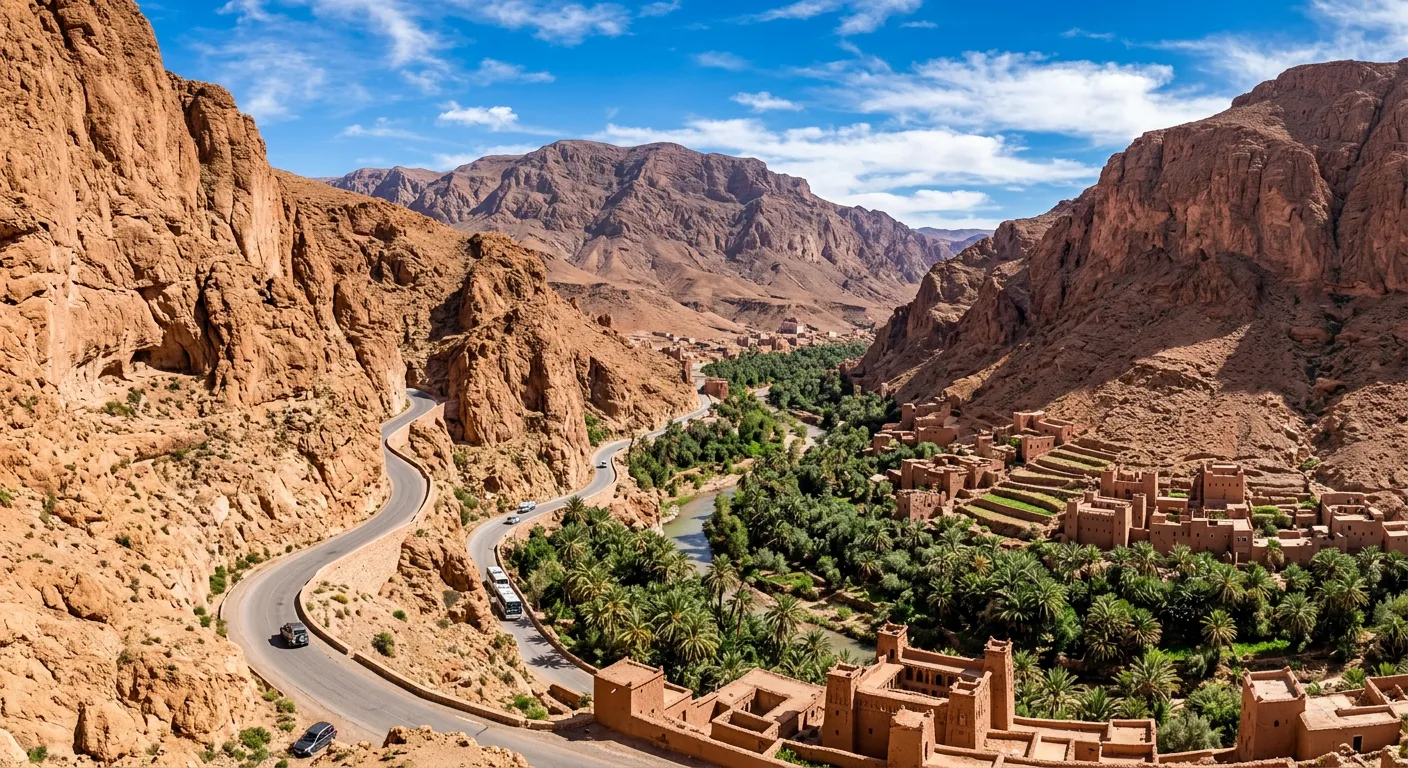
Dades Valley Switchbacks
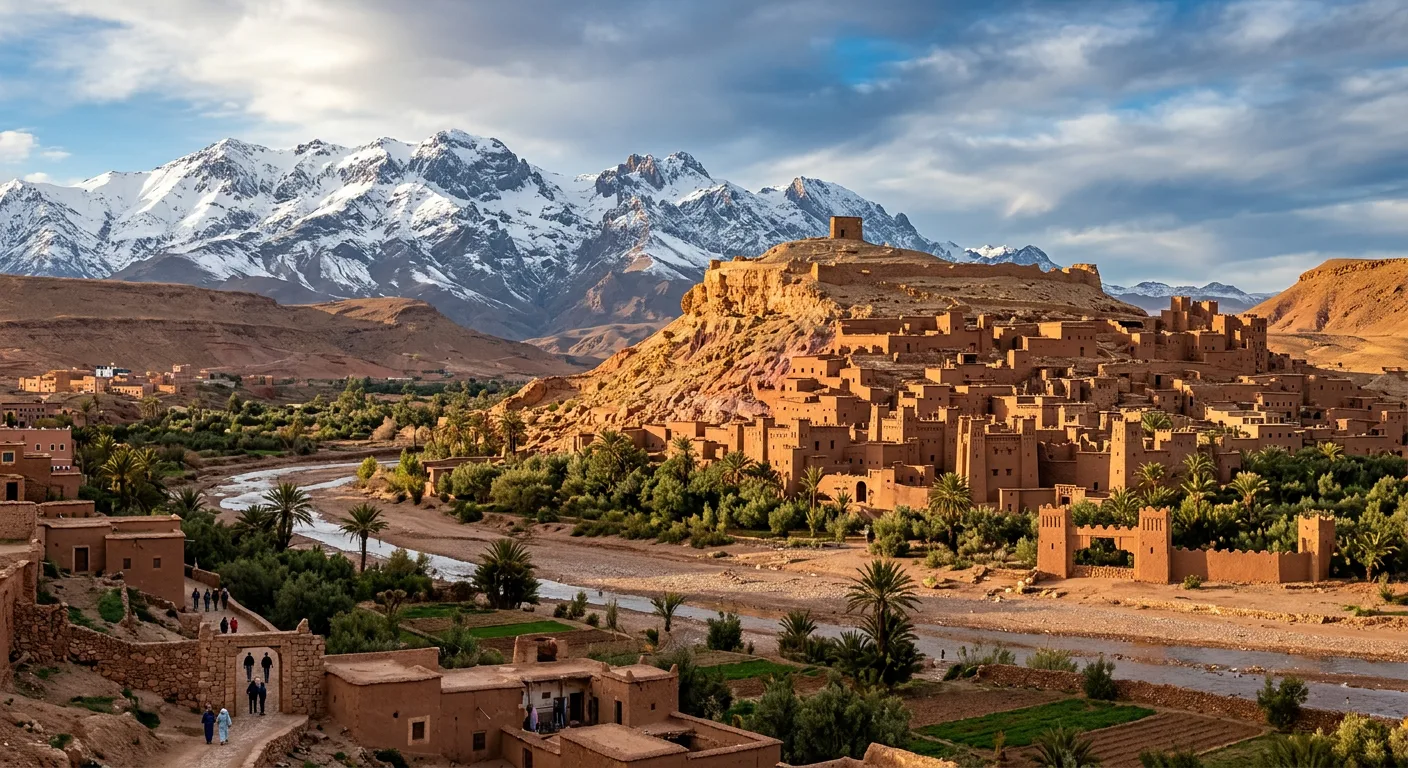
Ait Benhaddou Kasbah
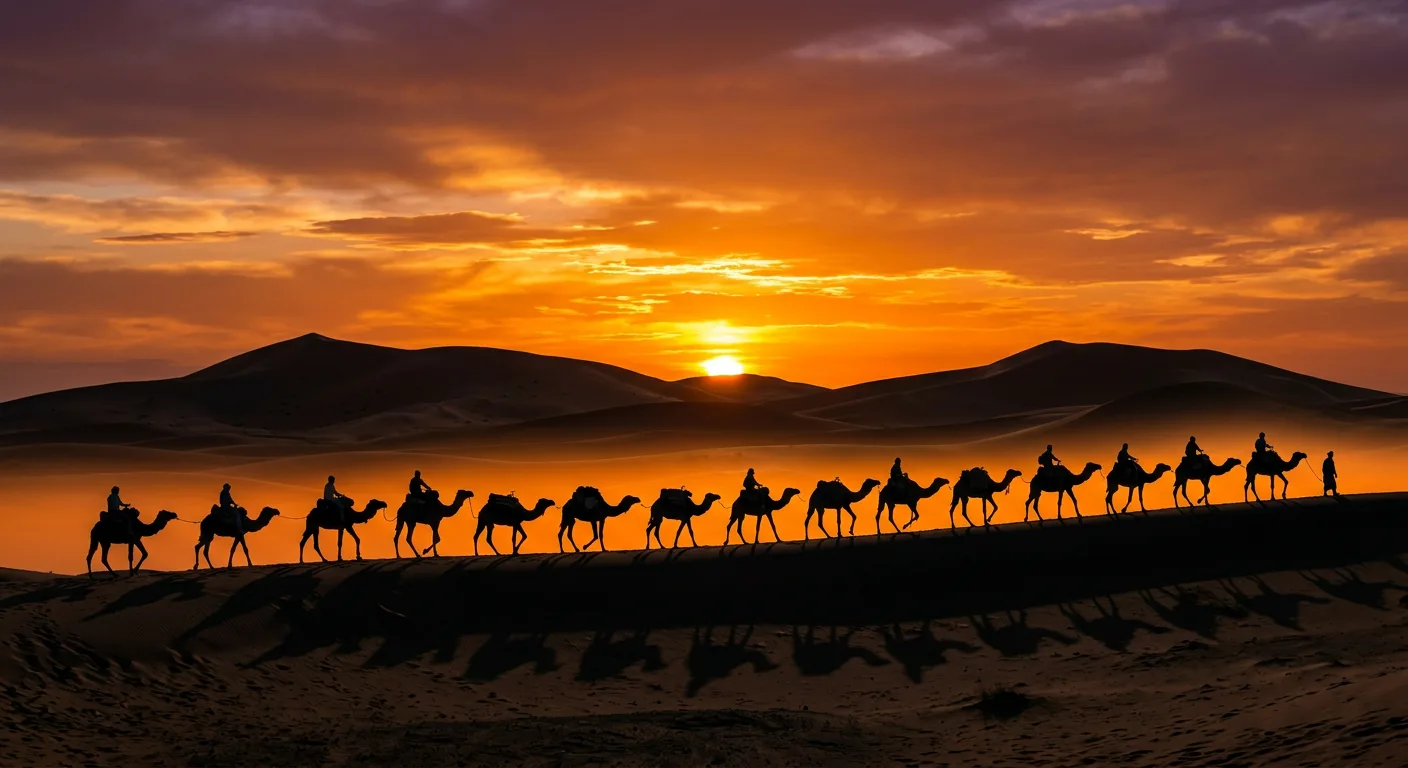
Erg Chebbi, Merzouga
Frequently Asked Questions
Answers to the most common questions about driving and road-tripping in Morocco.
Do I need an International Driving Permit to drive in Morocco?
If your domestic license is in French or Arabic, you can use it directly. All other licenses require an International Driving Permit (IDP) alongside your original license. Obtain an IDP in your home country before departure. Rental agencies enforce this rule strictly, and police checkpoints may request both documents.
How much does car rental cost in Morocco?
A basic economy car (Dacia Logan, Hyundai i10) starts from 250 MAD per day. A mid-range SUV or crossover starts from 500 MAD per day. A 4x4 suitable for desert pistes starts from 900 MAD per day. Prices drop significantly for weekly bookings. Add from 100-200 MAD per day for full insurance. Seasonal pricing can change during peak months (October-April and summer).
What side of the road do they drive on in Morocco?
Morocco drives on the right side of the road, same as continental Europe and the United States. Vehicles are left-hand drive. If you are from the UK, Australia, or Japan, plan extra focus for the first day. Roundabouts follow the continental European pattern: traffic already in the roundabout has priority.
Are Moroccan roads safe for tourists to drive?
Major highways (autoroutes) between cities are well-maintained, well-lit, and comparable to European motorways. National roads (routes nationales) are two-lane and require patience with slower traffic like trucks, donkey carts, and motorbikes. Mountain passes demand confident driving with tight switchbacks. Avoid driving at night outside cities, as unlit vehicles, pedestrians, and livestock on the road create serious hazards.
Can I drive a rental car from Morocco into another country?
Most rental companies prohibit cross-border travel entirely. A few agencies allow travel to Mauritania with advance written permission and extra insurance, but this is rare and expensive. No standard rental contract covers the Ceuta or Melilla Spanish enclaves. If you plan to cross borders, negotiate this before signing your rental agreement.
What fuel costs should I budget for a Morocco road trip?
Unleaded petrol (essence sans plomb) costs from 14 MAD per liter. Diesel (gasoil) costs from 12 MAD per liter. A typical 10-day road trip covering 2,500 km in a diesel economy car uses roughly 150 liters, costing from 1,800 MAD total. Fuel stations are common on major routes but sparse in the deep south and desert. Fill up whenever you see a station south of Ouarzazate.
Do I need a 4x4 for a Morocco road trip?
For the standard tourist routes (Marrakech to Merzouga via N10, Atlantic Coast, Imperial Cities), a regular car handles every road. You only need a 4x4 for unpaved desert tracks (pistes) south of Merzouga, the remote stretch to Erg Chigaga from M'Hamid, and certain Atlas Mountain tracks that bypass main roads. If in doubt, stick to paved roads in a regular car.
How do toll roads work in Morocco?
Morocco has a modern toll highway (autoroute) network connecting Tangier, Rabat, Casablanca, Marrakech, Fes, Meknes, and Agadir. You take a ticket at the entry booth and pay at exit. Cash (MAD) and Jawaz electronic tags are accepted. A Tangier to Marrakech toll costs from 200 MAD one-way. A Casablanca to Marrakech toll costs from 80 MAD. Toll roads save significant time compared to national roads.
Related Travel Guides
Sahara Desert Guide
Camel treks, desert camps, Erg Chebbi and Erg Chigaga dunes, stargazing, and practical tips for the Moroccan Sahara.
Read GuideAtlas Mountains Guide
Trekking routes, Berber villages, Toubkal ascent, and seasonal conditions for the High, Middle, and Anti-Atlas ranges.
Read GuideBudget Travel Morocco
How to travel Morocco on a backpacker budget. Transport, food, accommodation, and activities for under 400 MAD per day.
Read GuideMorocco Safety Guide
Practical safety advice covering scams, solo female travel, health, road safety, and emergency contacts.
Read GuideMore Transport & Travel Resources
Morocco Transport Guide
Complete overview of trains, buses, taxis, and domestic flights across Morocco.
Morocco Camping Guide
Wild camping, organized campsites, and overlanding tips for self-drive travelers.
Best Time to Visit
Month-by-month weather, crowds, and pricing to help you pick the ideal travel window.
First Time in Morocco
Everything a first-time visitor needs to know about culture, customs, and logistics.
Morocco Packing Guide
What to pack for desert, coast, and mountains -- season by season.
Morocco Itineraries
Curated 3-day to 14-day itineraries for every travel style and budget.
Ready to Hit the Road?
Start planning your Morocco road trip today. Browse our city guides for detailed information on every destination along your route.