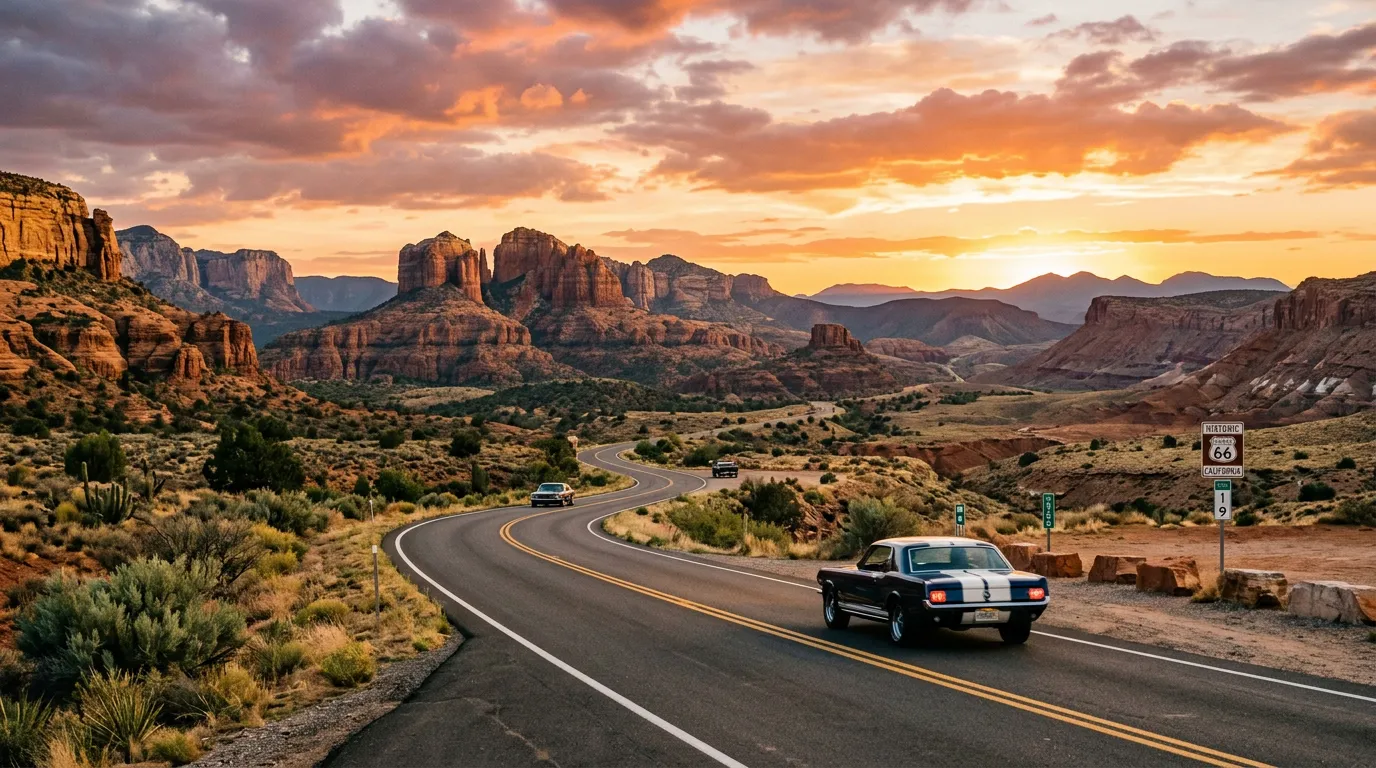
4x4, Overlanding & Vanlifein Morocco
Europe's favorite overlanding destination. From Atlantic beaches to Saharan dunes, Atlas mountain passes to hidden oases, Morocco offers the ultimate off-road adventure just a short ferry ride from Spain.
Why Morocco is Europe's Favorite Overlanding Destination
Every winter, thousands of overlanders and vanlifers cross the Strait of Gibraltar to explore Africa's most accessible adventure playground.
Just 14 km from Europe
Morocco is the closest African country to Europe. A 35-minute ferry from Tarifa or a 2-hour crossing from Algeciras puts you on the African continent with your own vehicle. No flights, no shipping containers, just drive on and drive off.
Astonishing Terrain Diversity
From Atlantic surf beaches and cedar forests to 4,000m mountain passes, lunar rock plateaus, palm-filled oases, and towering Saharan dunes. No other country this close to Europe offers such radical landscape changes within a single day of driving.
Wild Camping Friendly
Morocco is one of the most wild camping-friendly countries in the world. Outside of cities and military zones, free camping is widely tolerated. Overlanders park on beaches, in oases, beside rivers, and at the foot of sand dunes with rarely any issues.
Incredibly Affordable
Fuel costs roughly 50% less than Western Europe. Street food meals cost 15-30 MAD ($1.50-3), a campsite pitch is 50-80 MAD/night ($5-8), and even luxury glamping in the Sahara is a fraction of European prices. A couple can overland Morocco for $30-50/day.
Welcoming Local Culture
Moroccans are famously hospitable. Expect to be invited for tea, given directions with a smile, and helped when stuck in sand. The overlanding community is massive and well-established, with local mechanics who understand foreign vehicles.
Year-Round Sunshine
While Northern Europe shivers through winter, southern Morocco basks in 20-25 degrees. Thousands of European overlanders and vanlifers migrate south each October to spend the winter season camping along the Atlantic coast or in the desert.
5 Epic Overland Routes
From gentle coastal cruises to challenging desert pistes, these routes cover every terrain Morocco has to offer.
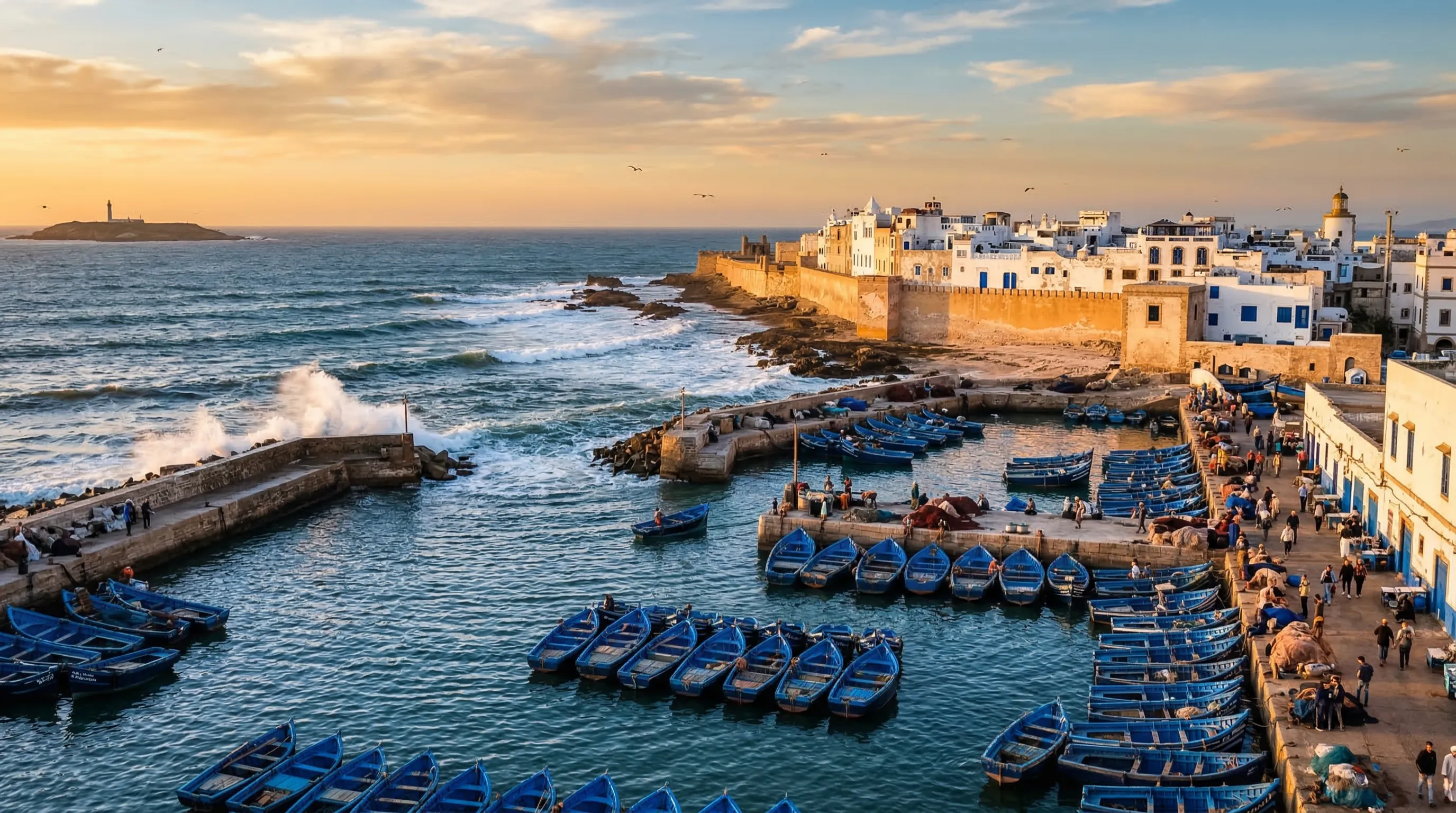
The Atlantic Coast Route
Tangier to Agadir via the Ocean Road
The most popular overlanding route in Morocco follows the Atlantic coastline from Tangier south to Agadir and beyond. This is the classic winter-sun route for European vanlifers escaping the cold. Mostly paved with easy beach detours, it suits all vehicle types including standard camper vans. The coast offers endless wild camping on beaches, world-class surfing, fresh seafood markets, and the gorgeous fortress towns of El Jadida, Essaouira, and Sidi Ifni.
Key Highlights
Terrain
Paved roads, coastal tracks, beach access
Best Season
October - April
Key GPS Waypoints
Tangier Med Port
35.8906, -5.5068
Ferry arrival point
Moulay Bousselham
34.8778, -6.2911
Lagoon wild camp
Oualidia Beach
32.7340, -9.0409
Oysters & calm lagoon
Sidi Kaouki
31.3570, -9.7911
Surf beach campsite
Taghazout
30.5444, -9.7084
Surf capital
Legzira Beach
29.5652, -10.0768
Iconic stone arches

Atlas Mountain Passes
Tizi n'Tichka, Tizi n'Test & Beyond
Cross the backbone of Morocco via its legendary mountain passes. The Tizi n'Tichka (2,260m) on the N9 is fully paved but spectacular, connecting Marrakech to the Saharan side. The Tizi n'Test (2,092m) on the R203 is narrower, wilder, and far less trafficked, a genuine mountain adventure. For experienced overlanders, the dirt pistes through the High Atlas between Demnate and Imilchil offer some of the most remote and stunning driving in North Africa.
Key Highlights
Terrain
Mountain passes, gravel tracks, some pistes
Best Season
April - June, September - November
Key GPS Waypoints
Tizi n'Tichka Summit
31.2924, -7.3831
2,260m paved pass
Tizi n'Test Summit
30.8667, -8.3750
2,092m narrow pass
Ait Benhaddou
31.0472, -7.1322
UNESCO kasbah
Imilchil
32.1522, -5.6261
Remote plateau camp
Lac Tislit
32.1774, -5.6208
High altitude lake
Cascades d'Ouzoud
32.0153, -6.7172
Morocco's tallest falls
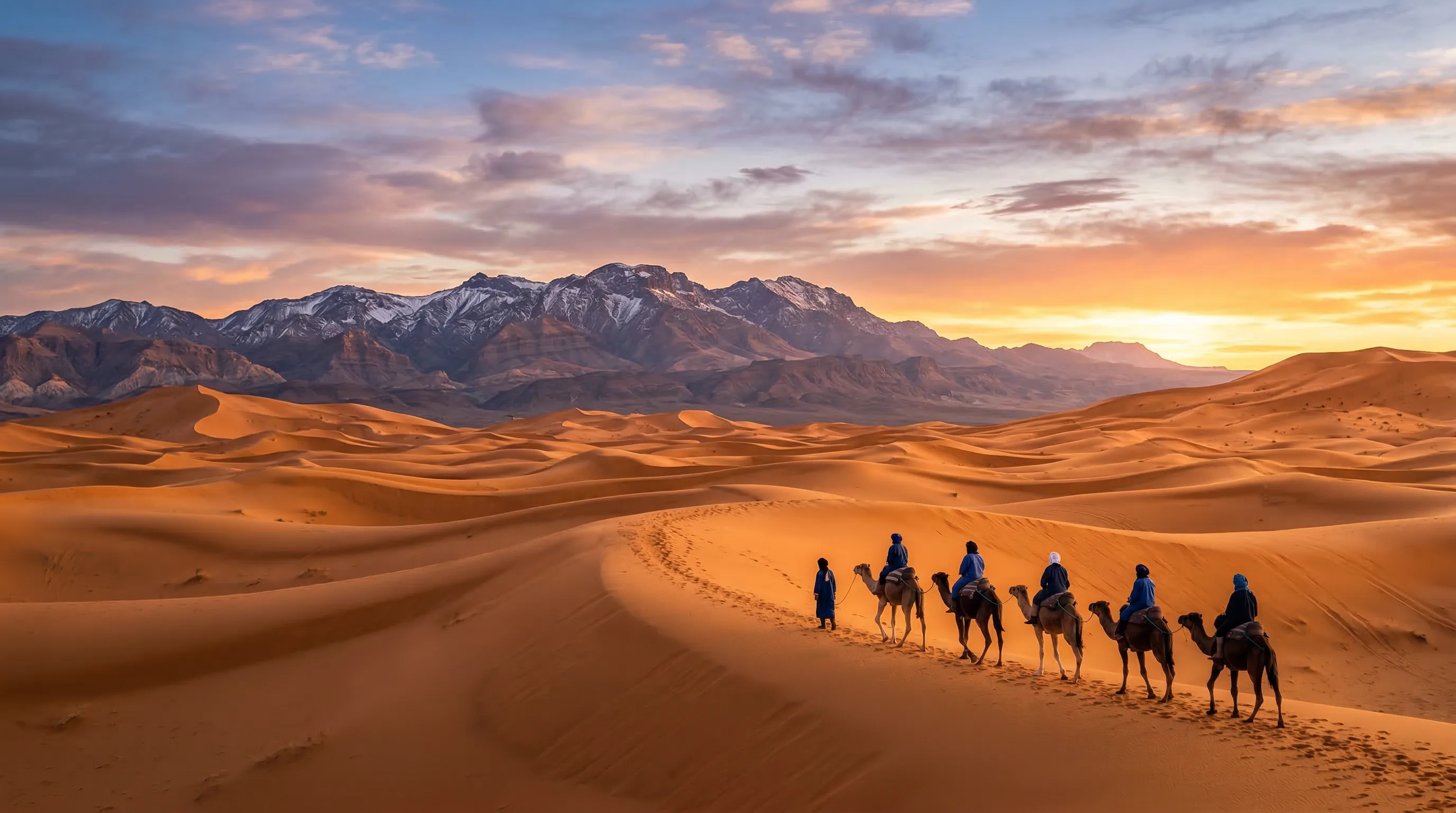
The Desert Circuit
Ouarzazate to Merzouga to Zagora
The crown jewel of Moroccan overlanding. This circuit takes you through the full spectrum of desert landscapes: the dramatic Dades and Todra gorges, the vast hamada (stone desert) plateaus, the towering Erg Chebbi dunes at Merzouga, and the endless Draa Valley palm groves leading to M'hamid and the edge of the true Sahara. 4x4 recommended for the desert pistes between Merzouga and Zagora, though the main roads are paved.
Key Highlights
Terrain
Paved, gravel pistes, soft sand sections
Best Season
October - April (avoid summer heat)
Key GPS Waypoints
Ouarzazate
30.9189, -6.8936
Circuit start point
Boumalne Dades
31.3707, -5.9944
Gorge entrance
Todra Gorge
31.5892, -5.5969
Iconic canyon camp
Merzouga
31.0801, -4.0131
Erg Chebbi dunes
Zagora
30.3281, -5.8381
Draa Valley hub
M'hamid
29.8252, -5.7222
End of the road, Sahara
The Anti-Atlas Loop
Tafraoute, Tata & Foum Zguid
The Anti-Atlas is Morocco's most underrated overlanding region. South of the High Atlas, this ancient granite landscape offers surreal rock formations, painted villages, prehistoric rock carvings, vast empty valleys, and some of the most spectacular free camping in the country. The loop through Tafraoute (with its famous painted rocks), Tata (date palm oasis), and Foum Zguid (gateway to Lac Iriqui) rewards those who seek emptiness and geological drama. 4x4 essential for many sections.
Key Highlights
Terrain
Remote pistes, rocky tracks, some sand
Best Season
November - March
Key GPS Waypoints
Tafraoute
29.7214, -8.9753
Granite valley base
Painted Rocks
29.6781, -9.0208
Jean Verame art
Ait Mansour Gorge
29.6111, -9.1667
Palm-filled canyon
Tata
29.7453, -7.9722
Desert oasis town
Foum Zguid
30.0833, -6.8833
Lac Iriqui access
Igherm
30.0636, -8.4281
Mountain village stop
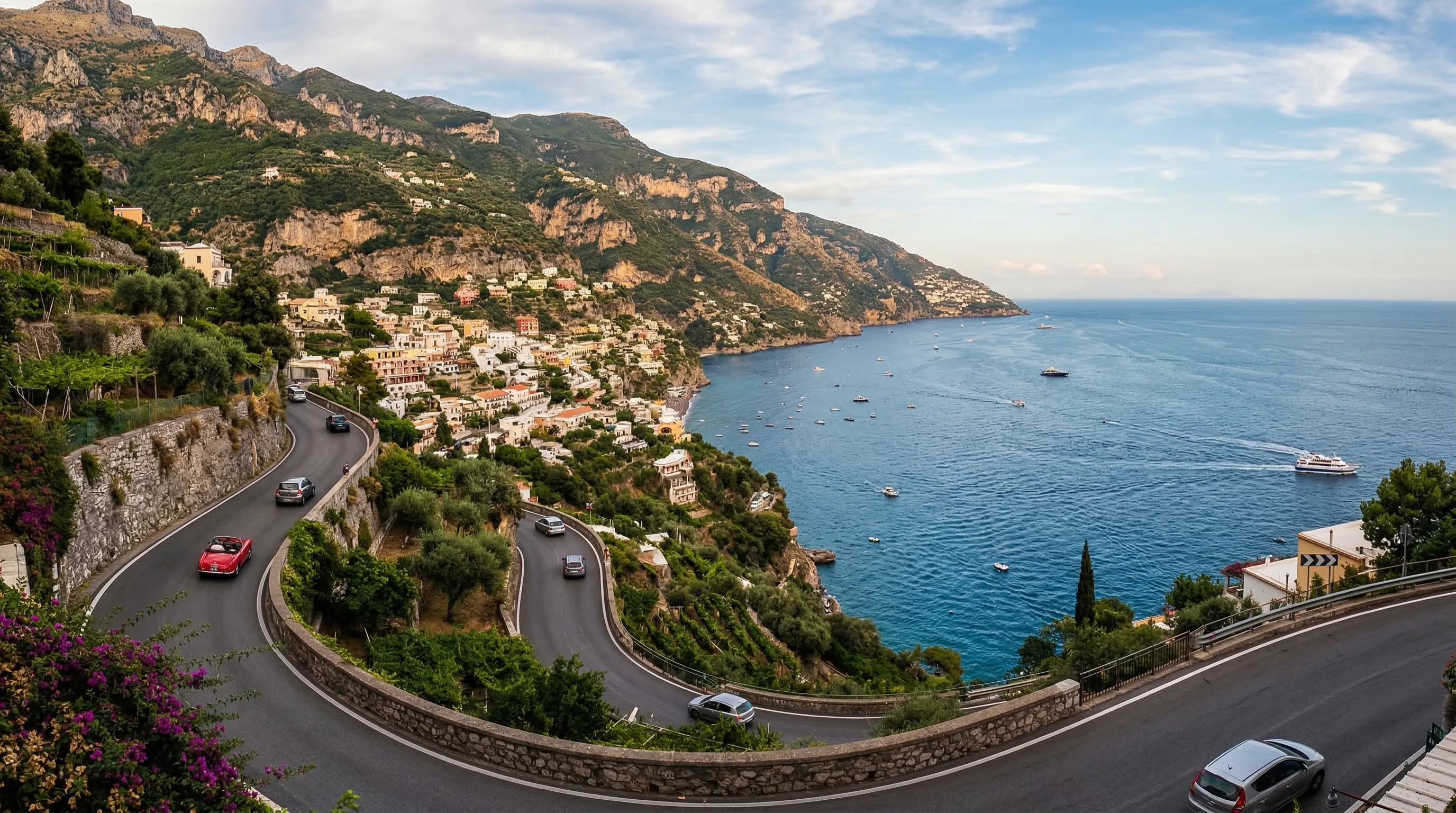
The Northern Circuit
Tangier, Chefchaouen, Fes & Meknes
The green, mountainous north of Morocco is a world apart from the desert south. This circuit connects the Mediterranean port of Tangier, the legendary blue-washed medina of Chefchaouen, the ancient imperial cities of Fes and Meknes, and the cedar forests of the Middle Atlas with their Barbary macaques. The Rif mountains offer beautiful forest camping, and the well-paved roads suit all vehicle types. Combine this with the coast or desert route for the ultimate grand tour.
Key Highlights
Terrain
Paved roads, mountain roads, some forest tracks
Best Season
March - June, September - November
Key GPS Waypoints
Tangier
35.7595, -5.8340
Ferry arrival point
Chefchaouen
35.1714, -5.2636
Blue city, mountain camp
Fes
34.0331, -5.0003
Imperial city
Volubilis
34.0730, -5.5544
Roman ruins
Meknes
33.8935, -5.5473
Imperial city
Azrou
33.4408, -5.2214
Cedar forest & monkeys
Vehicle Requirements & Recommendations
The right vehicle depends entirely on your route. Coast-huggers can use any van. Desert adventurers need serious capability.
Camper Van / Motorhome
Coast & main roadsPros
Self-contained living, comfortable, kitchenette, easy to drive
Cons
Cannot handle rough pistes, limited to paved and good gravel roads, challenging in narrow medina streets
Best For
Atlantic coast route, northern circuit, families wanting comfort
4x4 with Rooftop Tent
All routes including desertPros
Go anywhere capability, quick setup camp, good ground clearance, handles sand and rocks
Cons
Less living space than a van, exposed to elements, packing requires discipline
Best For
Desert circuit, Anti-Atlas, mountain passes, serious overlanding
Pickup Truck with Camper
Most routesPros
Good clearance, solid payload, real bed and kitchen, removable camper cell
Cons
Top-heavy on mountain passes, expensive to rent, harder to find in Morocco
Best For
Extended overlanding trips, couples wanting comfort with capability
Standard SUV + Tent
Most paved routes, some pistesPros
Cheap to rent, fuel efficient, easy to park, flexible with accommodation
Cons
Ground clearance limits, no self-contained camping, need separate tent and cooking gear
Best For
Budget overlanders, mixed hotel and camping trips, short desert excursions
Camper Van & 4x4 Rental Companies
16 vetted rental companies offering everything from budget campervans to fully expedition-equipped Land Cruisers.
Indie Campers Morocco
Marrakech, Casablanca
Large European fleet, well-maintained Fiat Ducato and VW-based vans. Online booking, one-way rentals available. Good customer support in English and French.
Roadsurfer Morocco
Marrakech
Premium camper vans with full kitchen and bathroom. German quality standards, comprehensive insurance included. Popular with European winter-sun travelers.
Moroccan Vans
Marrakech, Agadir
Local company with converted Renault Masters and Mercedes Sprinters. Good value, local knowledge, flexible pickup and dropoff locations throughout Morocco.
Sahara 4x4 Rental
Ouarzazate, Marrakech
Specializes in Toyota Land Cruisers and Hilux pickups. Desert-proven vehicles with sand plates, compressor, and recovery gear. Guides available.
Morocco Off-Road
Marrakech
Complete overlanding packages with rooftop tent, fridge, cooking gear, and GPS pre-loaded with off-road tracks. Land Rover Defenders and Toyota Land Cruisers.
Europcar Morocco
All major cities & airports
International brand with wide SUV selection. Dacia Duster is the popular budget 4x4 choice. Airport pickup, good roadside assistance network.
Hertz Morocco
All major cities & airports
Reliable international brand. RAV4 and Tucson available for light overlanding. Good insurance options but read the off-road exclusion clauses carefully.
Avis Morocco
All major cities & airports
Wide selection of SUVs. Some offices carry Mitsubishi Pajeros suitable for desert pistes. One-way rentals between major cities available.
Medlock 4x4
Marrakech
Land Rover Defender specialists. Fully expedition-equipped vehicles with long-range fuel tanks, recovery equipment, rooftop tents, and satellite phones.
Caravane du Sud
Ouarzazate, Zagora
Local operator with deep desert knowledge. Toyota Land Cruisers with experienced driver-guides available. Perfect for Sahara expeditions from the south side.
VanBreak Morocco
Casablanca
Budget-friendly converted vans. Fiat Ducato and Citroen Jumper bases. Basic but functional for coast-hugging vanlifers. Free airport transfer.
Wildcamper Morocco
Agadir, Marrakech
Unique 4x4 camper vans on Iveco Daily 4x4 base. Go off-road with full camper facilities. Small fleet so book well in advance, especially October-March.
Desert Majesty Tours
Errachidia, Merzouga
Self-drive 4x4 rentals or guided desert expeditions. Excellent for first-timers nervous about desert driving. Vehicles come with sat phone and sand ladders.
Sixt Morocco
Major airports
Good range of Dacia Dusters and Hyundai Tucsons. Budget-friendly for paved road overlanding. Be aware that off-road driving may void insurance coverage.
Yescapa Morocco
Various
Peer-to-peer camper van rental platform. Rent directly from owners. Wide variety of vehicles from basic vans to luxury motorhomes. Insurance included in platform fee.
Afric Cars
Marrakech, Ouarzazate
Local 4x4 specialist. Nissan Patrol and Toyota Land Cruiser fleet. Optional driver-guide and desert camping equipment packages. Flexible on pickup/dropoff.
Wild Camping Rules & Best Spots
Morocco is a wild camping paradise, but respect the land and the people to keep it that way for future travelers.
Wild Camping Guidelines
Wild camping (bivouac) is generally tolerated throughout Morocco outside of cities, military zones, and clearly signed private or protected areas.
Always ask permission if you see a nearby house, farm, or shepherd. A polite "Salaam, mumkin n-biatu hna?" (Can we camp here?) goes a long way.
Leave no trace. Pack out ALL trash. Burning waste is not acceptable. Moroccan rural communities notice and remember.
Avoid camping near military installations, police checkpoints, royal palaces, or border zones. These are strictly off-limits.
Beach camping is popular and generally fine along the Atlantic coast, though some popular beaches (like Legzira) have been restricted seasonally.
In national parks (Toubkal, Talassemtane, Souss-Massa), camping is technically regulated. In practice, discreet camping is rarely challenged.
Desert camping is universally accepted. The Sahara fringe areas are some of the most spectacular free camping in the world.
In the Rif mountains, be aware that some areas are cannabis cultivation zones. Avoid camping in isolated spots in this region.
Use existing fire rings where available. In dry season (June-September), avoid campfires entirely due to wildfire risk.
Park discreetly, arrive late, leave early. This "stealth" approach keeps wild camping viable for everyone.
Best Wild Camping Spots
Sidi Kaouki Beach
Atlantic Coast
31.3570, -9.7911
Surf beach south of Essaouira. Park on the beach edge or on cliffs above. Sunsets over the Atlantic. Wind can be fierce.
Legzira Beach
Atlantic Coast
29.5652, -10.0768
Famous red stone arches. Wild camp on the plateau above the beach. Stunning cliffs and empty coastline stretching for miles.
Taghazout Cliffs
Atlantic Coast
30.5444, -9.7084
Several pulloffs on the cliffs north of Taghazout village with ocean panoramas. Popular overlander spot with multiple vans in winter.
Todra Gorge Entrance
Desert Circuit
31.5892, -5.5969
Park at the wide area before the gorge narrows. River sounds, 300m limestone walls on both sides. Cold at night in winter.
Erg Chebbi Edge
Desert Circuit
31.0801, -4.0131
Park at the foot of the Erg Chebbi dunes. Watch sunset paint the sand gold and red. Absolute silence under billion-star skies.
Lac Iriqui
Anti-Atlas
29.9500, -6.5833
Dry lake bed south of Foum Zguid. Utterly flat, utterly empty, utterly spectacular. Milky Way photography paradise.
Ait Mansour Gorge
Anti-Atlas
29.6111, -9.1667
Palm-filled canyon near Tafraoute. Camp among the palms with pink granite walls rising above. Peaceful and sheltered from wind.
Azrou Cedar Forest
Middle Atlas
33.4408, -5.2214
Camp among the ancient cedars in the Middle Atlas. Visit the Barbary macaques in the morning. Cool mountain air even in summer.
Equipped Campsites Directory
31 vetted campsites across Morocco with facilities, prices, and coordinates.
Camping Amazigh
ExcellentTaghazout
30.5444, -9.7084
60-80 MAD /night
Hot showers, electricity, WiFi, restaurant, surf equipment rental
Camping Sidi Kaouki
GoodSidi Kaouki
31.3570, -9.7911
50-70 MAD /night
Showers, electricity, beachfront, small shop
Camping Le Calme
Very GoodEssaouira
31.5085, -9.7595
70-90 MAD /night
Hot showers, electricity, laundry, restaurant, shaded pitches
Camping Aain Nakhla
ExcellentOuarzazate
30.9189, -6.8936
50-70 MAD /night
Swimming pool, showers, electricity, restaurant, garden
Camping Zebra
Very GoodMerzouga
31.0801, -4.0131
60-80 MAD /night
Desert edge, hot showers, Berber tent lounge, camel rides arranged
Camping Auberge Chez Ali
GoodZagora
30.3281, -5.8381
40-60 MAD /night
Pool, showers, shaded palms, Berber music evenings
Camping Tizi Mzik
GoodImlil (Atlas)
31.1357, -7.9192
40-60 MAD /night
Mountain views, basic showers, trekking base, mule hire
Camping Jurassique
GoodAzilal
31.9615, -6.5693
50-70 MAD /night
Dinosaur footprints nearby, hot showers, restaurant, hiking trails
Camping Atlantica Parc
ExcellentMohammedia
33.6886, -7.3867
80-100 MAD /night
Full hookups, pool, playground, grocery store, laundry
Camping International
Very GoodChefchaouen
35.1714, -5.2636
60-80 MAD /night
Mountain views, hot showers, restaurant, short walk to medina
Camping Amridil
Very GoodSkoura
31.0603, -6.5617
50-60 MAD /night
Palm grove setting, pool, showers, kasbah views, silence
Camping Taouz
BasicTaouz (near Merzouga)
31.0694, -3.9764
40-50 MAD /night
Desert edge, basic showers, fire pit, fossil hunting area
Camping Ouirgane
GoodOuirgane (Atlas)
31.1497, -8.0889
60-80 MAD /night
Mountain riverside, showers, restaurant, horseback riding
Camping Le Relais de Marrakech
Very GoodMarrakech
31.6295, -7.9811
80-100 MAD /night
Pool, full hookups, security, walking distance to medina
Camping Asilah
GoodAsilah
35.4653, -6.0349
60-70 MAD /night
Beachfront, showers, restaurant, walk to medina, shaded
Camping Plage Blanche
BasicGuelmim
29.2431, -10.2322
40-50 MAD /night
Remote beach access, basic showers, tranquility, fishing
Camping Tifoultoute
GoodOuarzazate
30.9372, -6.9478
50-70 MAD /night
Kasbah views, pool, showers, electricity, BBQ area
Camping Agdz
GoodAgdz (Draa Valley)
30.6981, -6.4497
40-60 MAD /night
Palm grove, basic showers, peaceful, Draa Valley access
Camping Oasis Palm
BasicFiguig
32.1147, -1.2297
40-50 MAD /night
Remote oasis, basic facilities, ancient ksar nearby
Camping Moulay Bousselham
GoodMoulay Bousselham
34.8778, -6.2911
50-60 MAD /night
Lagoon views, showers, birdwatching base, fishing boats
Camping Tiznit
GoodTiznit
29.6975, -9.8000
50-60 MAD /night
Walled town access, showers, electricity, silver souk nearby
Camping Atlas Valley
GoodDemnate
31.7342, -7.0042
50-60 MAD /night
Imi n'Ifri bridge nearby, showers, mountain views, olive groves
Camping L'Oasis Sacrée
GoodN'kob
30.8667, -5.8667
40-60 MAD /night
Desert oasis, showers, 45 kasbahs village, star gazing
Camping Tata Palm
BasicTata
29.7453, -7.9722
40-50 MAD /night
Palm oasis, basic showers, cool shade, prehistoric carvings nearby
Camping Ocean Blue
GoodMirleft
29.5817, -10.0375
60-70 MAD /night
Cliff-top ocean views, showers, restaurant, surf access
Camping Bin el Ouidane
GoodBin el Ouidane
32.1106, -6.4633
50-70 MAD /night
Lake views, showers, kayak rental, mountain air
Camping Dades
GoodBoumalne Dades
31.3707, -5.9944
50-60 MAD /night
Gorge entrance, showers, restaurant, guided canyon walks
Camping Ifrane
Very GoodIfrane
33.5228, -5.1108
60-80 MAD /night
Cedar forest, hot showers, electricity, clean mountain air
Camping Sidi Ifni
GoodSidi Ifni
29.3797, -10.1731
50-60 MAD /night
Ocean views, showers, colonial town access, fishing port
Camping El Mansour
BasicAlnif
31.1133, -5.1711
40-50 MAD /night
Remote desert, basic showers, fossil quarries, true silence
Camping Cascades
GoodOuzoud
32.0153, -6.7172
50-70 MAD /night
Waterfall access, showers, restaurant, monkey spotting, swimming
Fuel Availability & Costs
Diesel (Gasoil)
10-12 MAD/liter
Most overlanders use diesel. Available everywhere including small towns. Quality is consistent from all major brands (Afriquia, Shell, Total, ZIZ).
Petrol (Essence)
13-15 MAD/liter
Available at all stations but some remote desert stations may only carry diesel. If running a petrol vehicle, fill up more frequently.
LPG (GPL)
4-5 MAD/liter
Available at many stations, especially in cities and on major routes. European LPG adapters work at most stations. Ask "GPL?" at the pump.
Station Availability
Variable
Major roads have stations every 30-50 km. In desert and Anti-Atlas areas, gaps of 100-200 km are common. Never pass a station with less than half a tank in remote areas.
Road Conditions & Off-Road Tracks
Morocco's road network ranges from world-class motorways to barely visible desert tracks.
Autoroutes (Motorways)
ExcellentMorocco has an excellent motorway network connecting major cities. Toll-based, well-maintained, and fast. Speed limit 120 km/h. Tolls cost roughly 50-100 MAD for long stretches.
Routes Nationales (N-roads)
GoodMain two-lane highways connecting cities and regions. Generally well-paved but narrow in places. Watch for slow trucks, donkey carts, and pedestrians. Speed limit 100 km/h.
Routes Régionales (R-roads)
VariableSecondary roads through rural areas. Quality varies from good tarmac to badly potholed. Mountain passes like Tizi n'Test are narrow R-roads. Speed limit 60-80 km/h.
Pistes (Dirt Tracks)
ChallengingUnpaved tracks ranging from graded gravel to rocky boulder fields to soft sand. Found throughout the desert, Anti-Atlas, and remote mountain areas. 4x4 essential for most pistes. No speed limit but rarely above 30 km/h.
Border Crossings
How to get your vehicle into (and out of) Morocco. Ferry routes, border procedures, and critical warnings.
Tangier Med Ferry Port
Spain (Algeciras, Tarifa, Barcelona)
The main entry point for overlanders. Modern port with efficient customs. Multiple daily crossings from Algeciras (2 hours, from 150 EUR with vehicle) and Tarifa (1 hour, from 80 EUR). Book in advance during summer. Vehicle import paperwork (Temporary Importation form) is processed at the port.
Nador / Melilla Border
Spain (Melilla enclave)
Alternative entry via the Spanish enclave of Melilla on the Mediterranean coast. Ferry from Malaga or Almeria to Melilla, then drive across the border. Can be extremely congested, especially during summer and Moroccan holidays. Allow several hours for the crossing.
Ceuta Border (Fnideq)
Spain (Ceuta enclave)
Similar to Melilla, entering via the Spanish enclave of Ceuta on the Strait of Gibraltar. Ferry from Algeciras to Ceuta (1 hour), then cross into Morocco at Fnideq. Historically very congested. The new border crossing opened in 2023 is faster.
Algeria Border
Algeria
The Morocco-Algeria land border has been CLOSED since 1994 and remains closed. There is no legal way to cross between Morocco and Algeria by land. Do not plan any route that requires crossing this border. The political situation shows no signs of changing.
Mauritania Border (Guerguerat)
Morocco to Mauritania
The southern exit from Morocco through Western Sahara to Mauritania. Overlanders heading deeper into Africa use this crossing. The road through Western Sahara is excellent (1,600 km of new highway). The border crossing at Guerguerat has improved significantly but still requires patience and paperwork.
Essential Equipment & Tools
What to pack for a safe and comfortable overlanding trip. The desert does not forgive lack of preparation.
Recovery & Safety
- Sand ladders / traction boards
- Tow rope rated for vehicle weight
- Hi-lift jack or exhaust jack
- Shovel (long-handled)
- Tire deflator and portable air compressor
- Jump start cables or portable jump pack
- First aid kit with desert additions (electrolytes, sunburn gel)
- Fire extinguisher
Tools & Spares
- Full tool kit with metric spanners
- Spare tire (two for remote desert)
- Tire plug kit and patches
- Spare fan belt and fuses
- Engine oil and coolant (2L each)
- Duct tape and zip ties (universal fixers)
- WD-40 or similar penetrating spray
- Spare fuel filter
Navigation & Communication
- GPS device with Morocco off-road maps
- Paper map as backup (Michelin 742)
- Smartphone with offline maps (Maps.me, OsmAnd)
- Satellite communicator (Garmin inReach recommended)
- Power bank (20,000+ mAh)
- Solar panel for charging (optional but useful)
- 12V to USB/AC inverter
- Local Moroccan SIM card (Maroc Telecom best coverage)
Camping & Living
- Rooftop tent or ground tent
- Sleeping bags rated to 0 degrees (desert nights are cold)
- Camping stove with gas canisters
- Water containers (minimum 20L capacity)
- Water purification tablets or filter
- Portable fridge or cool box
- Headlamp and lantern
- Folding table and chairs
GPS Waypoints & Navigation Apps
Reliable navigation is critical in Morocco, especially off-road where phone signal disappears and tracks are unmarked.
Maps.me
Offline MapsFree offline maps with excellent Morocco coverage including trails, campsites, and points of interest. Download the Morocco map before departure. Works without data.
OsmAnd
Offline Maps + NavigationOpen-source offline maps with turn-by-turn navigation. Better for overlanding than Google Maps as it shows tracks and pistes. Supports GPX track import.
Gaia GPS
Topographic MapsPremium topographic maps ideal for off-road navigation. Satellite overlay helps identify tracks in featureless terrain. Download Morocco topo maps for offline use.
iOverlander
Community POI DatabaseEssential app for overlanders. Community-sourced database of campsites, water points, fuel stations, mechanics, border crossings, and more. Updated constantly by travelers.
Park4Night
Camping SpotsEuropean-focused but excellent Morocco coverage. Find wild camping spots, aires, and campsites with reviews, photos, and GPS coordinates from other vanlifers.
Garmin Tracks
GPS Device MapsIf using a Garmin GPS device, download the OSM-based Morocco map. Pre-load GPX tracks for desert routes where phone GPS may be unreliable.
Google Maps
Online MapsGood for city navigation and main roads. Offline download available but misses many pistes and tracks. Use in combination with specialist apps, not as your only navigation.
Wikiloc
Track DatabaseHuge database of user-uploaded GPS tracks for Morocco including 4x4 routes, hiking trails, and cycling paths. Download GPX files and import into your navigation app.
Maintenance & Repair Shops
Moroccan mechanics are resourceful and affordable. These workshops are trusted by overlanders for quality repairs.
Garage Atlas 4x4
Marrakech
Land Rover and Toyota specialist. Full workshop, parts stock, English spoken.
Mécanique Saharienne
Ouarzazate
Desert vehicle preparation and repair. Sand damage repair, suspension work, AC service.
Auto Service Souss
Agadir
General mechanics, tire service, camper van repairs. Good for European vehicles.
Garage Fes Médina
Fes
General repair for all makes. Welding, electrical work, tire service. Affordable rates.
Pneus du Désert
Errachidia
Tire specialist. Essential stop before desert driving. Stock of 4x4 tires, repair service.
Garage Sahara
Tan-Tan
Last reliable mechanic before the Western Sahara highway. Basic repairs, tire service, fuel jerrycan filling.
Mécanique du Sud
Dakhla
Repairs before the Mauritania border crossing. Toyota and Nissan parts. Water tank repairs.
Garage Anti-Atlas
Tiznit
Suspension and shock absorber specialist. Good before Anti-Atlas loop.
Insurance for Foreign Vehicles
Getting your insurance right before crossing to Morocco is essential. Driving without valid coverage is illegal and risky.
Green Card Extension
Many European insurance policies extend coverage to Morocco via the green card system. Check with your insurer BEFORE departure. The green card must specifically list "MA" (Morocco). If Morocco is crossed out, you need border insurance.
Border Insurance
If your green card does not cover Morocco, you must purchase Moroccan motor insurance at the port of entry (Tangier Med, Nador, etc.). Costs approximately 500-800 MAD for 30 days. Available from insurance kiosks at the border.
Rental Vehicle Insurance
Rental companies include basic third-party insurance. CDW (Collision Damage Waiver) is strongly recommended but note that many policies EXCLUDE off-road driving. Read the fine print. Some credit cards provide supplemental coverage.
Travel Insurance
Standard travel insurance is essential. Ensure it covers: vehicle recovery, medical evacuation from remote areas, repatriation, and personal liability. World Nomads and SafetyWing both cover Morocco including adventure activities.
Vehicle Recovery Insurance
Consider specialist overlanding breakdown cover such as ADAC (Germany), AA (UK), or a Morocco-specific provider. Regular European breakdown cover typically does not extend south of Tangier.
Budget Breakdown
What overlanding Morocco actually costs, from shoestring wild camping to comfortable equipped campsite touring.
| Category | Budget | Mid-Range | Comfort |
|---|---|---|---|
| Fuel | 80 MAD | 120 MAD | 150 MAD |
| Camping | 0 MAD (wild) | 60 MAD | 100 MAD |
| Food | 50 MAD | 120 MAD | 200 MAD |
| Ferry (return) | 150 EUR | 250 EUR | 400 EUR |
| Vehicle Rental | 400 MAD | 700 MAD | 1,200 MAD |
| Activities | 0 MAD | 100 MAD | 200 MAD |
| SIM & WiFi | 10 MAD | 15 MAD | 20 MAD |
Daily totals (per couple, own vehicle): Budget: ~300 MAD ($30) | Mid-Range: ~600 MAD ($60) | Comfort: ~1,000 MAD ($100). Add vehicle rental costs if not bringing your own.
Community Resources & Forums
Connect with the overlanding community for real-time route updates, vehicle advice, and travel tips from people who have done it.
iOverlander Community
App & ForumThe overlanding community database. Submit and read reviews of campsites, water points, mechanics, and border crossings. Essential companion for any Morocco overland trip.
Morocco Overland (Chris Scott)
GuidebookThe bible of Moroccan overlanding. Detailed route descriptions, GPS waypoints, piste ratings, and practical advice. Updated regularly. Available in print and digital.
Expedition Portal
ForumHuge English-language overlanding forum with extensive Morocco trip reports, vehicle build threads, and route advice from experienced overlanders.
Facebook: Morocco Overlanding
Social GroupActive community of 50,000+ members sharing real-time route conditions, camping spots, border wait times, and vehicle issues. Ask questions and get fast responses.
Facebook: Vanlife Morocco
Social GroupFocused on the vanlife community in Morocco. Wild camping spots, van-friendly mechanics, meetup events, and seasonal route advice.
Pistefrance.com
Website (French)French-language database of GPS tracks and piste conditions throughout Morocco. Detailed track ratings, difficulty assessments, and downloadable GPX files.
Komoot
Route PlanningExcellent for planning specific routes with elevation profiles, surface types, and difficulty ratings. Active community of Morocco adventurers sharing routes.
Reddit r/overlanding
ForumActive subreddit with frequent Morocco trip reports and advice threads. Good for vehicle-specific questions and gear recommendations.
Seasonal Route Planning
When you go determines where you should go. Each season opens and closes different routes.
Autumn (October - November)
ExcellentRecommended Routes
All routes are open. Desert is cooling down to comfortable temperatures. Coast still warm for swimming. Mountain passes are clear.
Conditions
Daytime 20-30 degrees in the south, 15-25 in the north. Occasional rain starts in the north. Perfect overlap season where everything is accessible. Early October can still be hot in the desert.
October is when the European overlander migration begins. Campsites on the coast start filling with vans from France, Germany, Spain, and the UK. Book popular spots or arrive early.
Winter (December - February)
Good (South) / Variable (North)Recommended Routes
Southern desert and coast are ideal. High Atlas passes may have snow closures. Rif mountains can be wet and cold. Anti-Atlas is perfect.
Conditions
South: sunny, 15-25 degrees daytime, 5-10 at night. Desert nights can drop near freezing. North: 10-18 degrees with rain. Atlas: snow above 2,000m. Atlas passes may close temporarily.
Peak season for vanlifers on the southern coast. Agadir to Sidi Ifni stretch is packed with European campers. The desert around Merzouga and Zagora is quiet and beautiful. Carry warm sleeping gear.
Spring (March - May)
ExcellentRecommended Routes
All routes are open. Wildflowers bloom across the Atlas. Almond blossoms in the Anti-Atlas (February-March). Desert still comfortable. Coast warming up.
Conditions
Perfect temperatures everywhere: 20-28 degrees. Green landscapes from winter rains. Mountain passes clear of snow. Desert not yet unbearable. Light winds on coast.
The absolute best season for overlanding Morocco. Everything is accessible, temperatures are perfect, and the landscape is at its greenest. Easter period is busy. Booked-up campsites.
Summer (June - September)
Challenging (Inland) / Good (Coast)Recommended Routes
Coast is pleasant with Atlantic breezes. Inland desert is brutally hot (45+ degrees). Atlas passes are clear but hot at lower elevations. Anti-Atlas is dangerously hot.
Conditions
Desert: 40-50 degrees, dangerous heat. Coast: 22-28 degrees with reliable wind. Mountains: 25-35 degrees at altitude. Flash floods possible in late summer.
Only recommended for the Atlantic coast in summer. The desert is genuinely dangerous in July-August with temperatures exceeding 50 degrees. Most European overlanders head home by May and return in October.
Ready for Your Morocco Overlanding Adventure?
Start planning your route, pack your recovery gear, and point your wheels south across the Strait of Gibraltar.