Discovering...
Culture & Traditions
Morocco Traditional Music Guide
From the trance rhythms of Gnaoua to the refined orchestras of Andalusian Al-Ala, Moroccan music carries centuries of history in every note. This guide covers the major genres, instruments, live venues, festivals, and how to experience the real musical soul of Morocco.
Morocco sits at a crossroads of Africa, the Arab world, and Europe, and its music reflects every current that has passed through. Sub-Saharan African rhythms survive in Gnaoua trance ceremonies. The sophisticated court music of Moorish Spain lives on in Andalusian orchestras in Fes and Tetouan. Amazigh communities in the Atlas and Rif mountains maintain singing and drumming traditions that predate the Arab arrival by centuries. And in the working-class neighborhoods of Casablanca and Marrakech, Chaabi music turns malhun poetry into danceable anthems for weddings and street celebrations.
What makes Moroccan music distinctive is that these traditions are not museum pieces. They are alive and practiced daily. You will hear Gnaoua at sunset in Jemaa el-Fnaa, Andalusian music at a Fes conservatory, Chaabi at a Casablanca wedding, and Amazigh drumming at a harvest festival in the High Atlas. This guide will help you recognize each tradition, understand its instruments and history, and find the best places to hear it performed by masters.
1
UNESCO-recognized tradition (Gnaoua, 2019)
6+
Distinct musical genres across Morocco
10+
Annual music festivals across the country
Music & Moroccan Identity
Understanding why music matters so deeply in Moroccan society.
Music in Daily Life
Music is woven into Moroccan routines in ways that surprise first-time visitors. Taxi drivers play Chaabi and Rai at full volume. The call to prayer, while not music in the Western sense, uses melodic modes (maqamat) that shape the sonic landscape of every city. Vendors in the souk sing out their prices. Wedding parties fill entire neighborhoods with amplified drums and vocals that last past midnight. During Ramadan, the mesaharati (dawn drummer) walks the streets before fajr prayer, drumming to wake people for suhoor. Music is not a separate activity in Morocco. It is part of the texture of daily existence.
The Protest Music Tradition
Morocco has a strong tradition of music as social commentary. Nass El Ghiwane, formed in Casablanca in 1970, fused Gnaoua rhythms and Chaabi folk with politically charged lyrics about poverty, injustice, and identity. They have been called "the Rolling Stones of Africa." Their stripped-down sound, using only bendir, hajhouj (a smaller guembri), and voices, created a template for Moroccan protest music that persists today. Later groups like Jil Jilala and Lemchaheb followed the same path. Understanding this tradition adds depth to what you hear in the medinas and on Moroccan radio.
Modern Fusion & Global Influence
Moroccan musicians increasingly blend traditional forms with global genres. Gnaoua-jazz fusion has become a genre in its own right, with artists like Hassan Hakmoun and Aziz Sahmaoui performing at international jazz festivals. Hoba Hoba Spirit mixes Gnaoua with punk and ska. Electronic producers like Acid Arab sample Moroccan field recordings into dance tracks. In Casablanca and Rabat, a growing hip-hop scene raps in Darija (Moroccan Arabic) over beats that reference local percussion patterns. These modern developments do not replace the traditional forms. Instead, they exist alongside them, creating a musical ecosystem that is both rooted and forward-looking.
Morocco's Musical Traditions
Six major genres that define the Moroccan soundscape, each with its own history, instruments, and cultural context.
Gnaoua (Gnawa)
Essaouira, Marrakech, Meknes · Origin: Sub-Saharan African roots, brought by enslaved people
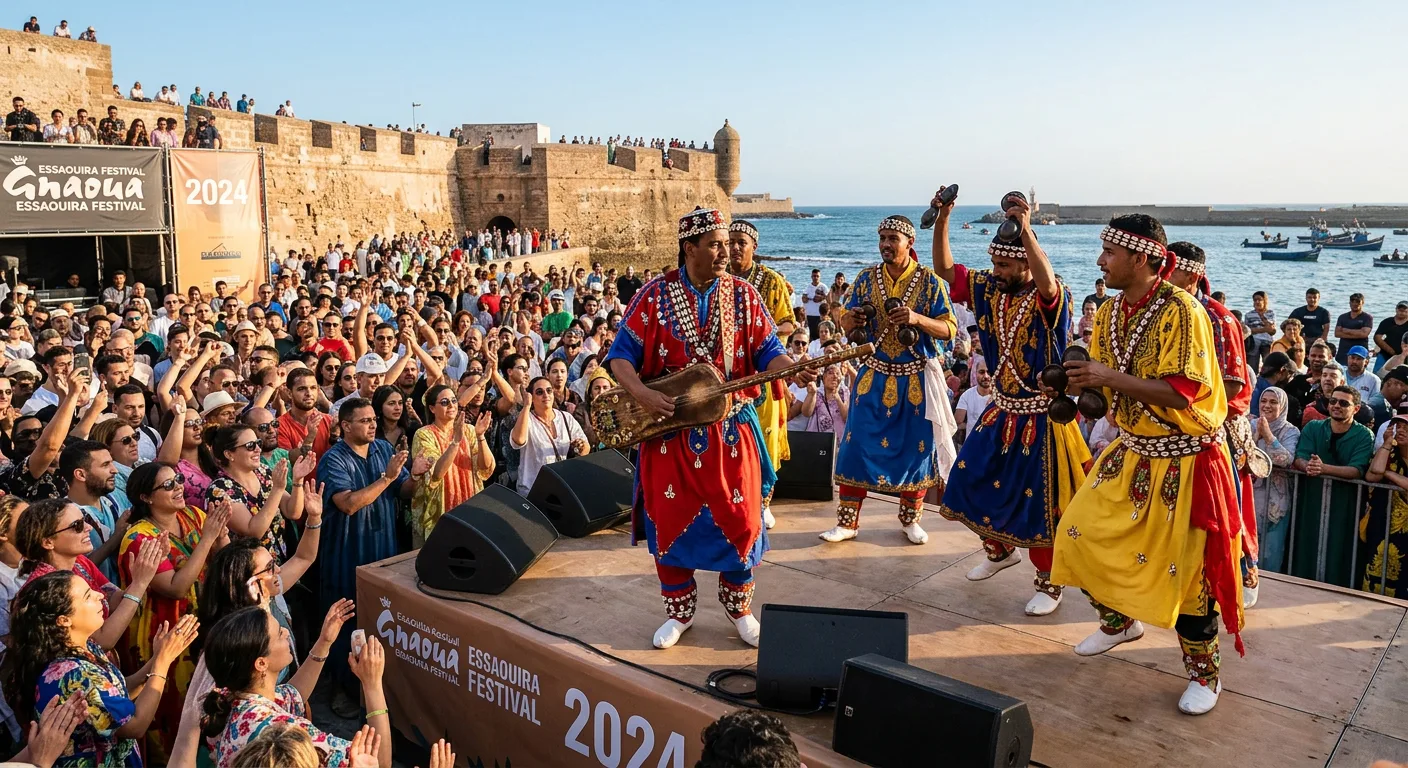
Gnaoua is a spiritual and healing music tradition that fuses sub-Saharan African rhythms with Sufi Islamic elements. Performances center on the maallem (master musician), who plays the guembri, a three-string bass lute covered in camel skin. Supporting musicians clap heavy iron qraqeb castanets in interlocking patterns while a chorus responds to the maallem's chanted invocations. A full Gnaoua ceremony (lila) lasts an entire night, moving through seven suites of songs, each associated with a different color, spirit, and incense. The music builds from slow, hypnotic bass lines to rapid rhythmic climaxes designed to induce trance states.
Inscribed on UNESCO's Intangible Cultural Heritage list in 2019.
Key artists: Maallems Mahmoud Guinea (d. 2015), Hassan Hakmoun, Hamid El Kasri, Mustapha Bakbou
Andalusian Classical (Al-Ala)
Fes, Tetouan, Rabat, Oujda · Origin: Moorish Spain, brought to Morocco after the Reconquista
When Muslims and Jews were expelled from Al-Andalus in 1492, they carried their court music to North Africa. In Morocco, this tradition evolved into Al-Ala, a refined orchestral form performed by ensembles of up to 30 musicians. A full Andalusian nuba (suite) contains five movements in different rhythmic modes and can last four to five hours. The music is performed on oud, rabab, nay, derbouka, and tar, with a lead vocalist. The lyrics draw on classical Arabic poetry about love, nature, and divine longing. Fes and Tetouan remain the strongest centers, where conservatories train young musicians in this centuries-old form.
Key artists: Abdessadak Chekara, Abdelkrim Rais Orchestra, Orchestre Moulay Ahmed Loukili
Chaabi
Casablanca, Marrakech, nationwide · Origin: Working-class neighborhoods of Casablanca and Marrakech
Chaabi means "popular" or "of the people," and this genre lives up to its name. Born in the souks and working-class quarters, Chaabi blends malhun poetry (a Moroccan literary tradition dating to the 16th century) with folk melodies and hand-drum rhythms. Performances are loud, communal affairs. A Chaabi band typically features a lead vocalist, bendir drums, derboukas, a violin, and sometimes an oud. The lyrics address everyday life: love, hardship, humor, and social commentary. Chaabi is the backbone of Moroccan wedding music, and during summer wedding season, Chaabi bands perform nightly across the country.
Key artists: Najat Aatabou, Daoudi, Hajja Hamdaouia, Nass El Ghiwane (also protest folk)
Rai
Oujda, eastern Morocco · Origin: Oran, Algeria; crossed into eastern Morocco
Rai originated in the port city of Oran in western Algeria and spread to eastern Morocco through the porous border region around Oujda. The word "rai" means "opinion" or "point of view," and the genre has always carried an edge of social rebellion. Modern Rai fuses traditional Bedouin vocal styles with synthesizers, drum machines, and Western pop structures. Lyrics deal openly with love, alcohol, heartbreak, and social frustration, topics that made Rai controversial with conservative authorities on both sides of the border. In Morocco, Rai is most popular in the eastern provinces and at weddings and nightclubs across the country.
Key artists: Cheb Khaled, Cheb Mami, Cheb Hasni, and Moroccan Rai artists Faudel, Douzi
Amazigh (Berber) Music
Atlas Mountains, Souss Valley, Rif Mountains · Origin: Indigenous Amazigh communities across Morocco
Morocco's Amazigh populations have distinct musical traditions tied to their three main linguistic groups. In the High Atlas, Tashelhit-speaking communities perform Ahwash: large-scale communal dances where men and women form opposing lines and move in synchronized patterns to complex polyrhythmic drumming. In the Middle Atlas, Tamazight speakers perform Ahidous, a similar communal dance with a tighter, circular formation. In the Rif Mountains, Tarifit speakers have their own styles influenced by Mediterranean and Spanish traditions. All three use the bendir frame drum, hand-clapping, and call-and-response singing. Amazigh music is inseparable from community gatherings, harvests, weddings, and seasonal festivals.
Key artists: Ammouri Mbarek, Fatima Tabaamrant, Rouicha, Izenzaren
Malhun
Meknes, Fes, Marrakech, Sale · Origin: Moroccan urban literary tradition, 16th century onward
Malhun sits between poetry and music. A qasida (poem) is composed in Moroccan Arabic by a poet, then set to music and performed by a small ensemble led by a vocalist accompanied by oud, swisen (a small mandolin-like instrument), and hand drums. The poems are long, intricate, and often humorous, covering themes of love, religion, trade, and daily life in the old medina. A single malhun poem can take 20 to 40 minutes to perform. Meknes is the historical capital of malhun, and the annual Malhun Festival there draws performers and scholars from across Morocco.
Key artists: Haj Houcine Toulali, Said Guennoun, Hajja Hamdaouia
Traditional Instruments
The instruments of Morocco are handcrafted from wood, animal skin, gut, clay, and iron. Each one carries a specific role in its genre.
Guembri (Sintir)
GnaouaA three-string bass lute carved from a single log (usually walnut or mahogany) and covered in camel or goat skin. The strings are made of dried gut. The guembri produces the deep, resonant bass lines that drive Gnaoua trance music. It is played exclusively by the maallem, and each instrument is considered to have its own spiritual character.
from 800 MAD for a tourist-grade instrument; from 2,500 MAD for a professional handmade guembri
Oud
Andalusian, ClassicalA pear-shaped, fretless stringed instrument with 11 or 13 strings grouped in courses. The oud is the ancestor of the European lute (the name "lute" derives from Arabic "al-ud"). It is the backbone of Andalusian orchestras and is also used in solo performances and modern Moroccan pop. Playing the oud requires years of training to master the microtonal intervals of Arabic maqam scales.
from 1,200 MAD for a student oud; from 4,000 MAD for a handcrafted concert-quality instrument
Bendir
All genresA large frame drum (about 40-50 cm in diameter) made of a wooden frame with a goatskin head and one or two gut snares stretched across the underside. The snares create a buzzing resonance that gives the bendir its distinctive rattle. It is found in every genre of Moroccan music and is the most common instrument at communal gatherings and Sufi dhikr ceremonies.
from 200 MAD for a basic bendir; from 600 MAD for a decorated professional-grade instrument
Qraqeb (Iron Castanets)
GnaouaHeavy iron double castanets about 30 cm long, shaped like oversized cymbals joined by a metal loop. Gnaoua musicians play them in interlocking rhythmic patterns that create a dense, shimmering metallic texture behind the guembri bass line. A typical Gnaoua ensemble has three to seven qraqeb players. The instruments are forged by blacksmiths and each pair has a slightly different pitch.
from 150 MAD for a basic pair; from 400 MAD for forged, tuned professional qraqeb
Rabab
Andalusian, AmazighA bowed string instrument with a narrow, boat-shaped wooden body and a single horsehair string (in Amazigh tradition) or two strings (in Andalusian orchestras). The Amazigh rabab produces a raw, reedy tone and is played by itinerant poets (imdyazen) who travel between villages. The Andalusian rabab has a more refined tone and sits within the classical orchestra.
from 500 MAD for an Amazigh rabab; from 1,500 MAD for an Andalusian orchestral rabab
Derbouka (Tabla)
All genresA goblet-shaped drum made from ceramic (traditional) or aluminum (modern). The player holds it under one arm or between the knees and strikes the goatskin or synthetic head with both hands. The derbouka produces sharp, ringing tones and deep bass notes. It is the primary rhythm instrument in Chaabi music, wedding bands, and popular Moroccan pop.
from 150 MAD for ceramic; from 300 MAD for a professional aluminum derbouka
Nay (Reed Flute)
Andalusian, SufiAn end-blown reed flute with five to seven finger holes, made from a single piece of cane. The nay has a breathy, haunting tone and is prominent in Andalusian orchestras and Sufi music. Playing it requires a specific embouchure technique where the player directs the air stream at an angle across the open end. The nay is one of the oldest instruments in the world, with examples dating back 5,000 years.
from 100 MAD for a simple nay; from 500 MAD for a professional concert nay
Taarija
Chaabi, devotionalA small, chalice-shaped clay drum with a goatskin head, roughly 20 cm tall. The taarija produces a high, sharp crack and is played with rapid finger patterns. It is a staple of Chaabi music, street performances, and devotional music at Sufi zawiyas. The clay body gives it a warm resonance distinct from the metallic derbouka.
from 50 MAD for a basic taarija; from 200 MAD for a decorated artisan piece
Buying tip: Instrument prices in the medina are always negotiable. Start by asking the maker to play the instrument so you can hear its tone. A well-made guembri or oud should have clear resonance with no buzzing or rattling. If you are serious about buying, visit multiple workshops before committing. Seasonal pricing can change, and tourist areas charge more than workshops in residential neighborhoods.
Where to Hear Live Music
From open-air squares to intimate cultural cafes, these are the best places to experience Moroccan music performed live.
Marrakech
Jemaa el-Fnaa
Open-air squareGnaoua circles, Chaabi singers, and Amazigh musicians perform nightly from sunset. Free to watch; tip from 10-20 MAD per group.
Dar Gnawa
Gnaoua restaurantLive Gnaoua performances during dinner. Dinner with music from 250 MAD per person.
Le Comptoir Darna
Restaurant & loungeLive Moroccan and international music, belly dancing shows. Dinner from 400 MAD.
Cafe Clock (Marrakech)
Cultural cafeRegular Gnaoua jam sessions, storytelling nights, and Hikayat performances. Tea from 25 MAD.
Essaouira
Place Moulay Hassan
Public squareGnaoua musicians play most evenings near the port. Free to watch; tips appreciated.
Gnaoua Culture Museum
Museum & venueSmall museum with Gnaoua artifacts and occasional live demonstrations.
Taros Cafe
Rooftop barLive music on the rooftop terrace overlooking the port. Drinks from 40 MAD.
Dar Souiri
Cultural centerFree Gnaoua concerts and art exhibitions. Check the weekly schedule posted outside.
Fes
Dar Batha Museum
Museum & concert venueAndalusian music concerts during the Fes Festival of World Sacred Music. Also hosts events year-round.
Cafe Clock (Fes)
Cultural cafeRegular live music nights with oud players and Gnaoua bands. Food from 60 MAD.
Bab Makina
Open-air stageMain outdoor stage for the Fes Festival. Free and ticketed concerts in June.
Fes Medina streets
Street musicItinerant musicians, especially around Bab Bou Jeloud gate and Talaa Kebira.
Casablanca & Rabat
Barometre
Live music bar (Casablanca)Jazz, blues, and Gnaoua fusion nights. Drinks from 50 MAD.
Theatro
Nightclub (Casablanca)Occasional live DJ sets mixing Rai and electronic. Entry from 150 MAD on weekends.
Rabat OLM Souissi
Concert venue (Rabat)Hosts Mawazine festival concerts and large-scale music events.
Renaissance Rabat
Cultural centerClassical Andalusian music concerts and Malhun evenings throughout the year.
Music Festivals Worth Planning Around
Morocco's festival calendar peaks from April through September. These events are worth building an entire trip around.
Gnaoua World Music Festival
Essaouira ·June
The flagship festival for Gnaoua music draws over 500,000 visitors across four days. Free outdoor stages along the beach and port feature collaborations between Gnaoua maallems and international jazz, blues, and world music artists. Indoor ticketed concerts at the Moulay Hassan stage showcase headline acts.
Tip: Book accommodation at least three months in advance. Essaouira fills up completely during the festival.
Fes Festival of World Sacred Music
Fes ·June
One of the most prestigious world music festivals, held in the ancient medina of Fes. Performances take place in courtyards, gardens, and the Bab Makina open-air stage. The lineup spans Sufi qawwali, Andalusian orchestras, Gospel choirs, Hindustani classical, and other spiritual music traditions from around the world.
Tip: Attend the evening concert at Bab Makina for the most atmospheric experience, with the illuminated palace walls as a backdrop.
Mawazine
Rabat ·June
One of Africa's largest music festivals, Mawazine has hosted artists like Rihanna, Stevie Wonder, and Shakira alongside Moroccan stars. Multiple stages across Rabat host everything from international pop to local Chaabi and Rai acts over nine days.
Tip: The OLM Souissi stage hosts the biggest international acts. The Nahda stage features more Moroccan and Arab music.
Timitar Festival
Agadir ·July
Focused on Amazigh music and culture, Timitar brings together Berber musicians from across North Africa and the Sahel with international world music acts. Performances take place in open-air venues across Agadir.
Tip: Combine with a beach holiday in Agadir. The festival atmosphere extends into the city's restaurants and cafes.
Jazzablanca
Casablanca ·April
Casablanca's premier jazz festival brings international jazz, soul, and funk artists to the Anfa Hippodrome. The lineup blends pure jazz with Gnaoua-jazz fusion and Moroccan experimental acts.
Tip: The late-night jam sessions at clubs around the Maarif district are where the real musical connections happen.
Malhun Festival
Meknes ·September
A more intimate festival dedicated to malhun poetry-music, held in the historic venues of Meknes. Poets and musicians perform extended qasidas (poems set to music) in the classical malhun tradition.
Tip: Understanding Moroccan Arabic (Darija) adds enormously to the malhun experience, as the poetry is intricate and allusive.
Music Workshops & Lessons
Hands-on musical experiences are available across Morocco for beginners and experienced musicians alike.
Gnaoua Guembri Lessons (Essaouira)
Several maallems in Essaouira offer private guembri lessons in their homes or workshops. Sessions cover basic technique, tuning, and one or two traditional pieces. No experience needed.
from 300 MAD per hour
Oud Workshops (Fes)
Fes conservatories and private teachers offer oud lessons for visitors. A typical session covers holding the instrument, basic right-hand plectrum technique, and a simple maqam scale. Multi-day courses available.
from 400 MAD per session
Percussion Sessions (Marrakech)
Group and private percussion workshops covering bendir, derbouka, and taarija. Learn basic Moroccan rhythmic patterns used in Chaabi and Gnaoua music. Instruments provided.
from 200 MAD per person (group); from 350 MAD private
Amazigh Music & Dance (Atlas Mountains)
Village stays in the High Atlas sometimes include communal music and dance evenings where guests can participate in Ahwash or Ahidous circle dances. Ask your guide or guesthouse to arrange.
Often included in village stay packages from 500 MAD per night
Practical Tips for Music Workshops
- Book workshops through your riad. They know the real musicians and can negotiate fair prices.
- Bring cash. Most musicians and small workshops do not accept cards.
- Ask permission before recording a session. Some musicians are happy to be filmed; others prefer not to be.
- Seasonal pricing can change. Festival season (June-July) is the most expensive period for private lessons as musicians are in high demand.
Etiquette for Live Music Experiences
Respect the musicians and the traditions, and you will be welcomed warmly.
Tip the Musicians
At Jemaa el-Fnaa and public squares, dropping from 10-20 MAD into the musician's bowl is standard if you stop to listen. Do not take photos and walk away without tipping.
Ask Before Recording
Some musicians welcome video and photos. Others consider their music sacred and prefer not to be recorded, especially during spiritual Gnaoua ceremonies. Always ask first.
Respect Spiritual Ceremonies
If invited to a Gnaoua lila (healing ceremony), remove your shoes, sit quietly, do not interrupt the ritual, and do not use flash photography. These are genuine spiritual events, not tourist performances.
Do Not Touch Instruments Without Permission
A guembri or oud is an extension of the musician. Never pick up or handle someone's instrument without being invited to do so. If you want to try, ask respectfully.
Stay for the Full Performance
At restaurant and cafe performances, it is disrespectful to walk out in the middle of a piece. If you need to leave, wait for a break between songs.
Dress Appropriately at Sacred Venues
If attending music at a Sufi zawiya or during a religious event, dress modestly. Cover shoulders and knees. Women may want to bring a headscarf, though it is not always required.
The Sound of Morocco
Gnaoua Performance
Gnaoua Festival, Essaouira

Festival Stage
Frequently Asked Questions
Answers to the most common questions travelers ask about Moroccan music.
What is Gnaoua music and where can I hear it in Morocco?
Gnaoua (also spelled Gnawa) is a spiritual music tradition rooted in sub-Saharan African rituals brought to Morocco by enslaved people centuries ago. It combines repetitive bass patterns from the guembri lute with iron qraqeb castanets and call-and-response chanting. You can hear Gnaoua nightly at Jemaa el-Fnaa in Marrakech, at Gnaoua restaurants in Essaouira and Marrakech, and at the annual Gnaoua World Music Festival in Essaouira every June.
Is Gnaoua music recognized by UNESCO?
Yes. In 2019, UNESCO inscribed Gnaoua on its Representative List of the Intangible Cultural Heritage of Humanity. The recognition covers the rituals, music, and ceremonies associated with Gnaoua practices across Morocco, particularly in Essaouira and Marrakech.
Can I attend a Gnaoua healing ceremony (lila) as a tourist?
Lilas are private all-night spiritual ceremonies and not typically open to casual tourists. However, some maallems (master musicians) in Essaouira and Marrakech do invite respectful visitors to attend portions of lilas, especially if introduced through a local contact. Ask at your riad or at a Gnaoua cultural center. Expect to sit quietly, remove your shoes, and refrain from recording unless given explicit permission.
What are the main traditional instruments in Moroccan music?
The core instruments include the guembri (a three-string bass lute used in Gnaoua), the oud (a pear-shaped fretless lute central to Andalusian music), the bendir (a large frame drum with snares), qraqeb (heavy iron castanets), the rabab (a bowed string instrument), the nay (a reed flute), the derbouka (a goblet drum), and the taarija (a small clay drum used in Chaabi music).
Where can I buy authentic Moroccan instruments?
The best places are the instrument workshops in the medinas of Marrakech, Fes, and Essaouira. In Marrakech, check shops along Rue Riad Zitoun el-Kdim. In Fes, look in the Talaa Kebira area. In Essaouira, several luthiers near the port make guembris by hand. Prices start from 200 MAD for a small bendir and from 800 MAD for a handmade guembri. Always play the instrument before buying, or ask the maker to play it for you.
What music festivals are worth attending in Morocco?
The Gnaoua World Music Festival in Essaouira (June) is the biggest and most accessible, with free outdoor stages. The Fes Festival of World Sacred Music (June) attracts international spiritual music acts. Mawazine in Rabat (June) is one of the largest music festivals in Africa. The Timitar Festival in Agadir (July) focuses on Amazigh music. The Jazzablanca Festival in Casablanca (April) draws top jazz and world music artists.
Can I take music lessons or workshops during my trip?
Yes. Several riads and cultural centers offer guembri, oud, and percussion workshops for beginners. In Essaouira, Gnaoua masters give private lessons from 300 MAD per hour. In Marrakech, Dar Cherifa and other cultural venues run music workshops. In Fes, the Fes Cooking and Cultural Tours organization includes music sessions. Book directly or ask your riad to arrange a session with a local musician.
What is the difference between Chaabi and Rai music?
Chaabi is Moroccan folk-pop music that originated in the markets and working-class neighborhoods of Casablanca and Marrakech. It uses traditional instruments like the derbouka and bendir and draws on malhun poetry. Rai originated in western Algeria and crossed into eastern Morocco (Oujda region). Rai uses more modern instrumentation like synthesizers and drum machines, with lyrics that often address love, freedom, and social frustration. Both are popular at Moroccan weddings.
Related Travel Guides
Morocco Nightlife
Bars, clubs, rooftop lounges, and after-dark entertainment across Moroccan cities.
Read GuideFestivals & Events
Month-by-month calendar of Morocco's festivals, moussems, and cultural events.
Read GuideArt Galleries
Contemporary art galleries, street art, and creative spaces in Morocco's cities.
Read GuideBerber Culture
Amazigh heritage, Tifinagh script, traditional villages, and cultural experiences.
Read GuideExperience Morocco Through Its Music
From the hypnotic bass of a guembri in Essaouira to a full Andalusian orchestra in Fes, Moroccan music offers experiences you cannot find anywhere else. Time your visit around a festival, take a percussion workshop, or simply follow the sound of drums through the medina. The music will find you.