Discovering...
Complete Heritage GuideAll 9 UNESCO World Heritage
All 9 UNESCO World Heritage
Sites in Morocco
From the ancient medina of Fes to the modern capital of Rabat, Morocco holds nine UNESCO-inscribed treasures spanning twelve centuries of history. This guide covers every site with entry fees, travel logistics, and what makes each one worth your time.
9
UNESCO Sites
1981
First Inscribed
0 Natural
All Cultural
14 Sites
Tentative List
Why Morocco's Heritage Matters
Morocco sits at the crossroads of Africa, Europe, and the Arab world. Its UNESCO sites reflect that position: Roman ruins from Mauretania Tingitana, medieval Islamic medinas that defined Moorish civilization, Portuguese colonial fortifications, and a modern capital that blends all these layers. No other North African country offers this range of heritage within such compact geography.
All nine inscribed sites are classified as cultural heritage. Morocco has no natural heritage inscriptions yet, though several natural sites sit on the tentative list. The country also holds UNESCO Intangible Cultural Heritage recognitions for traditions like Gnawa music and couscous preparation.
The Complete List
Each of Morocco's nine sites is detailed below with history, key attractions, current entry fees, the best season to visit, and transport options.
1. Medina of Fes
Inscribed 1981CulturalFes, northern Morocco
Historical Significance
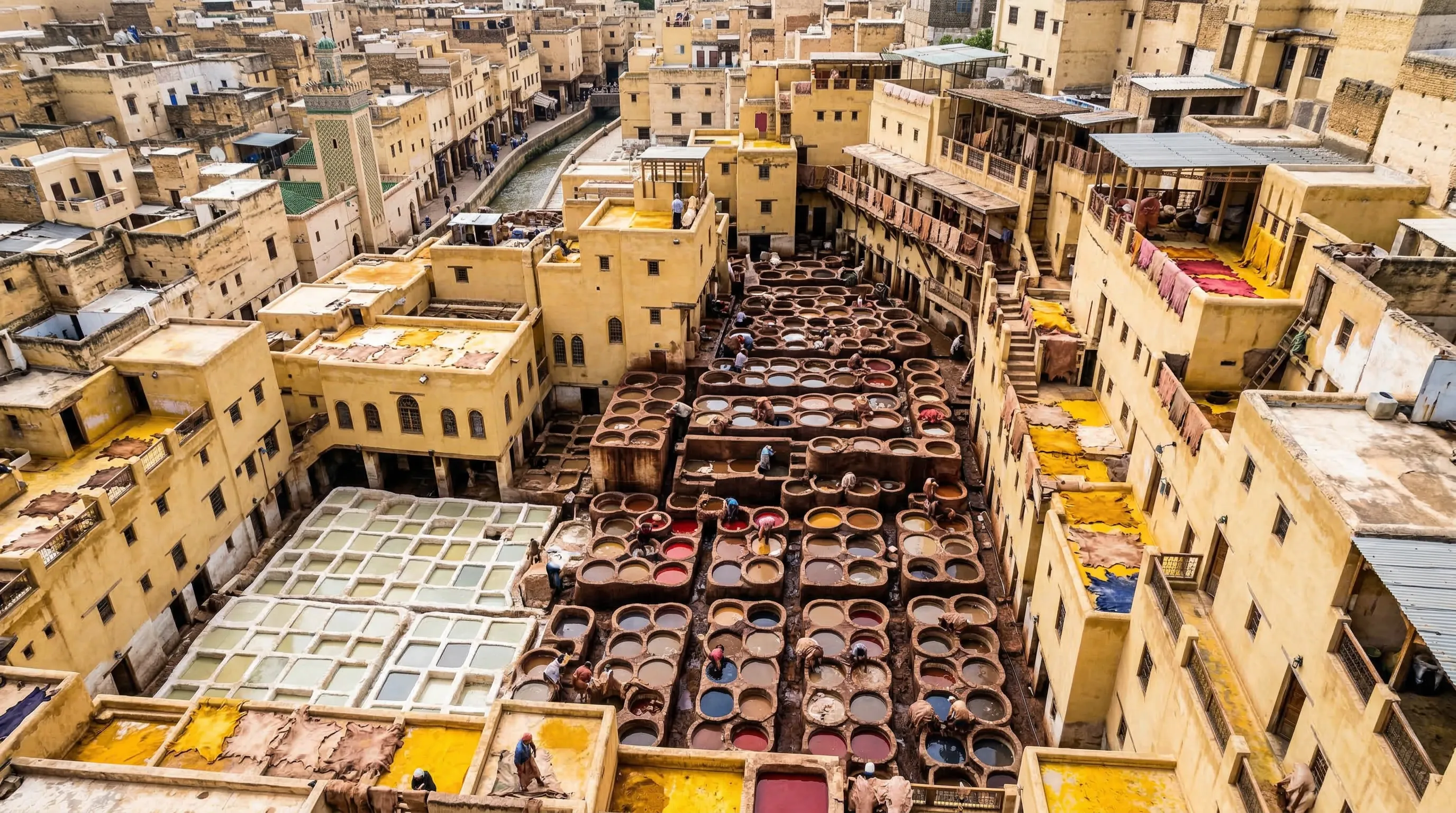
Founded in the 9th century under the Idrisid dynasty, Fes el-Bali is the world's largest car-free urban area. It houses the University of al-Qarawiyyin, established in 859 AD and recognized as the oldest continuously operating educational institution on earth. The medina contains over 9,000 narrow alleyways, 300 mosques, and some of the finest examples of Marinid architecture anywhere. The Chouara tanneries have operated since the 11th century, using the same techniques with natural dyes derived from saffron, poppy, and cedar.
What to See
Bou Inania Madrasa (14th-century theological school)
Chouara Tanneries (viewable from surrounding terraces)
Al-Qarawiyyin Mosque and University exterior
Dar Batha Museum (Hispano-Moorish arts)
Nejjarine Fountain and Woodworking Museum
Mellah (historic Jewish quarter)
Entry Fees
Medina access is free. Bou Inania Madrasa: from 20 MAD. Dar Batha Museum: from 20 MAD. Nejjarine Museum: from 20 MAD. Tannery terrace viewpoints are free but expect to purchase leather goods.
Best Time to Visit
March through May and September through November. Summer temperatures in Fes routinely exceed 40C and the enclosed medina traps heat.
Getting There
Fes-Saiss Airport (FEZ) receives flights from major European cities. Train from Casablanca (3.5h) or Rabat (2.5h). CTM buses connect from all major Moroccan cities.
2. Medina of Marrakech
Inscribed 1985CulturalMarrakech, central Morocco
Historical Significance
Founded in 1071 by the Almoravids as the capital of a Berber empire stretching from the Sahara to Spain, Marrakech shaped the architectural identity of the entire western Islamic world. The medina is ringed by 19 kilometers of rose-pink pisé ramparts. At its heart lies Jemaa el-Fnaa, a public square that UNESCO separately recognized as a Masterpiece of Oral and Intangible Heritage for its living tradition of storytellers, healers, acrobats, and musicians performing nightly.
What to See
Jemaa el-Fnaa (street performance square)
Koutoubia Mosque and gardens (exterior)
Bahia Palace (19th-century courtyard masterpiece)
Saadian Tombs (rediscovered royal mausoleum)
Ben Youssef Madrasa (carved stucco and cedar)
Majorelle Garden and Berber Museum
Entry Fees
Medina access is free. Bahia Palace: from 70 MAD. Saadian Tombs: from 70 MAD. Ben Youssef Madrasa: from 50 MAD. Majorelle Garden: from 70 MAD. Seasonal pricing can change.
Best Time to Visit
October through April. Marrakech is scorching in July and August (40-45C), but the souks offer some shade. Early mornings are the most comfortable.
Getting There
Marrakech Menara Airport (RAK) is Morocco busiest tourist airport with direct flights across Europe and the Middle East. Train from Casablanca (2.5h). CTM bus from Fes (8h) or Essaouira (2.5h).
3. Ksar of Ait-Ben-Haddou
Inscribed 1987CulturalOuarzazate Province, southeast Morocco
Historical Significance
A fortified village of packed-earth buildings rising above the Ounila River, Ait-Ben-Haddou is the most striking example of pre-Saharan earthen construction in Morocco. The ksar demonstrates building techniques using rammed earth, sun-dried bricks, and decorative geometric motifs specific to southern Moroccan oasis communities. Its dramatic silhouette has appeared in more than twenty major films, from Lawrence of Arabia (1962) to Gladiator (2000) and Game of Thrones.
What to See
Fortified granary at the summit (agadir)
Traditional kasbahs along the hillside path
Panoramic viewpoint from the hilltop lookout
River crossing (seasonal footbridge or wading)
Atlas Film Studios in Ouarzazate (30 km)
Local carpet and craft cooperatives
Entry Fees
Entry to the ksar is free. Guided tours available from 150 MAD at the parking area. Atlas Film Studios in Ouarzazate: from 50 MAD.
Best Time to Visit
March through May and October through November. Summer heat is extreme (above 40C). The ksar faces east, so morning light is best for photography.
Getting There
Located 30 km northwest of Ouarzazate. Most visitors arrive by car or organized tour from Marrakech (4h over the Tizi n Tichka pass). Grand taxi from Ouarzazate from 50 MAD. No train service to Ouarzazate.
4. Historic City of Meknes
Inscribed 1996CulturalMeknes, northern Morocco
Historical Significance
Sultan Moulay Ismail transformed Meknes into an imperial capital in the 17th century, aiming to rival Versailles. He surrounded the city with over 40 kilometers of massive ramparts and built monumental gates that remain among the finest in North Africa. Bab Mansour, finished in 1732, is a towering masterpiece of zellige tilework and carved marble columns recycled from Volubilis. The city blends Islamic and European architectural elements in a way unique among Moroccan imperial cities.
What to See
Bab Mansour (monumental gate with zellige tilework)
Heri es-Souani (vast royal granaries and stables)
Mausoleum of Moulay Ismail (free entry for all)
Place el-Hedim (central square, the local Jemaa el-Fnaa)
Dar Jamai Museum (Moroccan decorative arts)
Royal Stables (housed 12,000 horses)
Entry Fees
Medina access is free. Mausoleum of Moulay Ismail: free. Heri es-Souani: from 10 MAD. Dar Jamai Museum: from 20 MAD. Royal Stables: from 10 MAD.
Best Time to Visit
Spring and autumn. Meknes sits on a plateau and has hot summers but milder temperatures than Fes or Marrakech. April and October are ideal.
Getting There
Train from Fes (45 min), Rabat (2h), or Casablanca (3h). CTM bus from Marrakech (7h). Meknes is often combined with Volubilis and Moulay Idriss Zerhoun in a single day.
5. Archaeological Site of Volubilis
Inscribed 1997CulturalNear Meknes, northern Morocco
Historical Significance
The most extensively excavated Roman site in North Africa. Volubilis served as the capital of the Roman province of Mauretania Tingitana from the 1st century AD and remained occupied through the Islamic period until the 18th century. The 42-hectare site preserves remarkably intact floor mosaics depicting mythological scenes, a triumphal arch dedicated to Emperor Caracalla, a basilica, and the foundations of patrician houses that reveal daily life at the empire farthest southwestern frontier.
What to See
House of Orpheus (multicolored floor mosaics)
Triumphal Arch of Caracalla (217 AD)
Capitol and Basilica (civic and religious center)
House of the Athlete (desultor mosaic)
House of Venus (goddess mosaic collection)
Decumanus Maximus (main Roman street)
Entry Fees
Entry: from 70 MAD for adults, from 30 MAD for children. On-site guided tours from 150 MAD. The small museum at the entrance is included in the ticket.
Best Time to Visit
Spring, when wildflowers carpet the ruins and temperatures are comfortable. Early morning visits avoid tour groups and harsh midday light. There is virtually no shade on the site.
Getting There
Located 33 km north of Meknes and 60 km west of Fes. Grand taxi from Meknes from 100 MAD round trip. Most visitors combine Volubilis with Meknes and the holy town of Moulay Idriss Zerhoun.
6. Medina of Tetouan
Inscribed 1997CulturalTetouan, northern Morocco
Historical Significance
Tetouan was the principal point of contact between Morocco and Andalusia for centuries. After 1492, Moorish and Jewish refugees expelled from Spain rebuilt the city, importing Andalusian art forms, architectural styles, and craft traditions. The result is a medina distinct from any other in Morocco: whitewashed facades, overhanging wooden balconies in the Spanish style, and intricate plasterwork that merges Andalusian and Moroccan motifs. The local School of Arts and Crafts preserves these cross-cultural techniques.
What to See
Royal Palace and Hassan II Square
School of Arts and Crafts (live artisan workshops)
Archaeological Museum (Phoenician and Roman artifacts)
Mellah (Jewish Quarter with distinctive architecture)
Souk el-Houts (traditional food and fish market)
Artisan workshops for zellige, leather, and textiles
Entry Fees
Medina access is free. Archaeological Museum: from 20 MAD. School of Arts and Crafts: from 10 MAD.
Best Time to Visit
Year-round. Tetouan has a Mediterranean climate moderated by proximity to the coast. Summer stays in the low 30s. Spring brings clear skies.
Getting There
CTM bus from Tangier (1h) or Chefchaouen (1.5h). Grand taxi from Tangier from 30 MAD. No direct train; nearest station is in Tangier (65 km). Often combined with Chefchaouen day trips.
7. Medina of Essaouira (formerly Mogador)
Inscribed 2001CulturalEssaouira, Atlantic coast
Historical Significance
Essaouira is a late-18th-century fortified port designed by French architect Theodore Cornut for Sultan Mohammed III in 1764. It represents a rare fusion of European military engineering with North African urban planning. The grid-like street layout was revolutionary for a Moroccan city, and the fortifications, including the Skala bastions with their rows of bronze cannons, were modeled on the designs of Vauban. The city was a critical trading node linking Saharan caravan routes with Atlantic maritime commerce.
What to See
Skala de la Ville (rampart fortifications and cannons)
Working fishing port and daily fish auction
Medina streets with art galleries and woodworking shops
Moulay Hassan Square (central gathering place)
Thuya wood marquetry workshops
Beach and windsurfing along the coast
Entry Fees
Medina access is free. Skala de la Ville: from 10 MAD. Sidi Mohammed Ben Abdellah Museum: from 20 MAD.
Best Time to Visit
April through June and September through October. Essaouira is breezy year-round; summer winds (the alizé trade winds) can be very strong, making it a top kitesurfing destination but less ideal for casual beach days.
Getting There
Essaouira-Mogador Airport (ESU) has seasonal European charter flights. CTM or Supratours bus from Marrakech (2.5h). Grand taxi from Marrakech from 80 MAD per person.
8. Portuguese City of Mazagan (El Jadida)
Inscribed 2004CulturalEl Jadida, Atlantic coast
Historical Significance
The Portuguese built the fortification of Mazagan in 1514 as a colonial trading outpost on the Atlantic coast. It stood as an early and exceptional example of the interchange between European and Moroccan cultures. The Portuguese Cistern, originally an armory warehouse, is the standout attraction: a vast underground Gothic hall with stone columns reflected in shallow water on the floor, made famous by Orson Welles who filmed scenes from Othello here. The Moroccans recaptured the town in 1769 and renamed it El Jadida.
What to See
Portuguese Cistern (Gothic underground chamber)
Church of the Assumption (Manueline architecture)
Ramparts and sea bastions with ocean views
Manueline-style doorways and carved stonework
Former Jewish quarter within the fortifications
Panoramic walk along the rampart walls
Entry Fees
Portuguese Cistern: from 20 MAD. Rampart walk: free. Church of the Assumption: free.
Best Time to Visit
Year-round. El Jadida has a moderate Atlantic climate. Summer is warm but tempered by ocean breezes. Visit the cistern in the morning when a shaft of sunlight illuminates the interior through the oculus.
Getting There
Train from Casablanca (1.5h) to El Jadida station, then taxi or 15-minute walk to the old city. CTM bus from Marrakech (4h) or Essaouira (4h). Easily managed as a day trip from Casablanca.
9. Rabat, Modern Capital and Historic City
Inscribed 2012CulturalRabat, northwest Morocco
Historical Significance
Rabat is the only Moroccan UNESCO site that explicitly recognizes the blending of historic and modern urbanism. The inscription covers the 12th-century Almohad ramparts and Hassan Tower, the medieval medina, the Chellah necropolis with its Merinid and Roman layers, and the French Protectorate-era Ville Nouvelle with its Art Deco boulevards. Together these elements form a capital city where 800 years of Islamic heritage coexist with 20th-century European planning in a coherent and functional whole.
What to See
Hassan Tower and Mausoleum of Mohammed V
Kasbah of the Udayas (blue-and-white hilltop quarter)
Chellah necropolis (medieval ruins and stork colonies)
Royal Palace exterior and ceremonial guards
Rabat medina (compact and hassle-free)
Mohammed VI Museum of Modern and Contemporary Art
Entry Fees
Kasbah of the Udayas: free. Chellah: from 70 MAD. Mausoleum of Mohammed V: free. Mohammed VI Museum: from 40 MAD.
Best Time to Visit
Year-round. Rabat has a mild Atlantic climate. Summers rarely exceed 30C. The Chellah at sunset is particularly atmospheric, with storks returning to their nests on the medieval minarets.
Getting There
Rabat-Sale Airport (RBA) has domestic flights and some European routes. Train from Casablanca (1h), Fes (2.5h), or Marrakech (4h). Rabat Ville station is central and well-connected.
Entry Fees at a Glance
Quick reference for 2026 pricing. All fees are in Moroccan Dirhams (MAD). Seasonal pricing can change, especially during peak tourist months and holidays.
| Site | Medina Access | Key Monument | Museum |
|---|---|---|---|
| Medina of Fes | Free | Bou Inania Madrasa: from 20 MAD | Dar Batha: from 20 MAD |
| Medina of Marrakech | Free | Bahia Palace: from 70 MAD | Ben Youssef Madrasa: from 50 MAD |
| Ait-Ben-Haddou | Free | Ksar: free entry | Film Studios: from 50 MAD |
| Meknes | Free | Heri es-Souani: from 10 MAD | Dar Jamai: from 20 MAD |
| Volubilis | N/A | Site entry: from 70 MAD | On-site museum: included |
| Medina of Tetouan | Free | Arts School: from 10 MAD | Archaeological: from 20 MAD |
| Essaouira | Free | Skala: from 10 MAD | City Museum: from 20 MAD |
| El Jadida (Mazagan) | Free | Cistern: from 20 MAD | N/A |
| Rabat | Free | Chellah: from 70 MAD | Mohammed VI: from 40 MAD |
Practical Tips for Visiting UNESCO Sites
Timing Your Visits
Arrive at major sites early in the morning (before 9:00 AM) to avoid tour groups. Volubilis and Ait-Ben-Haddou are best at golden hour. During Ramadan, monument hours may be shortened. Friday afternoons see reduced activity across all sites.
Hiring Official Guides
Official guides carry a government-issued badge and are licensed for specific cities. Half-day rates start from 300 MAD. In Fes, a guide is nearly essential due to the medina complexity. At smaller sites, freelance guides at the entrance charge from 150 MAD.
Photography
Photography is permitted at all UNESCO sites but always ask before photographing people. Some monuments charge a small camera fee (from 10 MAD). Drone photography requires government permits and is restricted in medinas and near royal palaces.
Safety in Medinas
UNESCO medinas are generally safe but can be disorienting. Download offline maps (Maps.me works well in medinas). Watch for motorbikes in narrow alleys. Be cautious of unofficial guides who approach near monument entrances. Carry small change for tips.
Budget Planning
Budget from 200-400 MAD per day for entry fees and guides if visiting multiple monuments. Medina walking is free. Students with an international student card often receive 50% discounts. Children under 12 enter free at most sites. Seasonal pricing can change.
Local Customs
Non-Muslims cannot enter active mosques in Morocco (the Hassan II Mosque in Casablanca is the lone exception). Dress modestly near religious sites: cover shoulders and knees. Remove shoes when entering private homes or prayer rooms. Ask before entering artisan workshops.
Heritage Conservation and Responsible Tourism
Morocco's UNESCO sites face pressure from rapid urbanization, tourism growth, and climate change. Travelers play a direct role in either supporting or undermining preservation efforts.
Buy from Medina Artisans
Traditional crafts like zellige tilework, leather tanning, and copper engraving are integral to the heritage inscriptions. Purchasing directly from artisan workshops in the medinas sustains centuries-old techniques and keeps the medinas economically alive.
Stay in Historic Riads
Choosing a riad within the medina walls over a chain hotel outside supports the neighborhoods economically. Many riad owners invest profits into restoring traditional architecture, preserving courtyard layouts and decorative elements that would otherwise deteriorate.
Respect Living Communities
Morocco's UNESCO medinas are home to hundreds of thousands of residents. They are not open-air museums. Keep noise down near mosques and schools. Do not photograph people without permission. Stay on marked paths at archaeological sites like Volubilis to protect fragile remains.
Hire Official Guides
Official guides are trained in heritage interpretation and help manage visitor flow in sensitive areas. Their fees (from 300 MAD for a half-day) directly support the local economy. Unofficial guides often lack historical accuracy and can create friction with residents and shop owners.
UNESCO Tentative List: Future Heritage Sites
Morocco has submitted 14 properties to the UNESCO tentative list, the required first step before formal nomination. These are the most notable candidates that travelers can visit today.
Chefchaouen Medina
Submitted 2010The blue-painted mountain town in the Rif has become one of Morocco most recognizable images. Its medina was founded in 1471 as a fortress and retains Andalusian and Berber architectural traditions.
Ksour and Kasbahs of the Draa Valley
Submitted 2000A string of fortified villages along the Draa River south of Ouarzazate, representing centuries of oasis settlement and Saharan trade route architecture.
Taza Medina and Surroundings
Submitted 2002One of Morocco oldest cities, controlling the strategic Taza Gap between the Rif and Middle Atlas mountains. The Great Mosque dates to the 12th century Almohad period.
Prehistoric Rock Art Sites of the Atlas and South
Submitted 2011Thousands of rock engravings and paintings scattered across the Anti-Atlas and Saharan fringe, dating from the Neolithic to the Bronze Age. Sites like Oukaimeden and Tata hold Africa most concentrated open-air rock art.
Agadir Oufella (Kasbah)
Submitted 2022The hilltop fortress overlooking Agadir was rebuilt after the devastating 1960 earthquake. It holds cultural significance as the historical heart of the city and offers panoramic views of the bay.
Mogador Island and the Purpuraires
Submitted 1995Small islands off the coast of Essaouira where the Romans produced Tyrian purple dye from murex sea snails. Archaeological remains and bird colonies coexist on these protected islets.
About the tentative list: A site must spend at least one year on a country's tentative list before it can be formally nominated. The evaluation process typically takes 18 months. Morocco has been expanding its tentative list to include natural sites and cultural landscapes, diversifying beyond the current all-cultural inscription portfolio.
Frequently Asked Questions
Answers to the most common questions travelers ask about Morocco's UNESCO heritage sites.
How many UNESCO World Heritage Sites does Morocco have?
Morocco has 9 inscribed UNESCO World Heritage Sites as of 2026, all classified as cultural heritage. The first inscription was the Medina of Fes in 1981, and the most recent was Rabat, Modern Capital and Historic City, in 2012. Morocco also has 14 sites on the tentative list awaiting future evaluation.
Can I visit all 9 Morocco UNESCO sites in one trip?
Yes, with 10-14 days you can cover all nine sites. A practical route starts in Rabat, continues to Meknes and Volubilis, then Fes, south to Marrakech and Ait-Ben-Haddou, west to Essaouira, north to El Jadida, and finally Tetouan. Morocco has a reliable train network between major cities, plus CTM buses and grand taxis for secondary routes.
How much do entry fees cost at Morocco UNESCO sites?
Walking through the medinas is free since they are living cities. Individual monuments and museums charge from 10 MAD to 70 MAD. The most expensive single ticket is Volubilis at from 70 MAD for adults. Budget from 200-400 MAD per day if you plan to enter multiple monuments. Students with valid ID often receive 50% discounts. Seasonal pricing can change.
Do I need a guide to visit Morocco UNESCO medinas?
A guide is strongly recommended for Fes, where the medina has over 9,000 alleyways and is genuinely disorienting even for experienced travelers. Marrakech is more manageable but a guide adds historical depth. At Volubilis, Meknes, and smaller sites, the on-site guides at the entrance are affordable and knowledgeable. Official half-day guide rates start from 300 MAD.
What is the best time of year to visit Morocco UNESCO sites?
Spring (March through May) and autumn (September through November) are ideal. Temperatures hover around 20-28C, perfect for long walking days. Summer regularly pushes past 40C in Fes, Meknes, and Marrakech, making extended outdoor sightseeing difficult. Winter is mild but the north can see rain. Coastal sites like Essaouira and El Jadida are comfortable year-round.
Are Morocco UNESCO sites accessible for people with reduced mobility?
Most medinas have cobblestone streets, steep alleys, and stairs that make wheelchair access extremely challenging. Volubilis has uneven terrain with limited pathways. The most accessible sites are Rabat (the Mausoleum of Mohammed V and Hassan Tower area are flat), the Portuguese Cistern in El Jadida (ground level), and the exterior of Bab Mansour in Meknes. Hiring a guide who knows accessible routes helps significantly.
Can non-Muslims enter mosques at Morocco UNESCO sites?
No. Morocco restricts mosque access to Muslims, with very few exceptions. The Hassan II Mosque in Casablanca (not a UNESCO site) is the only major mosque open to non-Muslim visitors. At UNESCO sites you can admire mosque exteriors and enter former madrasas (religious schools) that now function as museums, such as Bou Inania in Fes and Ben Youssef in Marrakech.
Is the drive to Ait-Ben-Haddou from Marrakech worth it?
The 4-hour drive over the Tizi n Tichka pass at 2,260 meters is itself a highlight, with switchback mountain roads and sweeping High Atlas views. The ksar is one of Morocco most photographed spots and has served as a backdrop for Gladiator, Game of Thrones, and Lawrence of Arabia. A day trip is possible but staying overnight in Ouarzazate allows you to visit at sunrise without the tour bus crowds.
Related Travel Guides
Moroccan Architecture Guide
Riads, kasbahs, zellige tilework, and Islamic geometric patterns explained in depth.
Read Guide10-Day Morocco Itinerary
A day-by-day route covering the imperial cities, coast, and desert with budget breakdowns.
Read GuideBest Photography Spots
The most photogenic locations across Morocco, from blue streets to Saharan dunes.
Read GuideFirst Time in Morocco
Everything you need to know before your first trip: visas, money, safety, and culture.
Read GuidePlan Your Morocco Heritage Tour
Nine UNESCO sites, twelve centuries of history, one unforgettable trip. Start planning your route through Morocco's greatest cultural treasures today.