Discovering...
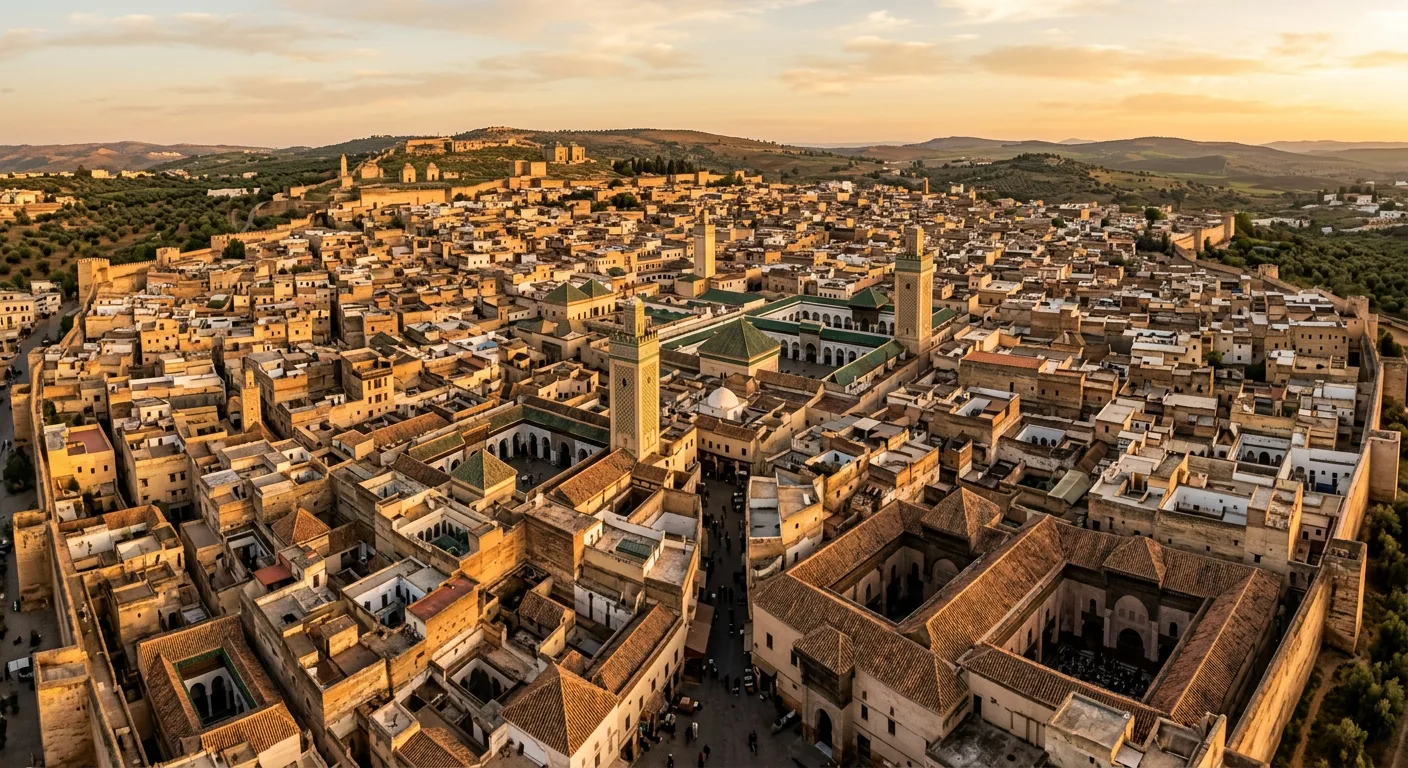
How to Navigate Moroccan Medinas
A complete survival guide to Morocco's ancient walled cities — from the 9,400 alleys of Fes el-Bali to the blue lanes of Chefchaouen. Practical navigation tips, fair prices, safety strategies, and why getting lost is half the point.
What Is a Medina?
The Arabic word "medina" simply means "city." In Morocco, it refers specifically to the historic walled quarter — the original urban core that existed before French colonial-era expansion.
Morocco has more UNESCO-listed medinas than any other country. Four of them — Fes (1981), Marrakech (1985), Meknes (1996), and Essaouira (2001) — hold individual World Heritage status. Tetouan (1997) earned its listing for preserving the strongest Andalusian architectural character outside Spain. These designations protect structures dating back to the 9th century.
Medinas are not museums. They are living cities. Hundreds of thousands of people are born, work, eat, pray, and die inside these walls. Fes el-Bali alone houses roughly 156,000 residents. The density forces a vertical building style — houses stack three or four stories above lanes that narrow to less than a meter in places.
The walls served a defensive purpose. Each medina was a fortified city with gates (babs) that closed at night. Guard towers punctuated the perimeter. Today the walls remain, but the gates stay open around the clock. The walls now serve as the clearest orientation tool you have — when in doubt, walk toward the wall, and you will find a gate that connects to the modern city.
5
UNESCO World Heritage Medinas
9th Century
Oldest medina foundations
1M+
People living inside medinas today
The 7 Best Medinas in Morocco, Ranked
Each medina has a distinct character. Fes is labyrinthine and raw. Marrakech is theatrical. Chefchaouen is photogenic. Essaouira is breezy and easy to navigate. Here is how they compare.
#1
Fes el-Bali
Fes
The largest car-free urban zone on Earth. Founded in the 9th century, Fes el-Bali packs 9,400 lanes, 350 mosques, and the world's oldest university (al-Qarawiyyin, est. 859 CE) into 280 hectares. The Chouara tannery, visible from surrounding rooftops, has operated since the 11th century. Mule trains still deliver goods because no vehicle can fit through most passages.
~156,000 residents 280 hectares, 9,400+ alleys Expert — easiest to get lost UNESCO 1981
Chouara TanneryBou Inania MadrasaAl-Qarawiyyin MosqueNejjarine Fondouk
#2
Marrakech Medina
Marrakech
The most visited medina in Morocco. Jemaa el-Fnaa square anchors the entire layout — if you are lost, ask anyone for "la place" and they will point you the right way. The souks radiate north from the square in a roughly grid-like pattern. Better signposted than Fes, with wider main arteries. The dye souk (Souk Sebbaghine) and spice square (Rahba Kedima) are standout sections.
~600,000 residents 600 hectares Moderate — major routes are clear UNESCO 1985
Jemaa el-FnaaBahia PalaceKoutoubia MosqueSouk Sebbaghine (Dyers' Souk)
#3
Chefchaouen Medina
Chefchaouen
The "Blue Pearl" of Morocco. Nearly every wall and staircase is painted in shades of blue, from powder to cobalt. Founded in 1471 as a fortress against Portuguese invaders, the medina sits on a hillside beneath the Rif Mountains. Plaza Uta el-Hammam serves as the central square. The Kasbah museum (from 60 MAD) anchors the layout, and the Ras el-Maa waterfall at the eastern edge is where locals still wash laundry.
~42,000 residents Compact — walkable in 2 hours Easy — small and well-signed
Plaza Uta el-HammamKasbah MuseumRas el-Maa WaterfallBlue-painted streets
#4
Essaouira Medina
Essaouira
The most navigable medina in Morocco. French military architect Théodore Cornut designed it in the 18th century with a rational grid plan — rare for a Moroccan medina. Two main streets (Avenue de l'Istiqlal and Avenue Mohammed Zerktouni) cross the center. The port, ramparts, and ocean serve as unmissable orientation points. Wind is constant; Essaouira means "little fortress."
~77,000 residents Compact — grid layout Easy — logical street grid UNESCO 2001
Skala de la Ville (ramparts)Port and fish marketMellah (Jewish Quarter)Galerie Damgaard
#5
Meknes Medina
Meknes
Meknes was Sultan Moulay Ismail's imperial capital in the 17th century, and the medina reflects that ambition. Bab Mansour, the grandest gate in Morocco, marks the entrance. The medina is less touristy than Fes or Marrakech, which means lower prices and more genuine interactions. The Heri es-Souani granaries and the underground prison of Christian slaves are unique to Meknes.
~550,000 (city) Large — fewer tourists Moderate — less signage UNESCO 1996
Bab Mansour gateHeri es-Souani (Royal Granaries)Mausoleum of Moulay IsmailPlace el-Hedim
#6
Tetouan Medina
Tetouan
A strong Andalusian character sets Tetouan apart. Refugees from Spanish Reconquista Granada rebuilt this medina in the 15th century, and the Spanish-Moorish architecture remains. White-washed walls, wrought-iron balconies, and tiled courtyards feel more Andalusian than North African. The medina has seven historic gates and the Royal Palace sits at its heart.
~380,000 (city) Medium — Andalusian influences Moderate — labyrinthine UNESCO 1997
Bab OklaRoyal Palace exteriorEthnographic MuseumArtisan school (Dar Sanaa)
#7
Tangier Medina
Tangier
Tangier's medina perches on a cliff above the Strait of Gibraltar. The Kasbah at the summit offers views across to Spain on clear days. The Petit Socco (Souk Dakhli) was the social hub of the "International Zone" era when writers like Paul Bowles and William Burroughs made Tangier their home. The Grand Socco connects the medina to the Ville Nouvelle.
~1.1 million (city) Medium — perched on a hill Moderate — steep terrain
Kasbah MuseumPetit SoccoGrand SoccoAmerican Legation Museum
How Medinas Are Organized
Medinas look chaotic, but they follow a logical structure. Understanding the building blocks makes navigation far easier.
Derb
A narrow residential lane, often a dead end. Derbs branch off main arteries and lead to clusters of homes. In Fes, some are barely shoulder-width. Locals know every turn in their derb — it functions as a micro-neighborhood.
Fondouk
A historic caravanserai — a two-story building with an open courtyard where traders stored goods and animals on the ground floor and slept upstairs. Today many serve as workshops for artisans. The Nejjarine Fondouk in Fes is now a woodworking museum.
Souk
The commercial marketplace. Souks are organized by trade: spices, leather, textiles, metalwork, carpets, pottery. In Marrakech, each souk section has its own name. Souk Smarine is the main covered artery. Souk el-Attarine sells spices and perfumes.
Jemaa (Mosque)
Every neighborhood has a mosque, and the main Friday mosque (jemaa) anchors the medina. The minaret is the tallest structure and serves as your best compass. Non-Muslims cannot enter most mosques in Morocco, but the architecture is visible from the street.
Riad
A traditional house built around an interior courtyard with a garden or fountain. The exterior walls are blank — all beauty faces inward. Thousands of riads in Fes and Marrakech have been converted into guesthouses, and sleeping inside the medina is the best way to experience it.
Bab (Gate)
The monumental gates in the medina walls. Fes has 14 historic gates. Bab Boujloud (the blue gate) is the most photographed. Gates serve as major orientation landmarks — when giving or receiving directions, gates are the primary reference points.
The Hierarchy of Space
Every medina follows a concentric hierarchy. The Friday mosque sits at the center. Surrounding it are the primary souks selling high-value goods (gold, silk, spices). As you move outward, you hit secondary souks (leather, pottery, woodwork). Beyond those lie the residential derbs. The periphery holds workshops producing noise, smoke, or smell — tanneries, dye works, and blacksmiths. The city walls form the final ring. This layout has not changed in a thousand years.
Navigation Tips That Actually Work
Forget Google Maps in the deep medina. These are the strategies that actually keep you oriented.
1. Use Minarets as Compass Points
Minarets are the tallest structures in any medina. In Marrakech, the Koutoubia minaret (77 meters) is visible from almost anywhere in the medina. In Fes, the Karaouine minaret helps orient the central quarter. Pick the nearest minaret and note which direction it sits relative to your riad. That is your anchor point all day.
2. Download Maps.me Before You Arrive
Maps.me uses OpenStreetMap data, which community volunteers have mapped down to individual derbs. It works offline. Download the Morocco map on airport Wi-Fi. Google Maps is adequate for Marrakech and Essaouira but misses hundreds of alleys in Fes. Pin your riad location on the first day — that blue dot will save you repeatedly.
3. Ask Shopkeepers, Not Passersby
A person walking through the medina might give you directions to lure you to their shop. A shopkeeper sitting at their stall has no reason to mislead you — they are already at work. Ask them. Use the name of the nearest major landmark: "Bab Boujloud?" or "Jemaa el-Fnaa?" They will point the way. Shopkeepers near your riad will start recognizing you by day two.
4. Hire a Licensed Guide for Day One
A half-day guided tour costs from 300 MAD in Fes and from 250 MAD in Marrakech. Official guides carry a government-issued laminated ID card with photo and license number. They will show you the main arteries, key gates, and your riad's location relative to major landmarks. After that initial orientation, navigating solo becomes dramatically easier. Book through your riad or at the official tourism office (ONMT) near the medina entrance.
5. Photograph Turns, Not Just Sights
When you leave your riad, take a photo at every turn for the first three or four intersections. Photograph distinctive doorways, painted walls, or shop signs. On the way back, swipe through your photos in reverse order. This trick is more reliable than any map in the deep derbs of Fes where GPS accuracy drops to 20-50 meters.
6. Follow the Flow of Traffic
In the morning, foot traffic flows inward — toward the souks and mosques. In the evening, it flows outward — toward the gates and the modern city. Donkeys and mule carts always travel along main arteries, never through residential derbs. If you hear "balak! balak!" (move aside), step against the wall and let the animal pass, then follow its route — it is on a main road.
Dealing with Touts and Faux Guides
Morocco passed Law 05-12 in 2014, making unlicensed guiding illegal with fines up to 10,000 MAD. Enforcement is improving, but faux guides still operate, especially near Bab Boujloud in Fes and Jemaa el-Fnaa in Marrakech.
Walk with Purpose
Touts target people who look lost or hesitant. Walk at a steady pace, eyes forward, even if you have no idea where you are going. A confident stride is your best deterrent. Stopping to stare at a map marks you as a target.
Say "La, shukran" and Keep Moving
"La, shukran" means "No, thank you" in Darija. Say it once, firmly, without stopping. Do not engage in conversation — the moment you respond to "Where are you from?" the interaction becomes harder to end. Silence works too.
Never Follow a "Shortcut"
A common approach: someone tells you the way ahead is closed and offers an alternative route. The route always passes through a relative's shop. The way ahead is almost never actually closed. Keep walking. If it genuinely is blocked (construction happens), backtrack to the last main artery.
Agree on a Price Before Accepting Help
If someone walks you to your riad, they may ask for payment afterward. This is fair — they provided a service. But agree on a price first. From 10-20 MAD is reasonable for a short walk. If they refuse to name a price upfront, they will likely demand from 100-200 MAD at the end.
Verify Guide Credentials
Licensed guides carry a laminated card with their photo, name, and license number issued by the Ministry of Tourism. Ask to see it. If they cannot produce one, they are not official. Report persistent faux guides to the Tourist Police (Brigade Touristique) — there is a station near every major medina entrance.
The "Tannery Viewing" Hustle
In Fes, men near Chouara Tannery will insist on "guiding" you to a rooftop terrace for free, then pressure you to buy leather goods at inflated prices. You can access tannery viewpoints independently from several leather shops around the perimeter. Tip from 10-20 MAD if you enter a shop just for the view.
Shopping in the Medina: A Haggling Survival Kit
Haggling is expected in every souk. Fixed prices exist only in government-run Ensemble Artisanal cooperatives and some modern shops. Everything else is negotiable. Seasonal pricing can change.
Fair Price Guide — What You Should Actually Pay
| Item | Category | Opening Ask | Fair Price |
|---|---|---|---|
| Leather babouche slippers | Leather | 300-500 MAD | From 80-150 MAD |
| Handwoven wool carpet (small) | Textiles | 2,000-5,000 MAD | From 500-1,500 MAD |
| Ceramic tagine (decorative) | Pottery | 200-400 MAD | From 60-120 MAD |
| Silver Berber ring | Jewelry | 200-800 MAD | From 50-200 MAD |
| Argan oil (1 liter, cosmetic) | Beauty | 500-800 MAD | From 200-350 MAD |
| Brass lantern (medium) | Metalwork | 500-1,200 MAD | From 150-400 MAD |
| Spice mix (100g ras el hanout) | Spices | 80-150 MAD | From 20-40 MAD |
| Leather crossbody bag | Leather | 500-1,000 MAD | From 150-350 MAD |
Step 1: Browse Without Showing Interest
Walk through the souk section first. Touch items casually. Do not ask prices immediately — this signals high interest and raises the starting price. Compare the same item across 3-4 shops before you start negotiating.
Step 2: Counter at 30-40% of the First Price
The seller's first price is typically 2-4 times the real value. Start your counter at 30-40% of their ask. They will act shocked. This is theater. The final price usually lands at 50-60% of the original quote. If a vendor accepts your first counter immediately, you bid too high.
Step 3: The Walk-Away Move
Once you have exchanged two or three counter-offers, politely say "that is my best price" and begin to leave. If they call you back, you are close to a fair deal. If they let you go, your price was genuinely too low — or you can find the same item cheaper at another stall.
Step 4: Pay Cash in Small Bills
Always carry small denominations (20 and 50 MAD notes). Pulling out a 200 MAD note to pay for a 60 MAD item makes the seller less likely to give change easily, and it signals you have more to spend. Keep your main cash hidden in a front pocket or money belt; keep negotiation cash in a separate, easily accessible pocket.
Medina Safety: Practical Advice
Moroccan medinas are generally safe. Violent crime against tourists is rare. The real risks are petty theft, scams, and the occasional twisted ankle on uneven cobblestones.
Pickpocket Prevention
Pickpockets work crowded areas: Jemaa el-Fnaa at sunset, Bab Boujloud entrance during peak hours, and any bus station adjacent to a medina gate. Use a crossbody bag worn in front. Keep your phone in a zipped pocket. Leave your passport at the riad — carry a photocopy instead. The most common theft method is a quick hand into an open bag or back pocket.
Common Scams to Recognize
The "free" henna artist who grabs your hand and demands from 200 MAD after. The mint-sprig-in-your-pocket trick (a "gift" that requires payment). The "my uncle's shop" detour that adds a commission to your purchase price. Restaurant menus without prices where the bill is double what you expect. Always confirm prices before accepting any service.
Night Navigation
Main medina arteries stay lit and active until around 22:00-23:00. Side alleys go dark earlier. Always carry a phone with a flashlight. In Fes, memorize the route from the nearest main artery to your riad during daylight. Marrakech's medina is safer at night because more restaurants and shops stay open late. Chefchaouen and Essaouira both feel safe well into the evening.
Tourist Police
Morocco operates a dedicated Tourist Police (Brigade Touristique) in all major cities. Officers speak French and often English. Stations are near main medina entrances — Bab Boujloud in Fes, Place Jemaa el-Fnaa in Marrakech. They handle complaints about unlicensed guides, overcharging, and harassment. The emergency number is 19 (police) or 190 (from a mobile).
Watch Your Step
Medina lanes are paved with uneven stones, sometimes slick with water or oil from nearby workshops. Open drainage channels run along some alleys. Wear shoes with good grip — sandals and flip-flops are a bad idea on steep Tangier or Chefchaouen lanes. Watch for mule droppings, especially in the Fes medina where animal transport is still common.
Carrying Money Safely
Split your cash between two locations: a money belt under your clothes for reserves, and a pocket with small bills for shopping and tips. ATMs are located outside the medina gates and in the Ville Nouvelle. BMCE and Attijariwafa banks accept most international cards. Avoid changing money with street changers — the rates are worse than banks, and short-changing is common.
Getting Lost Is Part of the Experience
Every traveler who has spent a day in Fes el-Bali has been lost at least once. The medina defeats GPS. It defeats maps. It defeats your sense of direction. And that is exactly the point.
The best discoveries in a medina happen off-route. A wrong turn in Fes led me to a 600-year-old fondouk where a coppersmith was hammering trays the same way his great-grandfather did. A dead-end derb in Marrakech opened onto a tiny square where three old men were playing cards under a fig tree. These moments do not appear on any itinerary.
The medina rewards patience. When you realize you are lost, stop. Buy a glass of mint tea from the nearest cafe (from 10 MAD). Sit down. Watch the street for five minutes. The rhythm of the medina will reassert itself. A familiar-looking shop sign. The sound of the call to prayer from a minaret you recognize. The smell of the tannery drifting from a known direction. Orientation returns.
If you are genuinely stuck, the failsafe method is simple: walk downhill. Most medinas slope toward the main gate and commercial center. In Fes, downhill leads toward Rcif and the Bou Inania area. In Tangier, downhill leads toward the port. Gravity is a better guide than any app.
Walk Downhill
Gravity leads to main streets and gates
Stop for Tea
Pause, reorient, ask the cafe owner
Follow Sound
Crowds, traffic, and call to prayer signal main routes
Best Times to Visit a Medina
The same medina feels like a different place at 7 AM versus 7 PM. Timing shapes your entire experience.
Early Morning (7:00-9:00)
The medina at dawn is a different world. Shops are shuttered. Locals sweep their stoops and head to the mosque for Fajr prayer. Light angles through narrow lanes and hits walls that are invisible by midday. Photographers: this is your window. Deliveries arrive by mule and handcart — the logistics of the medina are visible only at this hour.
Mid-Morning (9:00-12:00)
Peak shopping hours. Souks are fully open. Tour groups fill the main arteries. This is the best time for haggling because shopkeepers are fresh and competitive. Spice stalls are at their most aromatic. The main souks in Marrakech get genuinely crowded by 11:00 — arrive before 10:00 for a calmer experience.
Early Afternoon (12:00-15:00)
Many shops close for lunch and Dhuhr prayer. Summer temperatures in Marrakech and Fes can hit 40-45°C, and the medina becomes a furnace. This is rest time. Eat lunch at a medina restaurant, retreat to your riad, or visit an indoor attraction like a museum or madrasa. The Bou Inania Madrasa in Fes (from 70 MAD) is cool and empty at this hour.
Late Afternoon (15:00-18:00)
The medina wakes up again. Shops reopen. The light turns golden — the walls of Marrakech glow pink, the blue of Chefchaouen deepens. Shopkeepers are more willing to negotiate toward the end of the day, especially if sales have been slow. This is arguably the single best window to explore.
Evening (18:00-22:00)
Jemaa el-Fnaa in Marrakech transforms after sunset into a massive outdoor food market — rows of stalls selling grilled meats, snail soup, fresh juice, and pastries. A full dinner from a stall costs from 40-80 MAD. In Fes, the evening is quieter; locals gather at cafes near Bab Boujloud. Chefchaouen's plaza fills with families and cats. Ramadan shifts everything — the medina empties by day and surges after iftar (sunset meal).
Seasonal Note
October through April is the best season for medina exploration. Temperatures are mild (15-25°C). July and August in Fes and Marrakech are brutal — shade is limited, and the stone walls radiate heat. Chefchaouen stays cooler year-round due to its mountain altitude (600m). Essaouira stays breezy with Atlantic winds. During Ramadan (dates shift annually), many restaurants close during daylight hours, but the post-iftar atmosphere is extraordinary. Seasonal pricing can change.
Frequently Asked Questions
Is it safe to walk through a Moroccan medina at night?
Main thoroughfares in Marrakech and Fes stay active until 22:00-23:00 and are generally safe. Side alleys empty out after sunset, so stick to lit routes. Chefchaouen and Essaouira feel safe even later because foot traffic remains steady. Avoid poorly lit dead-end derbs after dark anywhere.
Do I need a guide to navigate the Fes medina?
Fes el-Bali has over 9,000 alleys, so a licensed guide helps enormously on your first visit. Official guides carry government-issued ID cards and charge from 300 MAD for a half-day tour. After one guided walk, you will recognize enough landmarks to explore sections on your own.
What is the best GPS app for medina navigation?
Maps.me works best inside medinas because it uses OpenStreetMap data that includes narrow alleys not shown on Google Maps. Download the offline Morocco map before you arrive. Google Maps works reasonably well in Marrakech and Essaouira but loses accuracy in the deep lanes of Fes.
How much should I pay for a leather bag in the Fes medina?
A genuine leather crossbody bag should cost from 150-350 MAD depending on size and quality. The first price quoted will be 2-3 times higher. A large travel bag runs from 400-800 MAD. Always check the smell and feel — real leather smells of tannery, not chemicals. Ask to see unfinished pieces to verify authenticity.
Are Moroccan medinas accessible for wheelchair users?
Most medinas are not wheelchair-friendly due to narrow lanes, uneven cobblestones, and frequent steps. Essaouira is the most accessible, with flatter terrain and wider main streets. Marrakech's Jemaa el-Fnaa square is accessible, but the souk alleys are tight. Riads often have stairs with no lift.
Can I take photos inside the medina?
General street photography is fine. Avoid photographing people directly without asking — a nod or gesture goes a long way. Never photograph military or police buildings. Some shopkeepers enjoy posing; others expect a small tip (from 5-10 MAD). The tanneries in Fes charge from 20 MAD for rooftop photography access.
What is the difference between a medina and a souk?
A medina is the entire old walled city, including residential neighborhoods, mosques, schools, and markets. A souk is specifically the commercial marketplace within the medina. Souks are organized by trade — you will find a souk for spices, one for leather, one for metalwork, and so on. Every medina contains souks, but the souk is only one part of the medina.
Related Guides
Morocco Haggling Guide
Advanced bargaining strategies, price benchmarks for 50+ items, and the psychology behind souk negotiations.
Read moreMorocco Souk Guide
City-by-city breakdown of the best souks, what to buy in each one, and how to spot genuine craftsmanship.
Read moreMorocco Safety Guide
Comprehensive safety tips covering scams, transport, health, solo female travel, and emergency contacts.
Read moreFes City Guide
Complete guide to Fes — the world's largest car-free urban zone, tanneries, madrasas, and street food.
Read moreMarrakech Guide
Jemaa el-Fnaa, Bahia Palace, the souks, riads, and day trips. Everything for your Marrakech visit.
Read moreChefchaouen Guide
The Blue Pearl of Morocco — how to get there, where to stay, photography spots, and hiking routes.
Read moreReady to Step Inside the Medina?
The alleys are waiting. Start with the medina that matches your comfort level — Essaouira for easy navigation, Marrakech for energy, Fes for the ultimate challenge. Pack light shoes, small bills, and your curiosity.