Discovering...
Souks & Markets
Morocco Souk Guide:
Navigate, Haggle & Shop
From Marrakech's legendary labyrinth to the blue alleys of Chefchaouen. Everything you need to navigate Moroccan souks, haggle with confidence, and bring home authentic treasures.
Shopping in Moroccan Souks: The Ultimate Experience
Moroccan souks are among the most sensory-rich shopping experiences on earth. These traditional markets have operated for centuries in labyrinthine medinas, with stalls organized by trade just as they were in medieval times. Spice vendors fill narrow alleys with the scent of cumin and saffron. Leather workers shape goods by hand. Metalworkers hammer intricate lantern designs. The souk is not just a market; it is a living museum of Moroccan craftsmanship.
But for first-time visitors, souks can feel overwhelming. Maze-like layouts, enthusiastic vendors, unfamiliar haggling customs, and the sheer volume of goods make it hard to know where to start, what to pay, or how to tell authentic craftsmanship from factory reproductions. This guide covers everything: the best souks by city, step-by-step haggling strategies, fair prices in MAD, what to buy, scams to avoid, souk etiquette, and how to ship your purchases home.
All prices listed are starting prices in Moroccan dirhams (MAD). Seasonal pricing applies during peak tourist months (October-April) and holidays, when souk prices tend to run 10-20% higher due to increased demand.
Best Souks in Morocco by City
Each Moroccan city offers a completely different souk experience. Here are the top four.

Marrakech
The Legendary Labyrinth
Intense, vibrant, theatricalPrice: Higher (tourist premium)
Marrakech has the most famous souks in Morocco, radiating outward from Jemaa el-Fna square in a maze of narrow alleys. Over 3,000 stalls are organized by trade: leather in one zone, spices in another, carpets in another. The energy is unmatched but so is the tourist markup. Prices run 20-40% higher than Fes, but the variety and theater of the experience are worth it.
Key Souks & Markets
Souk Semmarine
Textiles, clothing, and general goods; the main artery from Jemaa el-Fna
Souk el-Attarine
Spices, perfumes, and dried herbs in aromatic stalls
Souk des Teinturiers
Dyers' souk where freshly dyed fabrics hang overhead in vivid colors
Souk Haddadine
Blacksmiths' souk; wrought iron lanterns and metalwork
Tip: Enter via Souk Semmarine (the main entrance from the square) and let yourself get lost. The deeper you go, the better the prices. Use Place des Epices as a navigation landmark in the northern souks.
Fes
The Artisan Capital
Authentic, overwhelming, medievalPrice: Moderate (fewer tourists, better value)
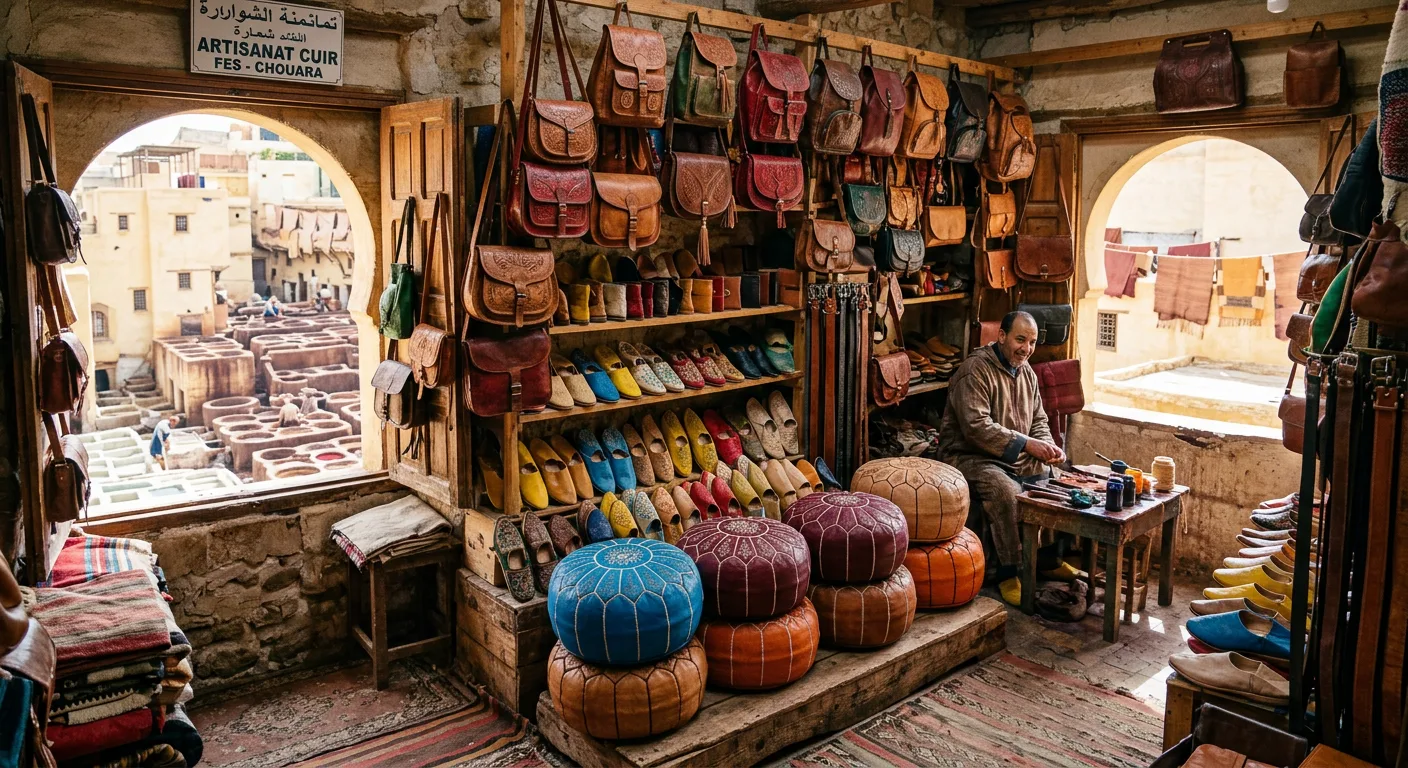
Fes el-Bali contains the world's largest car-free urban zone with over 9,000 artisan workshops. The medina feels frozen in time: donkeys carry goods through alleys too narrow for cars. Prices are lower than Marrakech because fewer tourists reach Fes, making it the best value for leather, ceramics, and brasswork. The tanneries are a must-see even if you buy nothing.
Key Souks & Markets
Chouara Tannery Quarter
The world-famous tanneries; leather goods at source prices
Souk el-Attarine
Spices and perfumes near the Al-Attarine Madrasa
Place Seffarine
Coppersmith square; hammered brass platters, teapots, and trays
Ain Nokbi Pottery Quarter
Workshops producing iconic Fes blue-and-white ceramics
Tip: Hire an official guide (from 300 MAD for a half day) for your first visit to Fes medina. The layout is genuinely disorienting. After one guided tour, you can navigate independently on subsequent visits.
Essaouira
The Relaxed Coastal Souk
Laid-back, artistic, breezyPrice: Moderate (fair, less aggressive bargaining)
Essaouira is perfect for first-time souk shoppers or anyone overwhelmed by Marrakech. The medina is compact and walkable, vendors are relaxed and less pushy, and fixed-price concept shops on Avenue de l'Istiqlal let you benchmark prices. Women's argan cooperatives on the road from Marrakech guarantee authentic oil at fair prices.
Key Souks & Markets
Medina Main Souk
Compact central market with clothing, spices, and souvenirs
Thuya Woodworkers' Quarter
Hand-carved thuya wood boxes, chess sets, and furniture
Skala de la Ville
Art galleries and marquetry workshops along the ramparts
Fish Market (Port)
Fresh seafood; choose your fish and have it grilled on the spot
Tip: Visit the thuya woodworking cooperatives near Skala de la Ville for fixed-price handcrafted items. The quality is superb and you can watch artisans at work. Essaouira is also the best place in Morocco for affordable silver jewelry.
Chefchaouen
The Blue Boutique Souk
Charming, photogenic, intimatePrice: Lower (excellent value)
Chefchaouen's souk is small but packed with unique finds unavailable elsewhere in Morocco. Woven Rif Mountain blankets, artisanal goat cheese, local wildflower honey, handmade olive oil soap, and hand-painted blue ceramics are all highlights. The souk atmosphere is gentle and bargaining is straightforward, making it ideal for visitors who find Marrakech or Fes overwhelming.
Key Souks & Markets
Place Outa el-Hammam
Central square with cafes and souvenir shops
Medina Blue Streets
Woven goods, handmade soap, and painted pottery along iconic blue alleys
Ras el-Maa Market
Local market near the waterfall; fresh produce and mountain herbs
Craft Cooperatives
Women's weaving cooperatives selling authentic Rif textiles
Tip: The women's weaving cooperatives on the outskirts of the medina sell handmade blankets and textiles at fair prices. Ask your riad for directions. Chefchaouen is also known for hand-stitched leather bags unique to the Rif region.
Souk Layout & Navigation
How to find your way through Morocco's maze-like markets without losing your bearings.
Download Offline Maps
Download Google Maps or Maps.me for offline use before entering the medina. GPS works inside souks even when data does not. Mark your riad, the nearest gate, and key landmarks before you start exploring.
Follow the Trade Zones
Moroccan souks are organized by trade: leather in one area, spices in another, metalwork in another. Once you understand the zone layout, navigating becomes intuitive. Major trade zones radiate outward from the central mosque or main square.
Use Landmarks, Not Street Names
Most souk alleys have no visible signs. Navigate by landmarks: mosques, fountains (sebils), painted gates, and open squares. The main mosque or central square is always the anchor point. When lost, walk downhill or follow the crowd.
Carry Your Riad's Business Card
Keep your riad's card with its address and phone number. If you get truly lost, any shopkeeper or local can point you in the right direction. Taxi drivers outside the medina can call the riad for GPS directions.
Morning vs. Afternoon Rhythms
Souks are quietest 9-11 AM, making navigation easier. By noon, alleys are packed. Many shops close for Friday prayers (12-2 PM). Late afternoon (4-6 PM) brings a second wave of activity as temperatures cool. Ramadan shifts everything later.
Look for Colored Arrow Signs
Many medinas (especially Fes and Marrakech) have installed colored directional signs pointing toward key exits, landmarks, and attractions. Follow these when you need to reorient. Blue arrows in Fes often point toward Bab Boujloud.
How to Haggle in Morocco: Step by Step
Haggling is an art and a social ritual. Follow these 9 steps to negotiate with confidence and mutual respect.
1
Research Fair Prices First
Before entering the souks, study price ranges in this guide and visit an Ensemble Artisanal (government fixed-price shop found in most cities) to learn baseline values. Knowledge is your strongest negotiating tool and prevents overpaying.
2
Browse Before You Buy
Walk through the entire souk section for your desired item before committing. Compare quality and prices across multiple stalls. Vendors in deeper, less-trafficked areas often offer better starting prices than those at busy entrances.
3
Show Interest, Not Desperation
Pick up items casually, examine them, and ask "how much?" without showing too much excitement. If a vendor senses you love an item, the price goes up. Accept the mint tea offered; it is part of the ritual and does not obligate you to buy.
4
Counter at 30-40% of Asking Price
If the vendor says 1,000 MAD, counter with 300-400 MAD. This gives both sides room to negotiate toward a fair middle ground. A serious vendor will always counter rather than let you walk away.
5
Stay Friendly and Patient
Haggling is a social ritual in Morocco, not a confrontation. Smile, laugh, make conversation. Vendors respect warmth and humor far more than aggression. The best deals come from genuine human connection.
6
Use the Walk-Away Technique
If you cannot reach your target price, say "shukran" (thank you) and start walking toward the exit. Most vendors will call you back with a lower offer. If they do not, you were already near their floor price.
7
Bundle Multiple Items
Buying multiple items from one vendor almost always gets you a better per-item price. Negotiate three scarves together, not one at a time. Say "what price for all three?" to signal a bulk deal.
8
Pay Cash in Small Bills
Cash in Moroccan dirhams always gets better prices than card. Carry small denominations (20 and 50 MAD notes) to avoid the "I have no change" tactic. Hand over the exact amount to close the deal cleanly.
9
Know When to Stop
Once you reach a fair price based on your research, accept it gracefully. Pushing for another 10 MAD after a long negotiation is disrespectful. A good deal should feel good for both parties. Shake hands and smile.
What to Buy in Moroccan Souks
The six essential categories of souk purchases, with prices and quality tips for each.
Leather Goods
From 80 MAD (slippers) to 800 MAD (jacket)
Morocco's leather tradition spans over a millennium. Bags, poufs, belts, wallets, and babouche slippers are all excellent buys. Goatskin is softer; cowhide is more durable for bags.
Best souk: Fes Chouara Tannery Quarter
Quality tip: Genuine leather has a natural scent, not a chemical one. Fes tannery prices are 20-30% lower than Marrakech.
Spices & Ras el Hanout
From 20 MAD per 100g
Ras el hanout (the signature blend with up to 30 ingredients), cumin, paprika, turmeric, saffron, and dried rosebuds. Incredibly affordable compared to Western retail prices.
Best souk: Marrakech Souk el-Attarine
Quality tip: Real saffron has thin red threads and tastes bitter. Ask vendors to vacuum-seal bags. Avoid pre-mixed tourist blends.
Ceramics & Pottery
From 50 MAD (small bowl) to 300 MAD (large plate)
Fes blue-and-white geometric designs, colorful Safi pottery, unique green-glazed Tamegroute ware. Plates, tagines, bowls, and zellige tile coasters make memorable gifts.
Best souk: Fes Ain Nokbi Quarter
Quality tip: Tap ceramics gently; a clear ring means solid quality. Ask if tagines are for cooking (lead-free) or display only.
Textiles & Blankets
From 80 MAD (scarf) to 500 MAD (Berber blanket)
Berber handira blankets from the Atlas Mountains, sabra (cactus silk) cushion covers, cotton scarves, and embroidered caftans. Handwoven pieces show subtle irregularities that prove authenticity.
Best souk: Marrakech Souk Semmarine
Quality tip: Check the back of textiles for slight irregularities; machine-made items have perfectly uniform patterns.
Argan Oil
From 80 MAD per 100ml (cosmetic)
Cosmetic argan oil is light and nearly odorless (cold-pressed from raw nuts). Culinary argan is darker with a rich nutty flavor (from roasted nuts). Women's cooperatives guarantee authenticity.
Best souk: Essaouira cooperatives
Quality tip: Real cosmetic argan absorbs into skin within a minute. If it sits greasy on the surface, it is diluted or fake.
Brass Lanterns
From 200 MAD (table) to 1,000 MAD (floor)
Hand-pierced brass and iron lanterns casting mesmerizing geometric shadow patterns. Table lanterns, hanging fixtures, and candle holders. The metalworkers of Marrakech are the acknowledged masters.
Best souk: Marrakech Place des Ferblantiers
Quality tip: Check electrified lanterns' wiring quality. Candle lanterns are simpler and safer. Negotiate harder when buying multiple pieces.
Fair Price Reference Table
Use these baseline prices to negotiate with confidence. Prices may vary by city and season.
Babouche slippers (plain leather)
From 80 MAD
Embroidered from 150 MAD
Leather crossbody bag
From 200 MAD
Higher for custom work
Ras el hanout (100g)
From 30 MAD
Vacuum-sealed recommended
Saffron (1g genuine)
From 20 MAD
Beware fake safflower
Fes blue plate (large)
From 150 MAD
Small bowls from 50 MAD
Decorative tagine
From 80 MAD
Cooking tagines slightly more
Cosmetic argan oil (100ml)
From 80 MAD
Buy from cooperatives
Cotton scarf
From 80 MAD
Silk-blend from 150 MAD
Berber blanket (handira)
From 300 MAD
Handwoven, Atlas origin
Small brass lantern
From 200 MAD
Large floor lanterns from 1,000 MAD
Berber silver bracelet
From 150 MAD
Check for 925 stamp
Tea glass set (6)
From 60 MAD
With tray from 200 MAD
Prices are starting points and may fluctuate seasonally. Peak tourist months (October-April) often see 10-20% higher asking prices in popular souks.
Souk Scams & How to Avoid Them
Morocco's souks are overwhelmingly honest, but knowing these common tricks helps you shop smarter.
The "My Friend's Shop" Redirect
A local offers to guide you to a "special shop" with "local prices." The guide collects a 10-30% commission added directly to your purchase price.
How to avoid: Politely decline unsolicited guides with "la shukran." Navigate independently using offline maps. If you use a guide, factor the commission into your negotiation.
Fake Saffron
Dyed safflower, corn silk, or plastic threads sold as expensive saffron. Real saffron has thin red threads, tastes bitter, and slowly turns water golden-yellow.
How to avoid: Buy from established spice shops. Taste a thread: real saffron is bitter. Expect from 20-40 MAD per gram; anything drastically cheaper is fake.
Machine-Made "Handmade" Carpets
Factory-produced rugs sold as handwoven at handmade prices. Machine-made carpets have perfectly uniform knots and a flat, synthetic backing.
How to avoid: Flip the rug over: handmade rugs show visible individual knots on the reverse. Pull a fringe thread; real wool feels organic, synthetic is smooth and plastic.
Diluted Argan Oil
Argan oil mixed with cheaper sunflower or olive oil, or entirely synthetic substitutes sold at premium prices.
How to avoid: Buy from women's cooperatives only. Real cosmetic argan absorbs into skin within a minute without greasy residue. If it sits on the surface, it is fake.
The Closed Riad Trick
Someone near your riad tells you it is "closed today" or "moved" and offers to take you to another accommodation. Your riad is fine; they earn a commission from the other hotel.
How to avoid: Ignore this completely. Walk directly to your riad. Call your riad if you feel uncertain. This scam targets newly arrived visitors near accommodation areas.
Inflated "First Price" for Tourists
Some vendors quote tourists 5-10x the fair price, far beyond the normal 2-3x markup. This is especially common at souk entrances near major tourist sites.
How to avoid: Know fair prices from this guide. Shop deeper in the souk where prices normalize. If a quoted price seems extreme, walk away without countering and try another stall.
Souk Etiquette: Do's & Don'ts
Respect local customs and you will be rewarded with warmer interactions and better prices.
Ask Before Photographing People
Always ask permission before photographing vendors, artisans, or locals. Many people are happy to pose; some prefer not to be photographed. A small tip (from 5-10 MAD) is appreciated when someone poses for you.
Dress Modestly
Souks are conservative spaces in a Muslim country. Cover shoulders and knees. Women do not need to cover their hair but modest dress earns respect and reduces unwanted attention from vendors.
Accept Tea Without Obligation
Being offered mint tea is a sign of hospitality, not a binding contract. You can drink the tea, chat, and still walk away without buying. However, sitting for tea signals you are a serious potential buyer.
Say "La Shukran" Firmly but Kindly
A clear "la shukran" (no thank you) with a smile and continued walking is the most effective way to decline vendors. Do not engage in conversation with sellers whose goods you have no interest in.
Respect Prayer Times
Many vendors close briefly for the five daily prayers, especially Friday noon prayer (12-2 PM). Do not try to rush a transaction during prayer call. Use the pause to rest, eat, or plan your next souk section.
Yield to Donkeys and Carts
In Fes especially, donkeys and hand-pushed carts are the delivery trucks of the medina. When you hear "balak!" (watch out!), press yourself against the wall to let them pass. They have the right of way.
Shipping Souk Purchases Home
Bought a rug too big for your suitcase? Here are the best ways to get your treasures home.
Barid Al-Maghrib (Post)
From 150 MAD2-4 weeks
Best for: Spices, small leather goods, textiles, scarves
DHL / FedEx / UPS
From 500 MAD3-7 days
Best for: Ceramics, valuable items, fragile goods, jewelry
Shop Shipping (Dealer)
From 200 MAD1-6 weeks
Best for: Carpets, large lanterns, furniture, heavy items
Packing Tips for Souk Purchases
Wrap ceramics individually in clothing or scarves you have also purchased
Ask vendors for bubble wrap; most ceramics sellers carry it
Argan oil bottles over 100ml must go in checked luggage, not carry-on
Get receipts for valuable items to declare at customs and prove authenticity
Frequently Asked Questions
What are the best souks to visit in Morocco?
The top souks are in Marrakech (the sprawling medina souks off Jemaa el-Fna with 3,000+ stalls), Fes (the world's largest car-free souk with 9,000+ workshops), Essaouira (relaxed coastal souk with argan oil and silver), and Chefchaouen (charming blue-walled souk with Rif Mountain crafts). Marrakech offers the most variety, Fes the best prices, Essaouira the most relaxed atmosphere, and Chefchaouen the most unique finds.
How do I haggle in a Moroccan souk?
Start by researching fair prices before entering the souk. Counter at 30-40% of the asking price, stay friendly and patient, and use the walk-away technique if needed. Bundle purchases for better per-item deals. Pay cash in Moroccan dirhams for the best prices. Haggling is a social ritual in Morocco, so enjoy the process and aim for a price that feels fair to both parties.
Are Moroccan souks safe for tourists?
Yes, Moroccan souks are busy and sometimes overwhelming but safe. Keep valuables in a front pocket or crossbody bag. Vendors can be persistent but are rarely aggressive. Say "la shukran" (no thank you) to decline. Avoid poorly lit alleys at night. The souks are family-oriented spaces and tourist police patrol major medinas.
What time do souks open and close?
Most souks open 9:00-10:00 AM and close by 7:00-8:00 PM. Many shops close for Friday prayers (12:00-2:00 PM). During Ramadan, hours shift later with evening shopping after iftar. Early morning (9-11 AM) is the best time to shop: fewer crowds, cooler temperatures, and some vendors offer better prices on the day's first sale.
Can I use credit cards in Moroccan souks?
Most souk vendors accept cash only. Some larger established shops take cards but often add a 3-5% surcharge. Always carry Moroccan dirhams in small denominations (20 and 50 MAD notes). ATMs are available at medina gates and main squares. Cash gives you significantly more bargaining leverage.
How do I avoid getting lost in a Moroccan souk?
Download offline maps (Google Maps or Maps.me) before entering. Note landmarks like mosques, fountains, and gates. Carry your riad's business card. Follow main thoroughfares and look for colored directional signs. Getting slightly lost is part of the experience, but main arteries always lead back to familiar squares and gates.
What should I not buy in Moroccan souks?
Avoid fake saffron (look for dyed safflower sold as saffron), machine-made carpets sold as handmade, diluted argan oil from street vendors, fake silver jewelry (test with a magnet), and plaster fossils. Always buy from established shops or cooperatives. If a price seems too good to be true, the product is likely counterfeit.
How do I ship large souk purchases home?
Use Barid Al-Maghrib (Moroccan Post) from 150 MAD for small parcels (2-4 weeks), DHL/FedEx/UPS from 500 MAD for fast delivery (3-7 days), or shop shipping arranged by established dealers (especially for carpets and lanterns). Many reputable rug and ceramic shops offer reliable international shipping with insurance. Get a receipt and tracking number for any shipped items.
Related Guides
Guide to Moroccan Souks
In-depth guide to every major souk in Morocco with maps, opening hours, and what to expect.
Read moreWhat to Buy in Morocco
The 11 best Moroccan souvenirs with real prices, quality markers, and city recommendations.
Read moreMorocco Shopping Guide
Complete shopping guide with price tables, customs info, and advanced bargaining strategies.
Read moreMoroccan Markets Guide
Explore traditional weekly markets, food markets, and modern shopping in Morocco.
Read moreMoroccan Crafts & Artisans
Discover the centuries-old craft traditions of Morocco from leather to zellige tilework.
Read more