Discovering...
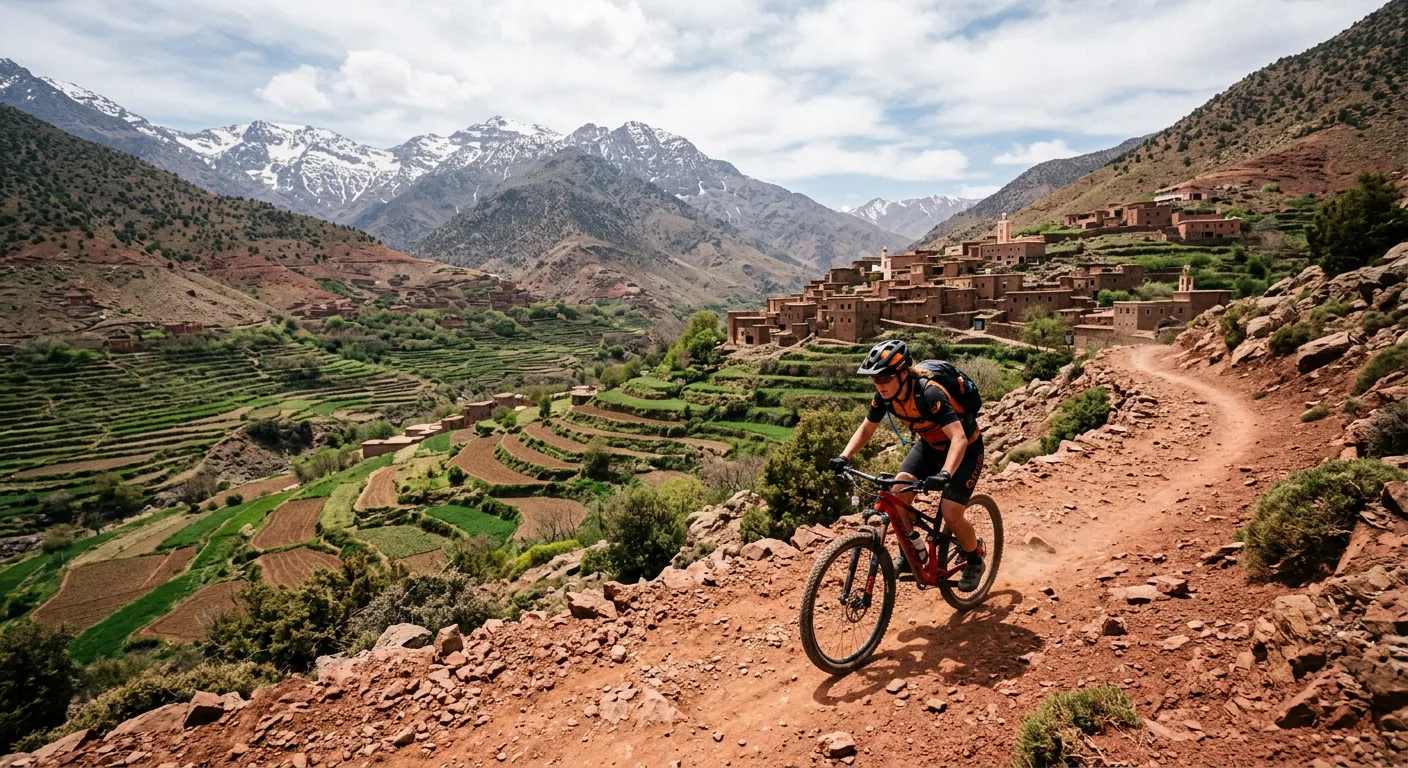
Morocco Mountain Biking Guide 2026
Atlas single-track, Sahara fatbiking, and Atlantic coastal trails — Morocco offers some of the most varied mountain biking terrain on the planet.
Why Morocco for Mountain Biking
Morocco has quietly built a reputation as one of the top mountain biking destinations outside Europe and North America. The draw is simple: an extraordinary range of terrain packed into a compact geography. Within a single week, you can ride high-altitude single-track above 3,000 meters in the Atlas Mountains, fat-bike across Saharan dunes at Erg Chebbi, and cruise coastal trails along the Atlantic at Essaouira.
The infrastructure for mountain biking has matured significantly. Marrakech now has professional bike shops offering rental fleets of current-model hardtails and full-suspension bikes. Guided tour operators run trips ranging from half-day Palmeraie spins to week-long trans-Atlas expeditions with vehicle support. And the riding season is long — October through May delivers rideable conditions across most of the country, with high-altitude Atlas trails opening from June to October when lower elevations become too hot.
What sets Morocco apart from other African MTB destinations is accessibility. Marrakech is a 3-hour flight from most European capitals. The cost of guided tours, accommodation, and food is a fraction of comparable experiences in the Alps or North America. And the cultural dimension — riding through Berber villages, sharing mint tea with farmers, sleeping in mountain guesthouses — adds a layer that pure bike-park destinations cannot match.
12+
Major Trail Routes
4,167m
Highest Peak (Toubkal)
8+ months
Rideable Season
350 MAD
Bike Rental/Day (from)
12 Best Mountain Biking Routes in Morocco
From beginner-friendly palm grove loops to multi-day trans-Atlas traverses. Each route includes distance, elevation, difficulty, and seasonal access.
1
Amizmiz Loop
IntermediateWestern High Atlas
The go-to day ride from Marrakech. Starting from the market town of Amizmiz (55 km south of Marrakech), the loop winds through Berber villages, olive groves, and rocky single-track with constant views of the snow-capped High Atlas. The climb out of Amizmiz is steady but not brutal, and the descent through Anougal valley rewards with fast, flowing trails on packed red dirt.
35 km950m gain4-5 hoursSeptember to May
Berber village pass-throughsOlive grove single-trackPanoramic Atlas viewsFast red-dirt descents
Access: Taxi from Marrakech (from 250 MAD one way) or tour operator shuttle
2
Ouirgane Valley Circuit
IntermediateHigh Atlas Foothills
A classic half-day ride through the lush Ouirgane Valley, 60 km south of Marrakech on the Tizi n'Test road. The circuit combines paved road, forest fire tracks, and single-track through oak and juniper forest. The valley sits at 1,000m elevation, making it cooler than Marrakech even in summer. Several guesthouses in Ouirgane offer bike storage and post-ride meals.
28 km700m gain3-4 hoursYear-round (best March-November)
Forest fire-track ridingOak and juniper woodlandCooler altitude climateGuesthouse lunch stops
Access: Drive or shared taxi via N8/Tizi n'Test road
3
Imlil to Toubkal Base Camp
AdvancedHigh Atlas — Toubkal Massif
A punishing but spectacular out-and-back from Imlil (1,740m) to the Toubkal refuge at Neltner (3,200m). The first section follows mule tracks through walnut terraces above Imlil, then transitions to rocky switchbacks as you gain altitude. Above 2,500m, the trail becomes increasingly technical with loose scree and boulder sections. Most riders push or carry for the final 2 km. The descent is raw and demanding — full suspension and body armor recommended.
24 km round trip1,500m gain6-8 hoursJune to October (snow-free)
Highest rideable trail in North AfricaMule-track switchbacksAlpine scree ridingViews of Jbel Toubkal (4,167m)
Access: Grand taxi from Marrakech to Imlil (from 200 MAD)
4
Dades Valley — Gorge to Roses
Intermediate to AdvancedCentral High Atlas
A point-to-point ride from the upper Dades Gorge down through the valley to the rose-growing town of El Kelaa M'Gouna. Starting at the famous hairpin bends of the gorge road (1,700m), you descend through dramatic canyon walls before the valley opens into agricultural terraces. The trail alternates between piste (unpaved road), single-track along irrigation channels, and short paved sections through villages. Best ridden with vehicle support to handle the logistics.
55 km one way600m net descent5-7 hoursMarch to May (rose season), September to November
Dades Gorge hairpin descentCanyon-wall ridingRose valley in spring bloomBerber village hospitality
Access: Vehicle transfer from Ouarzazate or Tinghir
5
Jbel Saghro Traverse
AdvancedAnti-Atlas
The Jbel Saghro massif between the High Atlas and the Sahara is one of Morocco's premier multi-day MTB destinations. The terrain is volcanic — black basalt towers, red-earth valleys, and hidden oases. The three-day traverse from Nkob to Boumalne Dades crosses the Tizi n'Tazazert pass (2,283m) and follows ancient nomadic routes. Nights are spent wild camping or in nomad tents. A local guide is essential, as trails are unmarked and water sources scarce.
85 km over 3 days3,200m total gain3-day itineraryOctober to April (too hot May-September)
Volcanic basalt landscapeNomadic camp overnight staysTizi n'Tazazert pass crossingZero tourist infrastructure
Access: Transfer from Ouarzazate to Nkob starting point
6
Erg Chebbi Fatbiking
Beginner to IntermediateSahara — Merzouga
Riding fat-tire bikes across the dunes of Erg Chebbi is a singular experience. Operators in Merzouga provide specialized bikes with 4.8-inch tires at low pressure (5-8 PSI) that float over packed sand. Morning rides follow the hard-packed reg (gravel desert) between dune fields, while sunset sessions tackle the dunes themselves. Full-day rides reach remote Gnawa villages and seasonal lakes (dayet). The physical effort is real — sand riding demands twice the energy of trail riding.
15-40 km (varies by tour)Minimal (dune undulation)2-6 hoursOctober to April (summer heat is extreme)
Sahara dune ridingSunrise and sunset sessionsGnawa village visitsDesert oasis stops
Access: Operators based in Merzouga and Hassilabied
7
Essaouira Coastal Trail
Beginner to IntermediateAtlantic Coast
A mellow coastal ride south from Essaouira along the Atlantic shore. The route follows a mix of hard-packed beach, sandy cliff-top tracks, and goat trails through argan groves. The turnaround point at Sidi Kaouki (a surf village) makes a natural lunch stop. Wind is a factor — ride south in the morning (tailwind) and return in the afternoon, or accept that the headwind back will double your effort. Best done at low tide when the beach sections are firm.
30 km out and back150m gain2.5-4 hoursYear-round (less wind September-November)
Atlantic beach ridingArgan grove trailsSidi Kaouki surf villageCoastal cliff scenery
Access: Start from Essaouira medina or Diabat village
8
Tizi n'Test Pass Descent
AdvancedHigh Atlas — Western
One of Morocco's great gravity rides. The Tizi n'Test pass (2,092m) connects Marrakech to the Souss Valley and Taroudant. Starting from the pass summit, the ride descends through hairpins and cliff-edge piste for 45 km to the valley floor. The first 15 km are on deteriorating tarmac with sharp switchbacks. At Tin Mal, you pass the ruined 12th-century Almohad mosque before the route transitions to gravel and single-track through almond orchards. Vehicle support required for the shuttle to the top.
45 km descent1,800m net descent4-5 hoursApril to November (pass closed in winter snow)
2,000m altitude descentTin Mal mosque ruinsCliff-edge switchbacksAlmond orchard trails
Access: Vehicle shuttle to Tizi n'Test summit from Marrakech or Taroudant
9
Palmeraie Circuit — Marrakech
BeginnerMarrakech Outskirts
The perfect introduction to off-road riding in Morocco. The Palmeraie (palm grove) north of Marrakech offers flat to gently rolling terrain on sandy tracks between palm trees. Several operators run guided sunrise and sunset rides through the grove, passing Berber farmsteads and irrigation channels. The terrain is non-technical but the sandy surface teaches bike handling skills useful for harder Moroccan trails. Available as a half-day add-on to most Marrakech MTB packages.
18 km80m gain1.5-2.5 hoursYear-round (avoid midday summer heat)
Flat beginner-friendly terrainPalm grove scenerySunrise and sunset ridesClose to Marrakech hotels
Access: Pickup from Marrakech hotels included with most operators
10
Anti-Atlas — Tafraoute to Ait Mansour
Intermediate to AdvancedAnti-Atlas
The granite landscape around Tafraoute in the Anti-Atlas is otherworldly — massive pink and orange boulders, painted rocks (by Belgian artist Jean Verame), and dramatic gorges. The loop from Tafraoute drops into the Ait Mansour gorge via a steep piste descent, follows the palmery along the gorge floor, then climbs back to Tafraoute via the Ameln Valley. The gorge floor section is technical with river crossings (seasonal). Winter and spring are ideal — the almond trees bloom in February.
42 km loop1,100m gain5-6 hoursNovember to April (summer too hot)
Painted Rocks landmarkAit Mansour gorge descentAlmond blossom (February)Pink granite boulder fields
Access: Drive from Agadir (3 hours) or Tiznit (1.5 hours)
11
Todra Gorge to Tinghir Loop
IntermediateEastern High Atlas
Starting from the dramatic 300-meter walls of Todra Gorge, this loop climbs the eastern rim via a piste before traversing high plateau with views across the Tafilalet oasis system. The descent back to Tinghir follows irrigation canal paths (seguias) through date palm groves. The gorge itself is too narrow and trafficked for safe riding, so the route bypasses it via the rim trail. A mechanical breakdown here is manageable — Tinghir has competent bike mechanics.
32 km550m gain3-5 hoursOctober to May
Todra Gorge rim viewsHigh plateau traverseDate palm irrigation trailsAccessible from Tinghir town
Access: Taxi from Tinghir to gorge mouth (from 50 MAD)
12
Marrakech to Ouarzazate — Tizi n'Tichka
Advanced (multi-day)High Atlas — Central
The classic trans-Atlas crossing for mountain bikers. Rather than riding the busy N9 highway over Tizi n'Tichka pass (2,260m), the MTB route uses parallel pistes and mule tracks that run east of the main road. Day one climbs from Marrakech foothills to a guesthouse at Telouet (1,800m) via the old Glaoui road. Day two crosses remote passes to reach Ait Benhaddou. Day three is the descent to Ouarzazate. Vehicle support carries luggage and provides mechanical backup. This is the route that put Morocco on the international MTB touring map.
200 km over 2-3 days4,500m total gain2-3 day itineraryApril to June, September to November
Trans-Atlas crossingTelouet Kasbah overnightAit Benhaddou UNESCO siteHistoric Glaoui trade route
Access: Guided tours depart from Marrakech with vehicle support
Trail Difficulty Ratings Explained
Moroccan trails are not graded with a standardized system. Here is how we classify the routes in this guide.
Beginner
Flat to gently rolling terrain on wide tracks or packed surfaces. No technical obstacles. Suitable for riders with basic fitness and bike-handling skills. Examples: Palmeraie Circuit, gentle Essaouira sections.
Intermediate
Sustained climbs of 500-1,000m. Mix of piste, single-track, and loose surfaces. Some rocky sections and route-finding required. Riders should be comfortable on varied terrain and have solid cardio fitness. Examples: Amizmiz Loop, Ouirgane Circuit, Todra to Tinghir.
Intermediate to Advanced
Long days (5-7 hours saddle time). Technical descents with loose rock, exposure, and steep gradients. High-altitude riding above 1,500m. Route-finding skills or a GPS essential. Examples: Dades Valley, Anti-Atlas Tafraoute loop.
Advanced
Extreme elevation gain (1,500m+), highly technical terrain, remote areas with no bail-out options. Riders should have multi-day bikepacking experience and be self-sufficient mechanically. Full-suspension bike recommended. Examples: Imlil-Toubkal, Tizi n'Test descent, Jbel Saghro traverse, Trans-Atlas crossing.
Bike Rental in Morocco
Marrakech is the hub for quality mountain bike rental. Prices are per day and typically decrease for multi-day bookings. Seasonal pricing can change.
Basic Hardtail
From 350 MAD/daySpecs: Aluminum frame, mechanical disc brakes, 100mm fork, 27.5" wheels
Best for: Palmeraie, Essaouira coastal, flat-to-moderate terrain
Mid-Range Hardtail
From 550 MAD/daySpecs: Aluminum/carbon frame, hydraulic disc brakes, 120mm air fork, tubeless-ready
Best for: Amizmiz, Ouirgane, Todra, day rides with moderate climbing
Full-Suspension Trail
From 850 MAD/daySpecs: 130-150mm travel, dropper post, hydraulic brakes, tubeless
Best for: Imlil-Toubkal, Tizi n'Test descent, Jbel Saghro, technical terrain
Fat Bike (Desert)
From 450 MAD/sessionSpecs: 4.0-4.8" tires, rigid fork, wide rims, low gearing
Best for: Erg Chebbi dunes, desert reg, sandy coastal sections
Rental Tips
- Test the bike thoroughly before leaving the shop. Check brakes, shifting, tire pressure, and saddle height.
- Ask about the damage policy upfront. Reputable shops offer a fair-wear clause for flats and minor scratches.
- Book at least 48 hours ahead in peak season (October-November, March-April). Stock is limited.
- Bring your own pedals, saddle, and helmet if you have strong preferences. Rental helmets are often basic.
Guided Tour Packages
Professional tour operators handle logistics so you can focus on riding. All prices are per person and seasonal pricing can change.
Day Ride with Guide
1 dayFrom 1,200 MAD/person
Includes: Guide, bike, helmet, lunch, transport from Marrakech
Routes: Amizmiz, Ouirgane, Palmeraie, or Essaouira coast
Weekend Explorer
2 days / 1 nightFrom 3,500 MAD/person
Includes: Guide, bike, accommodation, meals, vehicle support
Routes: Ouirgane + Amizmiz or Dades Valley
Trans-Atlas Crossing
3-4 daysFrom 6,500 MAD/person
Includes: Guide, bike, hotels/guesthouses, all meals, luggage transfer
Routes: Marrakech to Ouarzazate via Telouet and Ait Benhaddou
Grand Tour — Atlas & Desert
7 daysFrom 18,000 MAD/person
Includes: Expert guide, premium bike, all logistics, accommodation, meals
Routes: Marrakech — Atlas — Dades — Todra — Merzouga — Ouarzazate
Essential Gear Checklist
Pack these items for any ride beyond the Palmeraie. Remote Moroccan trails demand self-sufficiency.
Helmet
Non-negotiable. Rental shops provide basic helmets; bring your own for a proper fit.
Hydration Pack (3L+)
Water sources are scarce outside villages. Carry minimum 3 liters in summer.
Tire Repair Kit
Spare tube, tire levers, mini pump. Thorns from argan and acacia trees cause frequent punctures.
Chain Tool & Quick Links
Rocky terrain eats chains. Carry a chain breaker and 2 quick links for your chain type.
Sun Protection
SPF 50, arm sleeves, and a buff. Atlas UV exposure above 2,000m is intense.
Offline GPS/Maps
Download tracks to a GPS unit or phone app. Cell service disappears outside towns.
First Aid Kit
Antiseptic, bandages, blister treatment, electrolyte sachets. Remote rides mean slow evacuations.
Brake Pads (spare set)
Dusty conditions and long descents chew through pads fast. Carry a spare set.
When to Ride — Seasonal Guide
Morocco's varied geography means there is rideable terrain year-round if you choose the right region.
Spring (March — May) — Prime Season
The best all-around window. Temperatures in the Atlas foothills sit between 18-28°C. Snow retreats from passes above 2,500m by late April. The Dades Valley roses bloom in April-May. Desert rides (Merzouga, Jbel Saghro) are still comfortable before summer heat arrives. Book guided tours early — this is peak demand.
Summer (June — August) — High Atlas Only
Lower elevations hit 40°C+ and riding becomes dangerous. But the High Atlas above 2,000m is pleasant at 20-30°C with long daylight hours. This is the window for the Imlil-Toubkal route and high-altitude traverses. The Essaouira coast stays cool (18-24°C) year-round thanks to Atlantic winds, making it a viable summer option.
Autumn (September — November) — Prime Season
Equal to spring in quality. September is still warm but cooling rapidly. October and November are ideal for the full range of Moroccan MTB — Atlas day rides, multi-day tours, desert fatbiking, and coastal routes. Wind drops significantly at Essaouira, making coastal rides more pleasant. The landscape turns golden-brown after summer, offering dramatic contrast with red earth trails.
Winter (December — February) — South & Coast
Snow closes the Tizi n'Tichka and Tizi n'Test passes. High Atlas trails above 2,000m are inaccessible. But the Anti-Atlas (Tafraoute, Jbel Saghro) and desert regions enjoy mild 15-25°C temperatures. Essaouira and the Atlantic coast remain rideable. February brings almond blossom season in the Ameln Valley around Tafraoute — one of Morocco's most photogenic riding backdrops.
Mechanical Support & Repairs
Finding bike repair in Morocco ranges from excellent (Marrakech) to improvisational (rural Atlas villages).
Marrakech — Full Service
Multiple shops in Gueliz (new town) stock MTB parts including brake pads, chains, cassettes, and tubes. Staff understand disc brakes, suspension service, and tubeless setups. Basic repairs from 50 MAD. Full suspension service from 500 MAD. The Hivernage and Gueliz districts have the most MTB-aware shops.
Ouarzazate — Competent Basics
A few mechanics on the main avenue can handle tire, tube, chain, and brake cable repairs. Disc brake bleeding or suspension work is beyond most local shops. Carry your own spare pads and hydraulic fluid if heading to the Dades or Todra region.
Rural Villages — Improvised
Most Atlas villages have a veloman (bike mechanic) who works on commuter bikes. They can fix punctures, straighten wheels, and jury-rig broken components. Do not expect MTB-specific parts or tools. Carry spares for anything likely to break.
Common Mechanical Issues
Thorn punctures (acacia and argan spines), worn brake pads (dust and long descents), snapped chains (rocky terrain), and bent derailleurs (crash damage). Running tubeless sealant and carrying a spare derailleur hanger eliminates most trail-side emergencies.
Practical Riding Tips for Morocco
Hydration Strategy
Carry a minimum of 3 liters of water on any ride beyond city limits. In summer or desert rides, increase to 4-5 liters. Village wells and springs are common in the Atlas, but water quality varies. Carry purification tablets. Electrolyte sachets are essential — sweat loss at altitude and in dry heat depletes salts rapidly.
Interacting with Locals
Berber villagers are overwhelmingly welcoming to mountain bikers. Slow down through villages, wave, and say "salaam". If offered tea, accept — it is a genuine gesture. Ask before photographing people. Children may run alongside your bike; ride carefully. Buying snacks or water from village shops is a direct economic contribution.
Navigation
Cell service (Maroc Telecom, Orange, Inwi) is strong in towns and along main roads but drops out in remote valleys and passes. Download offline maps (Maps.me, OsmAnd) and GPX tracks before riding. A handlebar-mounted GPS unit (Garmin, Wahoo) is the most reliable option. Paper maps are useful as a backup for the Jbel Saghro and Anti-Atlas regions.
Safety on Roads
Moroccan road driving is assertive. Trucks and buses will pass close on narrow mountain roads. Wear high-visibility gear on road sections. Avoid riding the N-roads (national highways) — stick to R-roads (regional) and pistes where possible. Road sections near Marrakech can have heavy traffic; get off the main road quickly via planned exit routes.
Budget Planning
Self-supported day rides: from 150 MAD (transport + food). Guided day ride: from 1,200 MAD. Mid-range bike rental: from 550 MAD/day. Mountain guesthouses: from 300 MAD for half-board. Trailside village lunch (tagine + tea): from 60 MAD. Budget for a week of self-supported riding: from 5,000 MAD excluding flights.
Bringing Your Own Bike
Most airlines accept bike boxes or bags for a fee (from 500 MAD to 1,500 MAD per flight). Marrakech Menara airport has space for reassembly outside the arrivals hall. Bring a torque wrench for reassembly. Bike boxes can be stored at hotels or tour operator warehouses during your trip. Hardshell cases offer better protection than soft bags for Morocco's luggage handling.
Frequently Asked Questions
What is the best season for mountain biking in Morocco?
The best months are March to May and September to November. Summer (June-August) is too hot for lower elevations but rideable above 2,000m in the High Atlas. Winter riding is possible in the Anti-Atlas and coastal areas, though snow blocks high passes from December to February.
Can I rent a quality mountain bike in Morocco?
Yes. Marrakech has several reputable rental shops offering hardtail and full-suspension bikes from 350 MAD/day. For serious multi-day rides, operators provide Trek, Specialized, or Scott bikes. Bringing your own bike is recommended for advanced riders who want their exact setup.
Do I need a guide for mountain biking in Morocco?
For established routes near Marrakech (Amizmiz, Ouirgane), experienced riders can self-navigate with GPS tracks. For remote areas like Jbel Saghro, the Dades Gorge backcountry, or desert riding at Erg Chebbi, a local guide is strongly recommended due to unmarked trails and limited phone signal.
How much does a guided mountain bike tour cost in Morocco?
Day trips with a guide, lunch, and transport start from 1,200 MAD per person. Multi-day supported tours (3-7 days) with accommodation, meals, vehicle support, and guide range from 6,500 MAD to 18,000 MAD per person depending on duration and comfort level.
What fitness level do I need for mountain biking in Morocco?
Morocco offers trails for all levels. The Palmeraie loop near Marrakech suits beginners. Intermediate riders can handle Amizmiz and Ouirgane circuits. Advanced riders will find technical challenge on Imlil-to-Toubkal base camp trails and Jbel Saghro single-track. Altitude (1,500-3,200m) adds difficulty regardless of trail grade.
Is it safe to mountain bike in Morocco?
Morocco is generally safe for mountain biking. The main risks are heat exposure, dehydration, and mechanical breakdowns in remote areas. Carry at least 3 liters of water, a basic repair kit, and a charged phone with offline maps. Traffic on road sections can be aggressive, so stick to trails where possible.
Can I do fatbiking in the Sahara Desert?
Yes. Erg Chebbi near Merzouga is the main destination for desert fatbiking. Specialized operators provide fat-tire bikes (4-inch+ tires) designed for sand. Rides range from 2-hour sunset sessions (from 450 MAD) to full-day dune-to-oasis expeditions (from 1,400 MAD). Best conditions are October to April.
Should I bring my own bike or rent in Morocco?
Rental bikes have improved significantly, and shops in Marrakech now stock mid-to-high-end hardtails and some full-suspension models. For trips under a week, renting is practical. For multi-week trips or riders with specific bike fit requirements, bringing your own is worthwhile. Airlines charge from 500-1,500 MAD each way for bike boxes.
Where can I get a bike repaired in Morocco?
Every Moroccan town has at least one bike mechanic (veloman), though most specialize in city bikes. For MTB-specific repairs, Marrakech and Ouarzazate have shops familiar with disc brakes, suspension, and tubeless setups. Carry spare tubes, a chain tool, and brake pads for remote rides.
Continue Exploring Morocco
Morocco Hiking Guide
Trails for every level across the Atlas, from day hikes to multi-day treks through Berber villages.
Read moreAdventure Sports in Morocco
Rock climbing, canyoning, paragliding, and more adrenaline activities across the country.
Read moreCamping in Morocco
Wild camping spots, established campgrounds, and bivouac tips for the Atlas and Sahara.
Read moreAtlas Mountains Guide
Complete guide to the High Atlas, Middle Atlas, and Anti-Atlas — towns, passes, and experiences.
Read moreReady to Ride Morocco?
From beginner palm-grove loops to advanced trans-Atlas crossings, Morocco delivers world-class mountain biking at a fraction of European prices. Start planning your trip today.