Best Waterfalls in Morocco: Swimming, Hiking & Photography
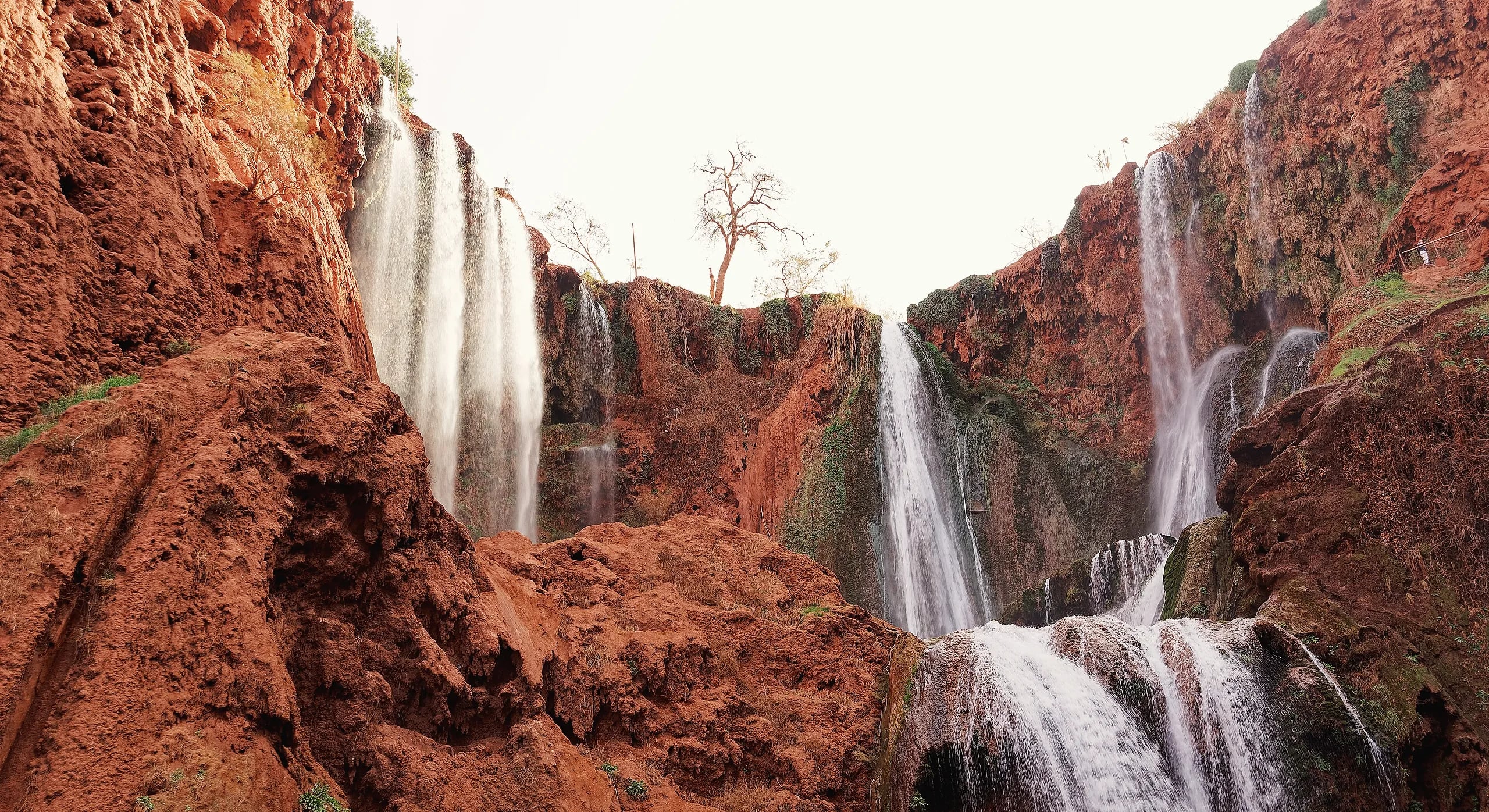
Ouzoud drops 110 meters in three tiers; Akchour and Paradise Valley end in pools you can swim in. Eight waterfalls with swimming, hikes, seasons and costs from 100 MAD.
Photograph: Jakub Hałun, CC BY 4.0
Highest fall
Ouzoud, 110 m
Falls in this guide
8
Self-guided day
From 100 MAD
Sites with swimming
6
1
Where the falls are and when they run
The biggest waterfall in Morocco is Ouzoud, a 110-meter drop 150 km from Marrakech, and you can visit it for free. Snowmelt from Atlas peaks above 4,000 meters feeds most of the country's falls, so they run hardest from March to June. Many end in pools you can swim in.
The easiest one to reach is Setti Fatma in the Ourika Valley, an hour from Marrakech. From Agadir, Paradise Valley is 45 minutes away and you can be swimming in its rock pools the same morning. Akchour, 30 km from Chefchaouen, needs a 3-4 hour return hike up a river gorge. Near Khenifra, more than forty springs pour out of a cliff at the Sources Oum er Rbia.
Below: eight waterfalls with heights, costs and swimming rules, then how to get to each, the best season, what to pack, and guided versus self-guided trips.
Spring snowmelt gives the falls their strongest flow. Ouzoud is the exception and runs all year.
2
Top Waterfalls in Morocco
Eight falls, from Ouzoud in the Middle Atlas to Akchour in the Rif, with height, difficulty, swimming and cost for each.
Waterfall
Height
Difficulty
Swimming
Cost
Ouzoud Falls
110 meters (3 tiers)
Easy
Yes: large plunge pool
Free entry, tours from 400 MAD
Akchour Waterfalls
20 m (small) / 60 m (grand)
Moderate
Yes: God's Bridge pool
Park fee from 20 MAD
Paradise Valley
Multiple cascades (5-15 m)
Easy-Moderate
Yes: multiple natural pools
Free entry
Setti Fatma Waterfalls
7 cascades (total 200+ m)
Easy (first) / Moderate (upper)
Yes: pools at lower falls
Guide from 100 MAD for upper falls
Sources Oum er Rbia
40+ springs (cascading)
Easy
No (sacred site)
Free entry
Cascades d'Imouzzer
30 meters
Easy
Limited pools below
Free entry
Cascades de Tizgha
25 meters
Moderate
Yes: small pools
Free entry
Cascades d'Imi-n-Ifri
15 meters into cave
Easy
No (cave setting)
From 10 MAD entry
All prices are starting prices per person. Seasonal pricing applies and costs may vary by operator.
1
Ouzoud Falls
Middle Atlas, near Azilal. Best season: Year-round (peak: March-June).
Three tiers drop 110 meters into a pool ringed by olive groves and red cliffs. Barbary macaques live in the trees above the path, and small boats take you to the foot of the falls for 20-30 MAD. It is the most popular waterfall day trip from Marrakech, and entry is free.
110-meter triple cascade with rainbow mist
Wild Barbary macaques in surrounding olive trees
Boat rides at the base for from 20 MAD
Riverside restaurants with views of the falls
2
Akchour Waterfalls
Rif Mountains, near Chefchaouen. Best season: March-November.
Akchour sits in Talassemtane National Park, 30 km from Chefchaouen. One trail follows a forested river gorge to the small waterfall (20 m); the longer route reaches the grand waterfall (60 m). God's Bridge, a natural rock arch over a deep pool, is a short detour off the path.
Grand waterfall cascading 60 meters into a gorge
God's Bridge natural rock arch with swimming pool
River gorge through Rif mountain forest
Easy day trip from Chefchaouen (30 km)
3
Paradise Valley
Anti-Atlas, near Agadir. Best season: April-October.
A chain of rock pools and small cascades (5-15 m) in a palm-lined gorge between Agadir and Imouzzer, about 45 minutes from the Agadir resorts. Entry is free. People jump into the pools from low ledges of 3-5 m. Around the gorge the land is dry and bare, so the green valley floor comes as a surprise.
Chain of natural swimming pools
Rock jumping from natural ledges (3-5 m)
Palm-lined gorge with red cliffs
Only 45 minutes from Agadir beach resorts
4
Setti Fatma Waterfalls
High Atlas, Ourika Valley. Best season: March-June (peak flow).
Setti Fatma is 60 km from Marrakech (about an hour by road), at the head of the Ourika Valley, and seven waterfalls climb the slope above the village. The first is an easy 30-minute walk. Reaching all seven means scrambling, and a local guide (from 100 MAD) is worth it for that part. Restaurants in the village put their tables on platforms over the river.
Seven cascading waterfalls over 200+ meters
Riverside restaurants built over rushing water
Just 60 km from Marrakech (1 hour drive)
Berber village experience with mint tea invitations
5
Sources Oum er Rbia
Middle Atlas, near Khenifra. Best season: Year-round.
More than forty springs pour out of a limestone cliff near Khenifra and become the Oum er Rbia, a 555 km river fed by Atlas snowmelt. The water runs year-round. Local Amazigh communities treat the site as sacred, so swimming is not allowed. Cedar forest covers the slopes around it.
40+ springs erupting from cliff face simultaneously
Source of Morocco's longest river (555 km)
Sacred Amazigh site with cultural significance
Cedar forest setting in the Middle Atlas
6
Cascades d'Imouzzer
Western Atlas, near Agadir. Best season: February-May (dry season: no flow).
A 30-meter waterfall in a canyon below the village of Imouzzer Ida Outanane, in the hills above Agadir. It only flows well after winter rain and drops to a trickle by late summer. The area is known for honey, with a Honey Festival in May. Most people pair it with Paradise Valley as a day trip from Agadir.
30-meter falls in a canyon
Famous local honey and annual Honey Festival
Combined day trip with nearby Paradise Valley
Panoramic viewpoints over the Atlas foothills
7
Cascades de Tizgha
Middle Atlas, near Azilal. Best season: March-June.
Tizgha is near Ouzoud but gets far fewer visitors. The water runs 25 meters down a series of travertine terraces, with small pools you can swim in. Around it you get red earth, olive groves and Berber farms. You can fit it into the same trip as Ouzoud.
Travertine terraced pools with cascading water
Far fewer tourists than nearby Ouzoud Falls
Berber farming landscape
Combinable with Ouzoud Falls in one trip
8
Cascades d'Imi-n-Ifri
Middle Atlas, near Demnate. Best season: Year-round.
Near Demnate, a 15-meter waterfall drops into a cave under a natural limestone bridge, sometimes called the "Natural Bridge of Imi-n-Ifri". The arch spans 30 meters above the river. Swallows and bats nest in the cave roof. Entry is from 10 MAD, and the site sits on the road between Marrakech and Ouzoud.
Waterfall inside a natural cave
30-meter natural limestone bridge arch
Bats and swallows nesting in the cave roof
En route between Marrakech and Ouzoud Falls
3
Guided Tours vs Self-Guided Visits
A guided day trip costs from 400-1,200 MAD per person; going on your own costs from 100-300 MAD.
Guided Day Trip
From 400-1,200 MAD per person
A driver picks you up from your hotel and handles the navigation, and a guide explains the falls, the geology and the nearby villages. Lunch is often included. Suits Ouzoud Falls, the Ourika Valley and the remote waterfalls.
Hotel pickup and drop-off included
Local knowledge and viewpoints off the main path
No navigation or driving
Traditional lunch often included
Best for: Ouzoud Falls, remote waterfalls, families, first-time visitors
Self-Guided Visit
From 100-300 MAD per person
Take a grand taxi, shared minibus or rental car and set your own pace. It works for falls with clear trails, such as Ouzoud, Paradise Valley and Akchour, costs less, and lets you stay as long as you like.
Your own schedule and pace
Much lower cost per person
Stay and swim as long as you wish
Combine several falls in one trip
Best for: Paradise Valley, Akchour, budget travelers, experienced hikers
4
Best Time to Visit Morocco Waterfalls
Go in March to May for the strongest flow, June to August for swimming. Water levels and trail conditions change a lot from season to season.
Spring (March-May)
Our verdict: Best
Daytime 18-28 C
Spring is the best season. Atlas snowmelt gives the falls their strongest flow, wildflowers line the trails, and days of 18-28 C suit both hiking and swimming. Ouzoud and Setti Fatma's seven falls run at full force, and the Akchour pools are full.
Top picks: All waterfalls at peak flow, especially Ouzoud, Setti Fatma, and Cascades d'Imouzzer
Summer (June-August)
Our verdict: Good
Daytime 28-40 C
Summer is swimming season, with days of 28-40 C. Ouzoud flows year-round and Paradise Valley is at its best. Seasonal falls such as Cascades d'Imouzzer can drop to a trickle. Start hikes early to miss the midday heat.
Top picks: Paradise Valley swimming, Ouzoud Falls, Akchour pools (early morning)
Autumn (September-November)
Our verdict: Good
Daytime 18-30 C
Autumn stays warm (18-30 C) and crowds thin out. Flow depends on recent rain: September can be dry, but late-October rain brings many cascades back. It is good hiking weather, and the low light helps photos. Villages near the falls are busy with the harvest.
Top picks: Ouzoud Falls, Akchour (after October rains), Sources Oum er Rbia
Winter (December-February)
Our verdict: Mixed
Daytime 8-18 C
Winter rain gives the falls heavy flow, but trails turn muddy and slippery and mountain roads to remote falls get harder. Ouzoud has full flow and few visitors. Most people find the water too cold to swim. Come for photos of the falls at full power.
Top picks: Ouzoud Falls (dramatic flow), Sources Oum er Rbia, Cascades d'Imi-n-Ifri
5
What to Bring to Morocco Waterfalls
Water shoes, a dry bag and cash in small notes matter most. The full list:
1
Water shoes or sturdy sandals
Essential for rocky pools and river crossings
2
Swimsuit and quick-dry towel
Many waterfalls have swimming spots
3
Waterproof phone case or dry bag
Spray and splashing are constant near falls
4
Sunscreen SPF 50+ and hat
Little shade on some approach trails
5
Hiking shoes (for Akchour and Setti Fatma)
Rocky terrain on longer hikes
6
Camera with polarizing filter
Cuts glare on water, deepens blue tones
7
2+ liters of water per person
Few water refill points on most trails
8
Cash in small denominations
For guides, boat rides, and village cafes
6
Waterfall Photography Tips
Shoot between 7 and 10 am for soft light and fewer people. These tips work on a phone or a camera.
1
Use a polarizing filter to cut reflections and deepen pool colors
2
Shoot in the morning (7-10 am) for soft light and fewer crowds
3
Slow shutter speed (1/4 second or longer) creates silky water effects
4
Bring a waterproof case: spray reaches further than you expect
5
Include people for scale, especially at tall falls like Ouzoud
6
Shoot from the base looking up for the most dramatic angles
7
How to Get to Morocco's Waterfalls
Transport options and journey times from the nearest major city to each waterfall.
Ouzoud Falls (from Marrakech)
150 km northeast, 2.5 hours by road. Day trips: from 400-800 MAD per person with transport and guide. Grand taxi: Marrakech to Azilal from 60 MAD (2 hours) then local taxi from 20 MAD. Rental car: paved road, easy drive with parking from 10-20 MAD.
Akchour Waterfalls (from Chefchaouen)
30 km south, 45 minutes by road. Grand taxi: from 30-50 MAD per person from Chefchaouen. Organized tour: from 300-600 MAD including guide. Rental car: paved road with parking at trailhead. Talassemtane National Park entry from 20 MAD.
Paradise Valley (from Agadir)
25 km north, 45 minutes by road. Grand taxi: from 20-40 MAD from Agadir. Day trip: often combined with Cascades d'Imouzzer from 300-600 MAD. Rental car: easiest option, paved road to the parking area. Free entry.
Setti Fatma (from Marrakech)
60 km south, 1 hour via Ourika Valley road. Shared minibus: from 20-30 MAD from Bab er-Rob. Day trip: from 400-800 MAD including Ourika Valley tour. Grand taxi: from 50-100 MAD. The most accessible waterfall from Marrakech.
Sources Oum er Rbia (from Khenifra or Beni Mellal)
40 km from Khenifra, 1 hour by road. Grand taxi: from 30-50 MAD from Khenifra. Best reached by rental car as public transport connections are infrequent. Can be combined with a wider Middle Atlas road trip. Free entry.
8
Frequently Asked Questions
Costs, swimming, guides and transport for Morocco's waterfalls.
What is the most beautiful waterfall in Morocco?
Most people pick Ouzoud Falls: 110 meters in three tiers, plunge pools at the base and Barbary macaques in the trees. Akchour, near Chefchaouen, comes second for its blue pools and river gorge.
Can you swim in Morocco waterfalls?
Yes. Ouzoud Falls has a large plunge pool at the base, Paradise Valley has a chain of rock pools, and Akchour has the pool under God's Bridge. The best swimming season is May through September. Always check local conditions and be cautious of currents after heavy rain.
How do I get to Ouzoud Falls from Marrakech?
Ouzoud Falls is about 150 km northeast of Marrakech, a 2.5-hour drive. Organized day trips cost from 400-800 MAD per person including transport, guide, and often lunch. You can take a shared grand taxi from Marrakech to Azilal (from 60 MAD, 2 hours) then another taxi to Ouzoud (from 20 MAD, 30 minutes). Rental cars offer maximum flexibility. Seasonal pricing applies.
What is the best time to visit Morocco waterfalls?
Spring (March-May) is the best season. Atlas snowmelt feeds the cascades at peak power, wildflowers bloom along trails, and temperatures are ideal. Autumn (September-November) is also excellent. Some waterfalls reduce to a trickle in late summer. Ouzoud Falls flows year-round regardless of season.
Are Morocco waterfall hikes difficult?
Most waterfall hikes are easy to moderate. Ouzoud Falls requires only a short walk down steps. Paradise Valley involves scrambling over rocks for about 45 minutes. Akchour is a moderate 3-4 hour return hike along a river gorge. Setti Fatma's upper waterfalls require some scrambling with a local guide. No technical climbing equipment is needed.
Do I need a guide to visit waterfalls in Morocco?
A guide is not required for Ouzoud Falls or Paradise Valley as paths are well-marked. For Setti Fatma's upper waterfalls, a local guide (from 100-200 MAD) is strongly recommended as the scramble can be tricky. Akchour trails are mostly clear but a guide helps navigate river crossings. Organized tours from cities cost from 400-1,200 MAD per person.
How much does it cost to visit Ouzoud Falls?
Ouzoud Falls has no entrance fee. A boat ride at the base costs from 20-30 MAD per person. Lunch at a riverside restaurant costs from 60-120 MAD. Day trip tours from Marrakech cost from 400-800 MAD including transport and guide. Grand taxis cost from 80-100 MAD each way. Parking costs 10-20 MAD. Prices are seasonal and may vary.
Which waterfalls are closest to Chefchaouen?
The Akchour waterfalls are the closest major waterfalls to Chefchaouen, about 30 km away in Talassemtane National Park. The site includes a small waterfall (1.5 hours hike), the grand waterfall (3-4 hours return), and God's Bridge natural rock arch. Grand taxis from Chefchaouen to Akchour cost from 30-50 MAD per person.